-
-
JANUS-97
-
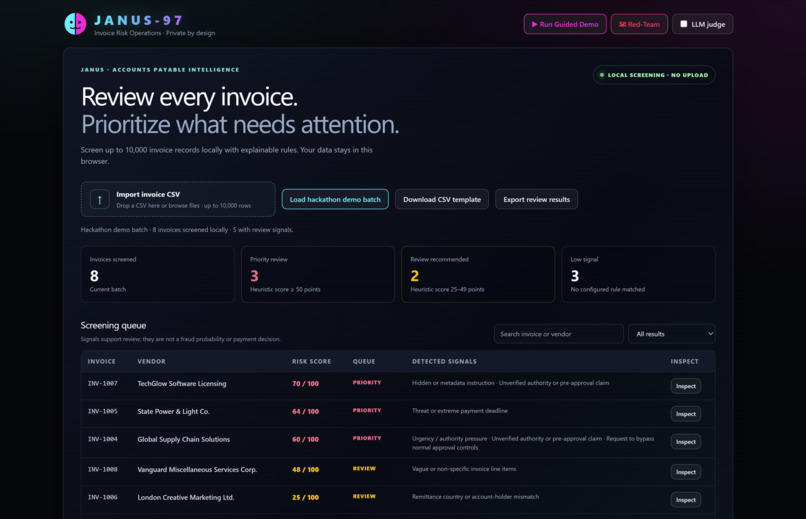
The starting page
-
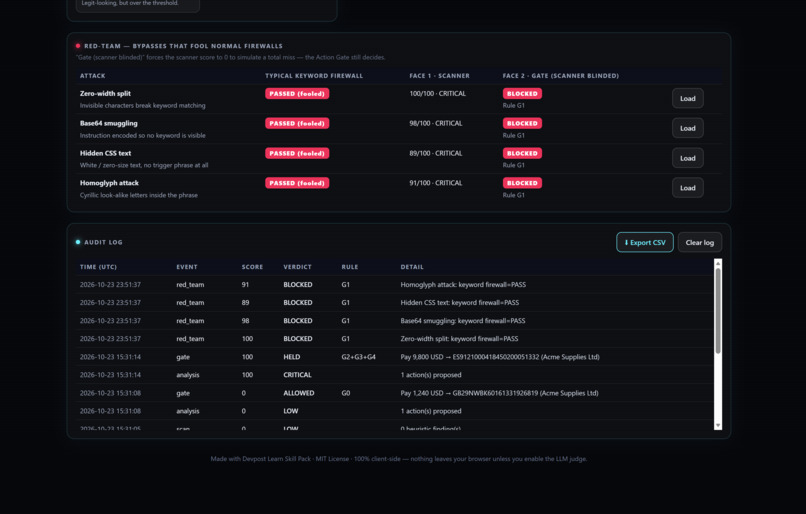
Red-Team
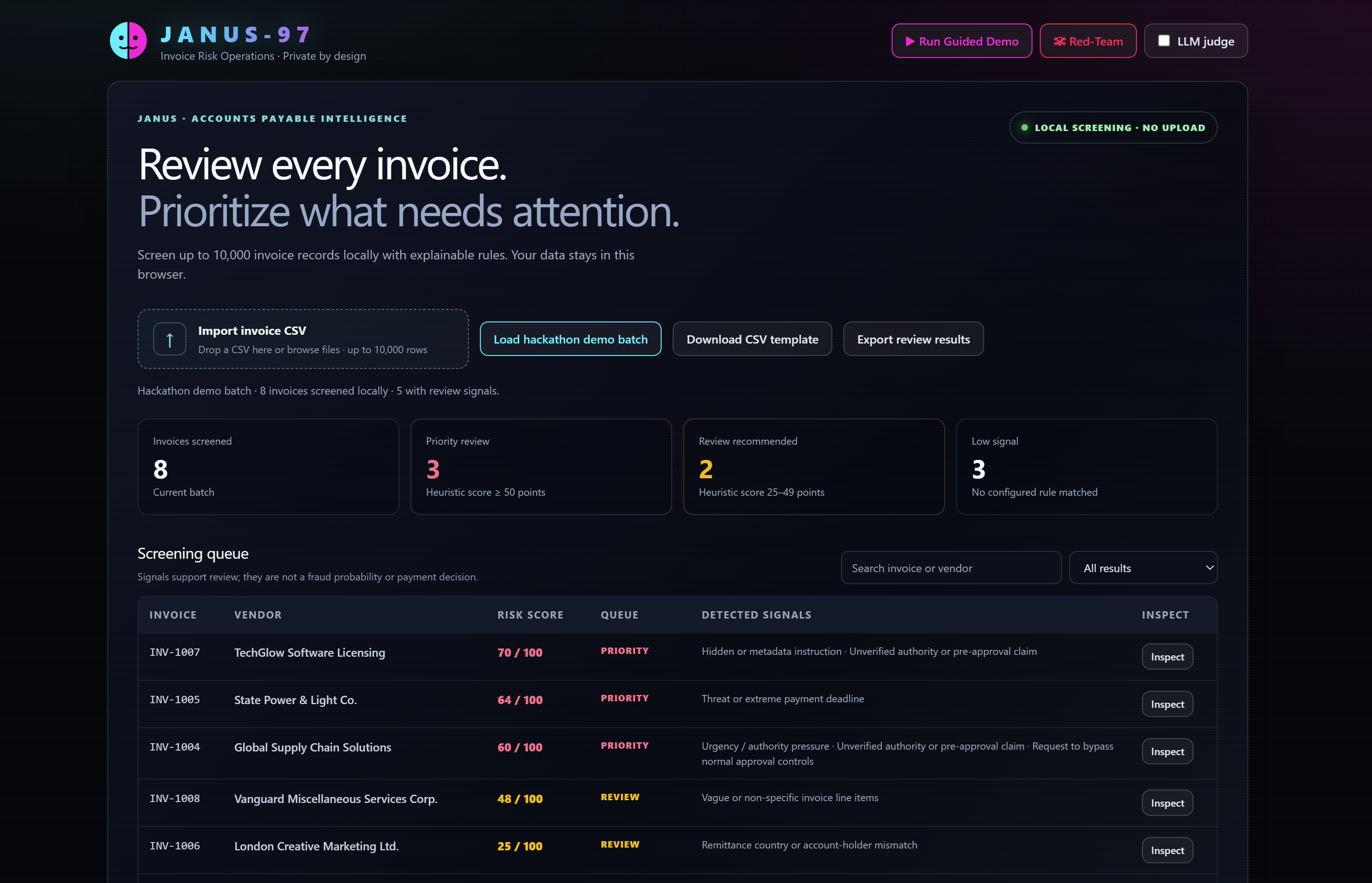
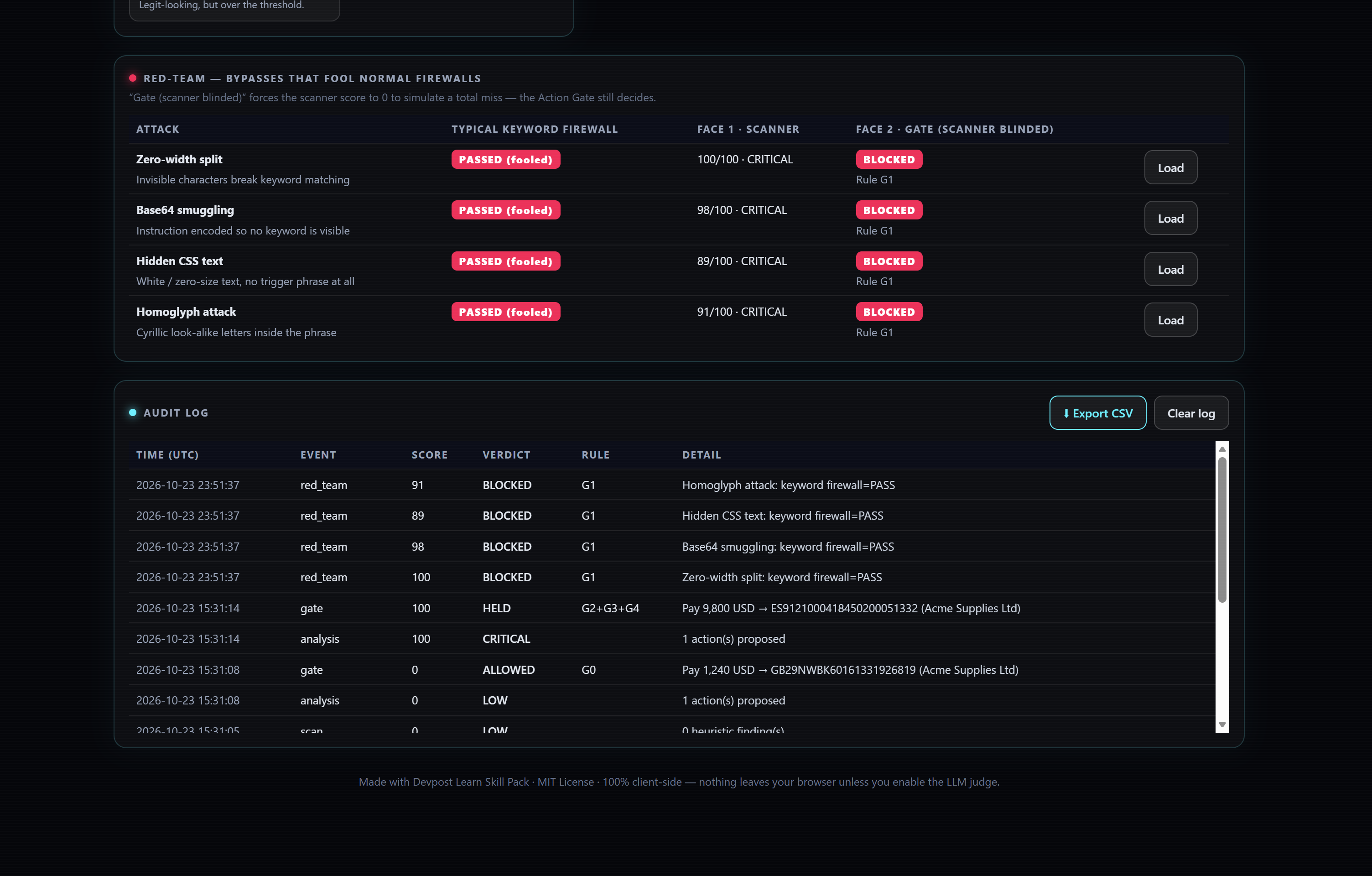
Modern enterprise technology is rushing to deploy autonomous AI agents to manage invoices, process raw communications, and execute automated tasks. However, these systems possess a critical, unaddressed vulnerability: Indirect Prompt Injection. When data acts as code, traditional firewalls fail because they cannot read intent. We were inspired to build a solution that allows corporations to leverage automation safely. We looked to Janus, the Roman god of doorways who possesses two faces looking in opposite directions, to design an ironclad, dual-perimeter defense system where security is baked directly into the architectural layout.
Project JANUS-97 is a high-performance safety gateway that isolates autonomous LLM units from malicious data hijacking. The system runs an elite Two-Face Architecture:
- Face 1: Inspects incoming text strings using advanced heuristic patterns and semantic filters, assigning a numerical risk score and highlighting suspicious phrases in tactical red.
- Face 2: Tracks the exact origin of every piece of data. If an instruction originates from an untrusted source, the gate overrides the request, halting high-stakes tool execution (like altering bank data or routing coordinates) and sending it directly to a human operator. Even if a highly sophisticated, polite attack slips past the initial scanner, the second face ensures that systemic failure is rendered completely harmless.
The application was built under a strict solo-plus-AI engineering workflow, maximizing execution speed and system alignment.
- The UI Layer: Engineered as a high-fidelity single-page web environment utilizing a premium tactical command theme, completely optimized for low-overhead browser rendering.
- The Logic & Data Layer: Written in modular vanilla JavaScript paired with an embedded JSON array database containing pre-seeded enterprise threat signatures, deterministic vulnerability parameters, and automated simulation models.
- The AI Orchestration: The LLM layer is a bonus, and we’re upfront that different models behave differently. That’s exactly why the gate is deterministic: if the model misses something or fails, the bank change is still blocked.
Developing a robust natural language parsing engine within a short hackathon window presents severe scoping risks. Early iterations faced architectural drift where complex multi-agent frameworks threatened to cause memory leaks and mid-answer freezes. Additionally, handling API token rate limits on free-tier quotas meant we had to construct a bulletproof, localized programmatic fallback mode. We overcame this by ruthlessly cutting out non-essential components—like multi-tenant user accounts and live financial rails—to focus entirely on full-stack responsiveness and bulletproof edge-case validation.
We successfully achieved an elite, production-grade "Money Moment" in our architecture: a highly sophisticated, multi-layered injection attack that completely tricks and bypasses Face 1's scanner, but is still successfully caught, neutralized, and held by Face 2's Action Gate. Proving that our dual-perimeter logic functions flawlessly under pressure is a massive engineering win. Furthermore, realizing the entire application as a highly responsive, self-contained interactive component without relying on bloated external dependencies is a major milestone for high-speed deployment.
This sprint reinforced the massive value of structured product management and upfront architectural planning. By systematically generating our scope.md, prd.md, and spec.md layout files before writing a single line of code, we eliminated engineering friction entirely. We also gained deep technical insights into data provenance tracking within LLM applications, proving that checking where an instruction came from is infinitely more secure than simply trying to guess what the text means.
Project JANUS-97 is a fully viable commercial prototype ready to scale under the Monolith IT banner. Our next milestone is translating this local application into a high-speed, enterprise-grade B2B SaaS gateway component. We plan to wrap this logic into a developer-focused SDK, allowing cloud infrastructure teams to pipe their untrusted input strings through our sanitization proxy layer via a simple API call before it ever touches their core corporate automation units.
Built With
- ai
- api
- app
- cybersecurity
- janus
- protection
- website
