-
-
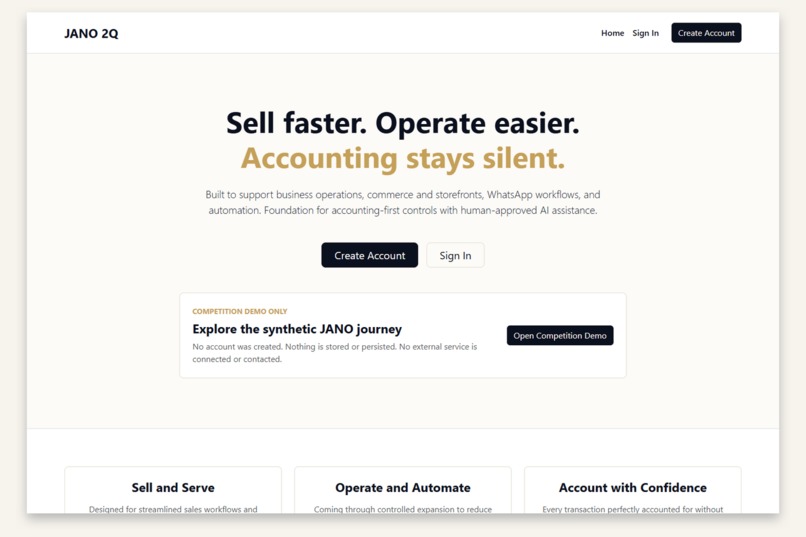
JANO 2Q: an accounting-safe commerce OS where AI assists, humans approve, and accounting stays protected.
-
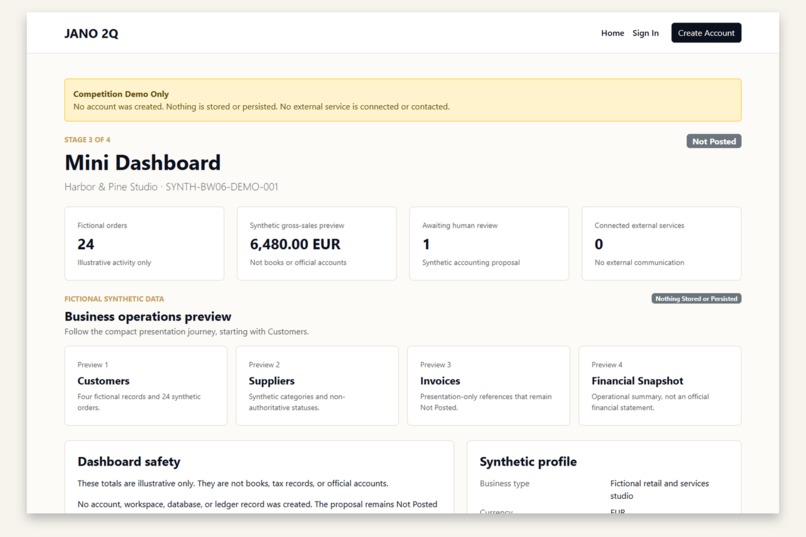
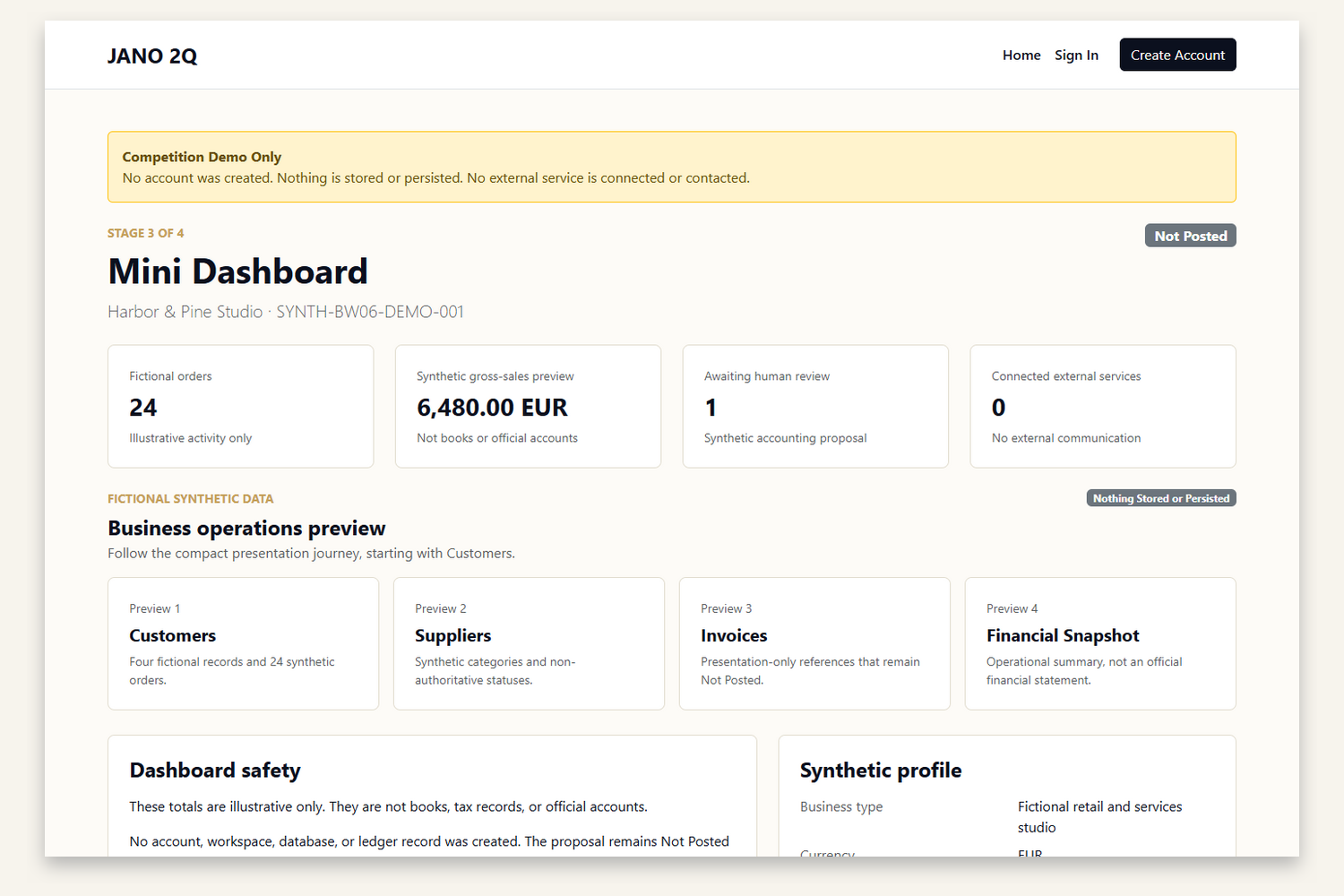
A synthetic operations dashboard showing sales previews, pending human review, and zero external connections.
-
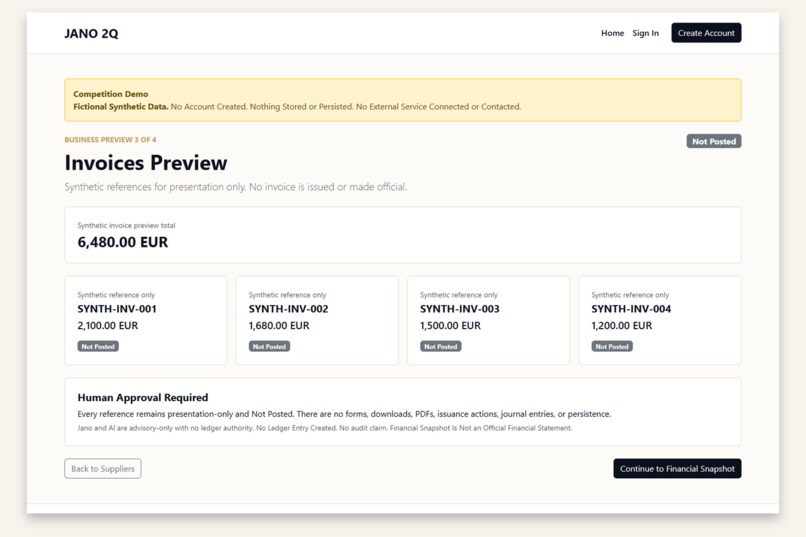
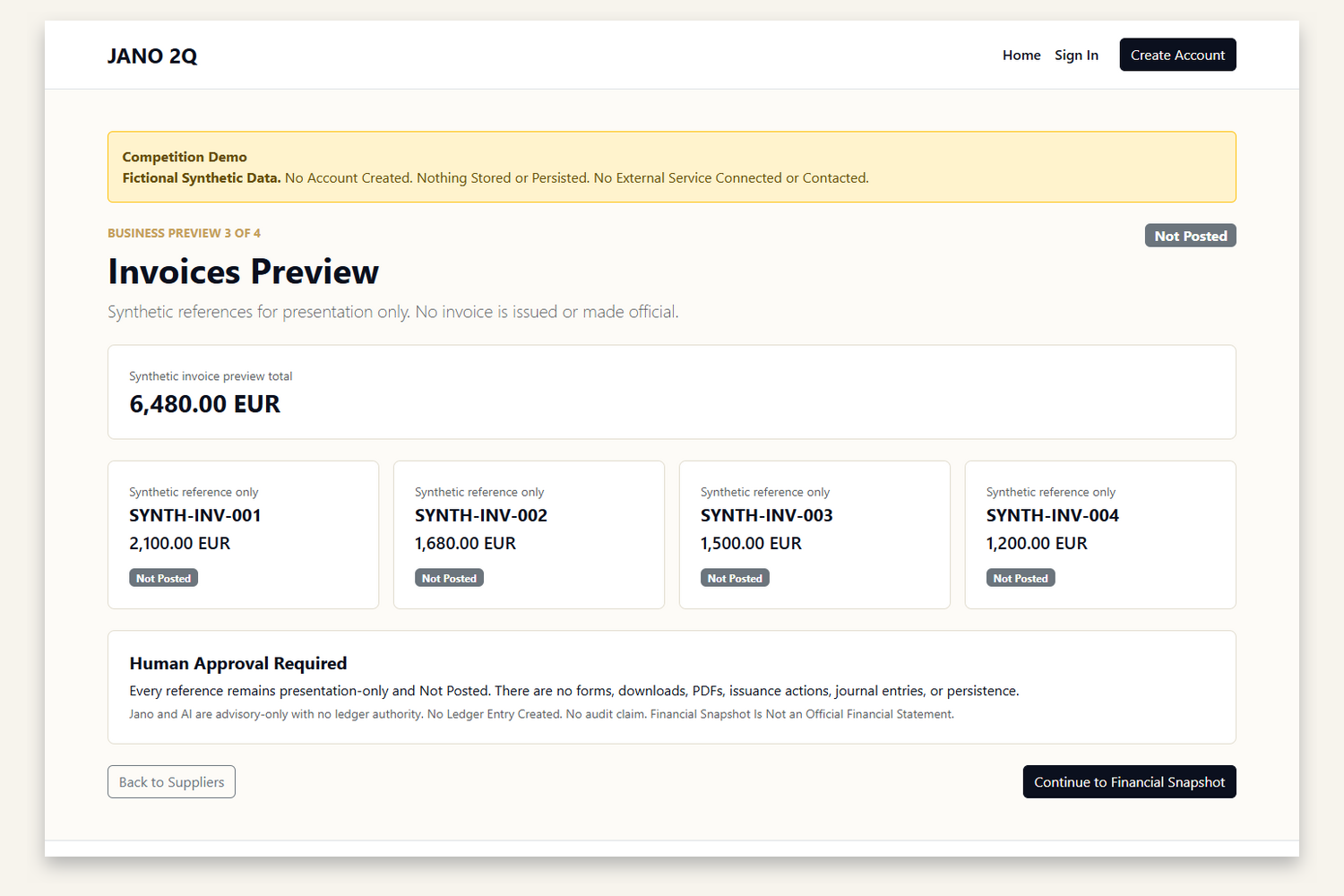
Synthetic invoice previews for commerce operations. Every item remains Not Posted and creates no ledger entry.
-
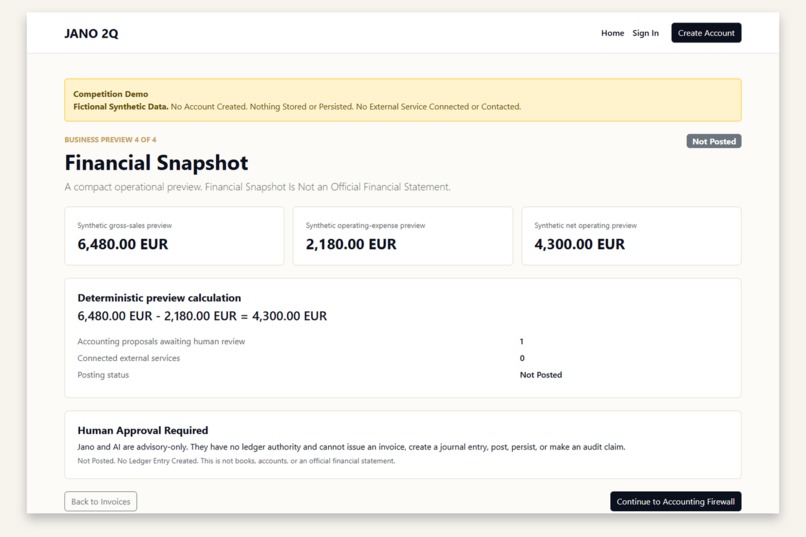
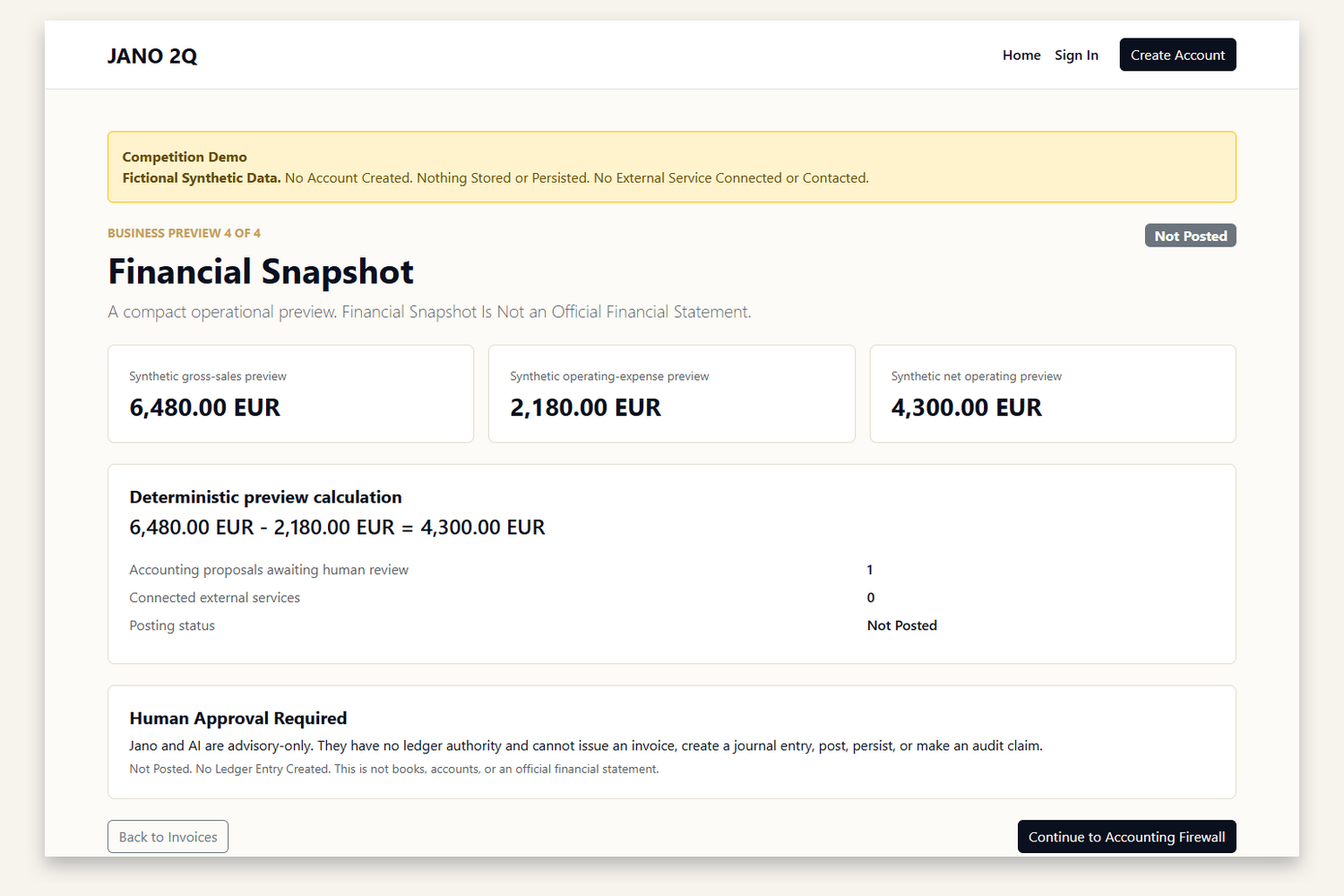
A deterministic financial preview with transparent calculations, no posting, and mandatory human approval.
-
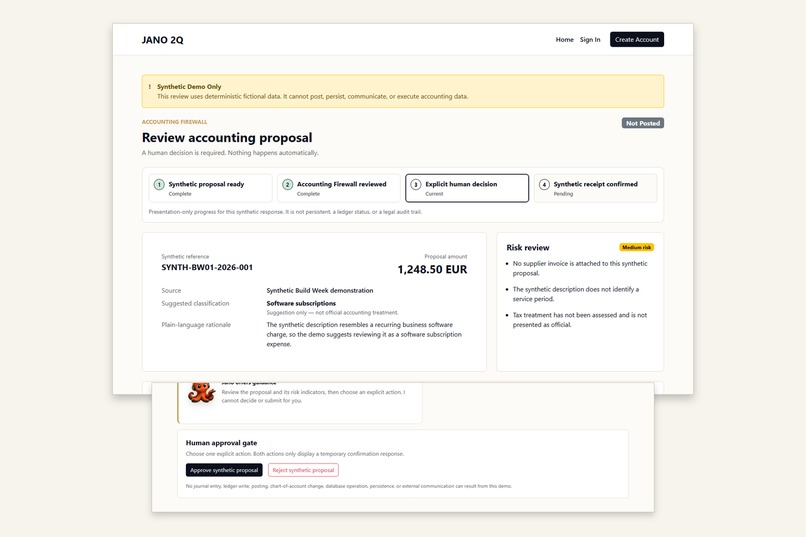
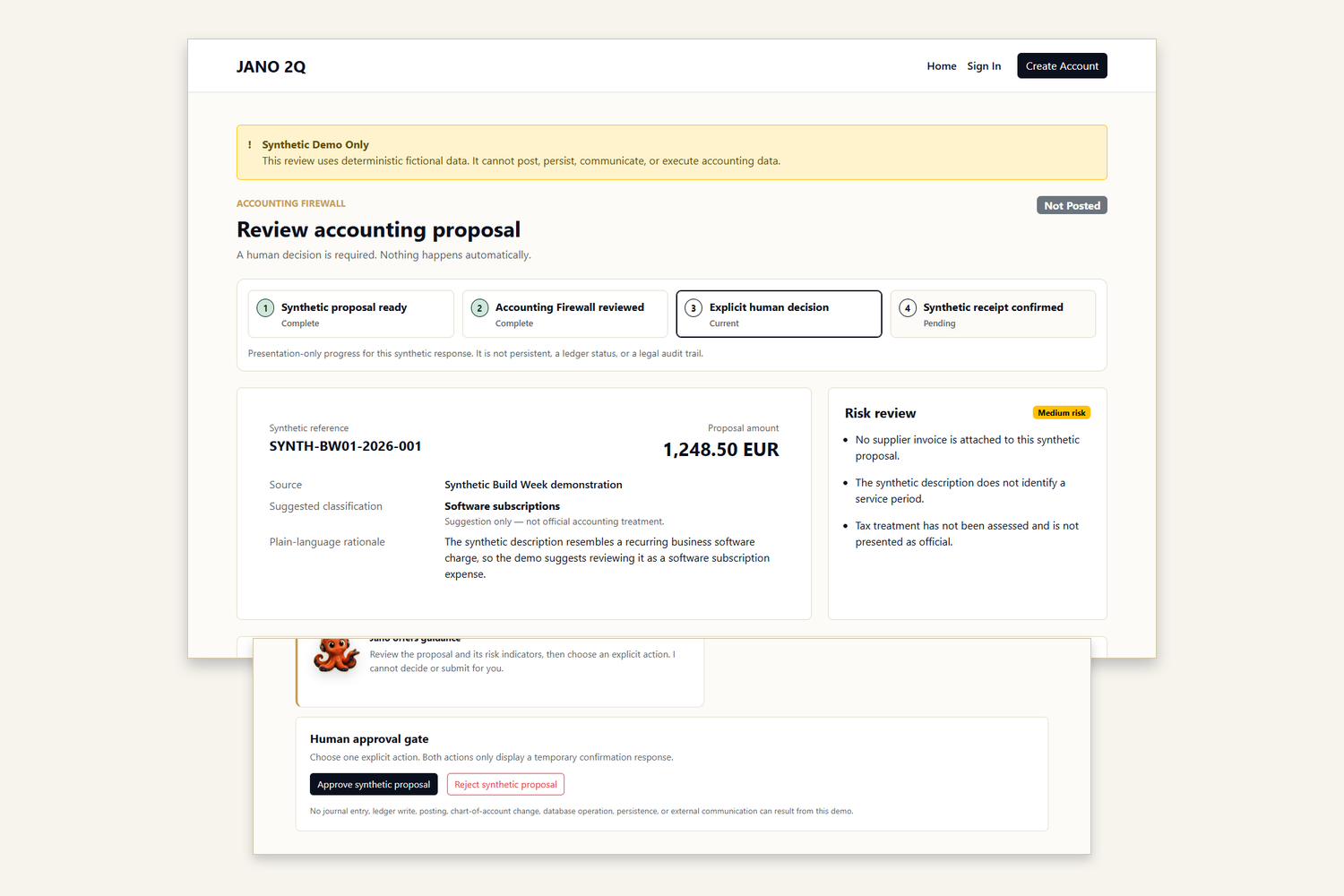
The Accounting Firewall reviews a synthetic proposal, flags risks, and requires an explicit human decision.
-
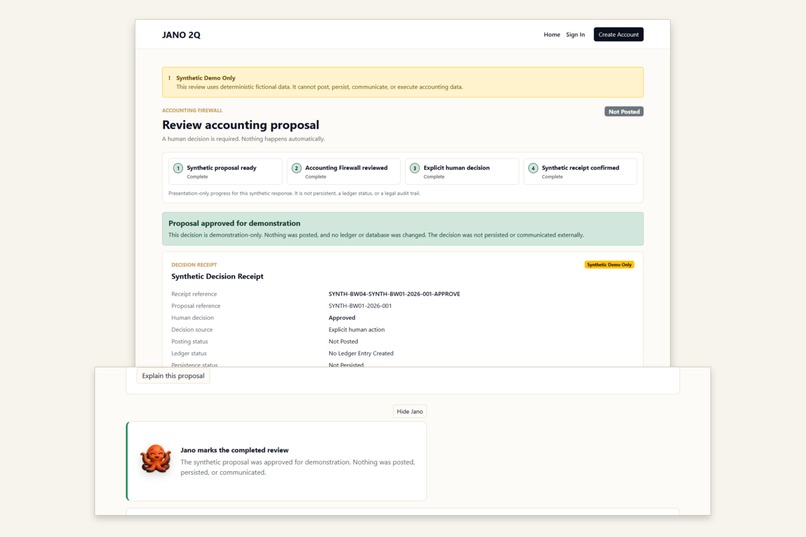
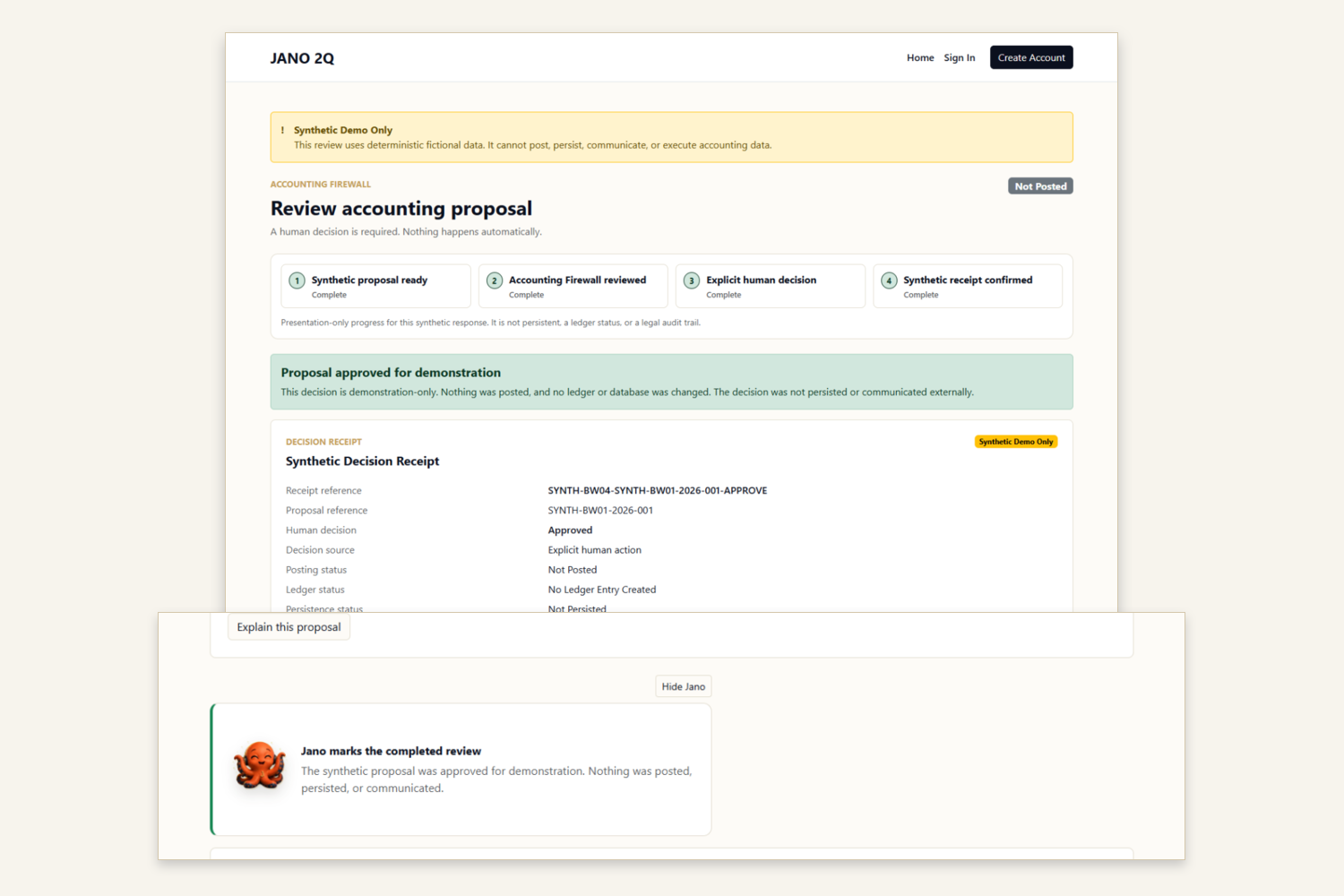
A synthetic decision receipt confirms human approval while nothing is posted, persisted, or sent externally.
Inspiration
I am an accountant and founder who learned software development while working with AI tools. Small merchants often use separate systems for sales, customers, suppliers, invoices, and accounting. This creates duplicated work, missed information, and pressure to trust automation with sensitive financial decisions.
I created JANO 2Q around one principle:
AI can assist the business, but it must never silently control the ledger.
The product vision is simple:
AI proposes → Accounting Firewall verifies → Human decides → Ledger stays protected.
What it does
JANO 2Q is an accounting-safe commerce operating system for small merchants.
The Build Week demo presents a complete synthetic business journey:
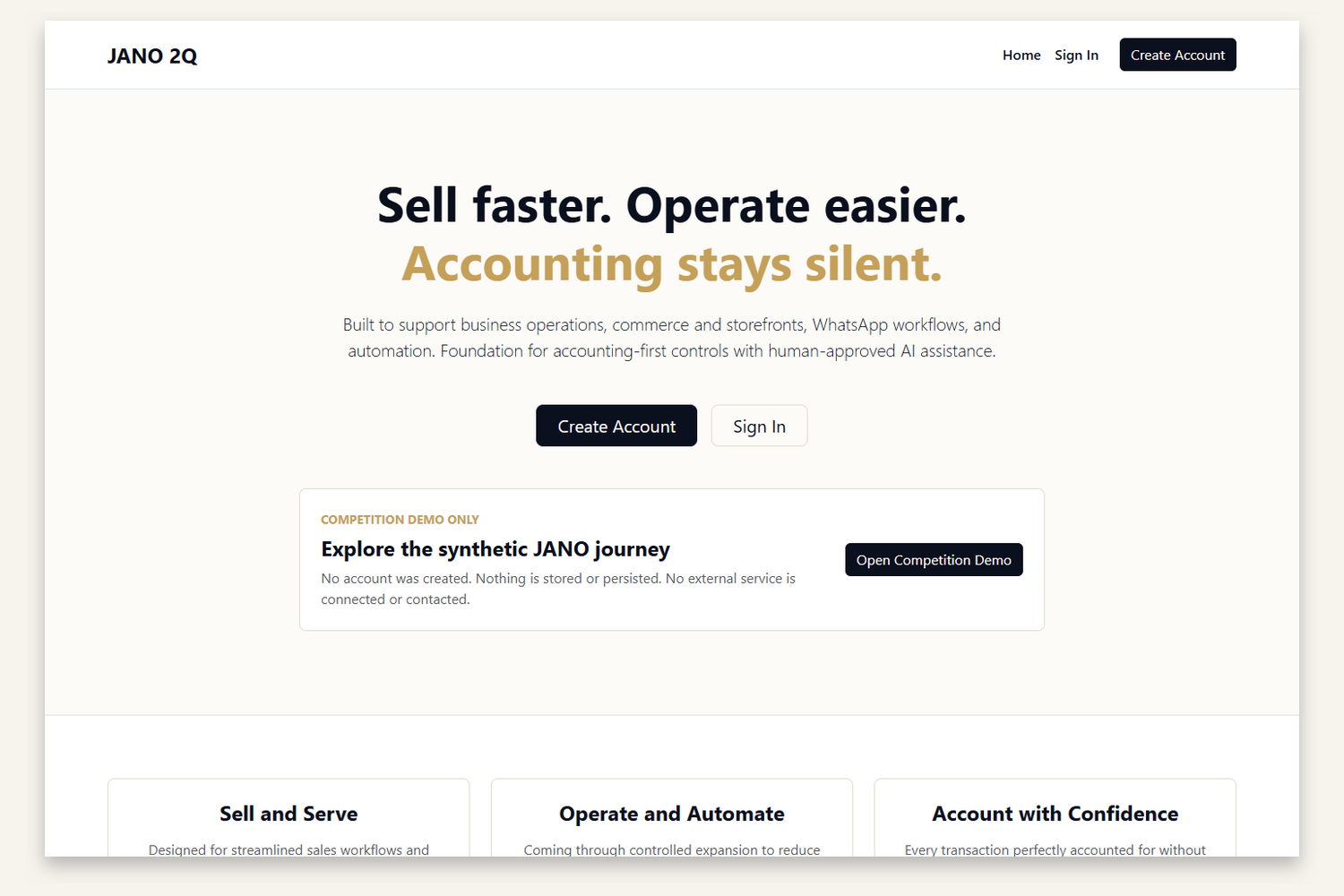
- Landing and registration preview
- Welcome setup
- Mini business dashboard
- Customer and supplier previews
- Synthetic invoice previews
- Financial snapshot
- Animated Jano Octopus assistant
- Accounting Firewall review
- Human approval or rejection
- Decision receipt confirming that nothing was posted
The demo uses a fictional business called Harbor & Pine Studio with deterministic synthetic data. It contains no real customer, supplier, invoice, credential, or financial information.
Jano assists, explains, and guides, but remains advisory-only. It cannot create ledger entries or bypass human approval.
The Accounting Firewall
The Accounting Firewall is the main differentiator.
Before any future accounting proposal could reach a ledger, it must pass through a visible review boundary. The human sees the proposal, explanation, warnings, and posting status before making a decision.
In the current competition demo:
- All proposals are synthetic
- Human approval is explicit
- Decisions are presentation-only
- Nothing is stored or persisted
- No ledger entry is created
- Every result remains Not Posted
- No external service is connected or contacted
This demonstrates the intended safety architecture without pretending that the demo is a production accounting system.
How we built it
The project uses:
- Laravel 13
- PHP 8.4
- Blade
- Bootstrap 5.3
- Vite
- PHPUnit
- Playwright
- Git and GitHub
- Codex powered by GPT-5.6
Codex and GPT-5.6 were central to the Build Week workflow. I used Codex to inspect the existing repository, design bounded implementation missions, create and refine the competition journey, identify middleware and session risks, implement automated tests, review accounting-safety boundaries, verify responsive layouts, and audit every Git change before commit and push.
I remained the final human decision-maker. Each branch, implementation scope, correction, staging operation, commit, and push required explicit approval.
What was built during OpenAI Build Week
JANO 2Q existed before the event as an early Laravel foundation with a public interface shell and CI groundwork.
During the official Build Week period, Codex and GPT-5.6 were used to meaningfully extend it through seven controlled phases:
- Synthetic Accounting Firewall
- Animated Jano Octopus Assistant
- Safe Synthetic AI Explanation
- Synthetic Human Decision Receipt
- End-to-End Competition Demo
- Competition MVP Shell
- Customers, Suppliers, Invoices, and Financial Snapshot previews
The dated Git commit history and Codex session evidence distinguish the Build Week implementation from the earlier foundation.
Challenges
The hardest challenge was demonstrating useful AI assistance without weakening accounting controls.
A normal demo could connect an AI model directly to financial actions, but that would contradict the product’s safety principles. Instead, the competition version uses deterministic synthetic proposals and explanations while preserving the intended human-controlled architecture.
We also resolved technical challenges involving session middleware, CSRF behavior, stateless demo routes, process-local test configuration, responsive layouts, and reliable verification without adding a database or environment file.
Validation
The final BW07 competition branch passed:
- 10 focused tests with 171 assertions
- 53 full-suite tests with 558 assertions
- PHP syntax validation
- Production Vite build with 63 modules
- Desktop review at 1440×1000
- Mobile review at 390×844
- No console errors
- No failed requests
- No horizontal overflow
- Accounting Firewall returned HTTP 200
- Clean local and remote Git alignment
What I learned
I learned that AI-assisted development works best when the human defines clear boundaries, verifies evidence, and keeps final authority.
Codex and GPT-5.6 dramatically accelerated implementation, debugging, testing, and review. The most valuable result was not simply faster code generation; it was the ability to maintain a controlled build process while repeatedly testing product, security, and accounting assumptions.
What's next
After Build Week, the next steps are to evolve the synthetic demo into a production-ready, multi-tenant platform with:
- Tenant isolation
- Human-controlled posting services
- Immutable posted records
- Reversal-only corrections
- Audit trails
- Secure AI provider integration
- Commerce, CRM, and communication workflows
The accounting principle will remain unchanged:
AI assists. Humans approve. The ledger stays protected.

Log in or sign up for Devpost to join the conversation.