💧 JalViv — AI-Powered Water Intelligence
Inspiration
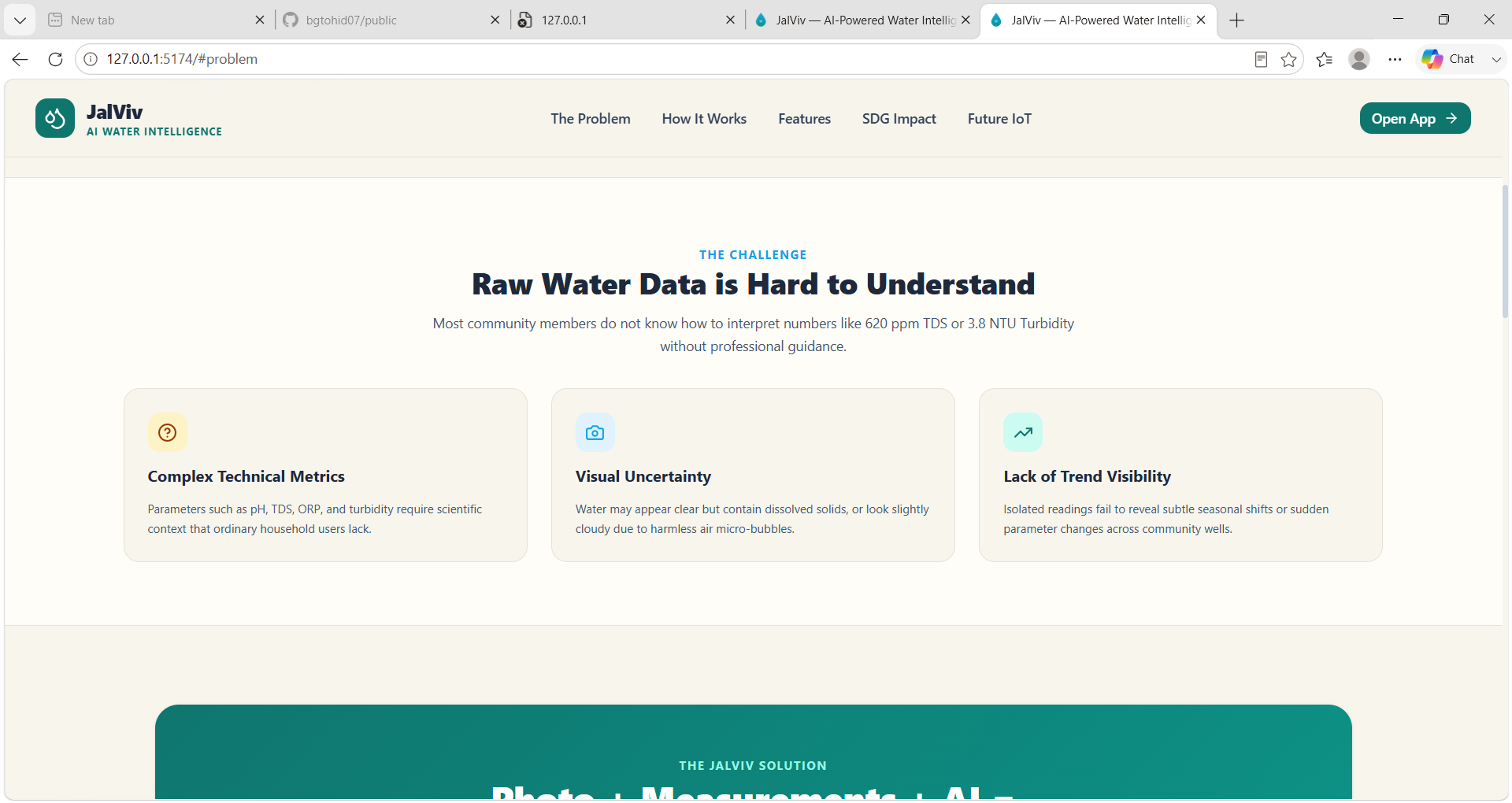
Water is essential to every community, but water-quality information is often difficult for ordinary people to understand. Parameters such as pH, TDS, turbidity, and temperature are usually presented as numbers without explaining what they mean or what someone should consider doing next.
We wanted to build something that could make this information more accessible.
The idea behind JalViv was to combine AI, computer vision, and water-quality data into a simple platform that helps users understand their water instead of simply showing them numbers.
The project also aligns with UN Sustainable Development Goal 6: Clean Water and Sanitation.
What JalViv Does
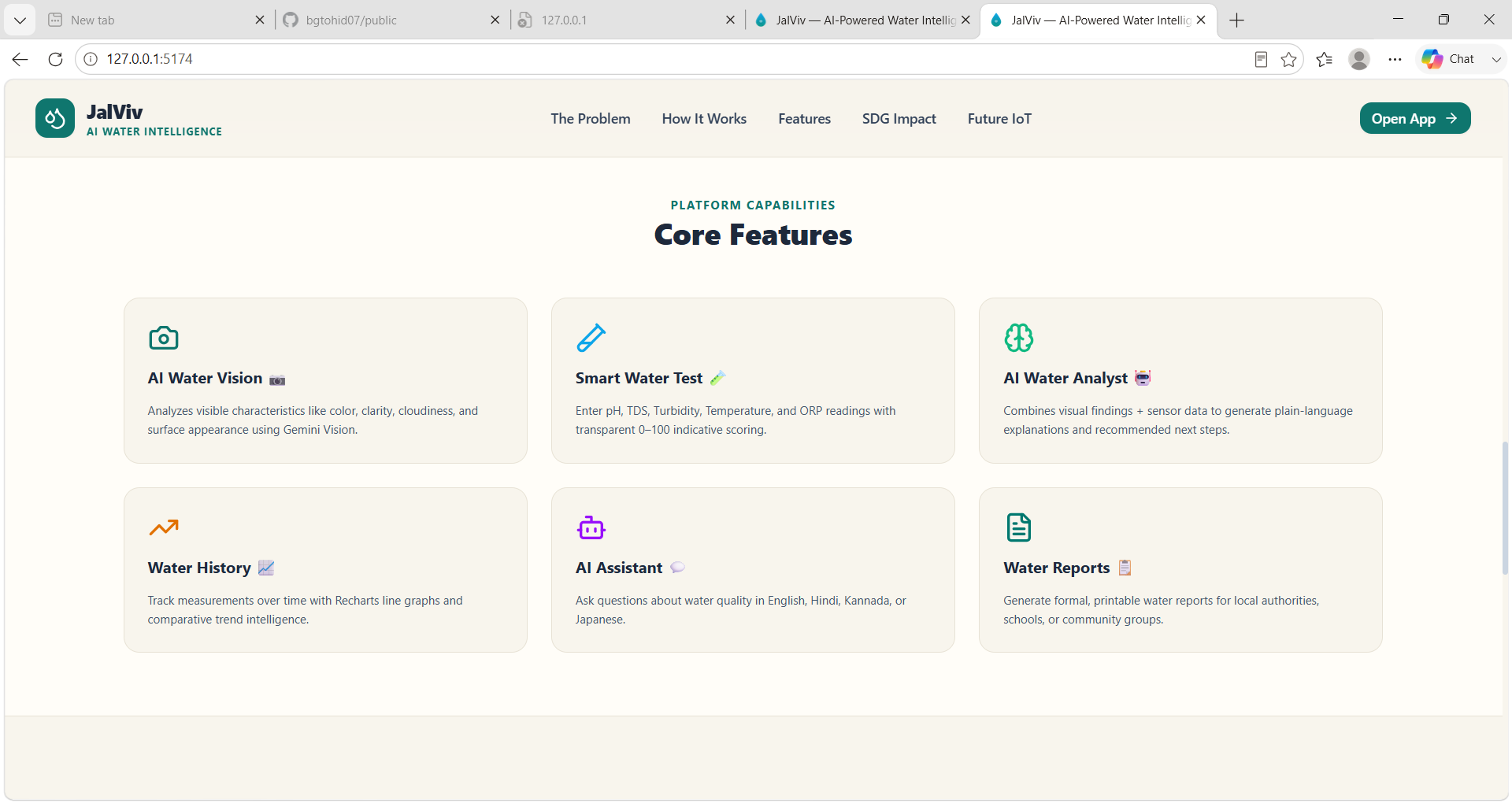
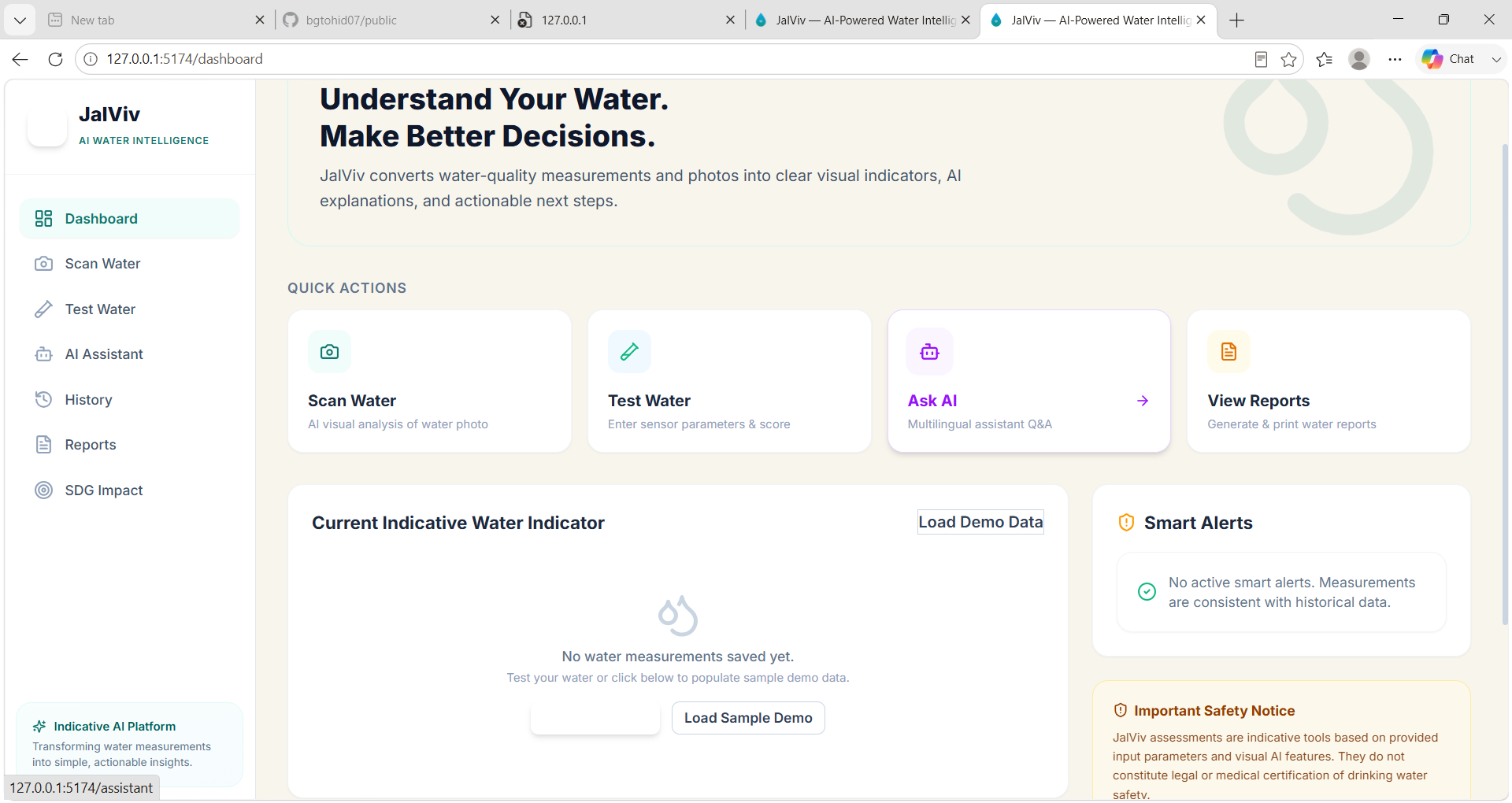
JalViv is an AI-powered water intelligence platform that combines:
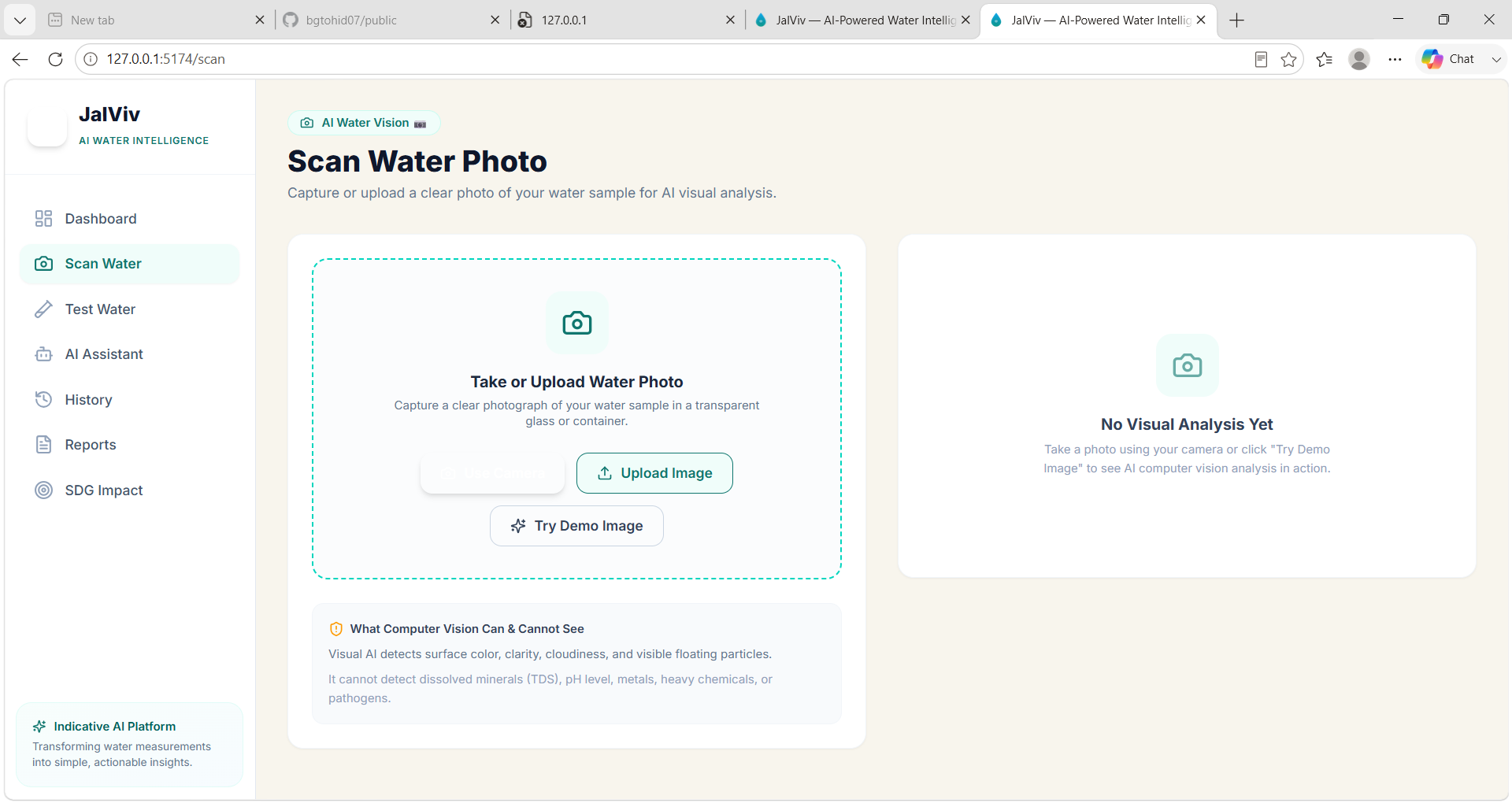
- 📷 AI Water Vision — analyzes visible characteristics of a water image, such as apparent color, cloudiness, and visible particles.
- 🧪 Water Measurement Input — allows users to enter pH, TDS, turbidity, temperature, and ORP measurements.
- 🤖 AI Water Analysis — combines the available visual and measurement information to generate understandable insights.
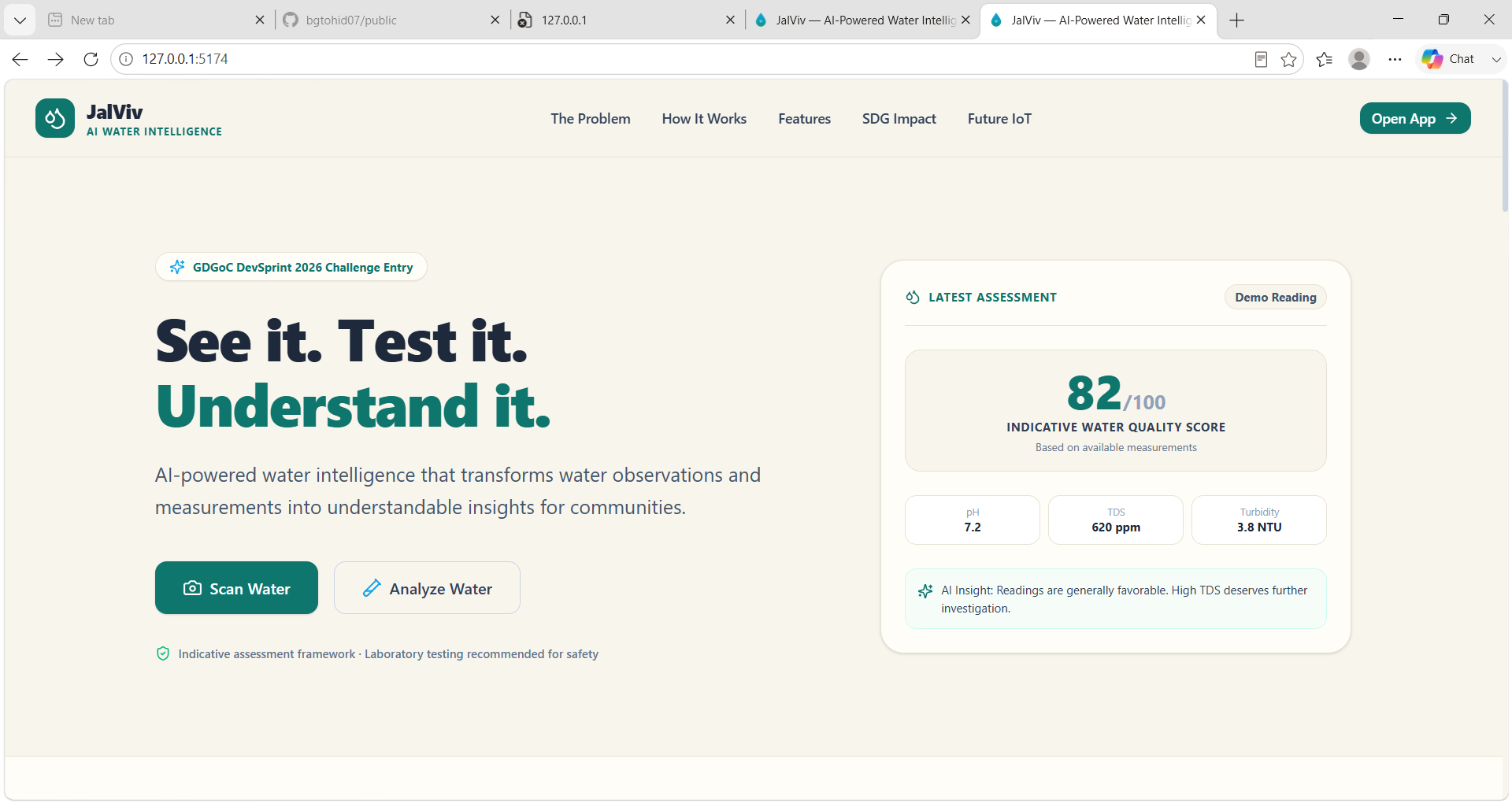
- 📊 Water Quality Indicator — provides an indicative score based on available measurements.
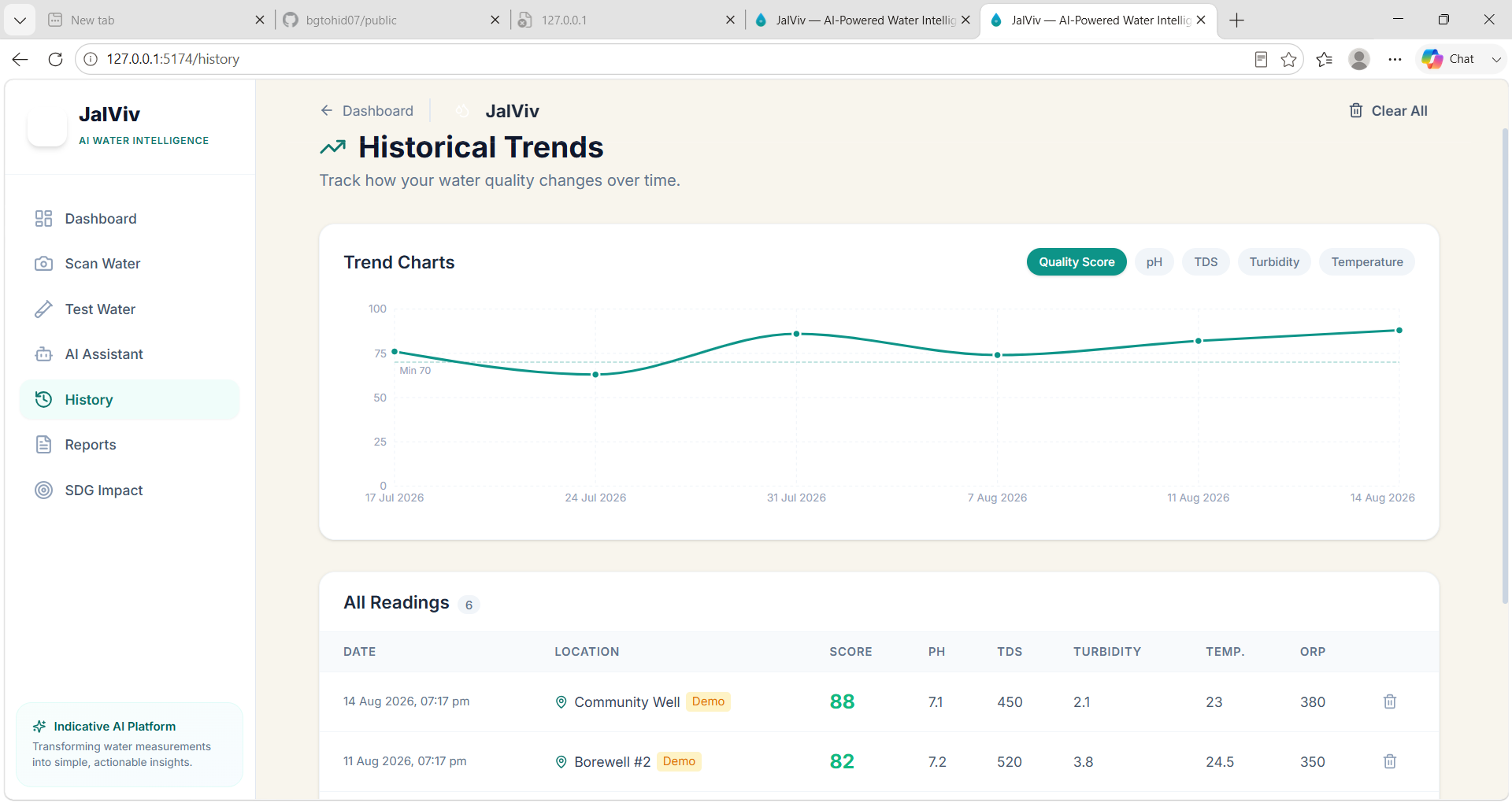
- 📈 Historical Analytics — helps users track changes in measurements over time.
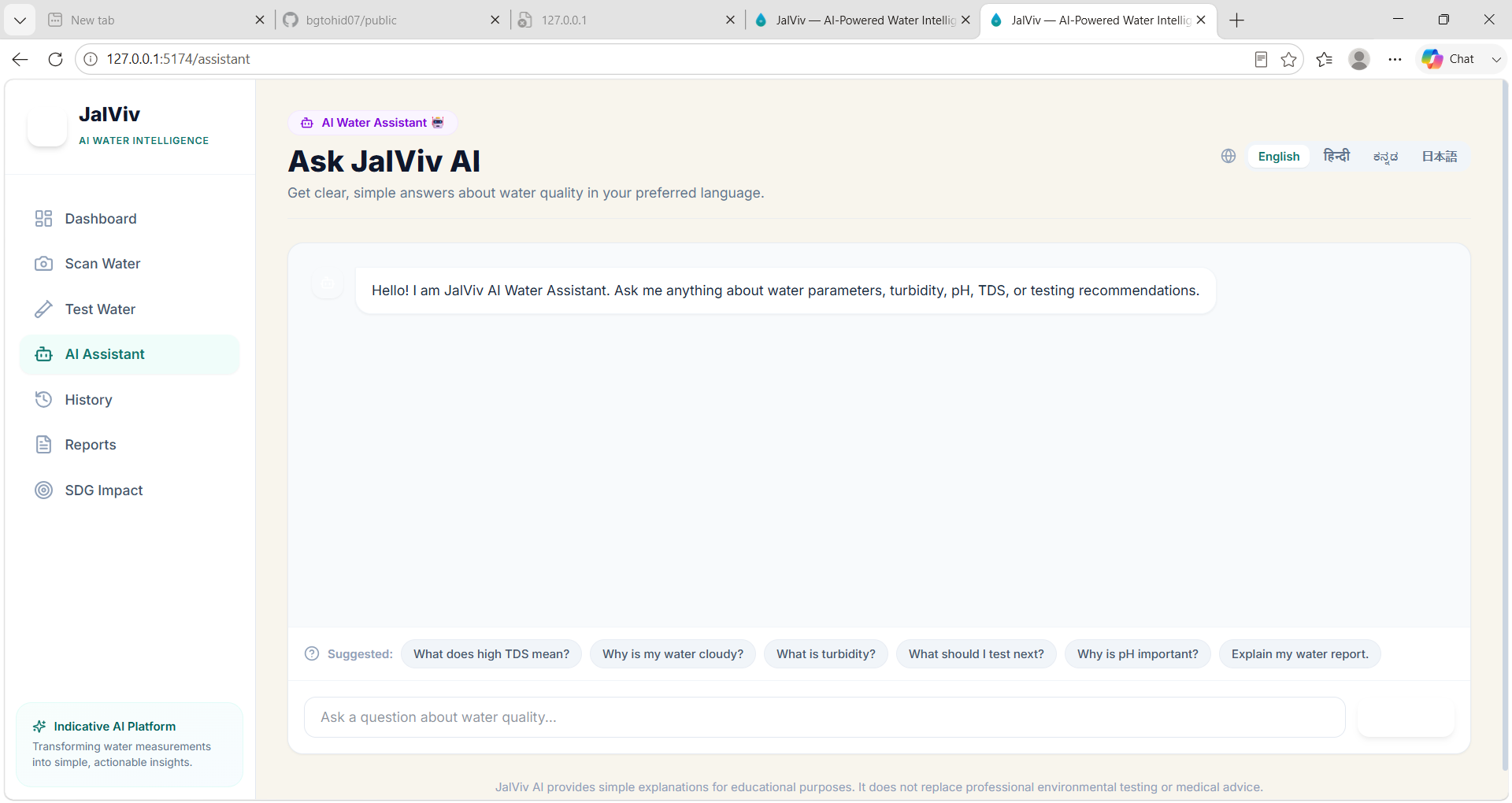
- 💬 AI Water Assistant — answers questions about water-quality concepts and recommends what information or testing may be useful next.
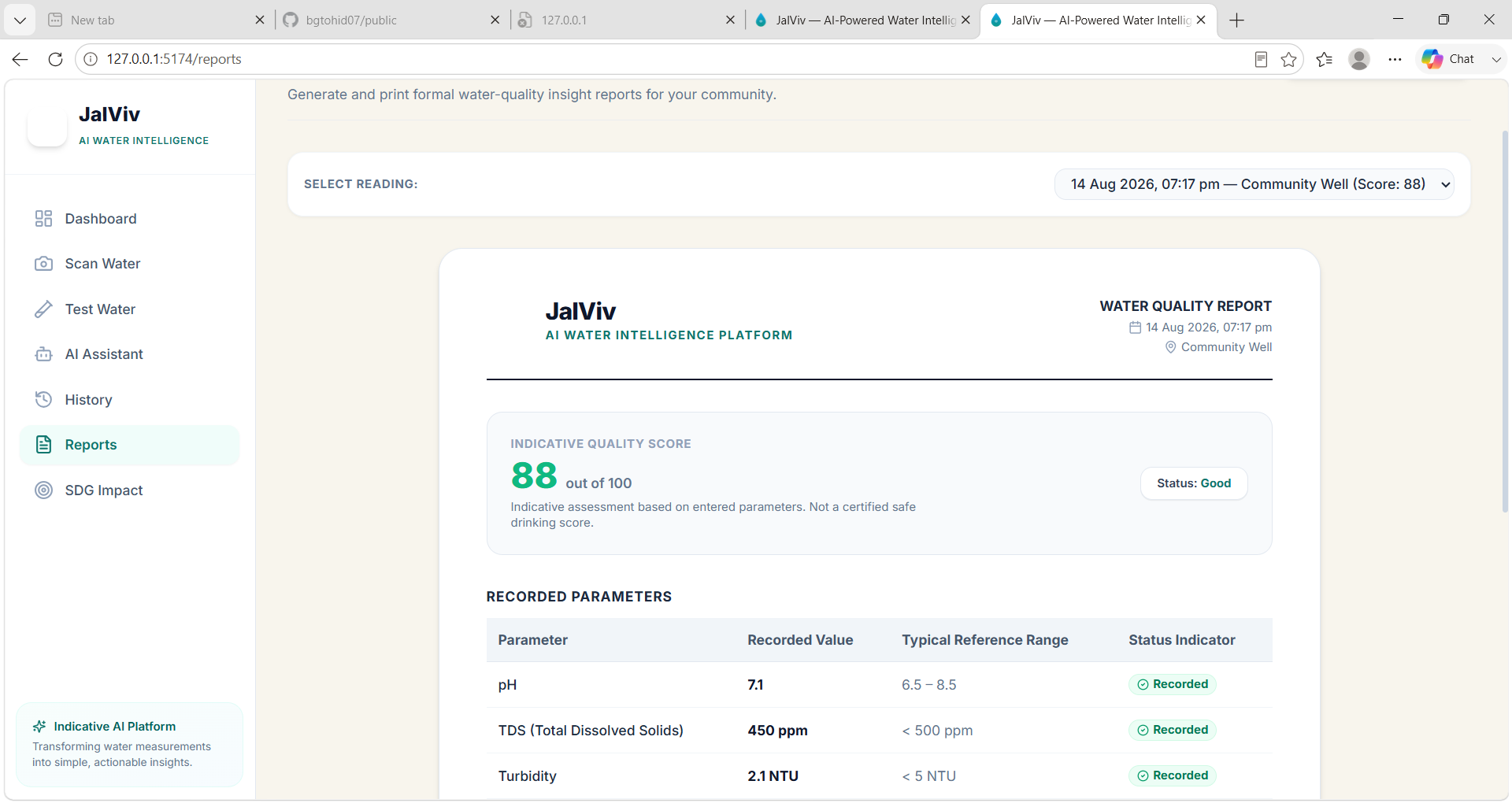
- 📋 Water Reports — summarizes observations, measurements, insights, and recommendations.
How We Built It
We built the current MVP as a web application using:
- React
- JavaScript
- Vite
- Tailwind CSS
- Recharts
- Gemini AI / Vision
- Supabase/Firebase (if used in the final implementation)
The application is designed around a simple workflow:
Water Photo
     ↓
AI Visual Analysis
     ↓
Water Measurements
     ↓
AI Interpretation
     ↓
Insights & Recommendations
     ↓
History & Reports
We designed the application to be mobile-first, since a future version of JalViv could be used directly at water sources using a smartphone.
AI + Computer Vision
One of the main ideas behind JalViv is that a water photograph can provide visual information, but it cannot reliably measure chemical or microbiological parameters.
Therefore, our AI vision feature focuses only on visible characteristics such as:
- Apparent color
- Clarity
- Cloudiness
- Visible particles
- Unusual appearance
The system does not claim that an image can determine pH, TDS, bacteria, heavy metals, or definitive drinking-water safety.
Instead, JalViv uses visual analysis as an initial observation and recommends appropriate measurements or further testing when necessary.
What We Learned
Building JalViv helped us understand that creating an AI application is not only about connecting an AI API to a frontend.
We learned about:
- Designing AI-powered user experiences
- Integrating computer vision into a web application
- Structuring AI responses
- Handling incomplete or uncertain data
- Building responsive dashboards
- Creating meaningful data visualizations
- Designing AI systems that communicate uncertainty responsibly
- Separating demo data from real-world measurements
- Designing software architecture for future IoT integration
One important lesson was that AI should support decision-making rather than create false certainty, especially when dealing with real-world environmental data.
Challenges We Faced
1. No Physical IoT Hardware
We did not have physical water-quality sensors available during the hackathon.
Instead of pretending that we had live sensor data, we designed the MVP around manual measurement input and created a future-ready sensor architecture.
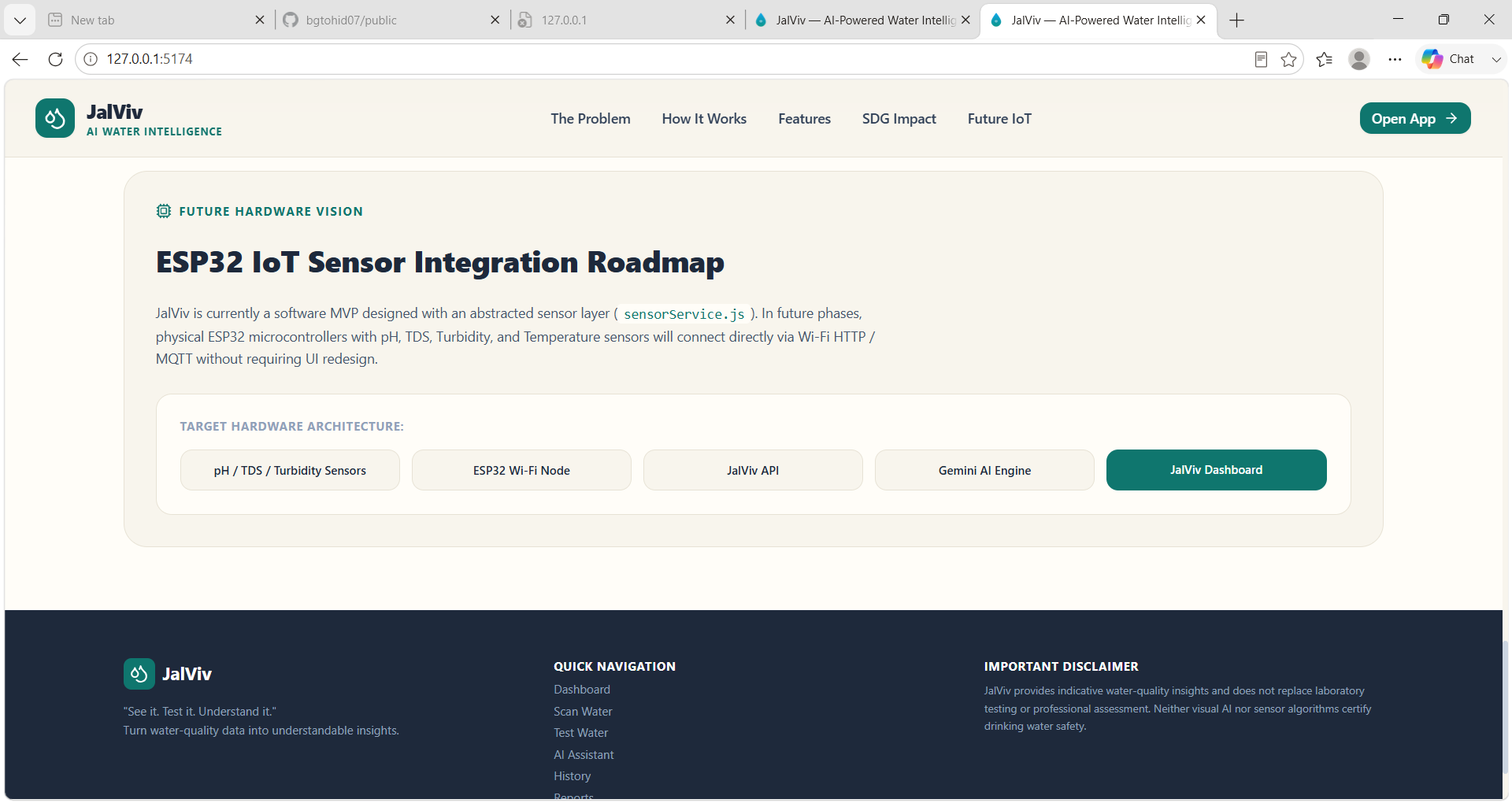
The planned architecture is:
pH Sensor
TDS Sensor
Turbidity Sensor
Temperature Sensor
        ↓
      ESP32
        ↓
      Wi-Fi
        ↓
    JalViv API
        ↓
     JalViv AI
This allows the current software architecture to eventually support real-time IoT data without redesigning the entire platform.
2. AI Accuracy and Responsible Claims
Water quality is a complex scientific problem. A visual AI model cannot determine many important water-quality parameters from an image alone.
We therefore designed JalViv to clearly distinguish between:
Visual observations → Measurements → AI interpretation → Further testing
rather than presenting AI predictions as laboratory results.
3. Building a Complete MVP Quickly
As an individual project, we had limited development time.
We prioritized the core experience:
Scan → Test → Analyze → Understand → Track
instead of trying to implement every possible feature.
Future Development
The current MVP is the foundation for a larger water-monitoring platform.
Future versions could integrate:
- ESP32-based sensors
- Real-time pH monitoring
- TDS sensors
- Turbidity sensors
- Temperature sensors
- Automated IoT data collection
- Community water-source monitoring
- More advanced environmental analytics
- Offline-first field usage
- Additional Indian regional languages
The long-term vision is to make water-quality information more accessible while connecting AI + IoT + environmental intelligence.
Our Vision
JalViv is built around a simple idea:
People should not need to be water-quality experts to understand their water data.
By combining computer vision, measurements, AI, and accessible design, JalViv aims to turn complex water information into insights that are easier to understand and act upon.
JalViv — See it. Test it. Understand it.
Built With
- ai
- clean-water
- computer-vision
- data
- environmental
- gemini
- generative-ai
- javascript
- react
- sustainability
- technology
- water-quality


Log in or sign up for Devpost to join the conversation.