Inspiration
Our project was inspired by the urgent need for emergency medical transportation on Thodelandia, a newly colonized planet with extreme environments. The challenge of moving patients safely across plains, oceans, and deserts in just 45 minutes pushed us to think creatively. We were particularly inspired by the gyrosphere from Jurassic World, imagining a vehicle that could maintain stability and comfort across harsh terrain while being energy-efficient and safe.
What We Learned
During this project, we learned how environmental conditions directly impact vehicle design. Thodelandia’s unique physics — gravitational acceleration: 𝑔 = 3m/s^2, high atmospheric density : 𝜌 = 100 kg/m^3, and extreme solar irradiance: 2000W/m^2 — meant we had to carefully consider: Aerodynamics for dense air: drag Stability over uneven terrain and waves
Energy efficiency using solar power and regenerative infrastructure
We also strengthened our team design skills, balancing speed, safety, and cost-effectiveness under tight constraints.
How We Built It
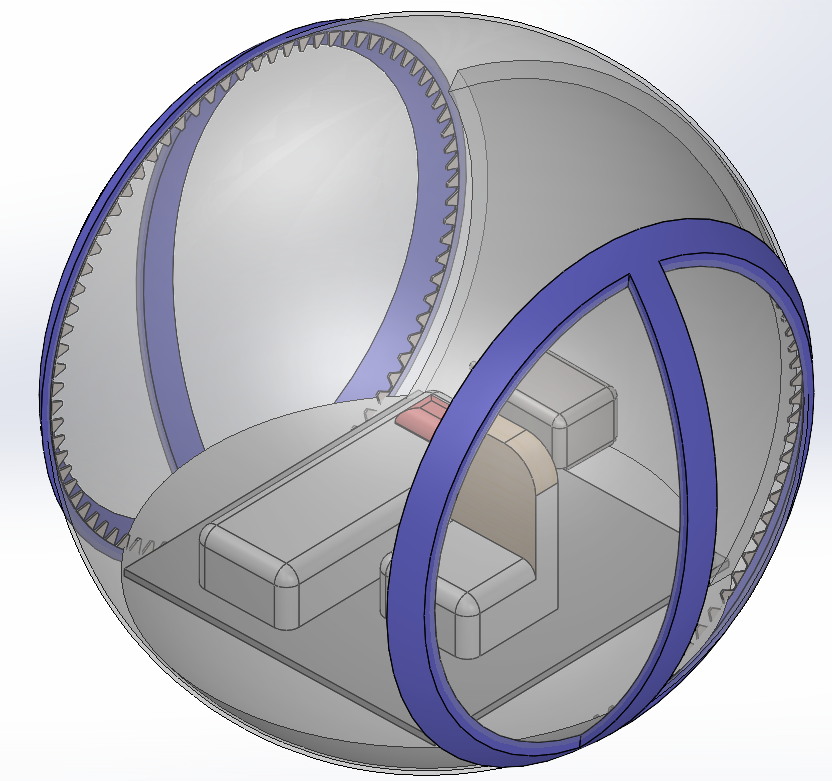
We designed ThodePod, a gyroscopically stabilized vehicle with a fully enclosed cabin for 1 patient + 1 paramedic. Its spherical shape minimizes drag and keeps the patient level, while shock isolation ensures comfort.
The transport route was carefully chosen:
Plains: 11.18 km — smooth, fast travel
Ocean: 6 km — low-wave, dense-atmosphere traversal
Desert: 30 km — solar-powered tunnel reduces heat, dust, and energy requirements
Final Plains: 5 km — safe arrival at HSL
The solar tunnel was designed to generate energy along the desert stretch, leveraging Thodelandia’s high irradiance to power the vehicle and assist motion. By combining vehicle design, route planning, and renewable energy, we ensured 10 patients/day could be transported within 45 minutes without refueling.
Challenges We Faced
Harsh terrain: The desert, ocean waves, and plains required different travel strategies.
Energy limitations: No fossil fuels or nuclear power meant we needed solar-assisted propulsion.
Patient comfort: Dense air and uneven terrain meant vibration, noise, and tilt could reduce survivability.
Time constraint: Designing a safe system that moves patients within 45 minutes while covering 52 km was a major challenge.
Through iteration, we integrated gyroscopic stabilization, infrastructure-assisted energy, and an optimized route, solving these challenges while keeping the system feasible and cost-effective.
Key Takeaway
ThodePod taught us that design can turn extreme environments into life-saving solutions. By combining clever engineering, renewable energy, and careful route planning, we created a system that prioritizes speed, safety, and comfort, proving that even on a harsh new planet, survival is a matter of design.
Built With
- arduino
- solidworks


Log in or sign up for Devpost to join the conversation.