-
-
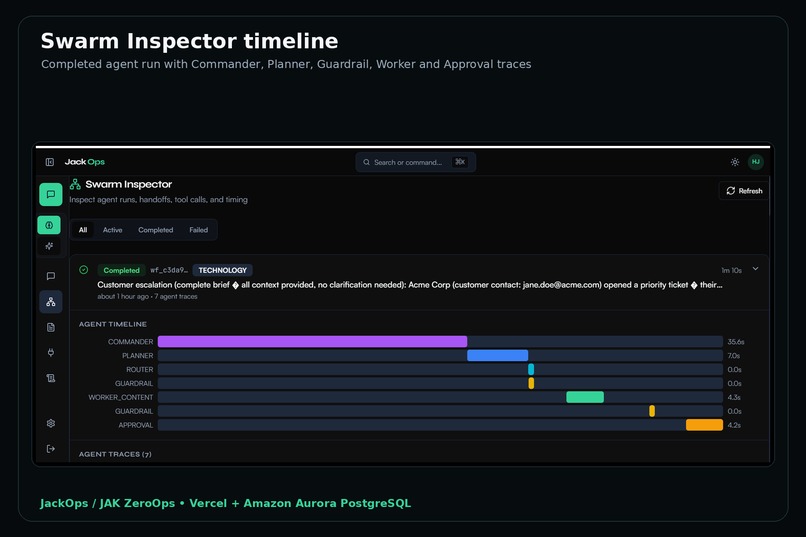
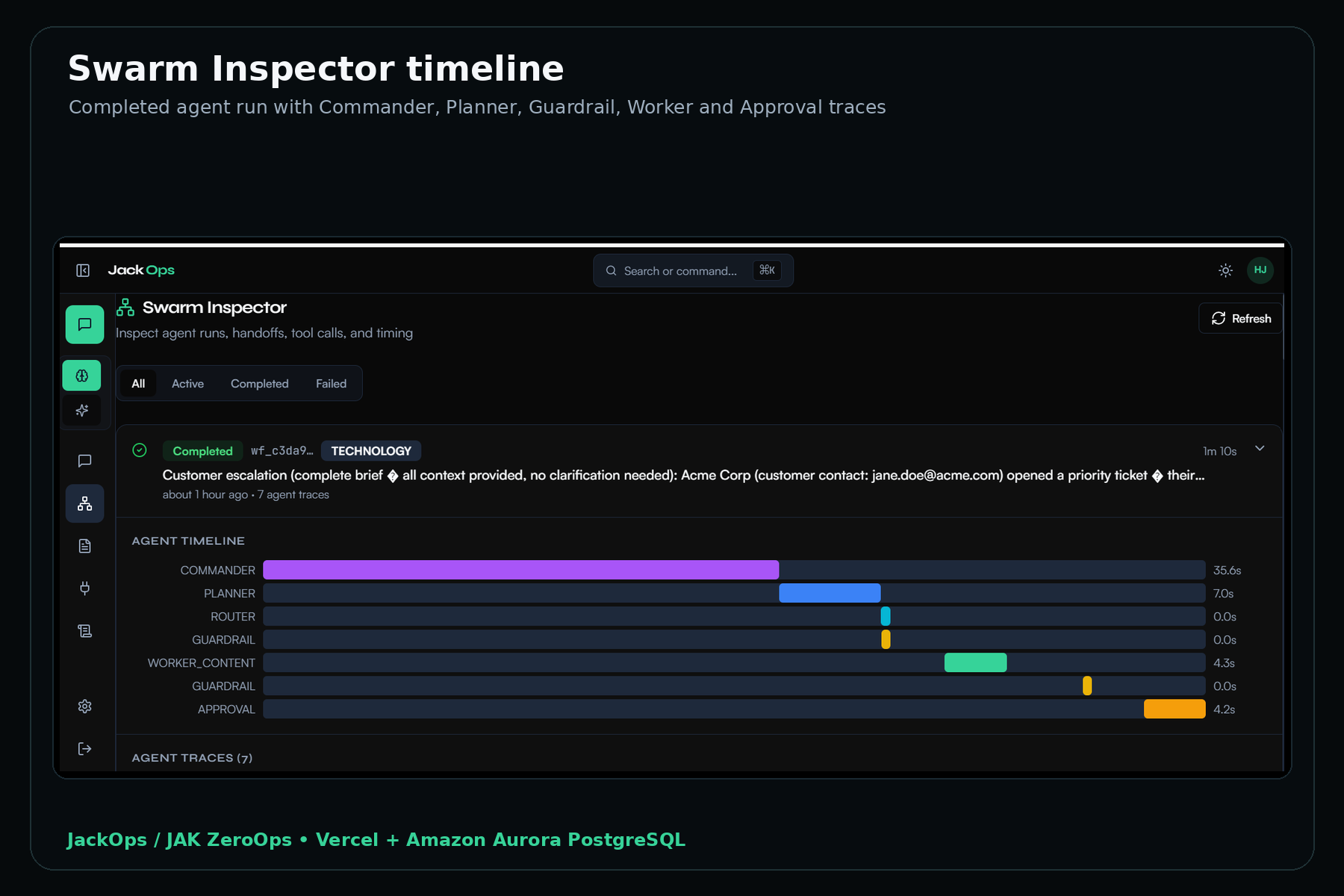
Swarm Inspector Timeline
-
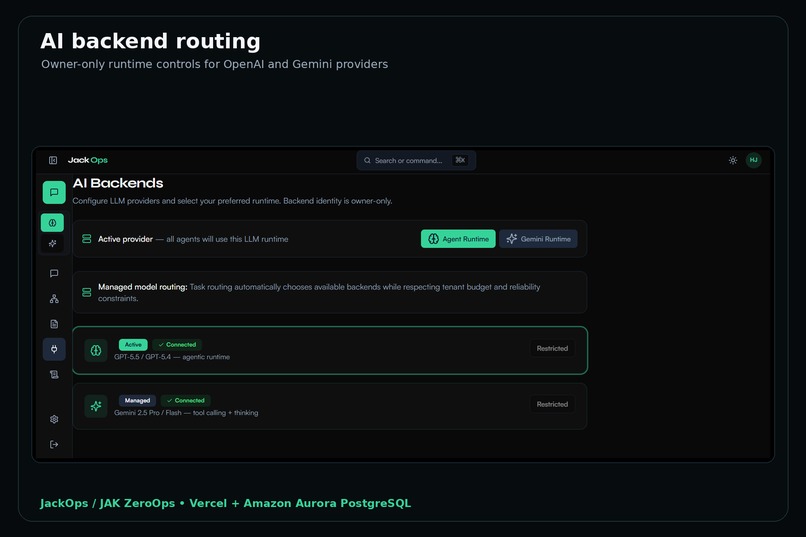
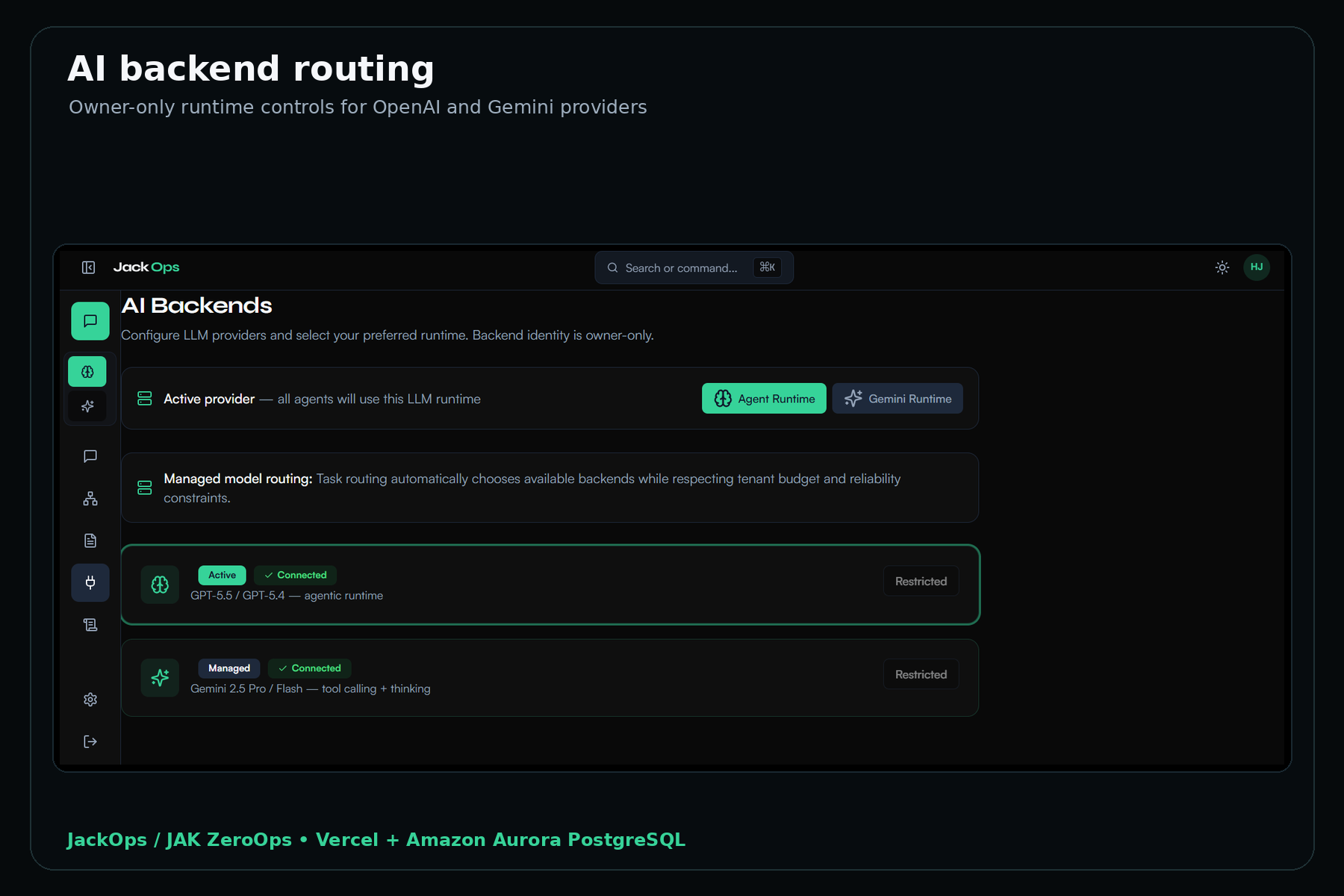
Backend ERouting
-
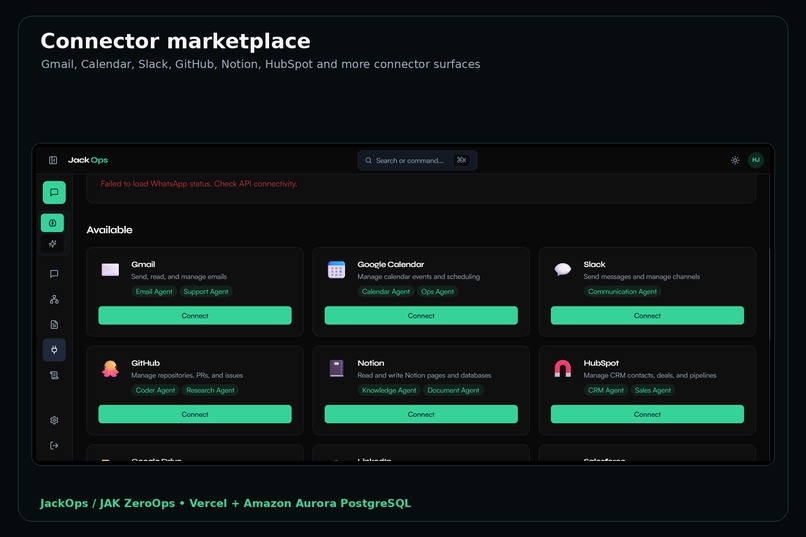
Connector Marketplace
-
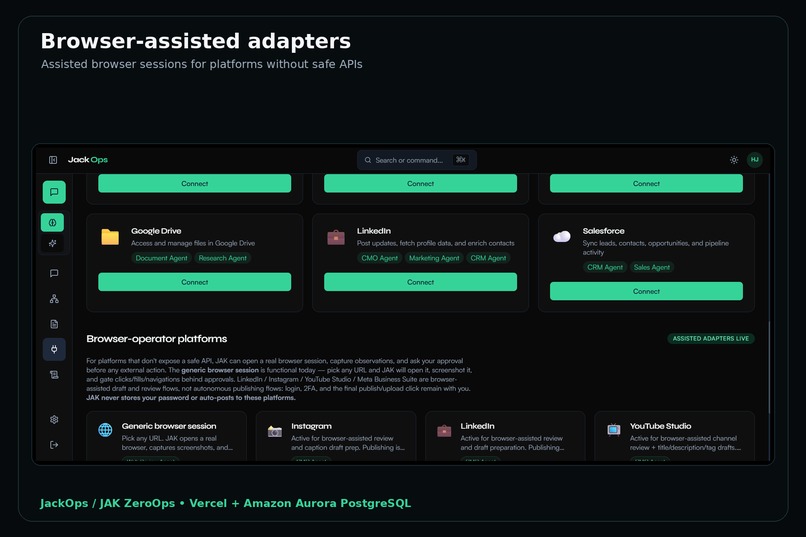
Browser Assisted Adapters
-
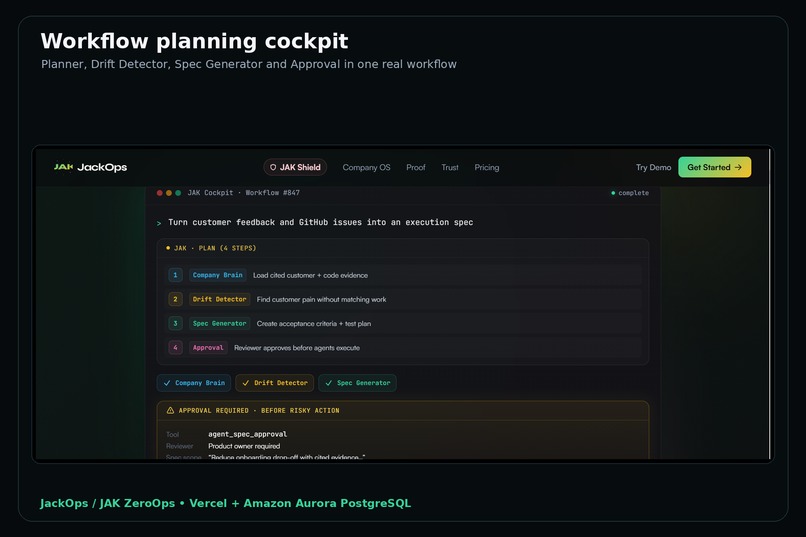
Landing page
-
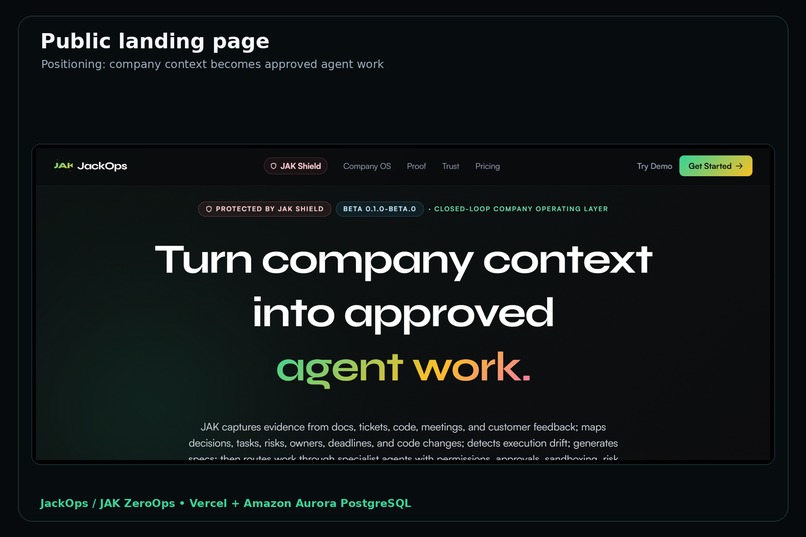
Landing page
Inspiration
AI agents are moving from demos into real company operations, but most businesses still lack a secure control plane to understand what agents did, why they did it, what data they used, what risk was detected, who approved the action, and how the workflow can be audited later.
This becomes critical when agents touch customer emails, tickets, documents, code, CRM records, internal notes, or operational decisions. A company cannot safely depend on autonomous agents if it cannot prove what happened.
JAK ZeroOps was built to solve this problem: it turns AI-agent activity into structured, replayable, database-backed business operations.
The core idea is simple: AI agents should not only work — their work should be provable.
What it does
JAK ZeroOps, presented as JackOps for this H0 build, is an AI operations command center for startups and SMEs. It helps a company run, monitor, approve, and audit agent workflows from one dashboard.
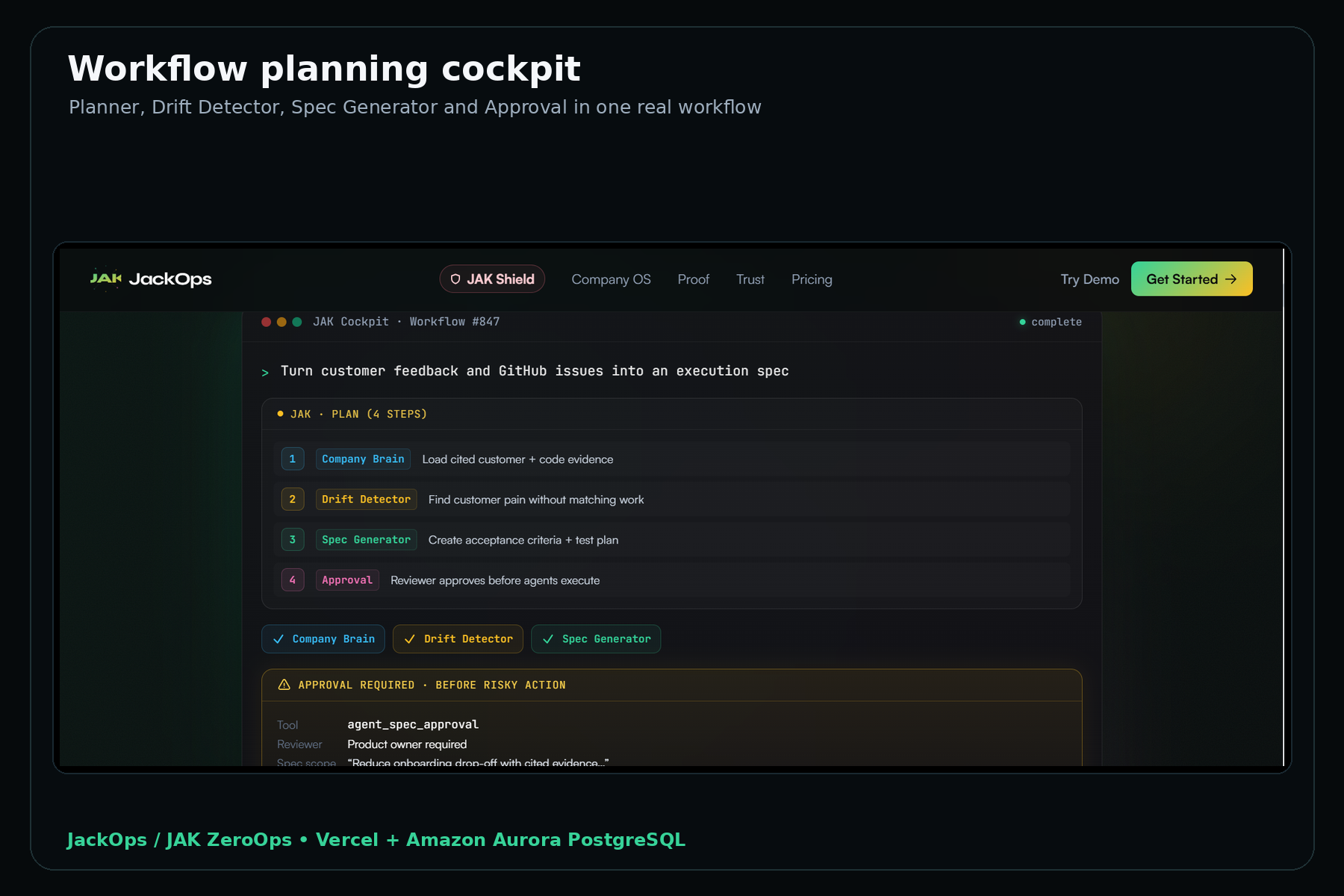
A user can create a business goal such as “prepare a Q2 market analysis,” “review a customer escalation,” “turn customer feedback and GitHub issues into an execution spec,” or “draft a business response.”
JAK then breaks the goal into agent steps, routes work to specialist agents, records the agent trace, checks risk, captures approval checkpoints, stores workflow status, tracks cost, and creates an audit trail that can be replayed later.
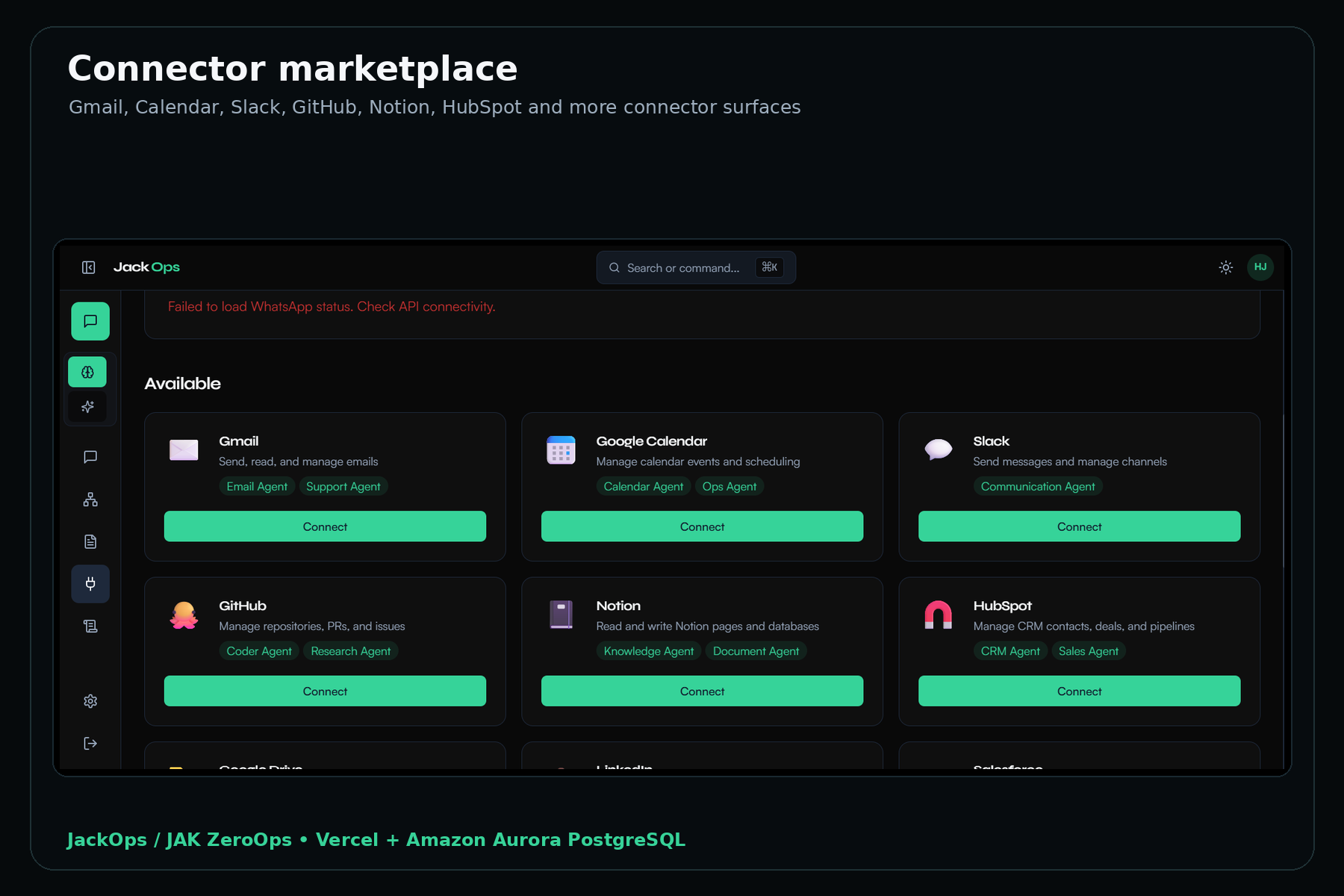
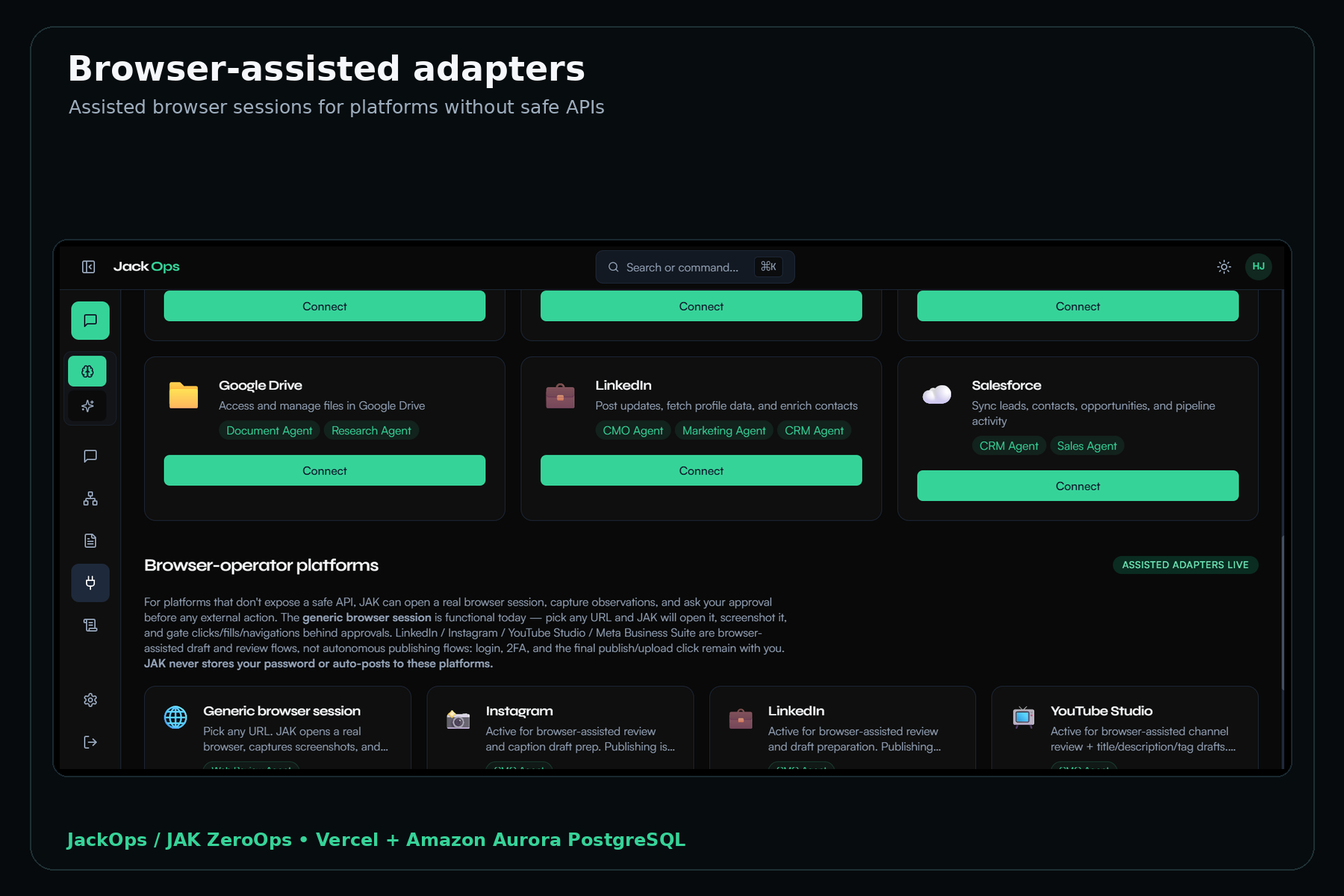
The product includes a live workflow cockpit, Swarm Inspector, JAK Shield approval gates, AI backend routing for OpenAI and Gemini, connector surfaces for business tools, and Aurora PostgreSQL-backed workflow history.
For the H0 hackathon demo, the app uses a preconfigured demo tenant so judges can explore the product immediately without signup friction.
Live demo: https://jackops.vercel.app/
Source code: https://github.com/inbharatai/JAKOps
How we built it
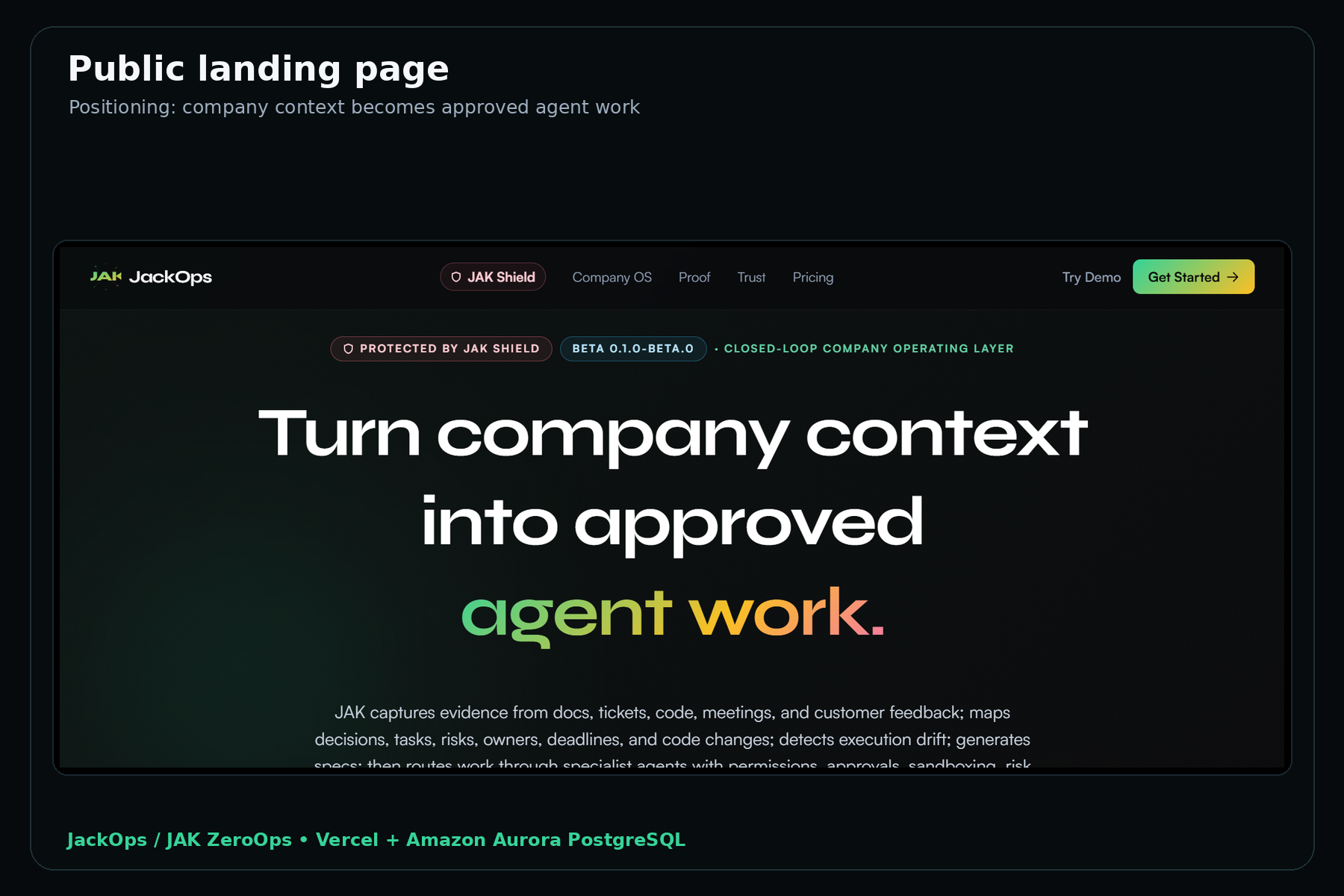
The frontend is deployed on Vercel as a Next.js dashboard. The app includes a public landing page, a live workflow cockpit, Swarm Inspector, AI backend settings, connector screens, approval views, and audit/replay surfaces.
The backend runs through same-origin Next.js route handlers on Vercel. These routes handle workflow creation, live workflow streaming, approval decisions, trace inspection, settings, and audit replay.
The agent workflow engine is the real JAK Swarm / SwarmRunner graph powered by LangGraph. A workflow moves through a structured execution loop:
Commander → Planner → Router → Guardrail → Worker → Verifier → Approval / Completion
JAK Shield sits inside this loop as the human-in-the-loop approval gate. When the system detects a high-risk external action, such as sending an email or writing to an external system, it pauses the workflow, creates an approval request, shows the reviewer an approval card, and records the decision.
The H0 build uses Amazon Aurora PostgreSQL as the system of record. Prisma connects the Vercel app to Aurora PostgreSQL and persists the core operational records.
The architecture is:
User / Judge → Vercel Next.js Dashboard → Next.js API Route Handlers → JAK SwarmRunner / LangGraph Engine → OpenAI or Gemini Workers → JAK Shield Approval Gate → Amazon Aurora PostgreSQL → Dashboard Replay / Swarm Inspector
This makes the app more than a frontend demo. Workflow state, agent traces, approval records, audit logs, checkpoints, tenant memory, token usage, and cost records are stored in the database and can be inspected after the agent run.
AWS Database used
We used Amazon Aurora PostgreSQL.
Aurora PostgreSQL is the primary operational database for the H0 build. It stores workflow runs, agent traces, approval requests, approval audit logs, audit events, workflow checkpoints, tenant memory, token usage, cost records, and demo tenant data.
This allows the application to behave like a production-ready AI operations system rather than a simple frontend demo. The agent run does not disappear after the LLM response. It becomes a durable operational record that can be reviewed and replayed.
Why Aurora PostgreSQL
JAK ZeroOps has relational business data: tenants, users, workflows, agent traces, approvals, tasks, audit logs, memory, checkpoints, and cost records.
Aurora PostgreSQL is a strong fit because it supports structured relational modeling, transactional integrity, durable records, and a clear audit trail for AI-agent operations.
For this project, Aurora PostgreSQL is not just used to store user accounts. It is the backbone of the product.
Every important agent event becomes a database-backed business object. A workflow has a status. A plan has steps. An agent run has traces. A risky action has an approval request. A reviewer decision has an audit record. A completed run can be replayed later.
That database layer is what makes the product trustworthy for real companies.
Challenges we faced
The biggest challenge was adapting an existing AI-agent system into a clean Vercel + AWS Databases hackathon architecture without breaking the core product or reducing it to a fake click-through demo.
The original JAK system had a broader production path, so for this H0 build we focused the submission around a clean Vercel-hosted Next.js app connected to Amazon Aurora PostgreSQL as the primary database layer.
Another challenge was making the database visible in the user experience. Instead of only showing AI outputs, we designed the dashboard to show the operational evidence behind those outputs: workflow state, agent steps, trace timing, approval checkpoints, audit records, and cost tracking.
A third challenge was safety. Autonomous agents that can act on external systems need a control point. JAK Shield was designed so high-risk actions are paused for review instead of being silently executed. In this H0 build, the approval decision and audit trail are recorded clearly, while unsafe uncontrolled external transmission is not hidden or faked.
What we learned
We learned that AI-agent products become much more trustworthy when the database is treated as the backbone of the product, not just a place to store users.
Aurora PostgreSQL allowed us to model agent work as auditable business operations. It helped us represent workflows, traces, approvals, audit logs, checkpoints, memory, and cost records as durable business data.
We also learned that Vercel and AWS Databases are a strong pairing for building full-stack AI software quickly. Vercel made it possible to ship a polished dashboard and API layer fast, while Aurora PostgreSQL provided the durable backend foundation needed for production-grade workflows.
The biggest lesson was that serious agent systems need visibility, approvals, replay, and audit — not only a beautiful chat interface.
What's next
Next, we plan to expand JAK ZeroOps into a full AI operations layer for companies, with deeper approval policies, stronger cost optimization, connector-based workflows, industry-specific agent packs, persistent workflow resume, signed audit exports, role-based access control, and enterprise-grade audit replay.
We also plan to harden the connector layer, expand JAK Shield security checks, add production tenant onboarding, and create specialized agent packs for sales, support, operations, product, legal, and engineering teams.
The long-term goal is to help companies safely adopt AI agents by giving them visibility, control, compliance, and operational memory from day one.
JAK ZeroOps is our answer to a simple but important question:
When AI agents work for a company, who watches the agents?
Built With
- amazon
- amazon-web-services
- api
- aurora
- cloud
- css
- databases
- gemini
- jak
- next.js
- node.js
- openai
- orm
- postgresql
- prisma
- react
- run
- swarm
- tailwind
- typescript
- v0
- vercel

Log in or sign up for Devpost to join the conversation.