-
-
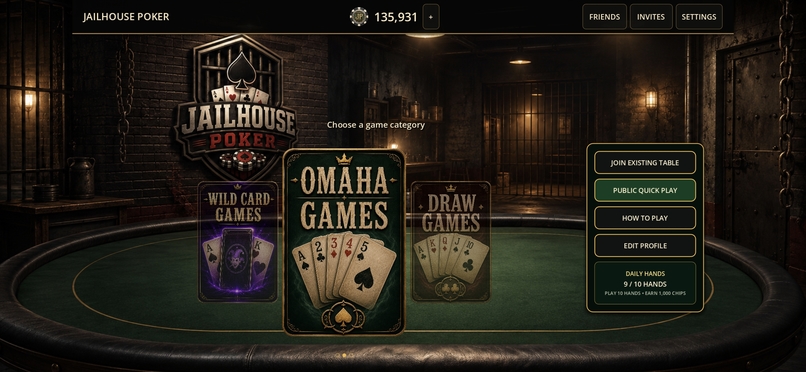
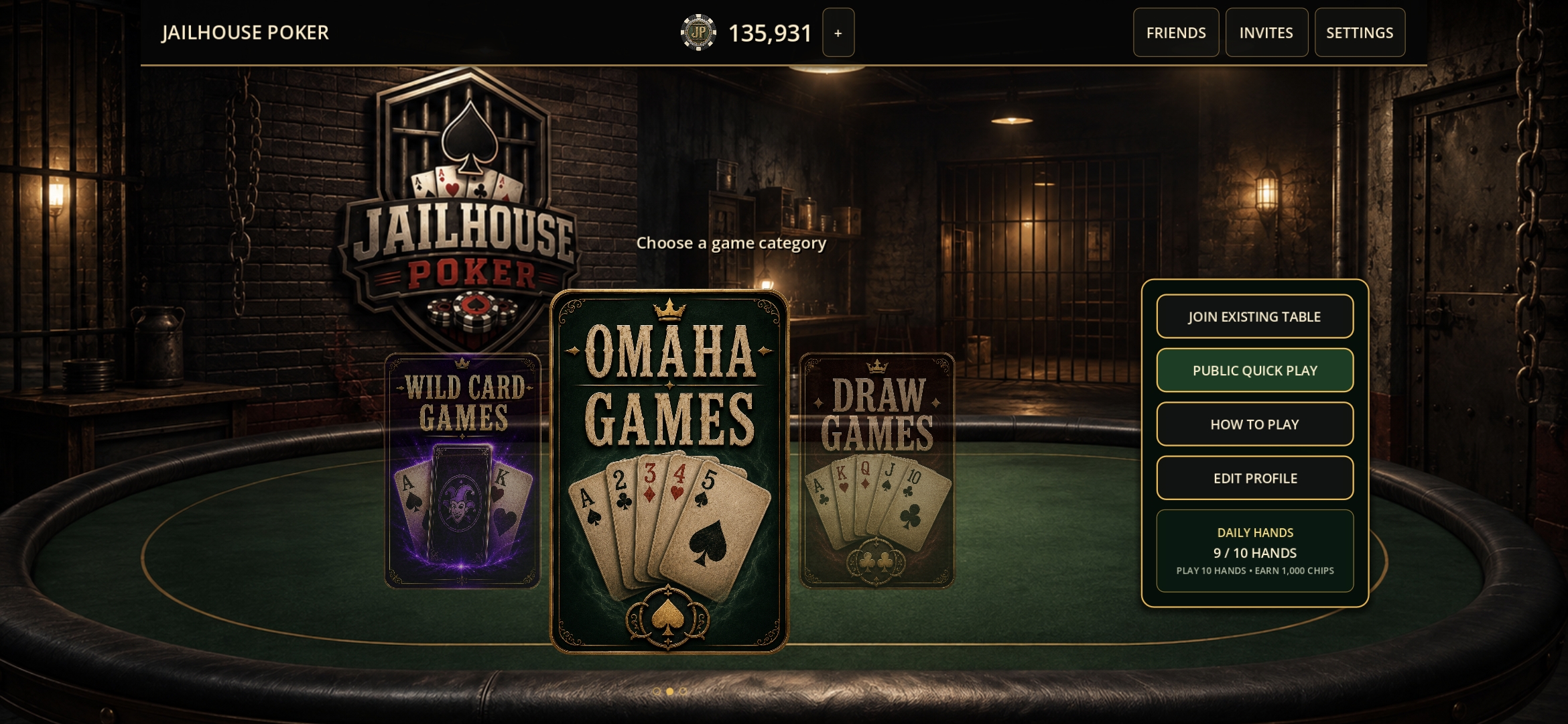
Choose from Wild Card, Omaha, and Draw game families—each with jailhouse variants you won't find in standard poker apps.
-
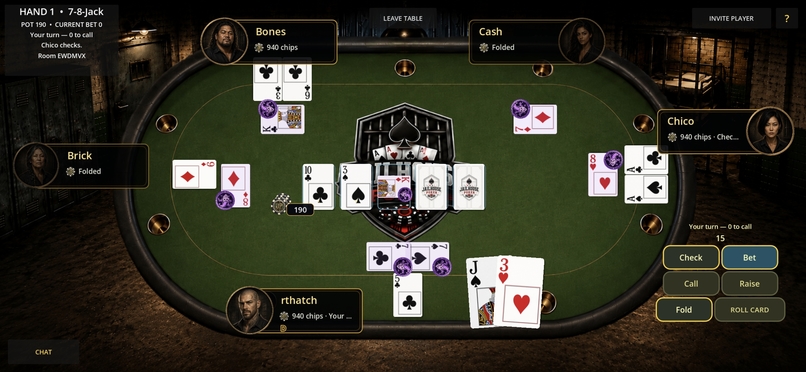
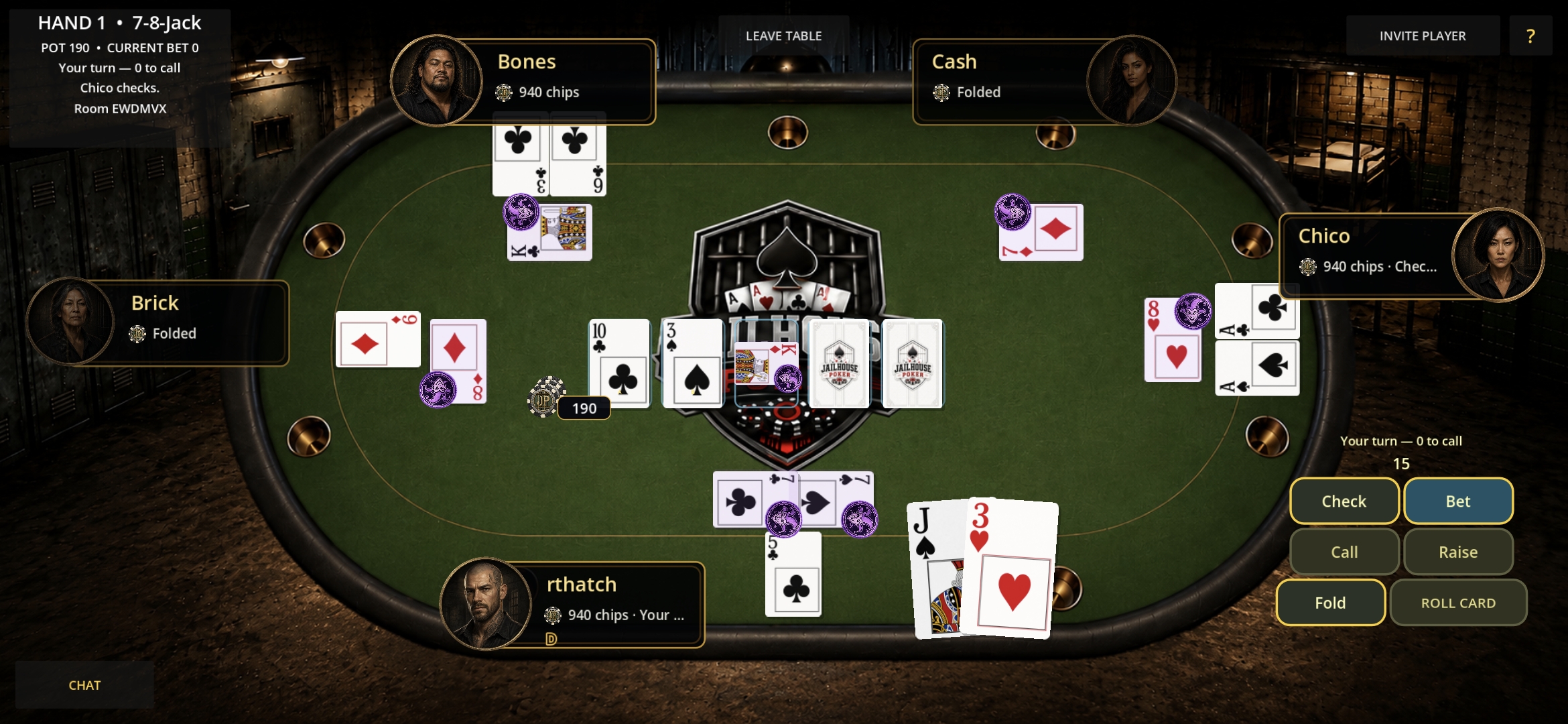
7-8-Jack in action: changing wild cards, player-specific rules, and gameplay very different from traditional casino poker.
-
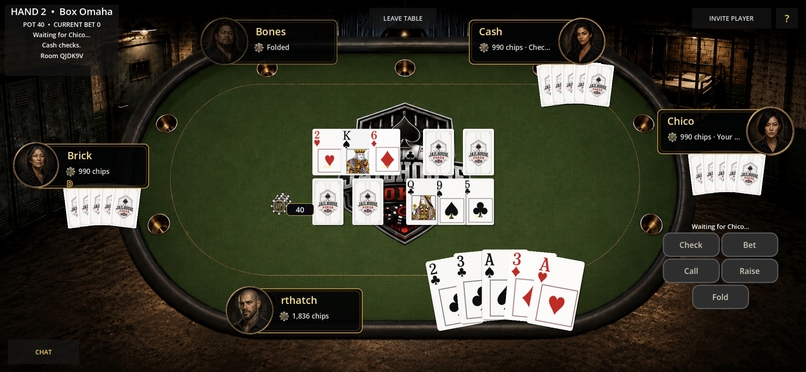
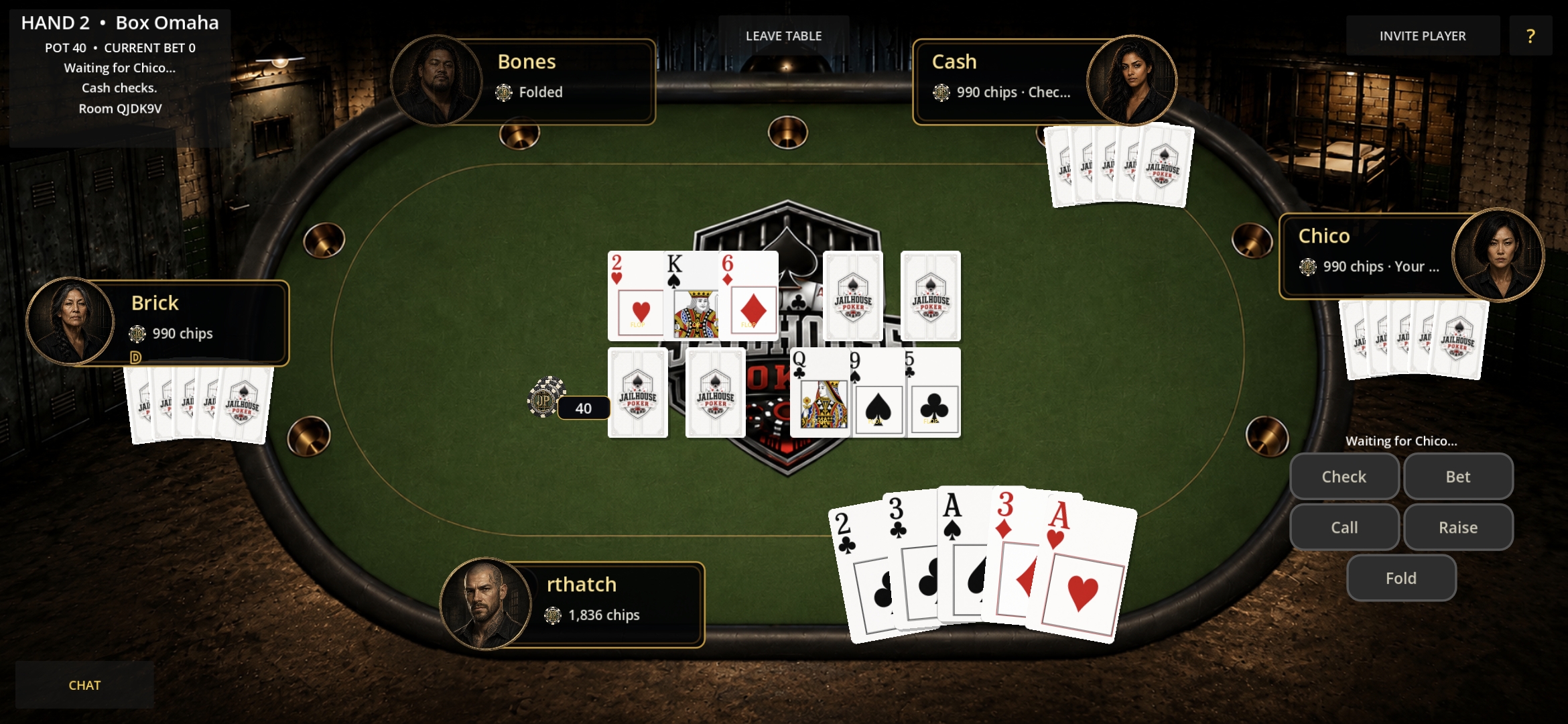
Box Omaha uses an unconventional board layout and five-card Omaha rules, creating a very different strategy from Hold'em.
-
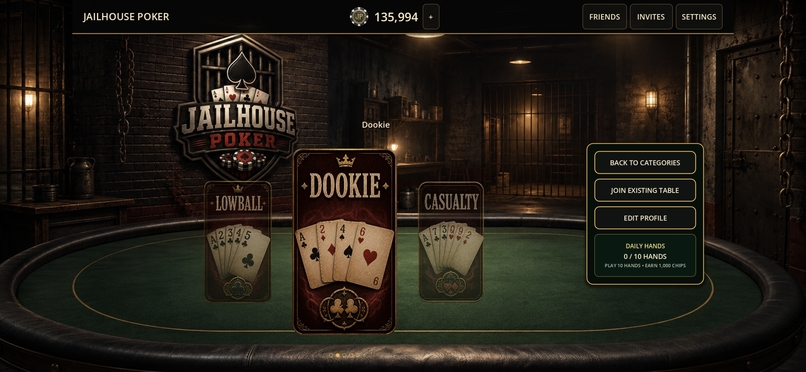
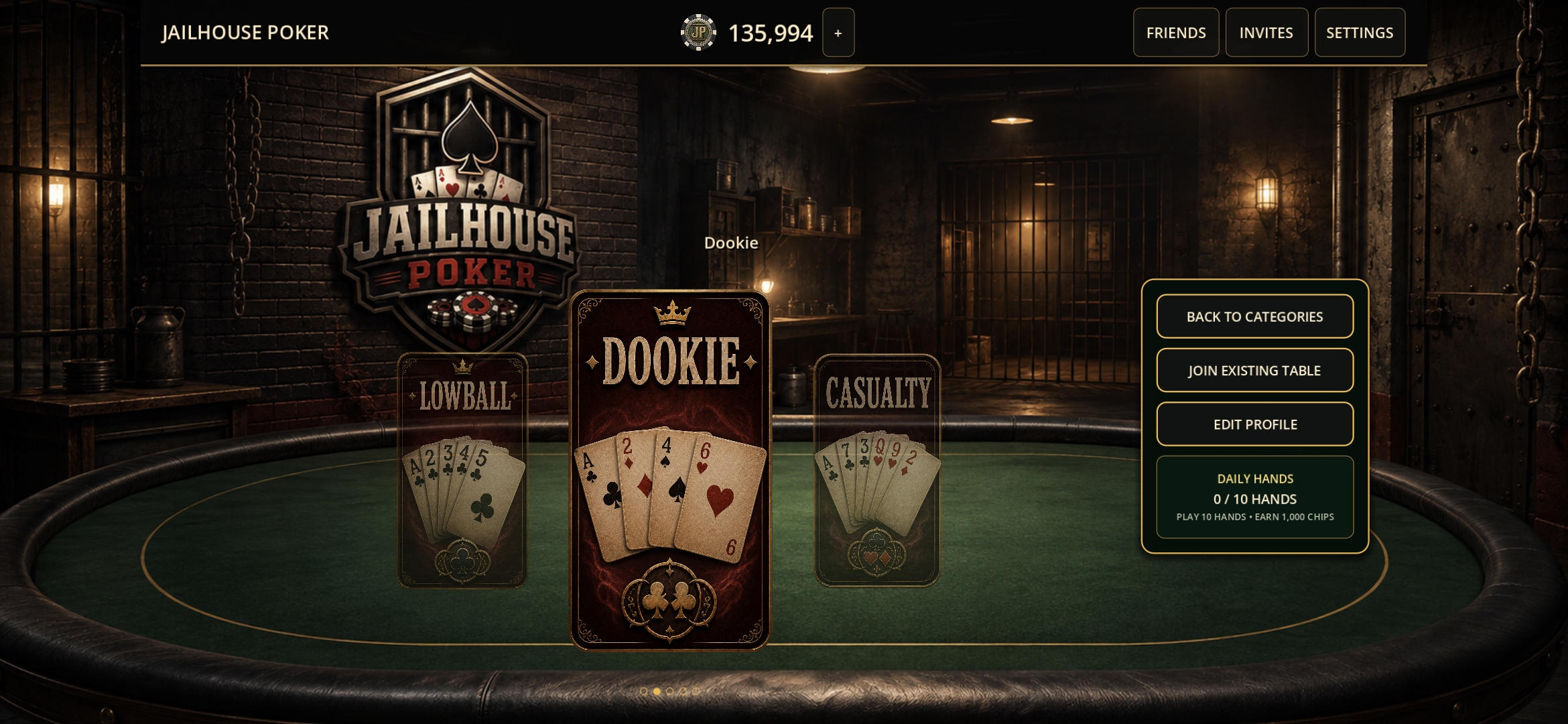
Dookie is one of several draw games included in Jailhouse Poker, alongside Lowball and Casualty.
-
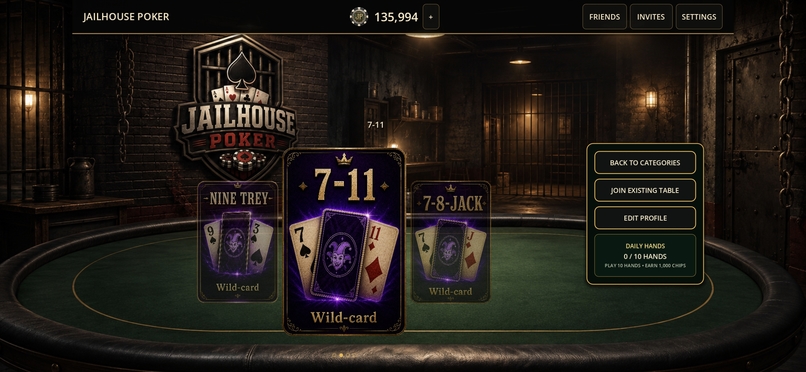
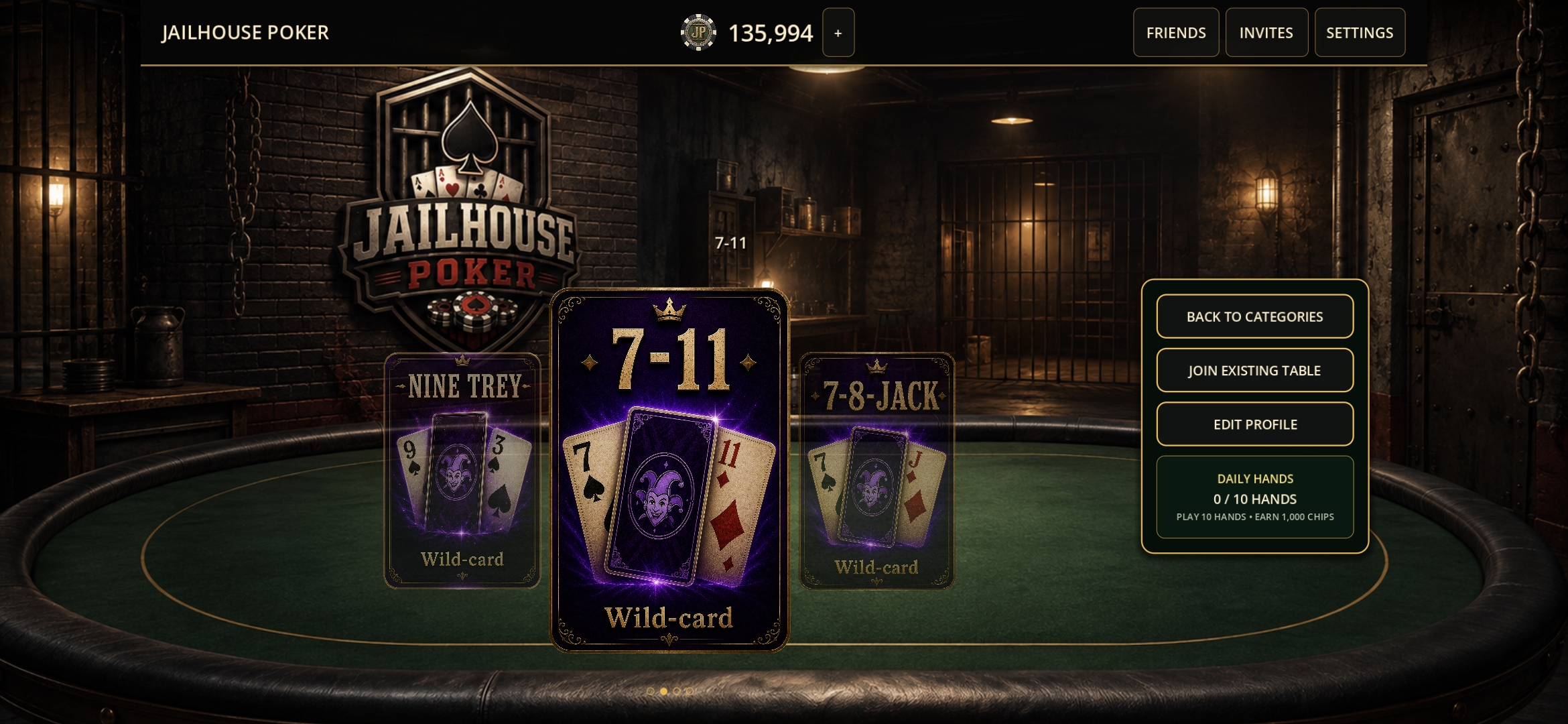
Wild-card games include 7-11, Nine Trey, and 7-8-Jack—variants traditionally passed from player to player inside.
-
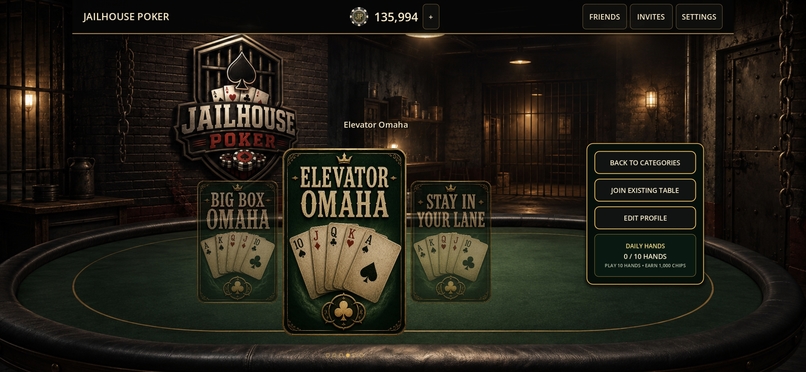
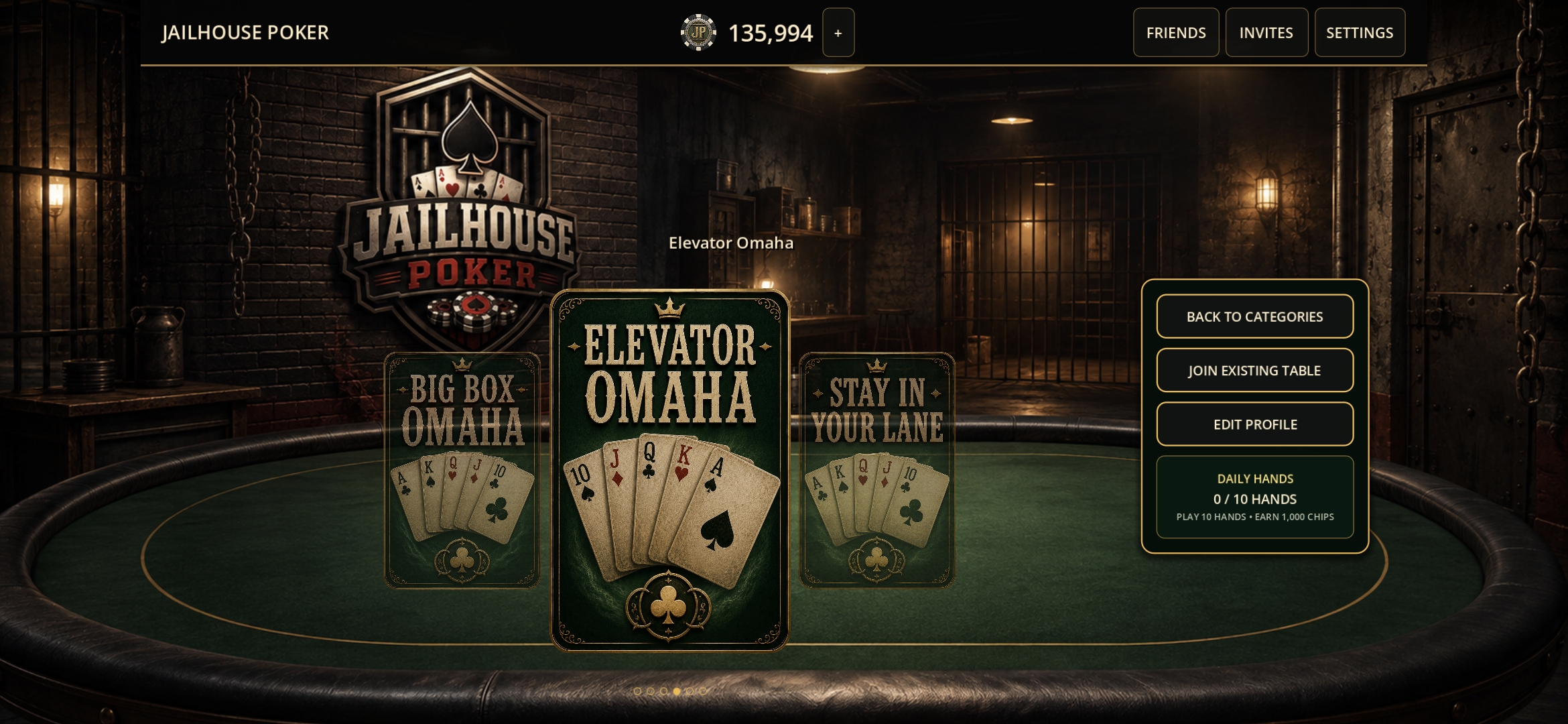
Explore jailhouse Omaha variants like Big Box Omaha, Elevator Omaha, and Stay in Your Lane—games you won’t find in standard poker apps.
-
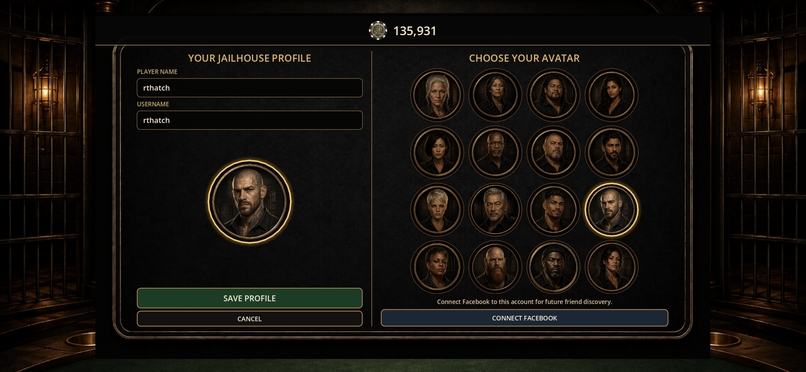
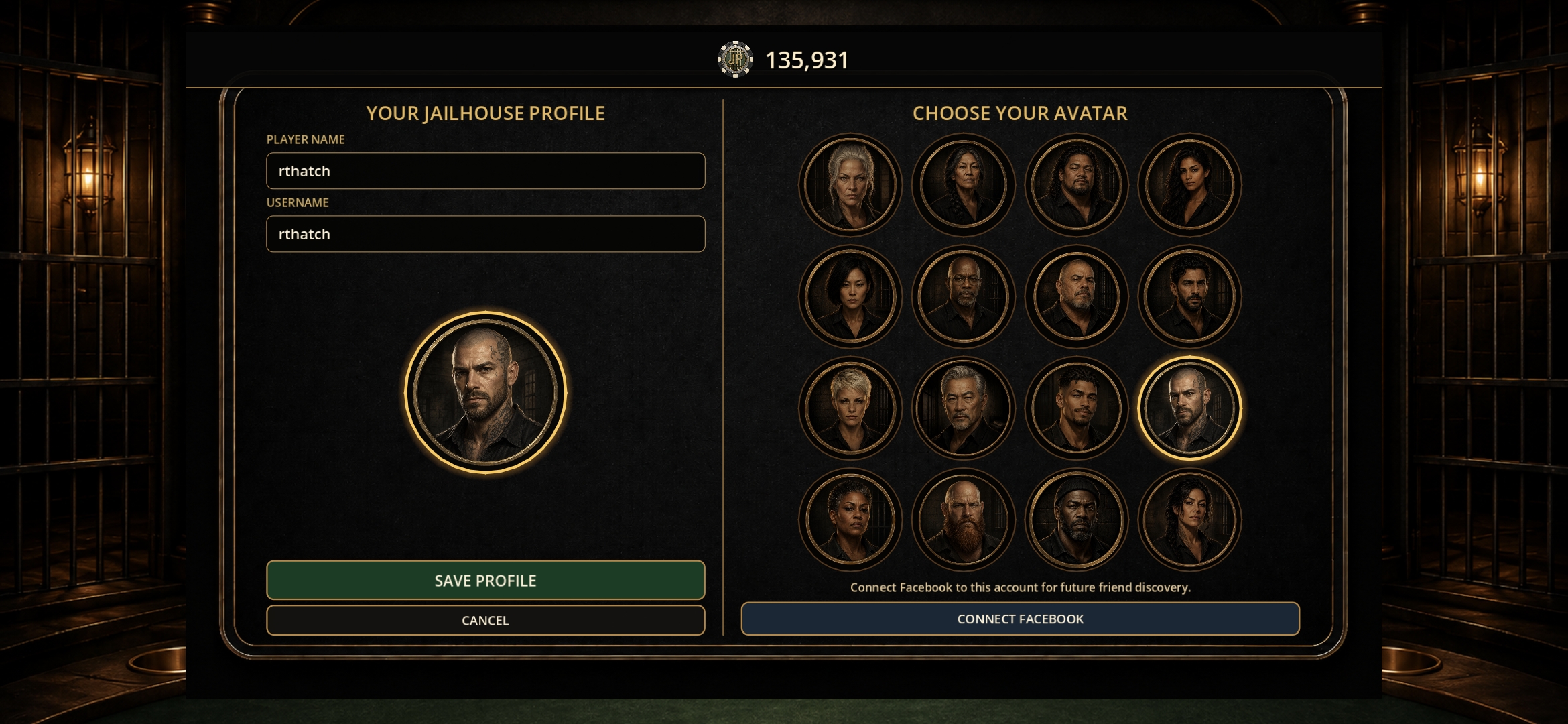
Players can create a profile, choose an avatar, build a chip balance, and return to persistent multiplayer play.
Inspiration
Poker played in jails and prisons across America is very different from what you will find in a casino.
Some of the wild-card games I learned are more regional to New York, while draw and Omaha-style games are played much more widely throughout state and federal institutions. These games are passed from person to person, table to table, and institution to institution. For a lot of people who have been incarcerated, they are as familiar as Texas Hold'em is to everyone else.
But you cannot open a mainstream poker app and play them. In fact, many of the games in Jailhouse Poker are not available in any other poker app at all.
I learned these games firsthand while incarcerated in jail and federal prison, and I wanted to preserve that part of poker culture instead of letting it exist only through word of mouth.
Jailhouse Poker is for the people who remember playing these games and miss them, but it is also for every poker player who has never had the chance to experience them.
Now you don't have to do a bid just to play them.
What it does
Jailhouse Poker brings real jailhouse and prison poker variants to mobile multiplayer.
Instead of building another app centered around Texas Hold'em, the game focuses on wild-card, draw, and Omaha-style games with rules and mechanics most poker players have never encountered.
The game includes variants such as Seven-Eight-Jack, Dookie, Box Omaha, Nine Trey and others, with mechanics including changing wild cards, player-specific wilds, unusual board layouts, custom draw rules and alternative hand requirements.
Players can:
- Learn unfamiliar games through interactive tutorials
- Practice against bots
- Play multiplayer tables against other players
- Build a persistent chip balance
- Collect daily rewards
- Discover poker variants that have traditionally been passed around by word of mouth
The goal is to recreate the experience of sitting down at a table and having somebody teach you a game you've never played before.
How we built it
Jailhouse Poker was built entirely on an Android phone.
No desktop or laptop computer was used to develop the game. The entire project has been created, tested, debugged, version-controlled and shipped from a Samsung Galaxy S24 FE.
The client is built in Godot, with Nakama providing the server-authoritative multiplayer backend. Game state and poker logic are controlled by the server rather than trusted to individual clients, which is especially important in a multiplayer card game.
OpenAI Codex generated roughly 90% of the project's code under my direction. Development has involved more than 350 pull requests, with Codex used to implement features, fix bugs, refactor systems and build automated regression tests while I designed the game rules, architecture, behavior and user experience and tested the results on-device.
RevenueCat handles the in-app purchase infrastructure for the virtual-chip economy, and OneSignal is being integrated for player messaging and retention.
The game also includes authentication, persistent player balances, matchmaking, bots, reconnect and recovery handling, tutorials, dealing and drawing animations, sound effects, daily rewards, and a growing library of poker variants.
Automated regression testing has become a major part of development. Tests cover individual game rules, multiplayer state, reconnect behavior, menu flows and mobile layouts so that adding one unusual rule does not accidentally break another game.
Challenges we ran into
One of the biggest challenges was building the entire game without a PC.
Jailhouse Poker has been developed entirely on a Samsung Galaxy S24 FE. That meant handling coding, Git, pull requests, testing, debugging, Android builds, server work, asset management and deployment from a phone. A workflow that would normally involve multiple desktop tools had to be adapted to a mobile environment.
The game itself created an even bigger technical challenge.
Jailhouse poker variants do not fit neatly into a traditional poker engine. Some games have cards that make other cards wild, player-specific wild cards, unusual board layouts, custom reveal orders, draw rules, alternate low-hand requirements and special redeal conditions. The challenge was building reusable systems without turning every game into a completely separate implementation.
Multiplayer made those rules much harder. The server has to remain authoritative while handling players who disconnect, reconnect, join in the middle of a hand, leave the table, lose their entire buy-in, rebuy or sit out waiting for the next hand. A small mistake in state handling can leave a player stuck or cause the client and server to disagree about what is happening at the table.
Another challenge was making unusual games understandable to someone who has never played them. Rules that make sense immediately to experienced jailhouse players can be confusing when presented for the first time on a phone. That led to a lot of work on tutorials, table feedback, card animations, prompts and mobile layout.
AI-assisted development also required a disciplined workflow. Codex generated most of the code, but every change still had to be specified, reviewed and tested. As the project grew past hundreds of pull requests, automated regression tests became essential for catching cases where fixing one game or UI flow accidentally broke another.
The hardest part has been making dozens of unusual rules, multiplayer networking and a mobile interface all feel like one coherent poker game.
Accomplishments that we're proud of
The biggest accomplishment is turning poker games that have traditionally been passed around verbally into fully functioning multiplayer game rules.
Jailhouse Poker now has a reusable poker engine capable of supporting very different wild-card, draw and Omaha-style games while sharing the same server-authoritative multiplayer infrastructure.
I'm also proud of how the game was built. The entire project was developed from a Samsung Galaxy S24 FE without a PC, using AI-assisted development and a GitHub-based workflow that has now grown beyond 350 pull requests.
What started as an idea based on games I personally learned while incarcerated has become a real multiplayer mobile game that can teach those games to someone who has never seen them before.
What's next for Jailhouse Poker
Shipaton is the beginning, not the finish line.
The immediate goal is to launch Jailhouse Poker publicly, continue polishing multiplayer and onboarding, improve the tutorials, and expand the community around these games.
After launch, I want to add more jailhouse poker variants, improve social features such as friends and table invites, continue expanding the game's animations and presentation, and bring Jailhouse Poker to additional platforms.
Long term, I want Jailhouse Poker to become the place where these games are preserved, taught, and played — including regional and institutional variants that have traditionally only been passed from person to person.
There are a lot more games still sitting around jail and prison poker tables that deserve to make it onto a screen.

Log in or sign up for Devpost to join the conversation.