-
-

Logo
-
UI/UX
-
UI/UX

Inspiration
Jakarta recorded 25,906 criminal incidents in 2023, up 30% from the year before. But the number that moved us was not the headline. It was the person behind it. A ride-hailing driver who loses their phone to a mugger does not just lose a gadget. They lose their only tool for work, and for a family living day to day, one crime can mean not knowing where tomorrow's food comes from. We are two actuarial science students and one economics student, and we are trained to ask one specific question about who bears the financial risk when something goes wrong and whether that is actually the right person. For low-income households in Jakarta, the answer is obvious and deeply unfair. That is what JAGA is trying to fix.
What it does
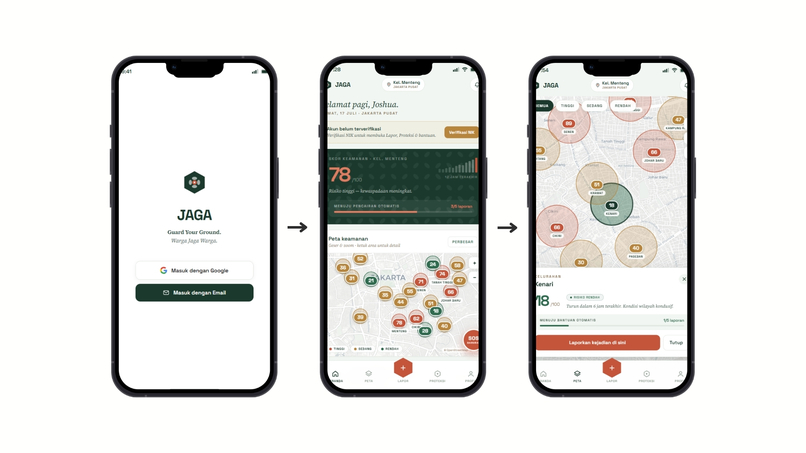
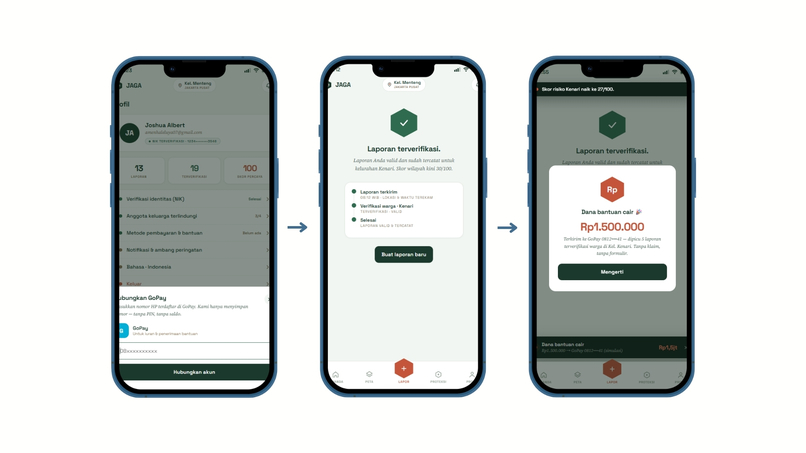
JAGA is a smart urban safety platform that connects a real-time crime risk engine, a community reporting system with admin verification, and parametric micro-insurance that pays out automatically. Citizens report incidents through a simple form, and those reports enter as raw signals that trigger nothing until the local administrator (sub-district head) verifies them. Once enough verified reports breach a statistical threshold specific to that kelurahan, cash is automatically sent to individuals who experienced the loss via e-wallet with no claim form, no surveyor, and no waiting. The piece we are most proud of is the Balanced Scorecard, which reimagines how local officials are incentivized. Instead of punishing them for having a high-crime area, we pay them per verified report, give them a bonus if crime drops month-over-month, and penalize wrongful rejections. We make honesty the profitable choice.
How we built it
Our team has almost no formal coding experience, so we split responsibilities clearly. The quantitative layer, including the credibility-weighted risk model, parametric trigger thresholds, and capital structure, was derived from our actuarial training during the hackathon using BPS DKI Jakarta 2022 and 2023 crime data as our empirical baseline. For the application itself, we used Claude as a technical co-pilot to scaffold the frontend, Folium heatmap, user dashboard, and live report simulator. Every prompt was driven by our own architectural decisions. The AI accelerated the build, but the product design and quantitative model were entirely ours.
Challenges we ran into
The biggest challenge was that no public kelurahan-level crime data exists in Indonesia. BPS only publishes at the city-region level, so we designed a hierarchical baseline where all kelurahans in a region share a regional starting point and diverge as local verified reports accumulate. This is the same logic used when pricing a new insurance class with no historical claims data of its own. We also underestimated how deep the moral hazard problem goes. Our first design made the local administrator the sole verification gatekeeper, which is an obvious single point of failure, so we added silence detection, tiered sign-offs, and random audits mid-sprint after stress-testing the mechanism ourselves.
Accomplishments that we're proud of
We built a real actuarial model in 30 hours, not a decorative one. Every parameter has a documented justification. Beyond the math, we are proud that we solved a governance problem and not just a technical one. Most crime-reporting tools fail because local officials have no incentive to participate honestly. The Balanced Scorecard is a mechanism design solution to that, and we think it is more durable than any algorithm. And honestly, we are proud that three people with almost no coding background shipped a working product.
What we learned
We learned that mechanism design matters as much as model design. You can get the math exactly right, but if the humans in the system have misaligned incentives, the math never runs on real data. We also learned that actuarial thinking generalizes far beyond insurance pricing. Credibility theory, anomaly detection, and capital sizing through Monte Carlo simulation are tools for reasoning under uncertainty with limited data, and they apply almost anywhere. Lastly, we learned how to cut scope without pretending the cut features do not need to exist. Knowing what to defer and what to build was one of the hardest decisions of the sprint.
What's next for Jaga
The most important improvement would be replacing the synthetic data feed with real verified crime reports from the local police department, so the risk model is calibrated against actual ground-truth data rather than simulated events. We would also want to refine the credibility model parameters through a proper pilot study, running the system across several kelurahans over multiple months to see how quickly the risk scores converge and whether our threshold assumptions hold in practice. On the insurance side, the current pool structure works for small-scale demonstration but would need a formal reinsurance layer to handle correlated shocks across multiple kelurahans at once. We would pursue a partnership with a domestic reinsurer and explore the OJK regulatory sandbox to make the product commercially viable. Finally, we would invest in the machine learning side of the anomaly detection system, training a proper supervised classifier on labeled historical incidents rather than relying purely on rule-based Poisson thresholds.
Built With
- claude
- css
- html
- javascript
- python

Log in or sign up for Devpost to join the conversation.