Inspiration
Healthcare emergencies among elderly patients often go unnoticed until they become critical. Many senior citizens live alone or forget medications, while caregivers and family members may not always be available in real time. We wanted to build an AI-powered healthcare companion that could proactively monitor symptoms, remember patient history, detect emergency risks, and support both patients and caregivers through autonomous AI agents.
The inspiration behind JacCareMind AI came from the idea of combining agentic AI with healthcare to create a system that feels less like a chatbot and more like an intelligent digital caregiver. We also wanted to explore how Jac’s graph-native architecture and autonomous walkers could orchestrate multiple specialized agents collaboratively.
What it does
JacCareMind AI is an autonomous multi-agent healthcare assistant designed for elderly care.
The system:
- Remembers patient medical history
- Analyzes symptoms in real time
- Dynamically asks follow-up questions
- Detects emergency risk levels
- Generates personalized care plans
- Alerts caregivers during high-risk situations
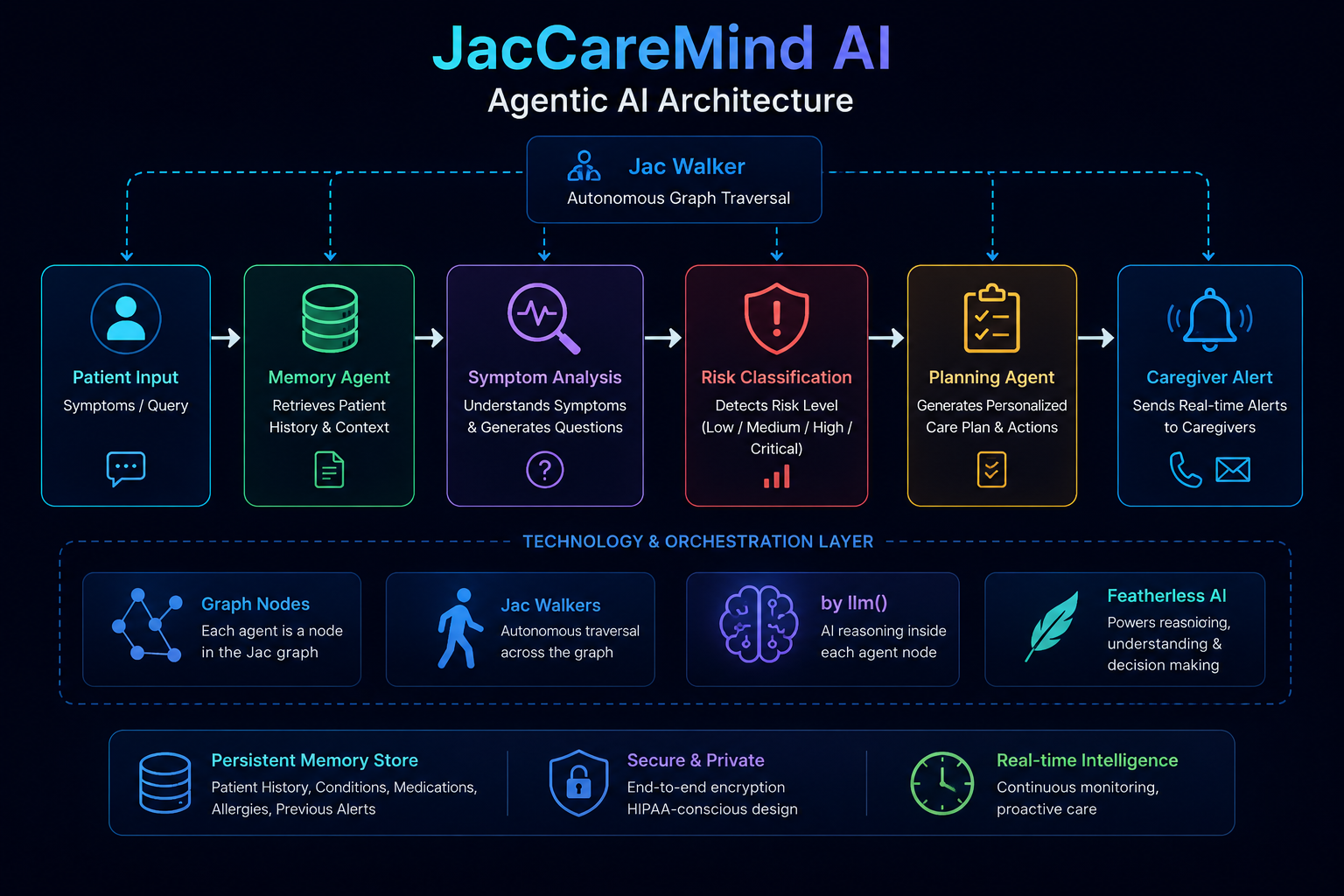
Instead of relying on a single chatbot response, JacCareMind AI uses multiple AI agents working together through a graph-based orchestration pipeline.
Core AI Agents
- Memory Agent → Retrieves patient history and medical context
- Symptom Analysis Agent → Understands symptoms and generates follow-up questions
- Risk Classification Agent → Detects LOW / MEDIUM / HIGH / CRITICAL health risks
- Planning Agent → Suggests personalized next-step actions
- Caregiver Alert Agent → Generates emergency caregiver notifications
The project demonstrates real agentic AI behavior using:
- Memory
- Planning
- Multi-step reasoning
- Graph traversal
- Autonomous agent collaboration
How we built it
JacCareMind AI was built using a modern AI-native architecture combining Jac, Featherless AI, FastAPI, and React.
Frontend
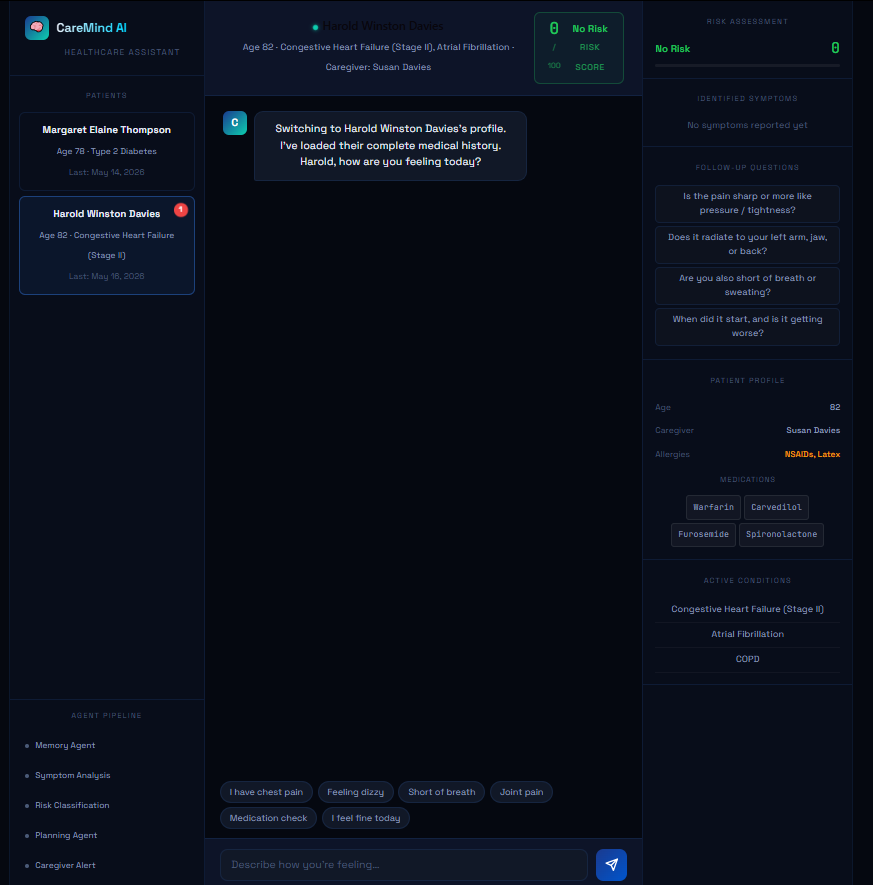
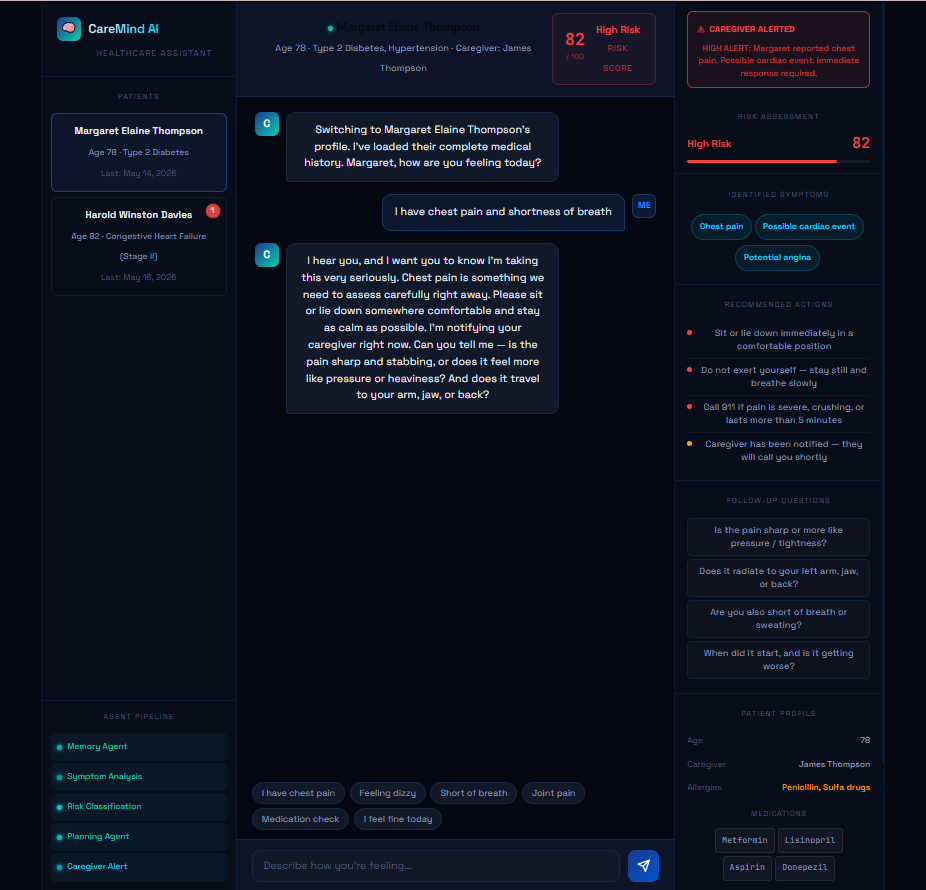
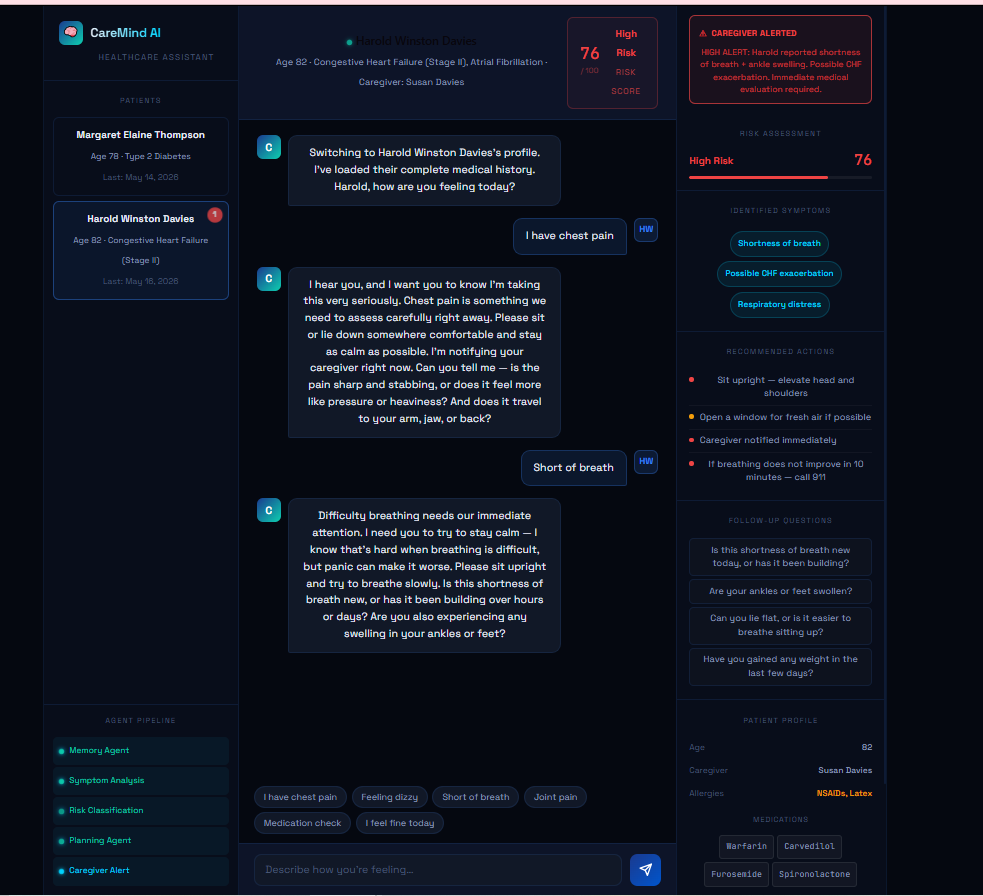
We built a futuristic healthcare dashboard using:
- React
- Tailwind CSS
The frontend provides:
- Real-time chatbot interaction
- Risk visualization
- Caregiver alert panels
- Patient monitoring dashboard
Backend
The backend was developed using:
- FastAPI
- Python
The API handles:
- Agent orchestration
- Patient memory retrieval
- AI inference requests
- Emergency classification
- Alert generation
Jac Agent Network
We used Jac to create a graph-native multi-agent orchestration system.
The Jac implementation includes:
- Graph nodes for each AI agent
- Walkers for autonomous traversal
- Memory-aware context propagation
by llm()integration for AI reasoning
Featherless AI Integration
Featherless AI powers the reasoning engine of the project.
It is used for:
- Symptom understanding
- Dynamic follow-up generation
- Emergency risk reasoning
- Personalized healthcare responses
Memory System
We implemented a lightweight patient memory store using JSON-based persistent storage to simulate longitudinal healthcare memory.
Challenges we ran into
One of the biggest challenges was designing autonomous agent collaboration in a short hackathon timeframe. Coordinating multiple AI agents while maintaining contextual consistency across the pipeline required careful orchestration.
Another major challenge was balancing medical reasoning accuracy with response speed. Since this was a hackathon MVP, we focused on creating believable and context-aware healthcare reasoning rather than building a medically certified diagnostic system.
Integrating graph-based Jac workflows with real-time frontend interactions was also challenging, especially while ensuring smooth communication between the frontend, backend, and AI reasoning layers.
We also experimented extensively with prompt engineering to make the AI agents feel collaborative rather than generating isolated responses.
Accomplishments that we're proud of
We are proud of building a fully functional autonomous healthcare assistant within a limited hackathon timeframe.
Some of our biggest accomplishments include:
- Building a real multi-agent AI orchestration system
- Successfully integrating Jac graph traversal and walkers
- Creating dynamic symptom-based reasoning workflows
- Implementing real-time caregiver alert generation
- Designing an emotionally impactful healthcare experience
- Combining Jac and Featherless AI into a cohesive healthcare solution
We are especially proud that the system behaves more like an intelligent healthcare companion than a traditional chatbot.
What we learned
Through this project, we learned how powerful graph-native agent orchestration can be when combined with large language models.
We explored:
- Autonomous AI system design
- Multi-agent collaboration patterns
- Jac graph modeling and walkers
- AI memory management
- Prompt engineering for healthcare reasoning
- Real-time AI workflow orchestration
We also learned that emotional impact and user experience are just as important as technical complexity when designing AI systems for healthcare.
What's next for JacCareMind AI
In the future, we plan to expand JacCareMind AI into a production-ready autonomous healthcare platform.
Future improvements include:
- Wearable device integration
- Voice-enabled healthcare interactions
- Real-time hospital API connectivity
- Personalized medication reminders
- Predictive health analytics
- Advanced long-term patient memory graphs
- Multi-language healthcare support
- Caregiver mobile application
We also want to explore how autonomous AI agents can proactively detect healthcare risks before emergencies occur, making elderly healthcare more accessible, intelligent, and preventive.


Log in or sign up for Devpost to join the conversation.