-
-
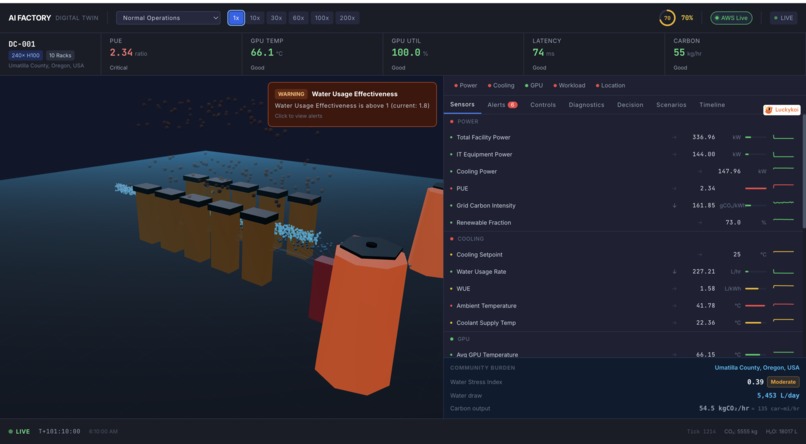
This is a overview of our project
Inspiration
AI data centers are growing faster than the accountability frameworks around them. Operators optimize for uptime and throughput — but the water drawn from drought-stricken communities, the carbon emitted during peak grid hours, and the free-tier users quietly dropped during capacity crunches remain invisible. We wanted to build something that made those costs impossible to ignore.
What it does
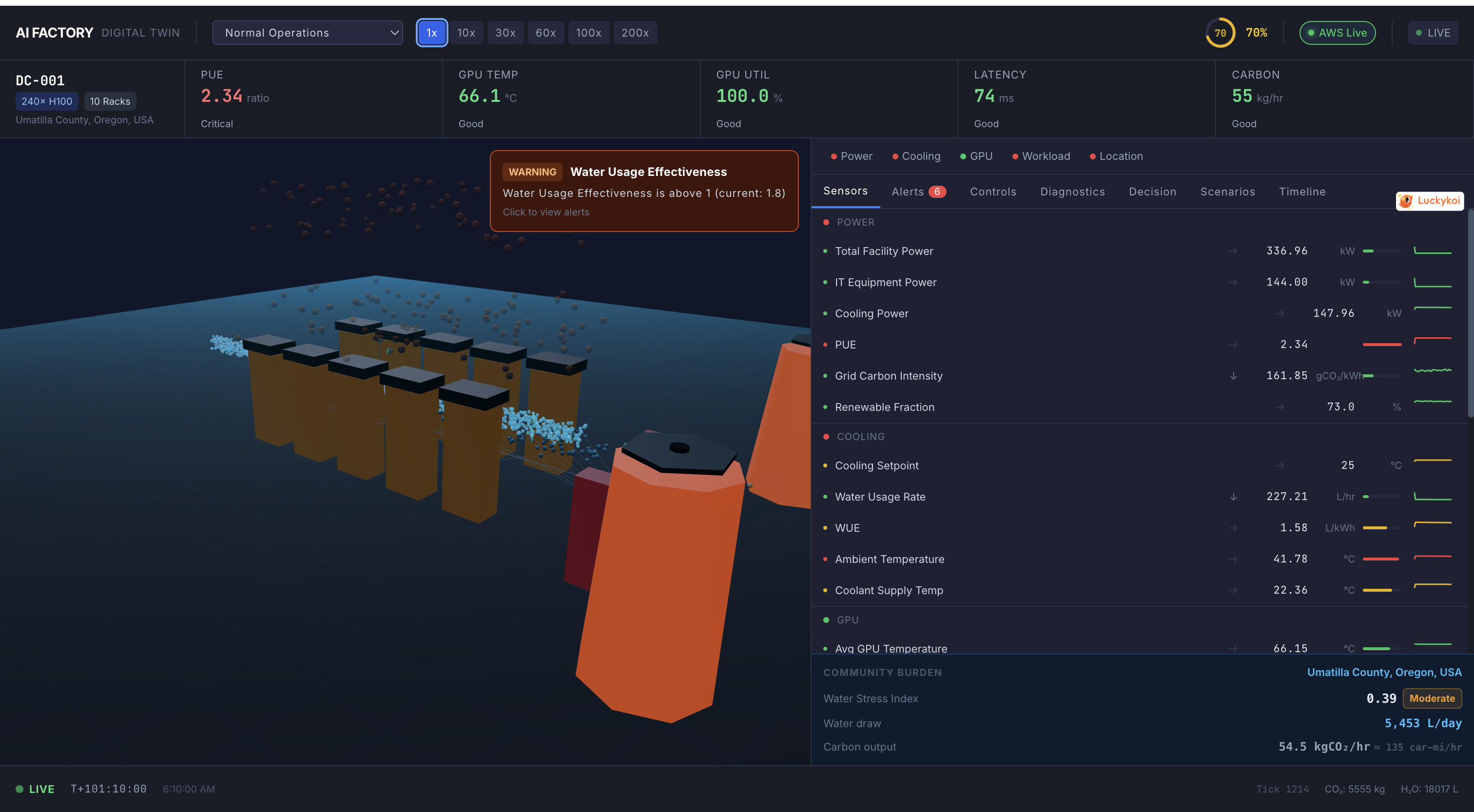
AI Factory Digital Twin is a real-time sustainability operations dashboard simulating a 240-GPU data center in Oregon. It models five interdependent infrastructure layers — power, cooling, GPU fleet, workload, and local environment — updating every 2 seconds via WebSocket. Every operational action triggers a mandatory Ethical Tradeoff Acknowledgment Modal that quantifies community water impact, carbon cost, and end-user effect before the change commits. Every decision is permanently logged in an append-only accountability artifact, exportable for audit.
How we built it
React and TypeScript on the frontend with React Three Fiber for the 3D digital twin visualization, Zustand for WebSocket-driven state management, and Tailwind CSS with Framer Motion for the UI. Node.js and Express on the backend running a deterministic simulation engine that ticks every 2 seconds, propagates layer interdependencies, evaluates alert thresholds, and pushes full state updates to clients over WebSocket. Deployed on AWS EC2 with the frontend served via S3 and CloudFront.
Challenges we ran into
Keeping the 3D scene performant while driving it entirely from WebSocket state updates required careful separation between simulation state and render state. Designing the ethical tradeoff modal was harder than expected — the tradeoff text, community impact, and end-user impact all needed to be dynamically generated from live simulation values, not hardcoded templates. Getting the layer interdependency propagation order correct so that lever changes cascaded realistically across all five layers took significant iteration.
Accomplishments that we're proud of
The Ethical Tradeoff Acknowledgment Modal is genuinely non-skippable — there is no way around it, no keyboard shortcut, no "don't show again". The community burden indicator is always visible and always current. The change log captures the full text of what the operator saw and acknowledged, not just the action taken. The Water Scarcity scenario — where the facility's water consumption doesn't change but its ethical weight triples because the community enters drought — is the kind of insight we're proud to have designed into the product.
What we learned
Sustainability in AI infrastructure is not primarily a technical problem — it's a visibility and accountability problem. The data to make better decisions largely exists. What doesn't exist is any mechanism that forces decision-makers to confront the human consequences of their choices before acting. We also learned that making ethics a gate rather than a report fundamentally changes how it feels to interact with a system.
What's next for AI Factory Digital Twin
Integration with real data center telemetry APIs (NVIDIA DCGM, cloud provider power APIs) to replace simulated metrics with live data. A multi-operator mode where decisions made by one operator are visible to others in real time. Regulatory compliance overlays — mapping committed actions against emerging data center sustainability disclosure requirements. And expanding the community burden model beyond water stress to include local air quality, grid stress, and land use impact.
Built With
- amazon-web-services
- aws-ec2
- express.js
- framer-motion
- node.js
- react
- react-three-fiber
- recharts
- tailwind-css
- three.js
- typescript
- websocket-(ws)
- zustand


Log in or sign up for Devpost to join the conversation.