-
-
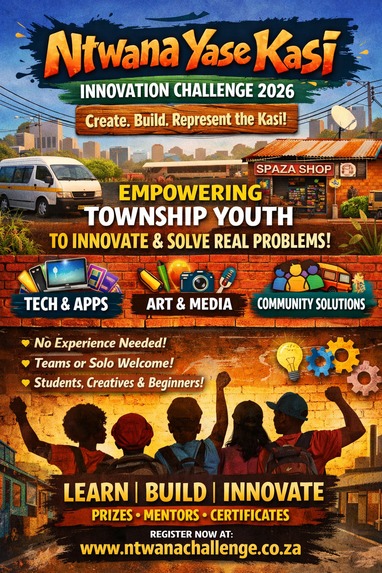
innovation
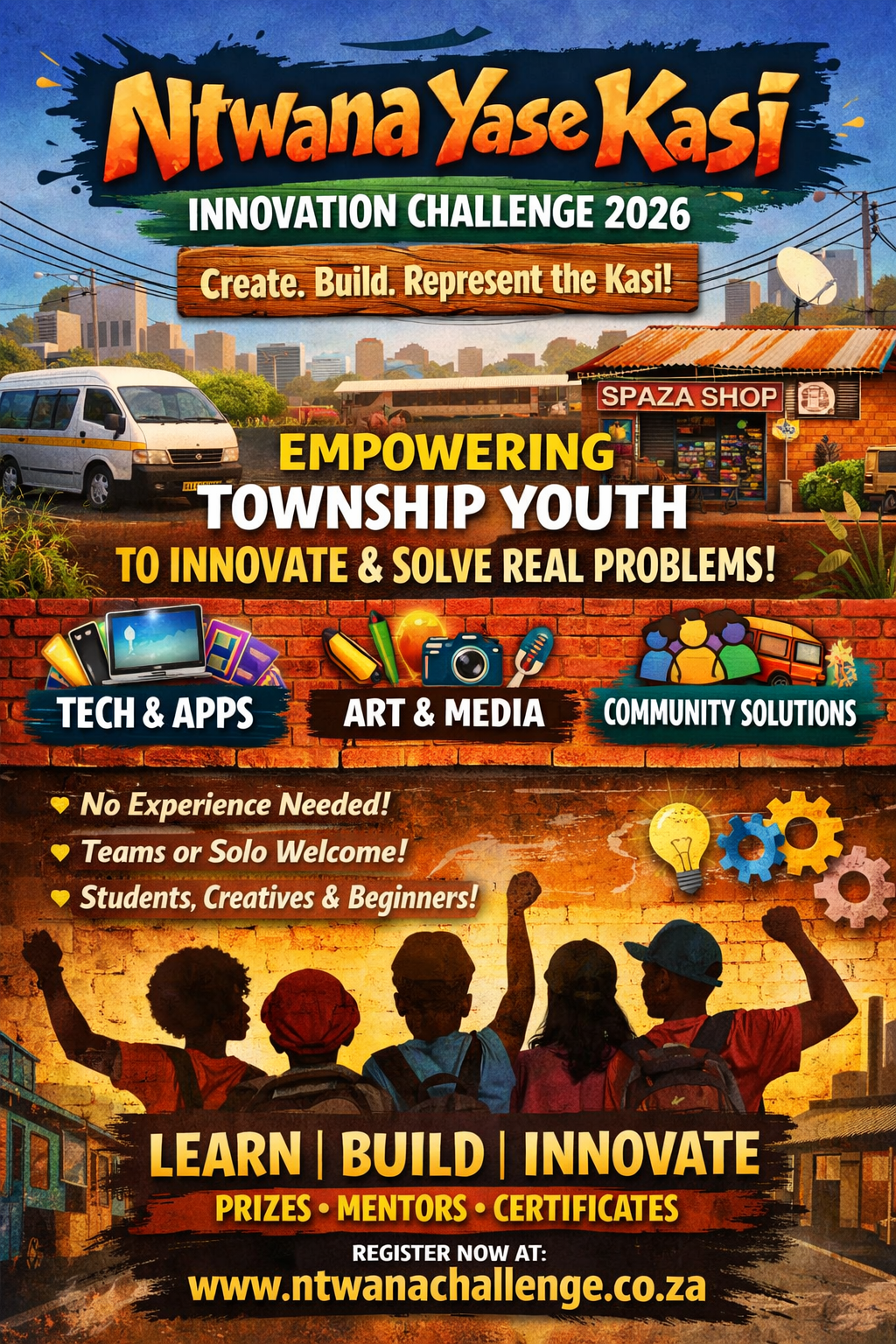
A comprehensive deep-dive project story for my entry, "Intwana Yase Kasi 2026."
This essay is designed to be approximately 1500 words, formatted in Markdown with LaTeX support, and written with a blend of technical rigor and the vibrant storytelling style required to capture the spirit of the South African township (Kasi).

(Please watch our project demonstration video above)
The Spark: What Inspired Us
The inspiration for Intwana Yase Kasi 2026 did not come from a Silicon Valley TED Talk or a university lecture hall. It was born on a dusty corner of Khayelitsha at 5:30 PM, amidst the chaotic harmony of taxi gauntlets and the smell of frying kotas.
We watched Ma’Dlamini, a local Spaza shop owner who has served our street for twenty years, struggling to tally her ledger by the light of a paraffin lamp during Stage 6 load shedding. We watched the "Intwanas"—the young guys on the corner—glued to their smartphones, consuming content but unable to participate in the digital economy because of exorbitant data costs and a lack of localized platforms.
We realized there was a massive disconnect. The "First Economy" of South Africa operates on cloud computing, high-speed fiber, and credit cards. The "Kasi Economy"—which sustains millions of people—runs on cash, handshake agreements, and memory. This disconnect creates what we call the "Poverty Premium." Ma’Dlamini pays more for her stock because she cannot buy in bulk with other shop owners. The youth pay more for data because they buy small bundles. The Kasi works harder but stays poorer because our infrastructure is analog in a digital world.
The spark was a simple, frustrating question: Why is technology built for us, but rarely by us?
We didn't want to build another charity app. We wanted to build an operating system for the township economy. We envisioned a future—specifically the year 2026—where the Kasi is a smart city, not by gentrification, but by digital innovation from within. Our project is a decentralized, offline-first digital ecosystem that aggregates community buying power, digitizes informal business records to build credit scores, and creates a mesh network for local data sharing.
The Journey: What We Learned
Our journey was defined by the philosophy of the "Slow Hack."
In the tech world, the mantra is often "move fast and break things." But in the Kasi, things are already broken. You cannot move fast when the electricity is out, or when your user base is skeptical of digital scams. We learned that we had to move slowly, intentionally, and build trust before we wrote a single line of code.
The Learning Curve
We started as a team of three with varying levels of expertise. We knew basic HTML/CSS and some Python, but Intwana Yase Kasi 2026 required full-stack engineering and mobile architecture. We had to transform ourselves from hobbyists into engineers.
We spent months on "YouTube University" and reading documentation, diving deep into:
- Flutter: For building a cross-platform mobile application that feels native on low-end Android devices, which constitute 90% of our user base.
- PWA (Progressive Web Apps): Learning how to cache data aggressively so the app functions perfectly without an internet connection.
- Data Science: Understanding how to interpret purchasing behaviors from Spaza shops to predict stock shortages.
The Community as the Classroom
The most profound lesson was that UX (User Experience) is cultural. We initially designed a sleek, minimalist interface similar to Uber or Airbnb. When we took it to Ma’Dlamini, she rejected it. It looked "too expensive" and "too complicated."
We learned that in the Kasi, density of information equals value. Users wanted to see everything on one screen. They didn't want swipe gestures; they wanted big, bold buttons. We learned to design for high-contrast visibility (for outdoor use) and to incorporate vernacular language—Tsotsitaal and local slang—into the UI to reduce friction.
We learned that technology is 10% code and 90% empathy. We spent weeks just sitting in Spaza shops, observing the flow of money, the negotiation of prices, and the physical exchange of goods. We learned that the "Intwana" isn't just a loiterer; they are potential logistics partners. This insight led us to integrate a "Gig" feature, allowing local youth to earn money by delivering goods between the bulk depot and the shops.
The Blueprint: How We Built It
The architecture of Intwana Yase Kasi 2026 is built on three pillars: Resilience, Aggregation, and Intelligence.
1. The Offline-First Architecture
Given the volatility of mobile network coverage in townships, we adopted a "Local-First" database strategy. We utilized WatermelonDB (a reactive database framework for React Native/Flutter) which plugs into an SQLite database on the user's device.
This ensures that Ma’Dlamini can record sales, check inventory, and place orders even when she has zero signal. The app creates a synchronization queue. As soon as the device detects a connection (even for a second), it "hydrates" the backend.
2. The Backend and Aggregation Engine
Our backend is hosted on Supabase (an open-source Firebase alternative), chosen for its robust PostgreSQL support and real-time subscription capabilities.
The core innovation is our Bulk Aggregation Algorithm. This logic groups orders from dozens of micro-enterprises within a specific geolocation radius to unlock wholesale discounts.
To optimize the delivery routes for the local couriers (the Intwanas on bicycles), we implemented a variation of the Knapsack Problem and the Traveling Salesperson Problem. We needed to maximize the value of goods carried while minimizing the distance traveled, constrained by the bicycle's carrying capacity.
We define the optimization function as follows:
Let $S$ be the set of Spaza shops and $K$ be the set of available couriers. We aim to maximize the Total Savings ($T_s$) generated by bulk delivery:
$$ T_s = \sum_{i \in S} (P_{retail}^i - P_{bulk}^i) \cdot q_i - \sum_{k \in K} \left( \alpha \cdot d_k + \beta \cdot t_k \right) $$
Where:
- $P_{retail}^i$ is the standard price per unit for shop $i$.
- $P_{bulk}^i$ is the discounted bulk price achieved through aggregation.
- $q_i$ is the quantity ordered by shop $i$.
- $d_k$ is the distance traveled by courier $k$.
- $t_k$ is the time taken (accounting for terrain/safety).
- $\alpha$ and $\beta$ are weighting coefficients for fuel/effort and time costs.
This formula runs dynamically on our server. Every evening at 8 PM, the "Market closes." The algorithm runs, batches the orders to maximize $T_s$, and generates the logistics manifest for the next morning.
3. Digital Identity and Credit
We used a lightweight implementation of Self-Sovereign Identity (SSI). Each shop builds a cryptographically verifiable ledger of their cash flow. This data is hashed and stored, allowing the shop owner to prove their income to micro-lenders without exposing their raw customer data. This turns their daily hustle into a credit score.
The Hurdle: Challenges We Faced
Building high-tech solutions in a resource-constrained environment is like trying to paint a masterpiece while running a marathon.
The Technical Barrier: The "Low-End" Reality
Our biggest technical hurdle was device fragmentation. We initially built the app using heavy libraries that ran smoothly on our laptops but crashed on the entry-level smartphones common in the Kasi (devices with 1GB RAM or less). We faced severe memory leaks.
- The Fix: We had to ruthlessly refactor. We stripped out heavy animation libraries. We optimized our image assets, compressing them to kilobytes. We rewrote our state management logic to be less memory-intensive. It taught us the art of efficient coding—making the app fly on a R500 phone was harder than making it run on an iPhone 15.
The Infrastructural Barrier: Load Shedding
Developing software during South Africa’s energy crisis was a nightmare. There were days we had no power for 8 to 10 hours. The cell towers would go down, cutting off our internet.
- The Fix: We adopted the "Midnight Coding" schedule. We slept during the day when the power was out and worked from 11 PM to 4 AM when the grid was stable. It was exhausting, but it bonded the team. We also learned to code "offline"—writing logic on whiteboards and paper when we couldn't power up the IDEs.
The Social Barrier: Trust
The most difficult hurdle was not technical; it was social. In the Kasi, people are wary of "schemes." When we first approached shop owners to digitize their stock, they thought we were tax collectors or scammers.
- The Fix: We realized we couldn't just launch an app; we had to launch a movement. We recruited "Ambassadors"—respected elders in the community—to pilot the app first. Their word was more valuable than any marketing campaign. We also implemented a "human-in-the-loop" support system. Instead of a chatbot, we had a WhatsApp number that went directly to our phones. Hearing a human voice speaking isiZulu or Sesotho bridged the trust gap.
The Future: Scaling the Impact
Intwana Yase Kasi 2026 is not just a project title; it is a deadline.
By 2026, we envision our platform powering not just Spaza shops, but the entire informal ecosystem: early childhood development centers (creches), local mechanics, and street vendors.
Scaling the Mesh
Our next technical milestone is implementing a LoRaWAN (Long Range Wide Area Network) mesh. We want to deploy low-cost, solar-powered nodes at participating Spaza shops. This will create a community intranet that allows the app to sync data between shops without using expensive mobile data. It effectively creates a "Kasi Cloud."
Economic Integration
We plan to partner with major FMCG (Fast Moving Consumer Goods) wholesalers. Currently, we are the middlemen. In the future, we want our API to plug directly into their supply chains, automating the flow of goods from the factory floor to the Kasi corner, reducing costs by a further 15-20%.
The Human Legacy
Ultimately, the success of this project won't be measured by lines of code or server uptime. It will be measured by Ma’Dlamini having extra money to send her grandchild to university because her stock costs decreased. It will be measured by the "Intwana" who used to sit on the corner, who is now a logistics manager for his block, managing a fleet of bicycle couriers via our dashboard.
We are proving that the Kasi is not a place of scarcity, but a place of untapped efficiency. We are building the digital roads for the future of our township. We are the Intwana, and this is our time.
Built With
- css
- flask
- geminiapi
- python
- react
- typescript

Log in or sign up for Devpost to join the conversation.