-
-
Main Page
Inspiration
Food waste and incorrect trash sorting are persistent behavioral and operational inefficiencies. On campuses and in restaurants, significant volumes of food are wasted due to portion misjudgment, menu misalignment, or lack of real-time feedback. Simultaneously, recycling streams are contaminated because users lack clear, contextual guidance at the point of disposal. Rather than relying on awareness campaigns alone, we wanted to design a behavior-driven platform that intervenes at the exact moment of decision. Our goal was to align individual incentives with institutional sustainability outcomes through real-time feedback and measurable impact. We wanted to build something practical: a system that helps people make better decisions at the exact moment they interact with food or waste, instead of relying only on awareness campaigns.
What it does
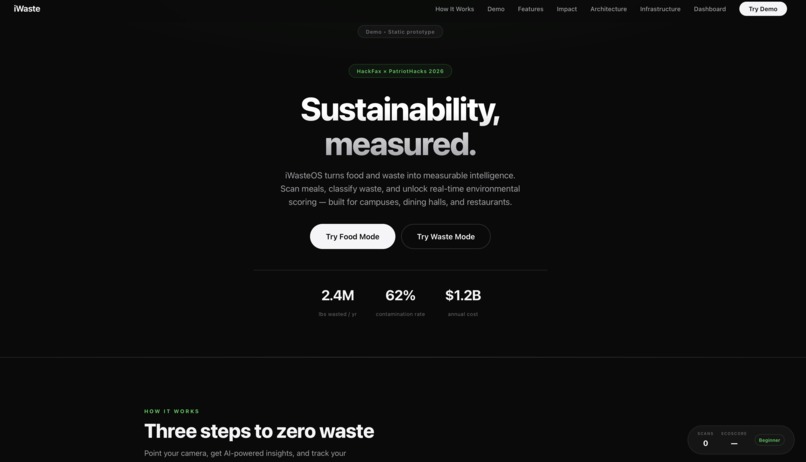
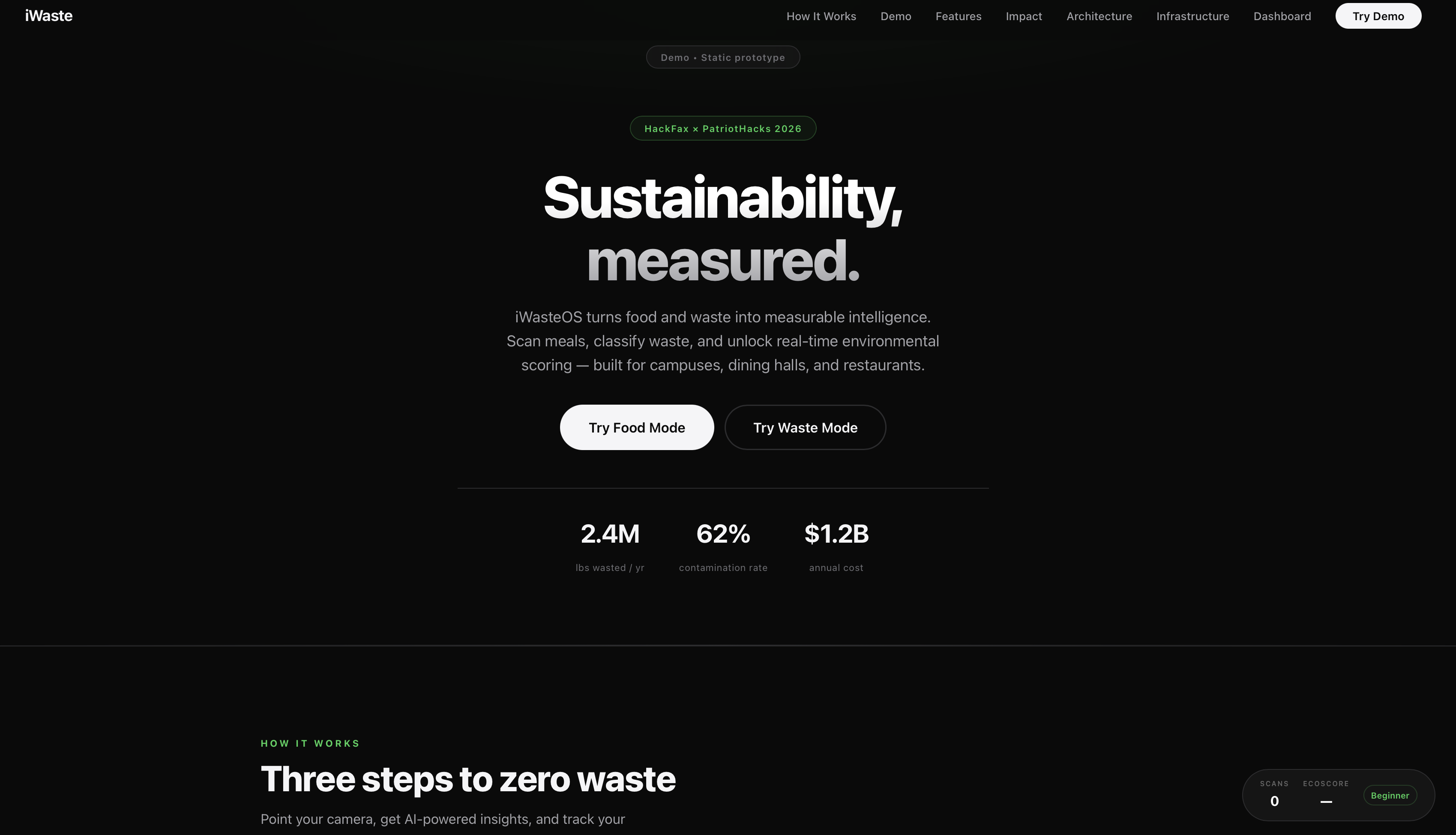
WasteOS is a camera-first sustainability platform that reduces food waste and improves sorting accuracy while creating a shared data ecosystem between users and operators. The system operates in two core modes: Food Mode allows users to scan their meal or menu to receive estimated nutritional and environmental impact metrics. After eating, users can scan leftovers to estimate food waste. Eco scores and reward multipliers are tied to consumption efficiency rather than simply participation, reinforcing responsible behavior through incentive design. Waste Mode enables users to scan an item before disposal. The platform classifies the material and recommends the appropriate bin (e.g., landfill, recycling, compost, or special handling), reducing contamination rates.
At the institutional level, anonymized aggregate data provides dining halls and restaurants with actionable operational intelligence: High-waste menu item detection, Portion optimization signals, Behavioral waste trends, Sustainability performance metrics. This creates a two-sided platform structure: Users generate behavioral data, Operators receive operational insights, Incentives align both sides.
How we built it
We built a working prototype that demonstrates the core mechanics of the platform: Camera-based food scanning flow, Waste classification assistant, Eco scoring and tier progression logic, Progressive behavioral reinforcement, Session-level analytics dashboard for operators. The architecture follows a scalable model: Frontend → API simulation layer → AI analysis → Session data store → Analytics visualization. The backend currently manages user sessions and stores interaction data at a prototype level. Image analysis services simulate food and material recognition. The interface presents environmental impact in a simplified, decision-oriented format. Due to hackathon time constraints, the focus was on demonstrating system logic, incentive structure, and platform viability rather than production-grade model accuracy.
Challenges we ran into
The primary challenge was modeling food and waste recognition within limited development time. Accurate computer vision systems require extensive datasets and training pipelines, which exceed a weekend build scope. Another challenge was designing frictionless user flows. Sustainability tools must operate within existing behavioral patterns, particularly in dining halls where time and attention are limited. We also had to balance user-facing product design with institutional analytics features, reflecting the platform’s dual-sided structure.
Accomplishments that we're proud of
We built a functioning platform prototype that connects user behavior with operational intelligence. Instead of acting as a passive tracking tool, iWasteOS demonstrates a behaviorally informed incentive system that: Encourages responsible consumption, Reduces contamination, Generates actionable institutional data. Within a constrained timeframe, we delivered: A full interaction model, Reward logic and eco-tier progression, Institutional analytics mockup, A scalable architectural framework.
What we learned
Sustainability systems must reduce cognitive load. The easier the interaction, the higher the adoption rate. We also learned that sustainability data becomes strategically valuable when it creates network effects: More users generate better behavioral data, Better data improves institutional decisions, Improved operations reduce waste at scale, Reduced waste increases user trust and participation This creates a reinforcing data flywheel between individuals and institutions. When applied responsibly, this flywheel can be directed toward measurable environmental impact. Correctly sorted waste improves recycling efficiency, reduces contamination in material streams, and enables cleaner processing methods. In some regions, properly separated waste can also be routed to controlled waste-to-energy systems, generating usable energy with lower environmental impact than unmanaged landfill decomposition. By aligning user incentives with operational efficiency, the platform transforms sustainability from passive awareness into coordinated action, supporting environmental protection, resource optimization, and long-term system resilience.
What's next for iWasteOS
Future development focuses on expanding integration depth and scaling the platform ecosystem. Planned improvements include: Restaurant menu integrations for structured sustainability metadata, Improved food recognition and portion estimation, Personalized nutrition and consumption tracking, Smart recycling bin integration, AR-assisted sorting workflows, Partnerships with campuses and restaurants. Long term, the platform could integrate with municipal recycling infrastructures and regulated waste-to-energy systems, allowing communities to reward sustainable behavior at scale while improving environmental efficiency across the network.


Log in or sign up for Devpost to join the conversation.