About IVGuard
Inspiration
IV infusion is a common part of hospital care, but small problems with an IV line can sometimes go unnoticed. A tube may become bent, the flow may slow down, the line may become blocked, or the infusion may finish. Healthcare staff have to regularly check these conditions, especially when several patients need attention at the same time.
This made us think:
«What if an IV line could continuously monitor its own condition and warn healthcare staff before a small problem becomes a bigger one?»
That idea inspired us to create IVGuard, an intelligent IV line safety and early-warning system.
What We Built
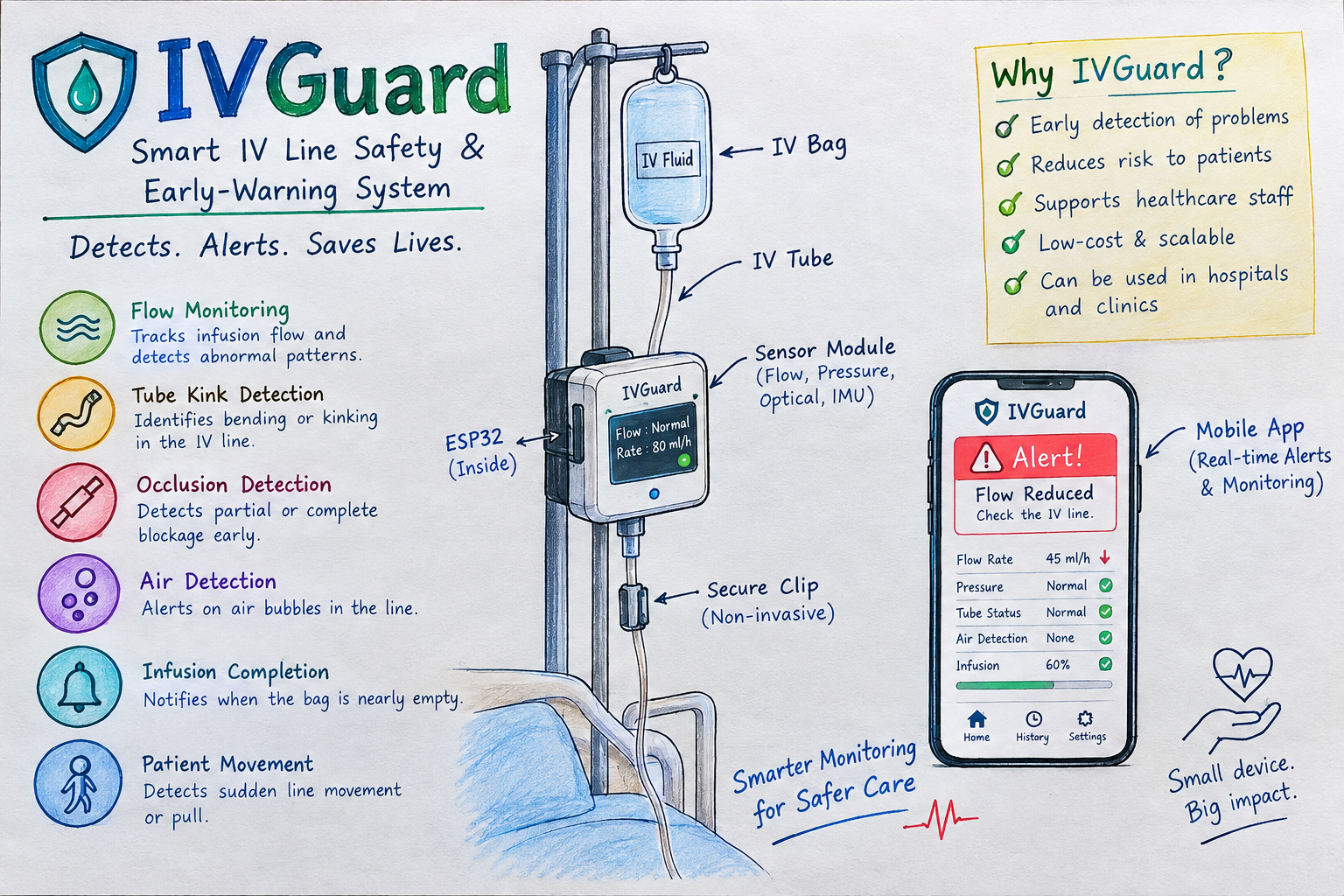
IVGuard is designed as a compact device that can be attached to an IV infusion setup. It combines sensor data to monitor the condition of the infusion in real time.
The system can identify conditions such as:
- Normal IV flow
- Reduced or abnormal flow
- Tube bending or kinking
- Possible blockage or occlusion
- Air-related abnormalities
- Completion of the infusion
- Sudden movement or disturbance of the IV line
The sensor information is processed by a microcontroller and the system provides an immediate warning when an abnormal condition is detected.
Our goal is not to replace healthcare professionals. Instead, IVGuard is designed to act as an additional safety layer that can help healthcare staff notice potential IV problems earlier.
How We Built It
The prototype consists of an IV-tube simulation setup, sensors, an ESP32 microcontroller, an alert system, and a monitoring interface.
The basic workflow is:
IV setup → Sensors → ESP32 → Data processing → Condition detection → Alert
For the prototype, we use a safe laboratory setup with water or another suitable fluid instead of connecting the system to a patient.
The system observes changes in the infusion conditions and compares the sensor readings with normal operating patterns. When an abnormal pattern is detected, the system generates an alert.
A future version could use a machine-learning model trained on different flow patterns to distinguish between normal infusion and different types of abnormalities.
What We Learned
While developing IVGuard, we learned that biomedical engineering is not only about collecting sensor data. The important part is understanding what the data means in a real healthcare situation.
We learned about:
- IV infusion and flow monitoring
- Sensors and signal acquisition
- ESP32-based embedded systems
- Real-time data processing
- IoT-based healthcare monitoring
- Basic machine-learning concepts
- Prototype development and testing
- Designing technology around real clinical needs
We also learned that a biomedical device needs to be designed with safety and reliability in mind. A prototype that works in the laboratory is not automatically ready for clinical use.
Challenges We Faced
One of our biggest challenges was detecting different IV conditions reliably. A change in flow can happen for several reasons, so simply detecting that the flow has changed is not enough.
We therefore focused on combining multiple types of information instead of depending on a single sensor.
Another challenge was creating a prototype that could demonstrate the concept safely. Since this is a hackathon prototype, we designed our testing around a simulated IV setup rather than a real patient.
We also had to balance accuracy, cost, size and simplicity. Our aim is to create a system that can eventually become compact and affordable enough to be useful in different healthcare environments.
Why IVGuard?
Existing IV monitoring approaches can focus on individual parameters such as flow or drip rate. Our project explores a broader safety approach by combining multiple indicators of an IV-line problem into one monitoring system.
The key idea behind IVGuard is simple:
«Don't wait until an IV problem becomes obvious. Monitor the warning signs continuously and alert healthcare staff early.»
IVGuard is currently a prototype and would require extensive validation, clinical testing, and regulatory approval before real-world patient use. Our hackathon goal is to demonstrate the concept and show how low-cost sensing and intelligent monitoring could add another layer of safety to IV infusion.


Log in or sign up for Devpost to join the conversation.