-
-
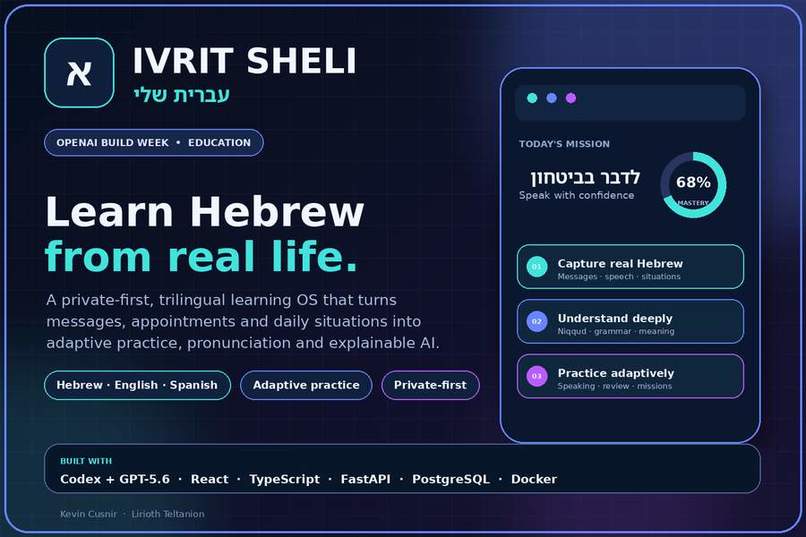
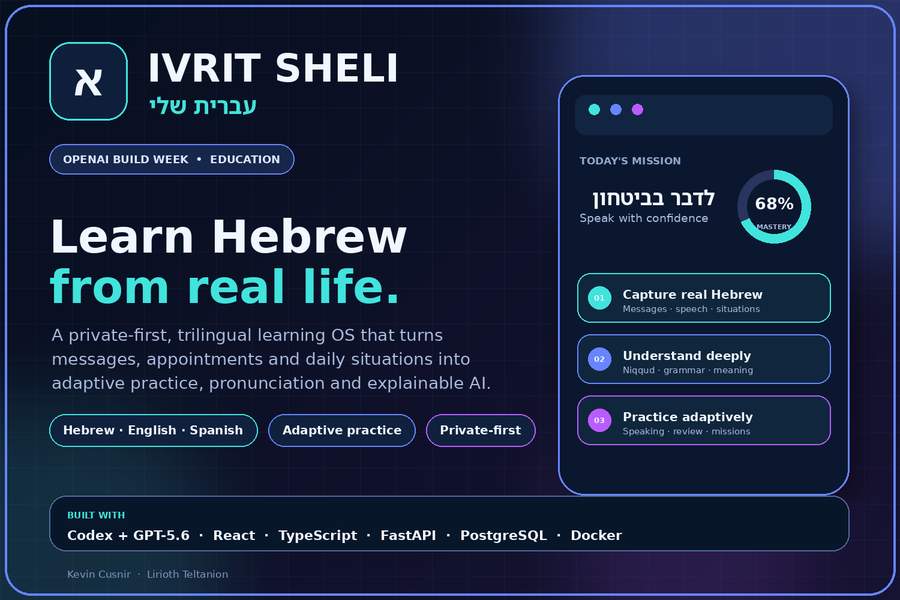
Ivrit Sheli 2.4 — illustrated onboarding, dictionary, pronunciation, adaptive progress and private persistence.
-
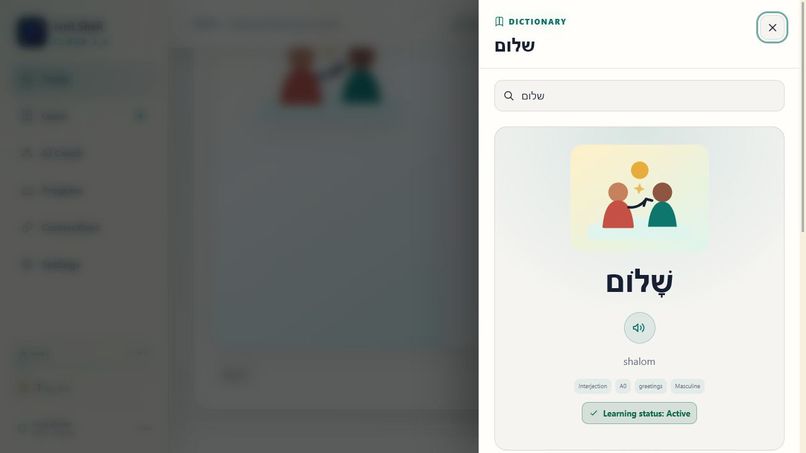
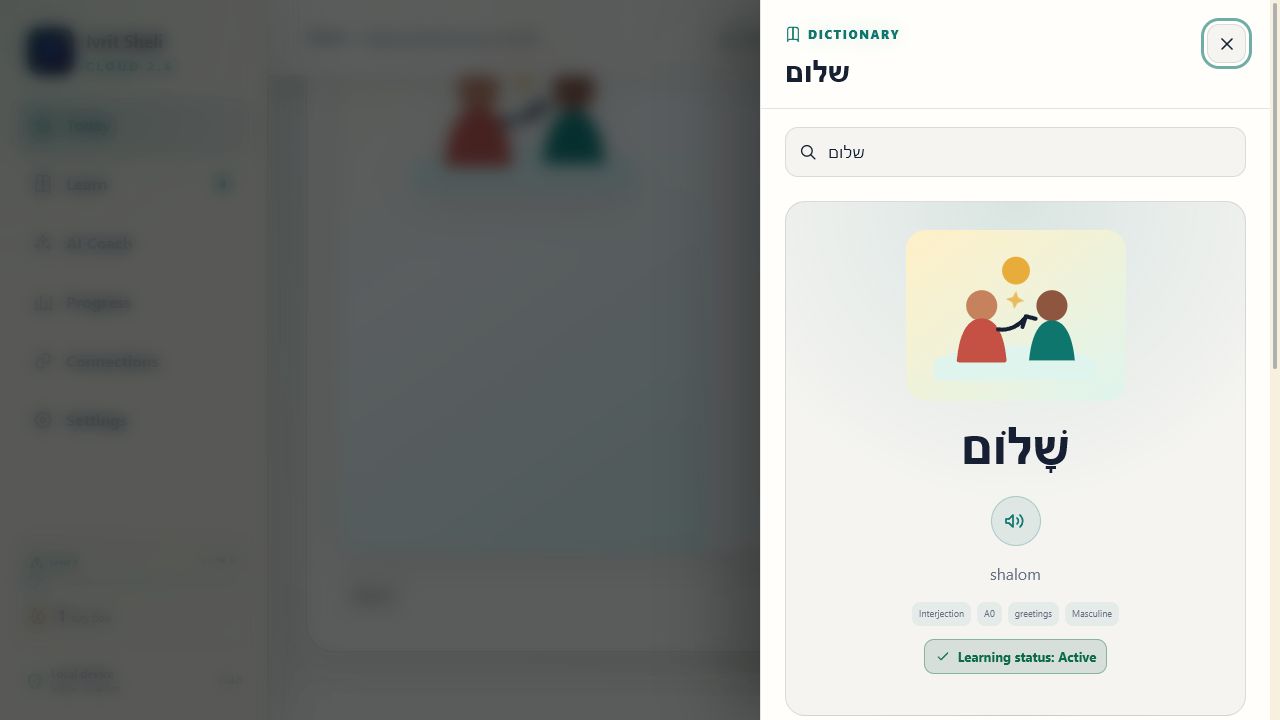
Connected visual dictionary: meaning, pronunciation, grammar, source and learning state.
-
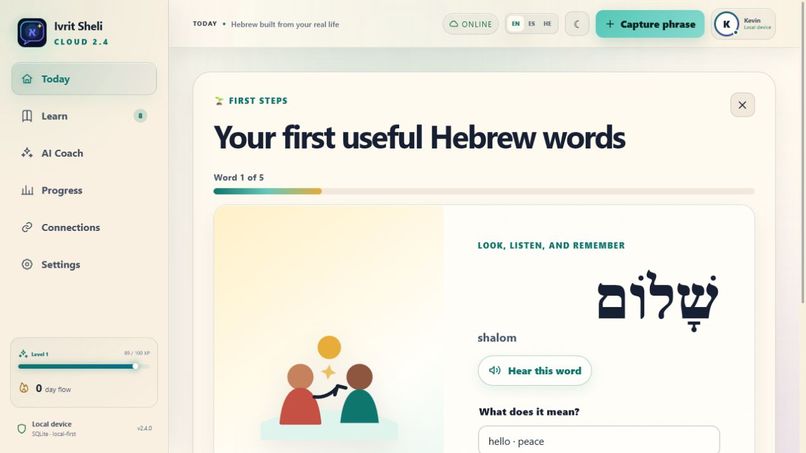
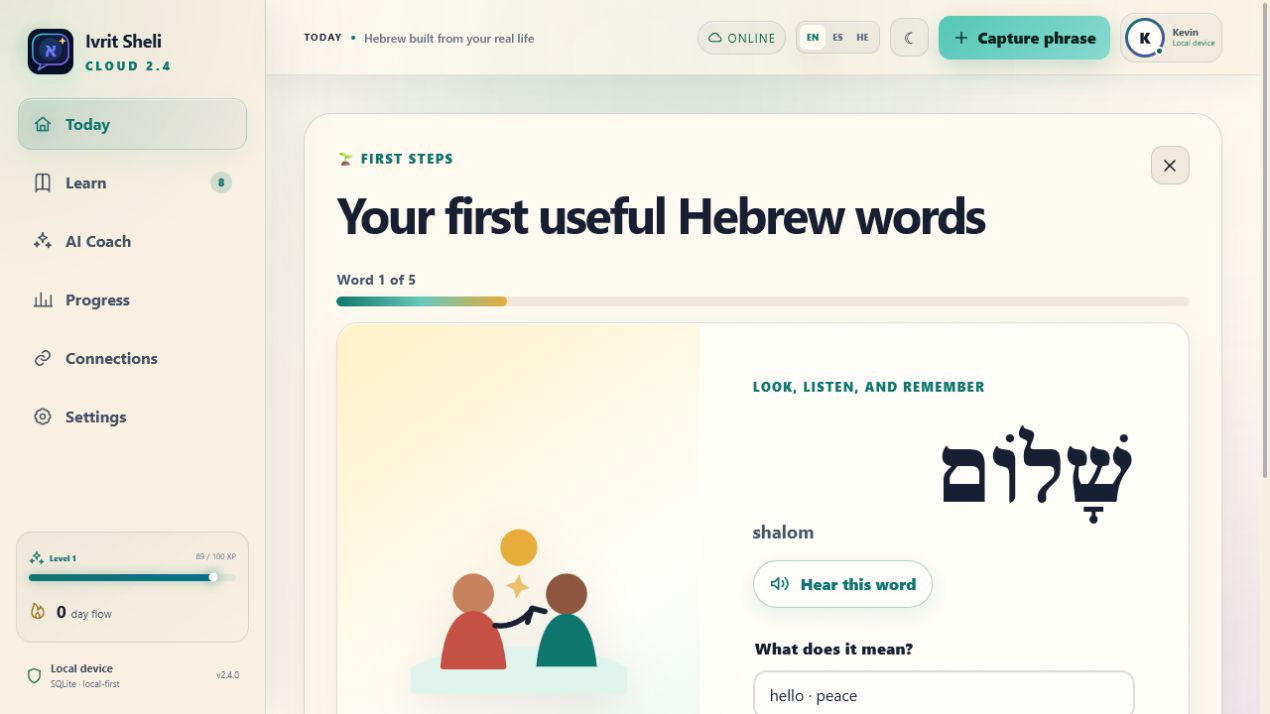
Warm First Steps: visual Hebrew, niqqud, transliteration, audio and real-life examples.
-
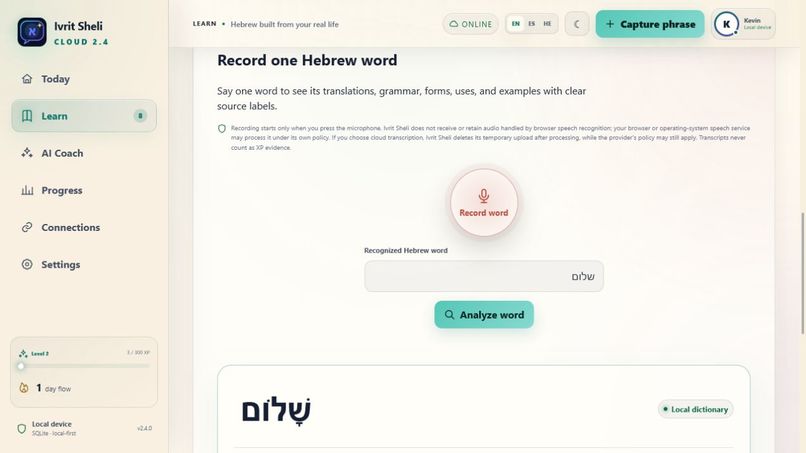
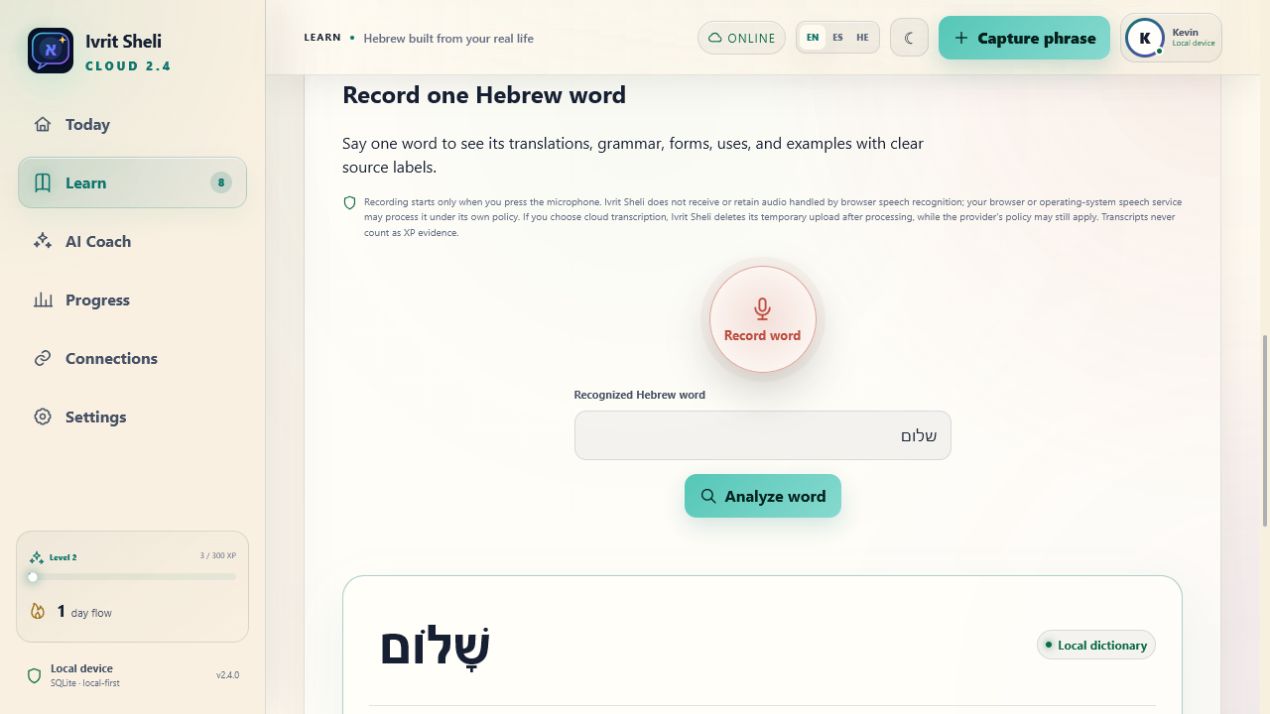
One-word intelligence: microphone or typed Hebrew with structured local analysis.
Ivrit Sheli 2.4 Contest Edition — Hebrew from the life you actually live
Ivrit Sheli — העברית שלי (“My Hebrew”) is a private-first, adaptive Hebrew-learning app built for people who need usable Hebrew in daily life, not another generic vocabulary course.
Inspiration
Moving through work, healthcare, transport, bureaucracy, messages, and everyday relationships creates urgent language needs that fixed curricula cannot predict. Hebrew adds right-to-left layout, missing niqqud, roots and binyanim, gendered forms, homographs, register, pronunciation, and mixed Hebrew/English content.
I wanted one calm place where a real word or phrase could become a complete learning journey:
- Capture what the learner actually encountered.
- Understand meaning, niqqud, transliteration, root, grammar, forms, register, examples, and provenance.
- Practice recognition, production, listening, and speaking.
- Use it in a practical real-life mission.
- Reflect and adapt using mistakes, confidence, context, and review timing.
What it does
Version 2.4 Contest Edition gives beginners a warm, illustrated path from setup to their first successful lesson. Learners choose English, Spanish, or Hebrew, set their level, goal, and daily pace, then practice five essential words with visual cues, niqqud, transliteration, audio, translations, and real examples.
Every Hebrew word connects to a source-aware visual dictionary. The pronunciation studio provides selectable masculine-style and feminine-style synthetic voices. A user-triggered microphone flow can explain one spoken, recorded, or typed Hebrew word through meanings, grammar, forms, pronunciation, uses, examples, and related vocabulary.
Saved vocabulary preserves review history and separate recognition, production, listening, and speaking mastery. Recommendations combine review urgency, demonstrated weakness, real-life relevance, learner goals, and freshness, so the learner can understand why an item appears next.
A four-stop guided judge tour explores the lesson, visual dictionary, pronunciation tools, and adaptive progress without changing shared demo data.
What is new in 2.4
- A warm, illustrated, trilingual beginner journey designed for non-technical learners.
- An English-first contest tour with accessible motion and reduced-motion support.
- A connected visual Hebrew dictionary with niqqud, transliteration, roots, grammar, bilingual meanings, examples, learning state, and source provenance.
- Masculine-style and feminine-style voice selection, playback, recording, recognition, and one-word intelligence.
- Persistent saved vocabulary, progress, XP, achievements, and explainable recommendations.
- Identity-only Google sign-in using only openid and profile—no Gmail, Drive, or Calendar access.
- Isolated PostgreSQL learner persistence in the cloud, with a complete private SQLite path for local use.
- Responsive desktop/mobile navigation, Hebrew RTL, keyboard-safe dialogs, visible focus, contrast support, and graceful degraded states.
How I built it
The frontend uses React 19, strict TypeScript, Vite, a PWA shell, custom visual components, browser Speech APIs, and MediaRecorder. The backend uses Python, FastAPI, Pydantic, SQLAlchemy, Alembic, SQLite FTS5, and PostgreSQL 17.
The cloud architecture includes OIDC/OAuth with PKCE and protected state, HMAC-hashed server-side sessions, CSRF controls, explicit tenant predicates, PostgreSQL row-level security, structured redacted logs, correlation IDs, health/version endpoints, a non-root Docker image, Railway deployment, and GitHub Actions with CodeQL.
Dictionary data is source-aware and extensible through a streaming Kaikki/Wiktionary importer. Local and cloud modes share the same learning concepts without pretending that configured external integrations are automatically verified.
How Codex and GPT-5.6 helped
I directed the problem, audience, product loop, privacy boundaries, architecture trade-offs, acceptance criteria, and release decisions. Codex with GPT-5.6 acted as my engineering partner to:
- turn the product vision into versioned, testable releases;
- implement and review frontend, backend, migrations, and deployment configuration;
- analyze security, account isolation, privacy, accessibility, and failure paths;
- diagnose Docker and Railway issues from evidence;
- create and refine automated tests;
- keep the README, architecture, release notes, test report, and live product aligned.
Ivrit Sheli also includes an optional OpenAI Responses API adapter with strict JSON Schema outputs for corrections, naturalness and register analysis, niqqud, transliteration, contextual exercises, dialogues, weekly plans, missions, and bounded recommendation support. Cloud processing is explicit and consent-gated. Selected content is bounded and redacted, and deterministic offline fallbacks keep the app useful without an API provider.
Challenges
The hardest work was not adding more screens. It was making the complete experience trustworthy:
- mixing Hebrew RTL and Latin LTR content without broken layout;
- keeping audio useful across uneven browser support;
- preventing an uncertain transcript from changing mastery or awarding XP;
- preserving exact dictionary homographs and provenance;
- making a public judge demo safe while supporting writable, account-isolated learner state;
- keeping OAuth, CSRF, sessions, database roles, Docker, migrations, and Railway deployment coherent;
- reducing a large feature set into a first journey that a beginner can understand.
Verification
The released source passes 213 unique automated tests: 151 backend and 62 frontend. The release also passes formatting/linting, strict typing, the production frontend build, dependency audits, Docker smoke checks, PostgreSQL integration checks, CI, and CodeQL.
The live Railway deployment reports version 2.4.0 and uses PostgreSQL 17 account persistence. Identity-only Google sign-in has been verified live. The public judge experience uses synthetic data and does not expose private learning history.
What I learned
I learned that adaptive education is strongest when it explains itself. A learner should know not only what to review, but why. I also learned that privacy, accessibility, and degraded-mode behavior are product features—not documentation added after the demo works.
What's next
After the contest I will test the journey with a real beginner, expand the illustrated vocabulary and real-life missions, improve pronunciation feedback without overstating transcription accuracy, run a managed backup/restore drill, verify the remaining live GitHub OAuth path, and iterate from learner feedback.
Try it
- Live app: https://ivritsheli-production.up.railway.app/?lang=en
- Source: https://github.com/LiriothTeltanion/IvritSheli
- Version 2.4 release: https://github.com/LiriothTeltanion/IvritSheli/releases/tag/v2.4.0
- Contest video: https://youtu.be/JxWyJJH87Rk
Built With
- accessibility
- alembic
- codex
- docker
- fastapi
- github-actions
- gpt-5.6
- oauth
- openai
- postgresql
- pwa
- pytest
- python
- railway
- react
- rtl
- sqlite
- typescript
- vitest


Log in or sign up for Devpost to join the conversation.