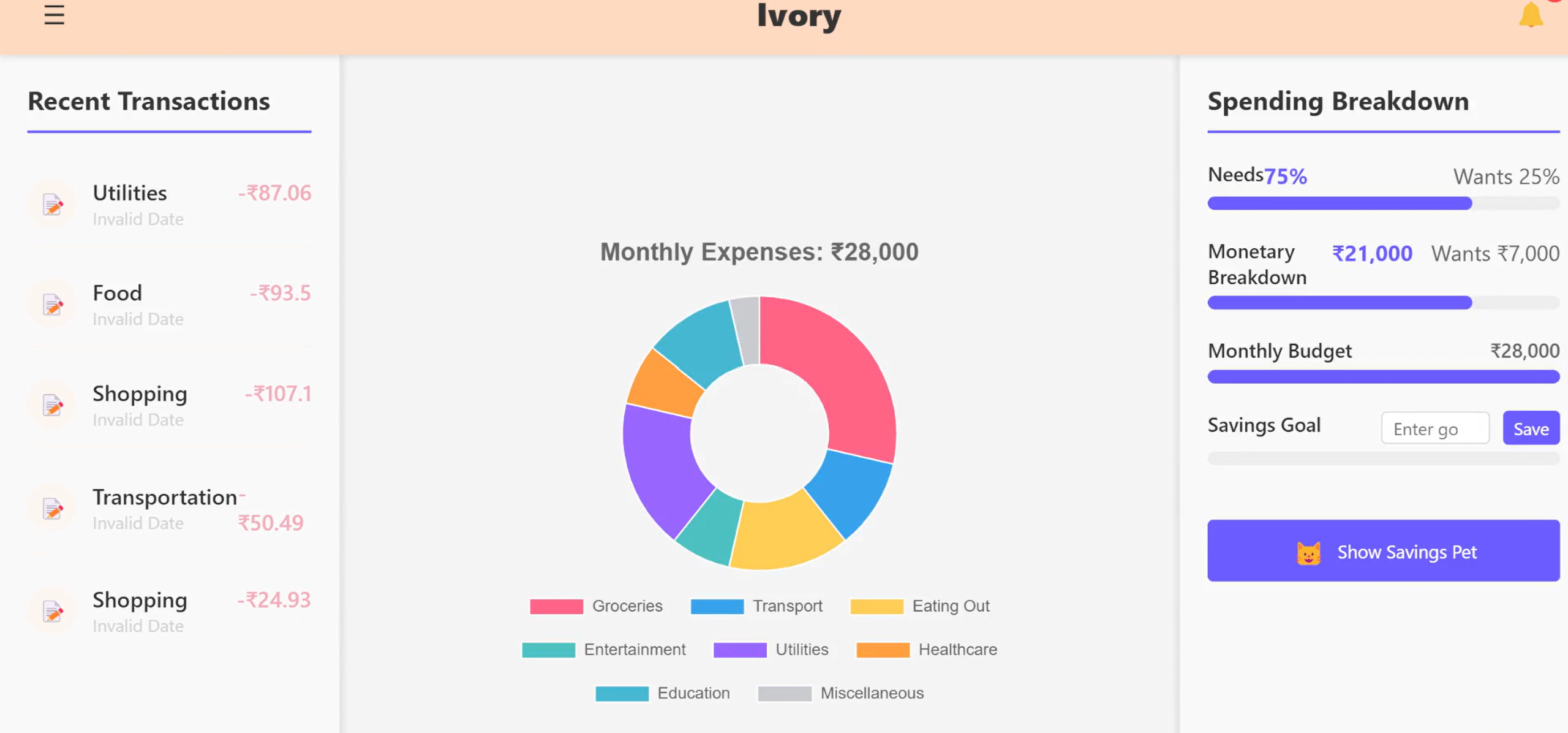
Ivory, by CodeDiggers
Inspiration
The idea for this project was born out of a common struggle — managing personal finances efficiently without getting overwhelmed by numbers, trends, and jargon. As students ourselves, we noticed how many people, especially young adults, find it difficult to make informed financial decisions due to a lack of guidance, planning tools, or time. We wanted to change that by creating a smart financial assistant — one that not only tracks expenses but also uses AI to give insightful advice, predict spending behavior, and simplify financial planning.
How We Built It
Our tech stack centered around Flask for the backend and Mockaroo for generating realistic mock financial data based on a sample dataset. Here’s a breakdown:
- Backend: Built with Flask, handling API routes, data parsing, and logic for financial insights.
- Mock Data Integration: Used Mockaroo's API to simulate financial records (e.g., transaction types, dates, vendors, amounts).
- Data Processing: Performed data cleaning, aggregation, and basic ML logic to generate suggestions or flags (like overspending, budgeting anomalies, etc.).
- AI Logic: Incorporated a simple rule-based AI model (with future plans for ML/NLP enhancements).
- Version Control: Managed using Git and GitHub for collaboration.
The project was structured in modular folders for clarity:
/data_processing//model_training//api//mock_data/
What We Learned
This project taught us a ton, including:
- Effective API integration using external data generators like Mockaroo.
- Working in a real-world Flask backend structure, beyond simple apps.
- Debugging Git merge conflicts under time pressure .
- Building cleaner and more maintainable code, with a focus on separation of concerns and scalable logic.
- Collaborating on a team project with tight deadlines and rapidly evolving scope.
Challenges We Faced
- Git merge conflicts: Early miscommunication led to conflicting changes that slowed progress, especially during critical hours.
- Data inconsistencies: Mockaroo sometimes returned data that needed additional pre-processing to be useful.
- Time constraints: Balancing feature ambition with time made us rethink scope multiple times.
- AI tuning: We initially aimed for more advanced AI features, but had to scale back to simpler rule-based logic due to time and data limitations.
What's Next?
We plan to:
- Add a frontend dashboard for visualizing insights.
- Replace rule-based logic with machine learning models trained on actual anonymized spending datasets.
- Incorporate voice/chat-based interaction using LLMs for a more intuitive assistant experience.

Log in or sign up for Devpost to join the conversation.