-
-
ITSM Process Flow
-
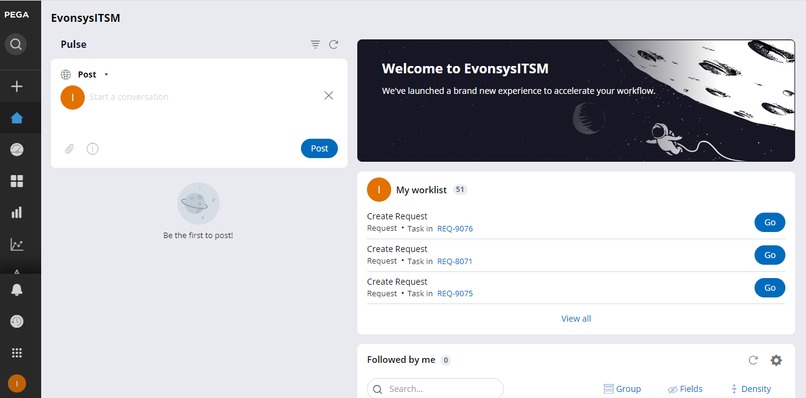
Application - Home
Inspiration
At present, the company that is represented by our team lacks a process-oriented approach to IT service management. IT engineers are daily faced with queues of requests and escalations from users, and they are finding it extremely difficult to handle them in an effective and efficient manner. Below were the key statistics that we came across, for us to determine that we are having a growing problem:
- All team members are 100% working from home across 4 different time zones due to Covid restrictions (some members working on shifts as well)
- Company size has nearly grown by 2x within last year
- Therefore, number of IT incidents and service requests have grown by 3x
- Due to complexities in setting up home work spaces
- Increased number of team members who require IT services for day-to-day work
There are many ITSM applications in the market, but being a company that specializes in PEGA based technology solutions we wanted to develop a ITSM application using the PEGA platform itself. This also minimizes the licensing cost that would have otherwise be spent on purchasing a 3rd party application. So, after careful evaluation, we decided that the perfect solution will be to introduce a companywide ITSM software solution to streamline IT management by automating key processes.
With this solution we are hoping to solve issues and complexities we experienced in these areas:
- Improve efficiency and reduce operational costs
- Reduce workload for IT engineers through effective ticket assignment
- Provide solutions to specific needs within the company
- Increased control and governance
- Better service and user experience
- Standardized process flow and documentation
- Improve collaboration within and across business functions
What it does
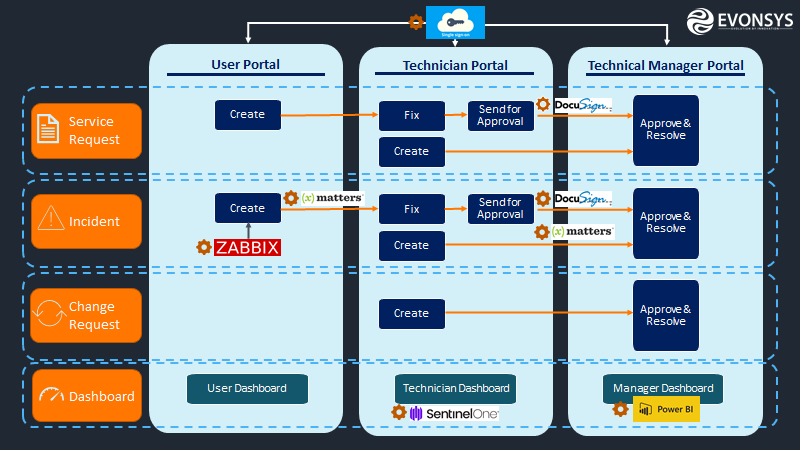
ESDesk 1.0 consists of 3 portals based on 3 different user groups. These portals are inter-connected and ensures that an IT ticket created by a user moves through the appropriate flow until it is resolved.
User Portal
A user (team member) is provided with the ability to create two types of tickets as incidents and service requests via the user portal. The user can also provide additional details via the options provided in the incident and service request forms. Also, the user can track and see the progress of any tickets created by him/her through a dashboard.
Technicians Portal
An IT engineer is provided with this portal and is able to see the incidents and requests created by users. Also, the engineer would be able to create service, incident tickets, and change request type tickets. For each of these ticket types, technicians are provided with functionalities to manage, interact and provide a better user experience. Dashboards are also available for the engineers to track and monitor progress and each of these ticket types as well as their own performance.
Technical Manager Portal
Technical manager is a user who overlooks the IT functions and has administrative access. These users will be able to supersede actions by customers and technicians. Also, technical managers have access to enhanced dashboard functions to overlook progress of tickets and engineer performance.
To summarize below are some of the key features:
- Ability to create multiple ticket types such as service requests, incidents and change requests.
- Track, manage and interact via functions available in each of the automated flows available in these ticket types.
- Dashboards for each user group to track and monitor performance, activity and security threats.
- Predictive search function which suggests users with appropriate reference titles for service requests, when entering a keyword in the title area. This feature helps in increasing the selection of the titles accurately and providing the solutions faster.
How we built it
ESDesk 1.0 has been built on PEGA Platform version 8.5 by leveraging multiple out of the box features and other integrations.
Following are the key integrations:
- PEGA Mash-up – People HCM (internal HRMS) is an application that is used currently within our company for HR functions. We have been able to embed the PEGA application within this, so that the IT services are accessible to each user in the company.
- Single sign-on – If a user is logged into the HRMS available in our company, they will be able to login to their respective portal without signing in again through the HRMS dashboard.
- Zabbix – When an alert is created, an incident will be created automatically and will be able to be tracked.
- xMatters APIs – ‘On Call’ API available in xMatters has been integrated so that users are able to see the engineers who are available and in their shift
- Docusign – This is an integration which allows to create and manage electronic agreements. By integrating this within the flow of the tickets, once a ticket is about to get resolved user agreement can be obtained to ensure completion by sending the contracts for signature from the service desk itself.
- Power BI dashboards– We have integrated a dashboard view with the Technical Manager portal using Power BI, so that admin level users are able to view and track progress related to ticket and performance of engineers.
- SentinelOne – This endpoint security software has been integrated with the Technicians portal to show the virus alerts through a separate dashboard
Challenges we ran into
- With limited time availability, gathering the requirements and engaging in development has been the key challenge.
- There were many complexities which were encountered while handling integrations for the application and some ideas had to be scrapped due to limited time and issues.
- Adding attachments through Sharepoint integration was another area which was targeted. Due to issues encountered help was requested from PEGA team. But within the time frame of the Hackathon we were unable to collaborate and get this issue resolved.
- Due to integration with many external API services, there was a learning curve involved for each team member.
Accomplishments that we're proud of
- Due to the Covid situation, team has been working remotely. There are team members from 3 different countries and time zones, and team has been able to sync-up regularly and keep the momentum.
- All team members have been able to dedicate adequate time while working part-time on this project, amidst having other work priorities.
- We have been able to quickly identify a growing issue, gather requirements and provide a solution which can be presented for the hackathon.
- We have been able to integrate this application with multiple other functionalities outside of PEGA platform to enhance it’s capabilities.
What we learned
Majority of the integrations that we have included as well as tried, was done for the first-time and it has been an entirely new learning experience. It required the team to work with multiple stakeholders and get issues resolved while self-learning.
We also found new ways to work collaboratively and maximize our output. While having regular meeting using MS Teams and documenting and tracking our requirements via Agile Studio we have been able to improve the way we collaborate and radiate information.
What's next for ITSM
This is an initial version of ITSM and only provides features which were the highest priority to implement. We are planning to add other functionalities such as other ticket categories, external vendor involvement, abilities to create and manage projects and deeper integration with Predictive Studio.
Overall, upon completion this application will be introduced within our company to replace existing systems. We are also planning to provide this application in PEGA marketplace, since currently there is no such ITSM application built on PEGA platform available.


Log in or sign up for Devpost to join the conversation.