-
-
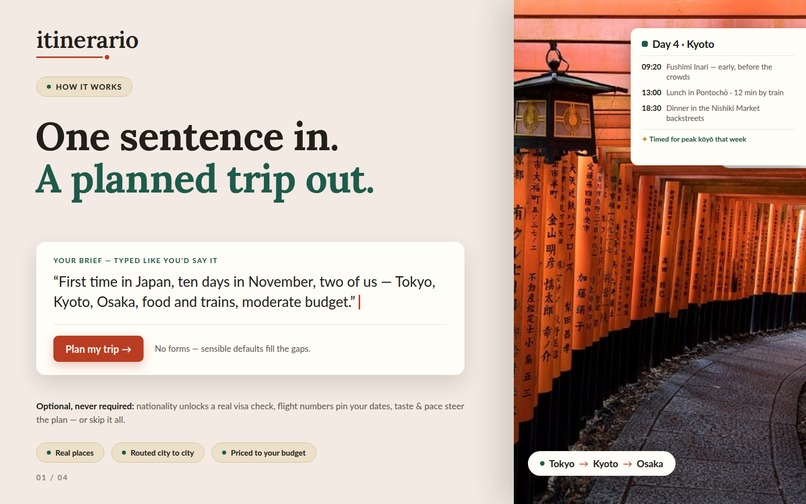
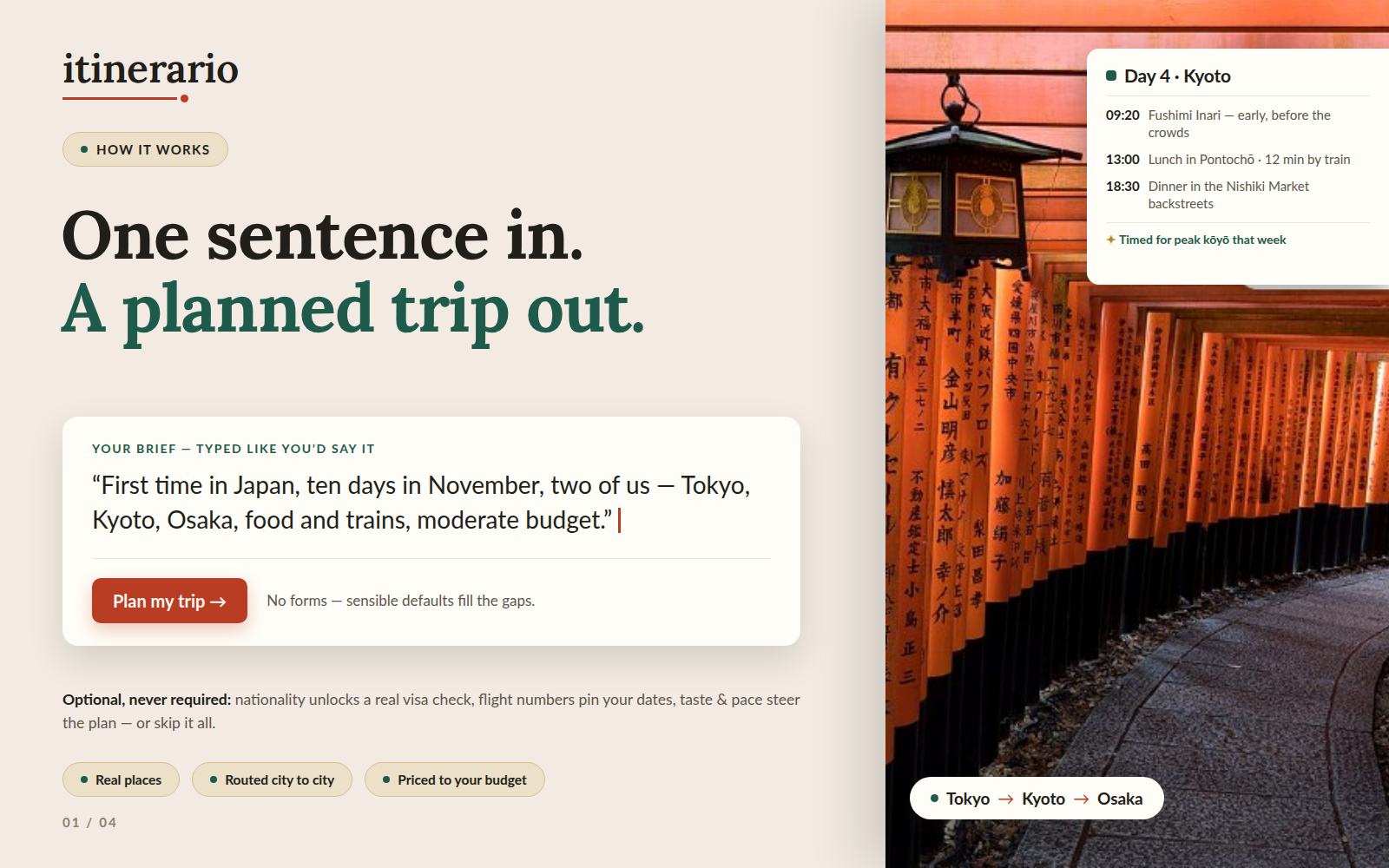
One sentence in — a real, routed, budget-matched day-by-day itinerary out. No forms required.
-
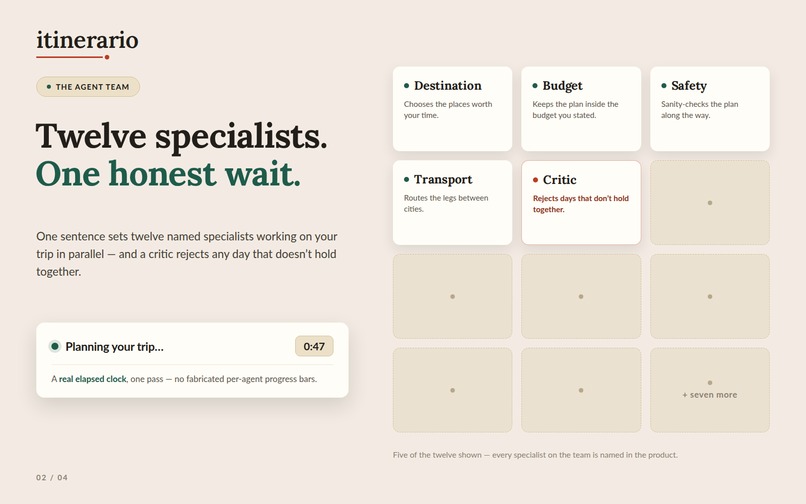
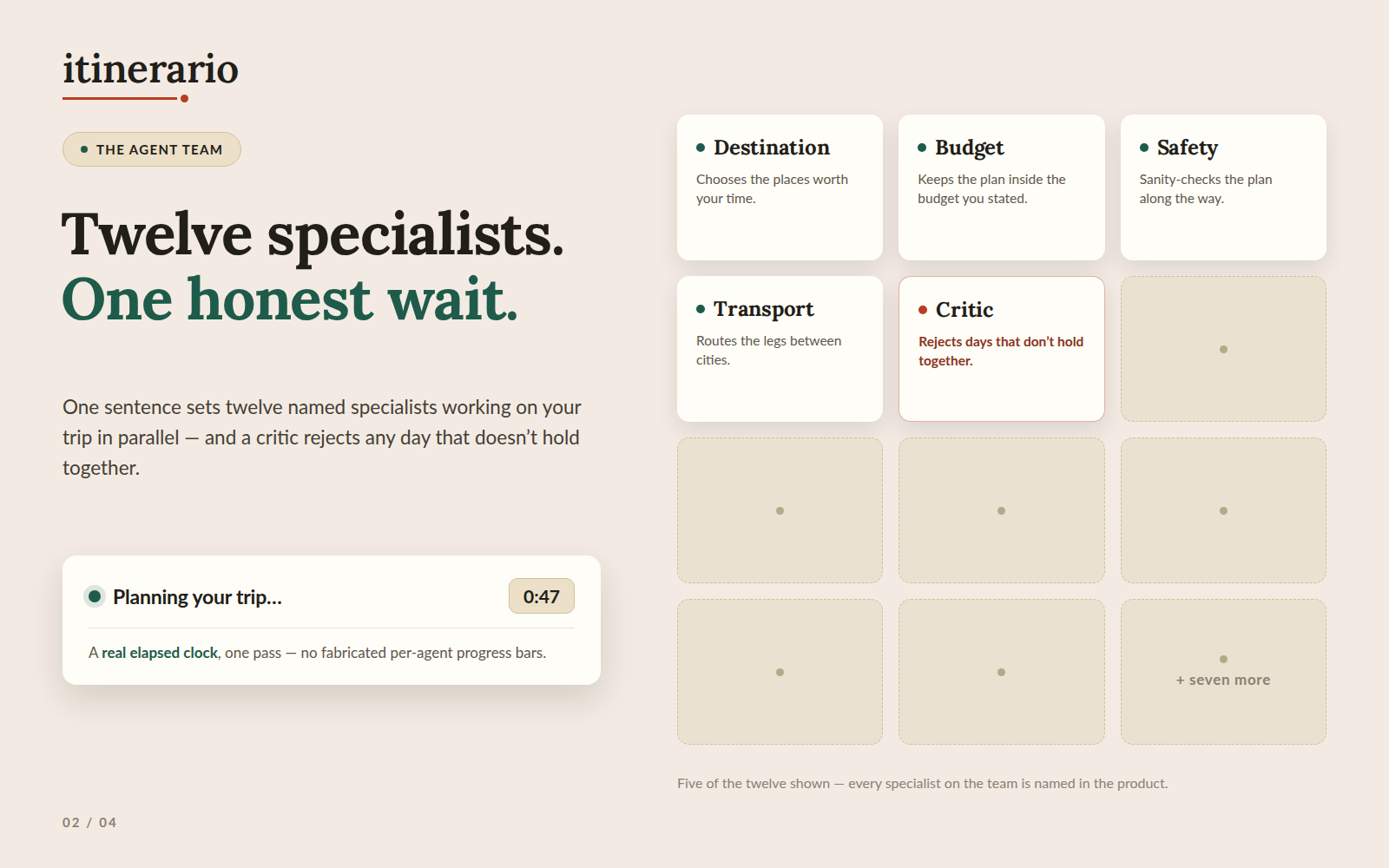
Twelve named specialist agents work in parallel, shown with one honest elapsed-time wait — no fabricated progress bars.
-
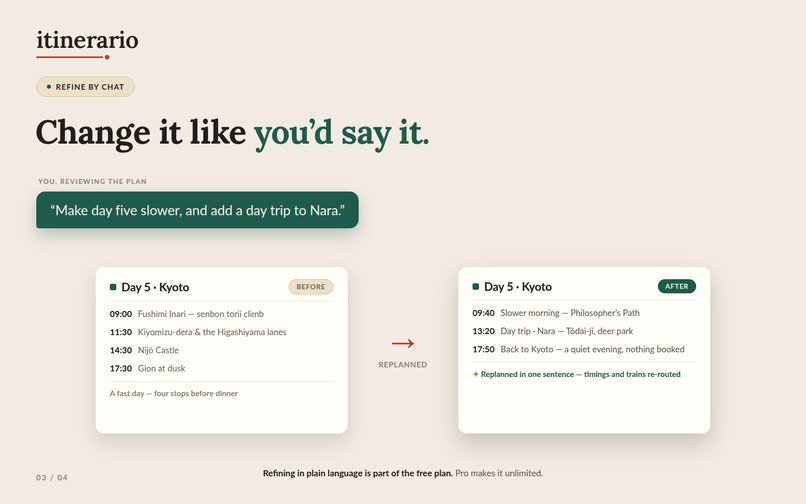
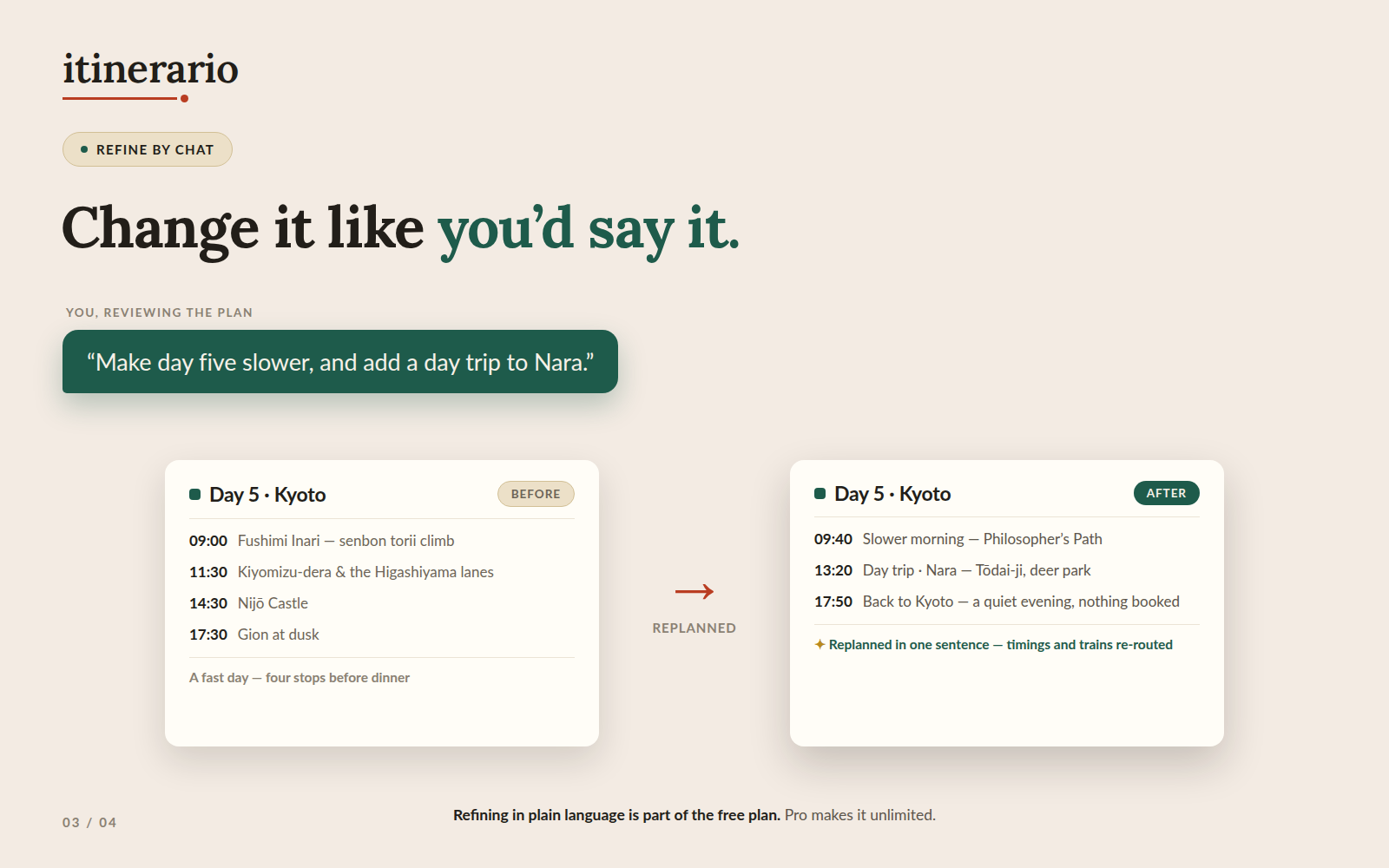
Refine your itinerary by chatting in plain language, and it replans around exactly what you asked for.
-
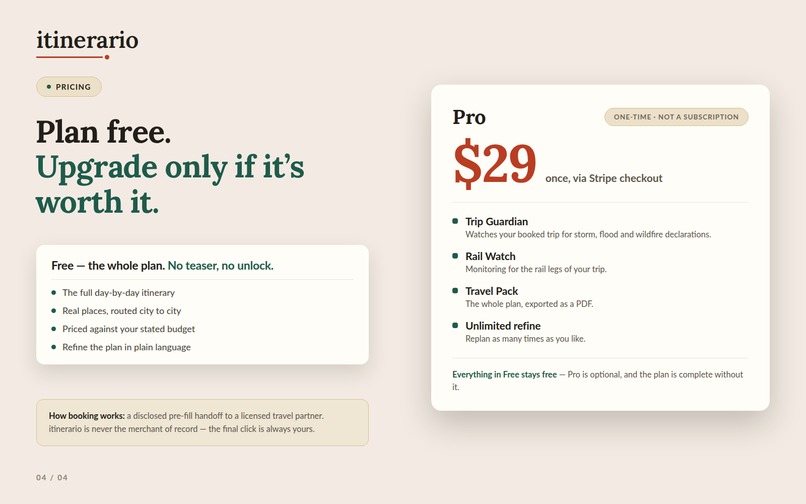
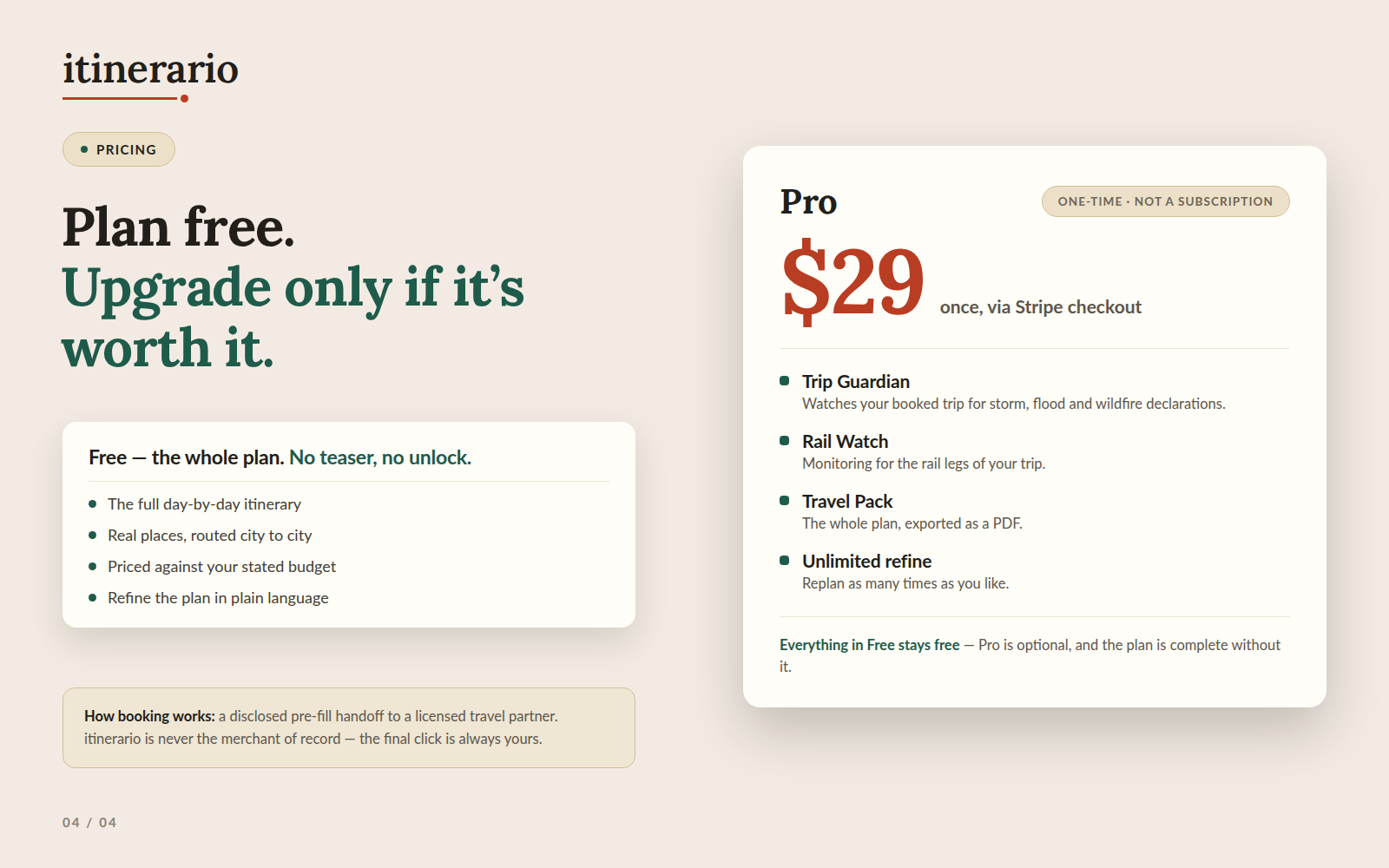
Plan free, always. Pro is a one-time $29 upgrade — never a subscription — for extra trip-monitoring features.
Inspiration
Two real, anonymized travel derailments motivated this project. One traveler's flight-dependent itinerary cascaded through two cancellations into a lost tour day and a forced new ticket. Another insured their rental car but not weather disruption, then lost days to an uninsured, weather-cancelled cascade. In both cases, the plan itself wasn't the problem — the plan looked fine on paper. What failed was everything downstream of the plan: nobody had checked whether the itinerary could actually survive contact with reality.
AI itineraries are a commodity now — judges have seen ten this week, and so have we. ChatGPT and Gemini will happily plan a trip. What none of them do is hold themselves to the plan. They hand it back and say "verify this yourself," because an LLM that is its own only judge can't be trusted to catch its own mistakes. We built the opposite: a system where the safety checks live outside the model, so a wrong answer can't just talk its way past them.
What it does
You type one sentence — "first time in Japan, ten days in November, two of us, Tokyo, Kyoto, Osaka, food and trains, moderate budget" — and a society of specialist AI agents (destination, budget, safety, transport, and more, with a critic that rejects any day that doesn't hold together) turns it into a real, day-by-day, city-routed, budget-matched itinerary. No forms required — nationality unlocks a real visa check, flight numbers pin your dates, but you can skip all of it and sensible defaults fill the gaps.
Don't like a day? Say so in plain language — "make day five slower, add a day trip to Nara" — and it replans around exactly that, no menus, no forms.
The whole plan is free, with no teaser and no unlock. Pro is a $29 one-time purchase (not a subscription — trip planning is episodic, a handful of times a year, not a monthly habit) that adds Trip Guardian (storm/flood/wildfire watch on your booked trip), Rail Watch, a Travel Pack PDF export, and unlimited refine. Booking itself is a disclosed pre-fill handoff to an already-licensed OTA partner — itinerario is never the merchant of record, and the final click is always yours.
How we built it
The core insight: structure, not a bigger model, is what makes AI-generated advice trustworthy. A single LLM agent is non-deterministic — the same model can nail a trip today and flake on the identical trip tomorrow. So we split the system in two: a reasoning layer that plans and negotiates, and a set of deterministic checks — budget limits, risk and compliance gates, a critic that re-verifies every plan — sitting outside the model where they can't be talked past.
Google's Gemini plays two real roles: keeping our destination data current, and generating the natural-language summary a user reads after each plan is built. Both are genuine, working integrations in the deployed product.
We validated the approach with internal testing: the structured, multi-agent architecture produces reliably complete itineraries where a single unstructured agent measurably doesn't — that reliability gap is what makes the product
Challenges we ran into
The honest one first: revenue to date is $0, and we're saying that plainly rather than dressing it up. Two real reasons. Internal auditing surfaced correctness issues in how we understand free-text trip requests that would have produced wrong itineraries for paying users, and we fixed them before opening to real traffic rather than shipping broken and hoping nobody noticed. Separately, legal review of our privacy and data-handling practices took real calendar time before we could responsibly take real user payments. The revenue mechanism itself is built and tested; it simply hasn't run against real traffic long enough within the window to report a number above zero.
The other real challenge was a business decision, not a technical one: an earlier version of the product let the agent society hold and spend money autonomously. We deliberately retired that capability rather than take on the licensing and compliance burden it would take to run it for real. That underlying architecture is still real and load-bearing for the advisory product today — it's just not wired to autonomous settlement, and we'd rather say that outright than let the product imply something it doesn't do.
Security was a challenge we treated as core product work, not an afterthought. Because the product handles real payments and real personal trip data, we took a security-first approach throughout: genuine anti-automation protections around our planning pipeline, and a dedicated, hardened identity system kept separate from the rest of the application to protect user accounts and data. Building that discipline in from the start, rather than bolting it on later, was its own real engineering investment.
What we learned
The clearest lesson: a moat built on structure is a business-model choice, not just an engineering one. Any general assistant can ship a basic trip-planning mode quickly — several already have. What none of them can ship that fast is a guarantee, because a guarantee means taking the LLM off the final decision, and that's an architectural commitment, not a prompt tweak. We also learned that honesty compounds — every place we chose to disclose a limitation plainly, like the $0 revenue and the retired autonomous-booking flow, turned out to be a place a skeptical reviewer would have found anyway, and it's far better to get there first.
Built With
- alibaba-dashscope
- ap2
- caddy
- docker
- gcp
- go
- google-gemini-api
- google-places
- google-search-grounding
- node.js
- postgresql
- python
- qwen
- rfc-9421
- sqlite
- svelte
- systemd
- typescript
- vertex-ai
- vite

Log in or sign up for Devpost to join the conversation.