-
-
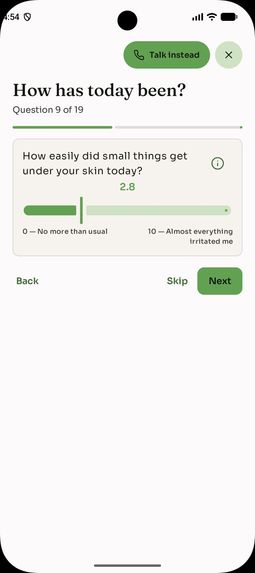
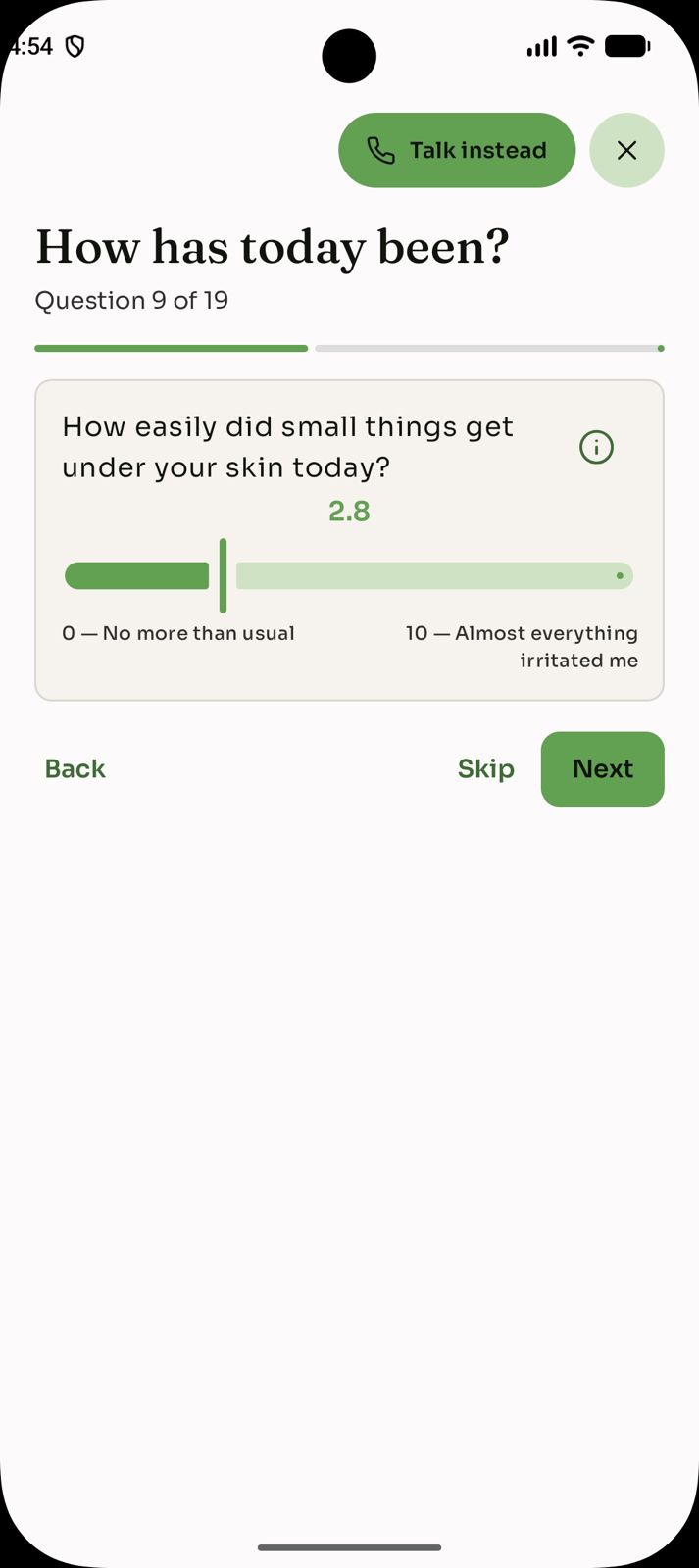
Mobile screen showing a rating slider question assessing daily irritability with options to skip, go back, or switch to voice check-in.
-
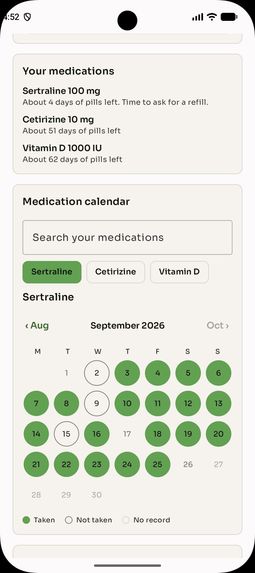
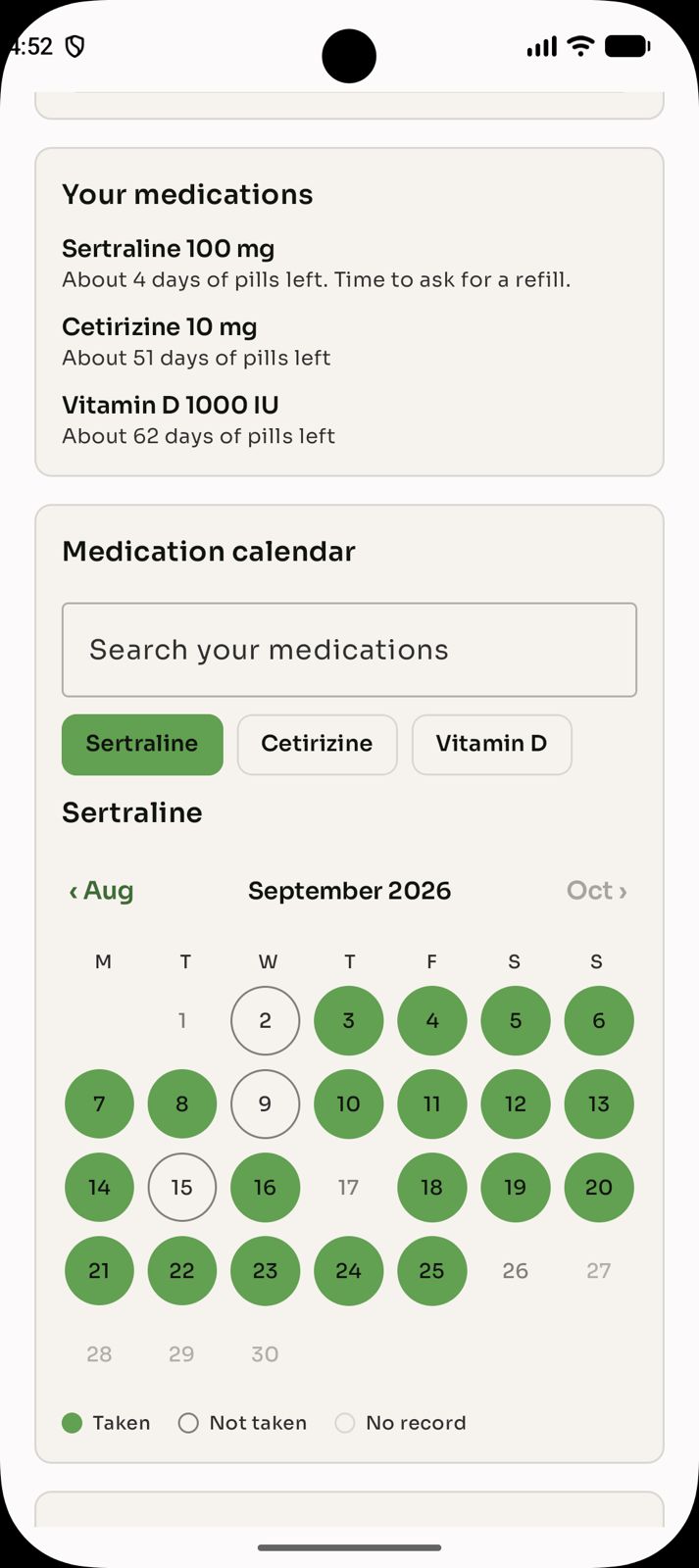
Mobile screen showing active prescriptions with supply counts alongside a monthly calendar tracking daily medication adherence.
-
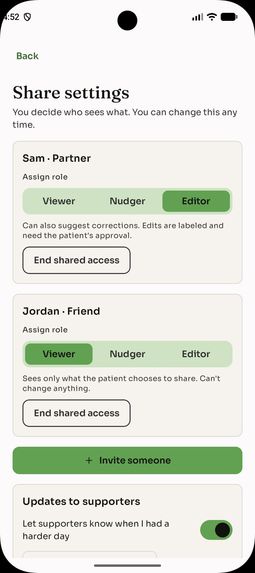
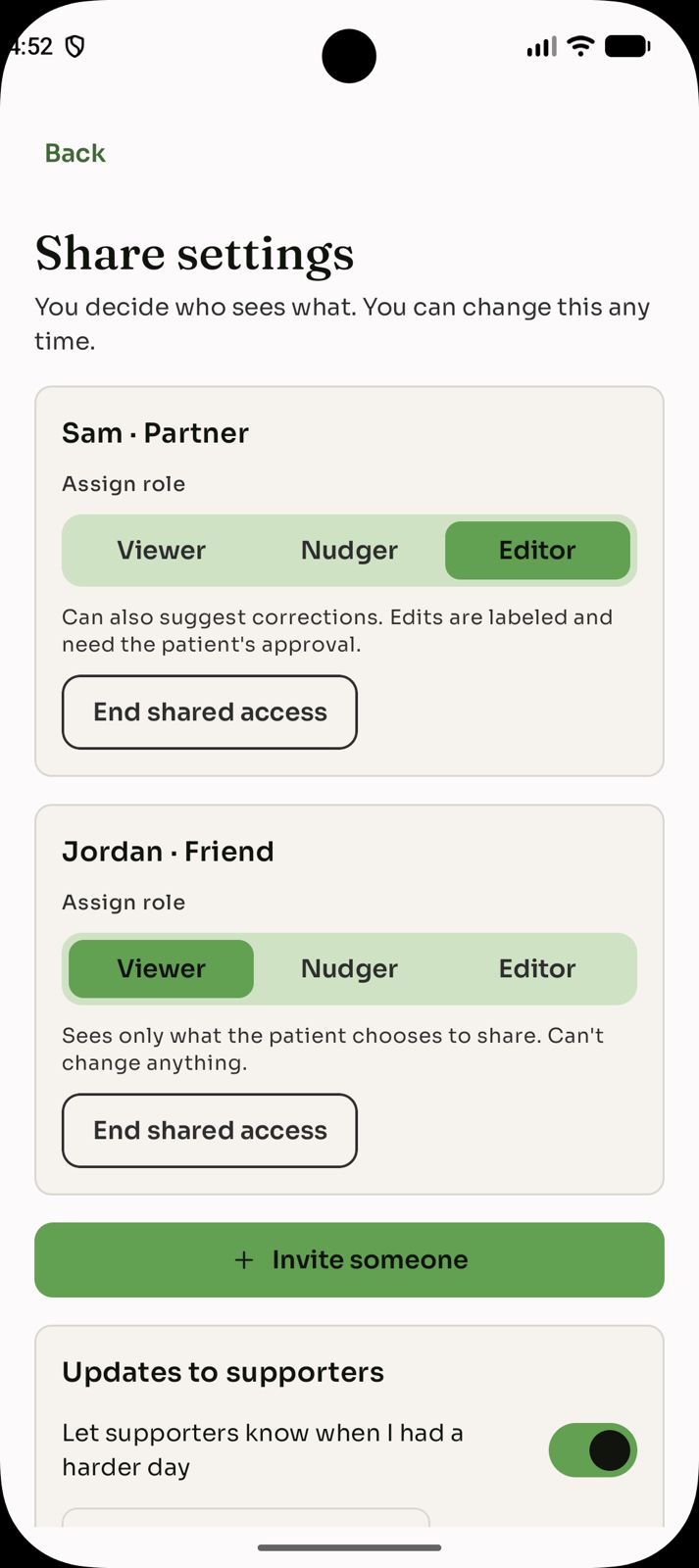
Mobile screen showing role assignment options like Viewer, Nudger, and Editor for sharing health updates with trusted supporters.
-
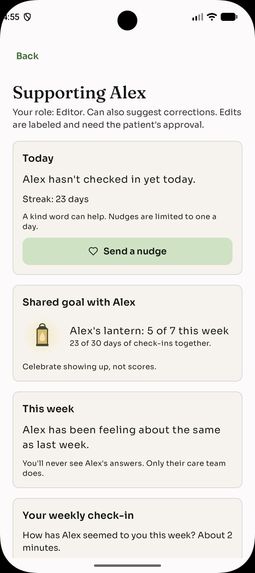
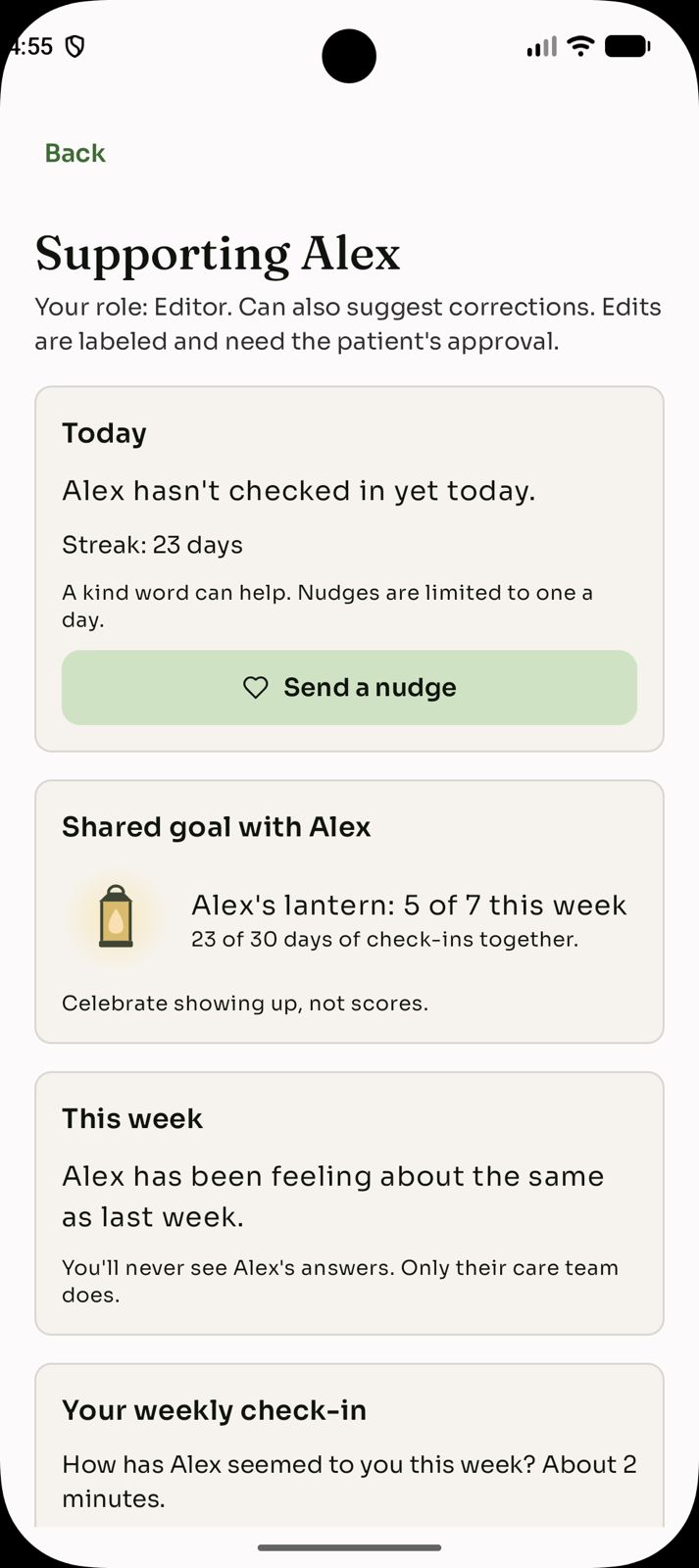
Mobile screen displaying a patient's check-in streak, shared lantern goals, and high-level weekly progress summaries for supporters.
-
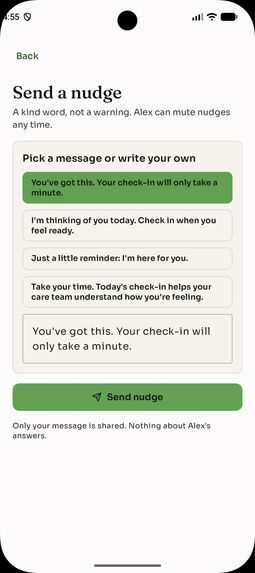
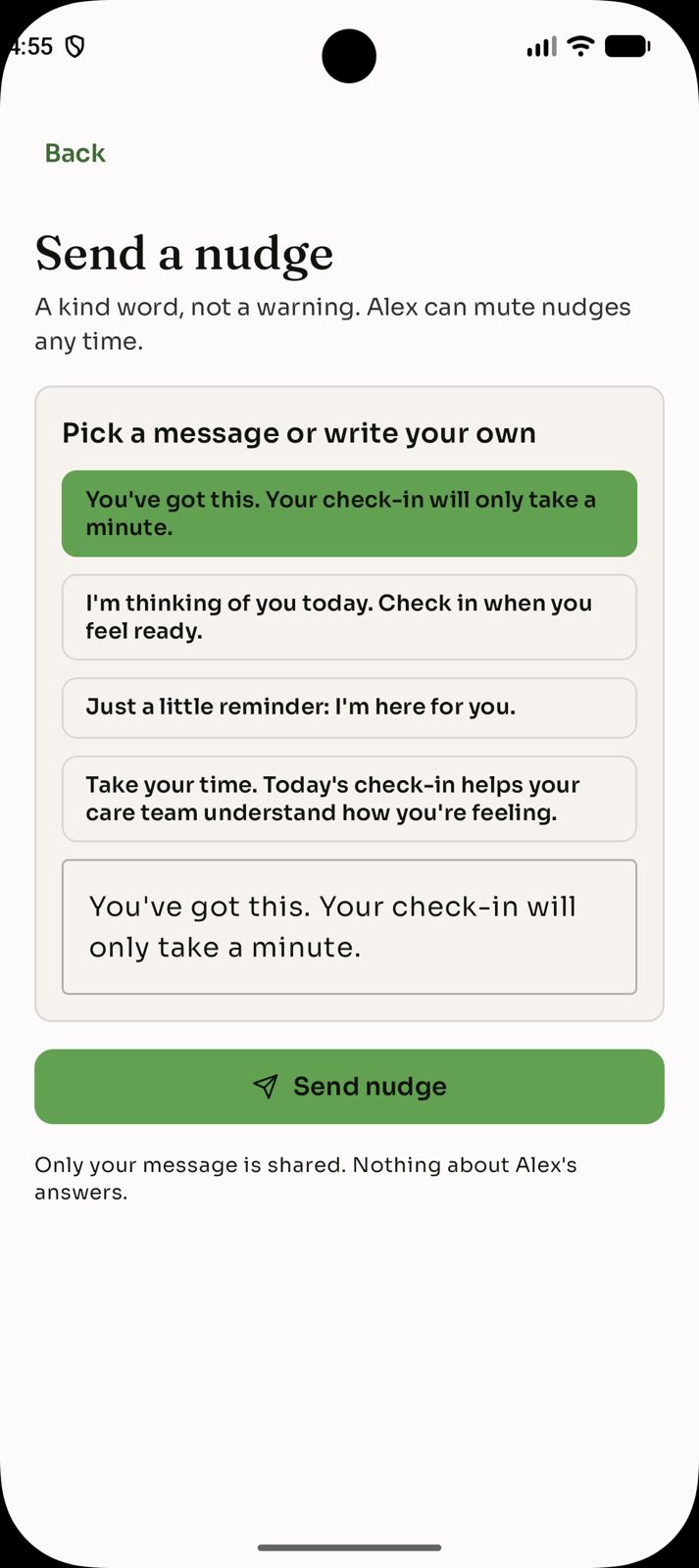
Mobile screen with preset supportive messages for supporters to send friendly check-in reminders without viewing private patient data.
-
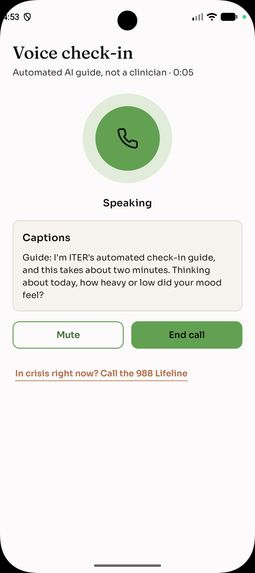
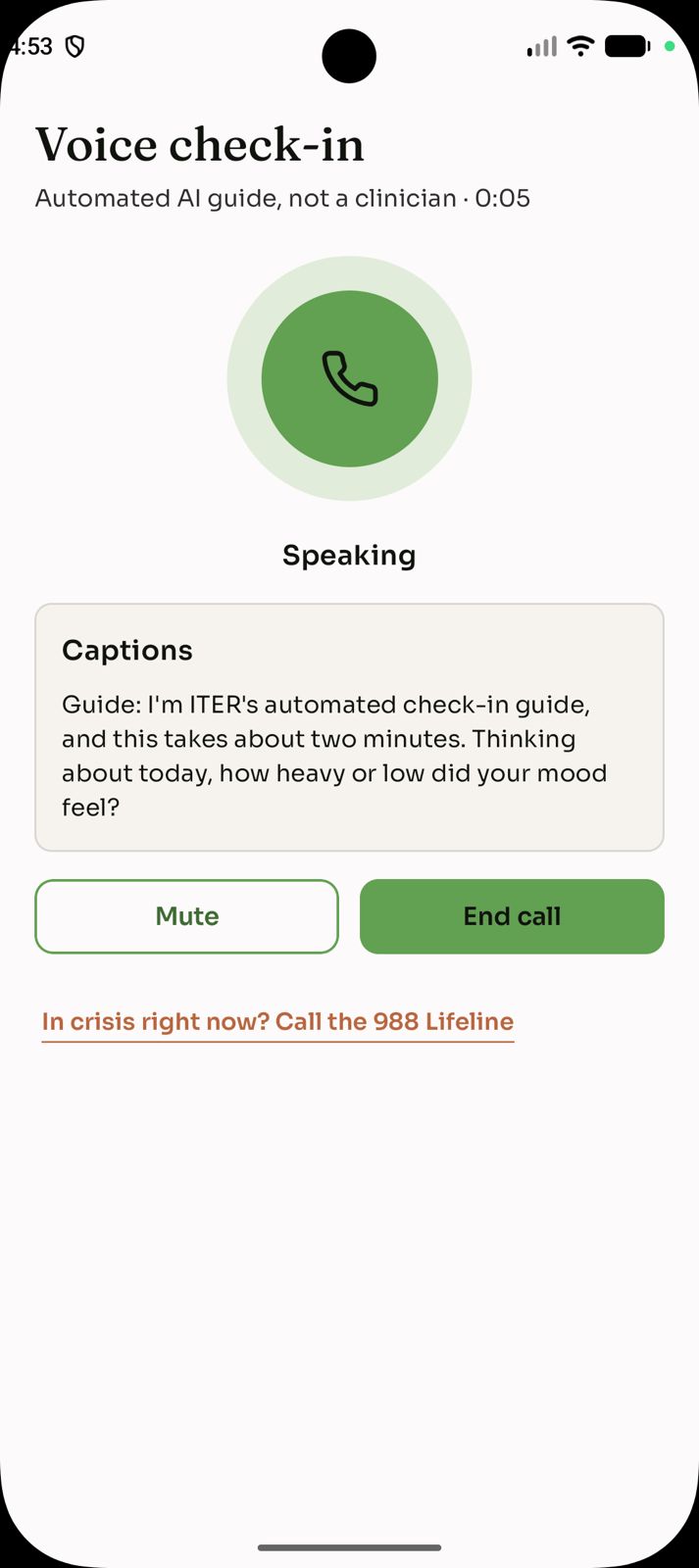
Mobile screen depicting an active voice call survey with automated AI captions asking about mood levels + an option to call the 988 Lifeline
-
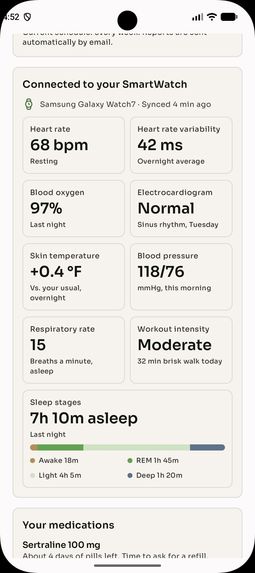
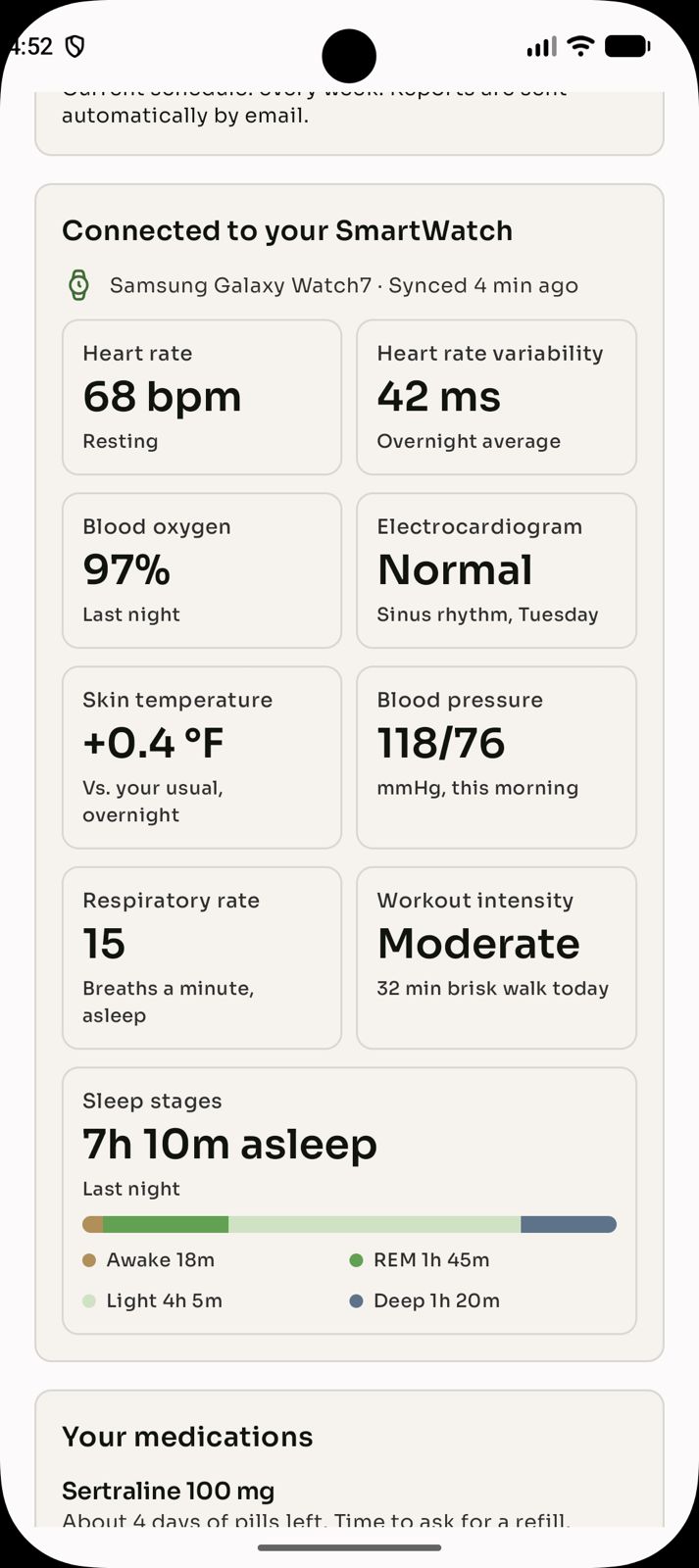
Mobile screen with health metrics synced from a smartwatch, like resting heart rate, sleep records, blood pressure, + blood oxygen levels.
-
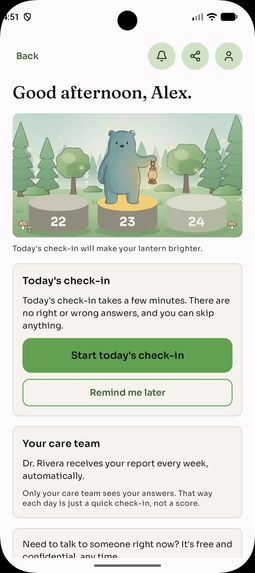
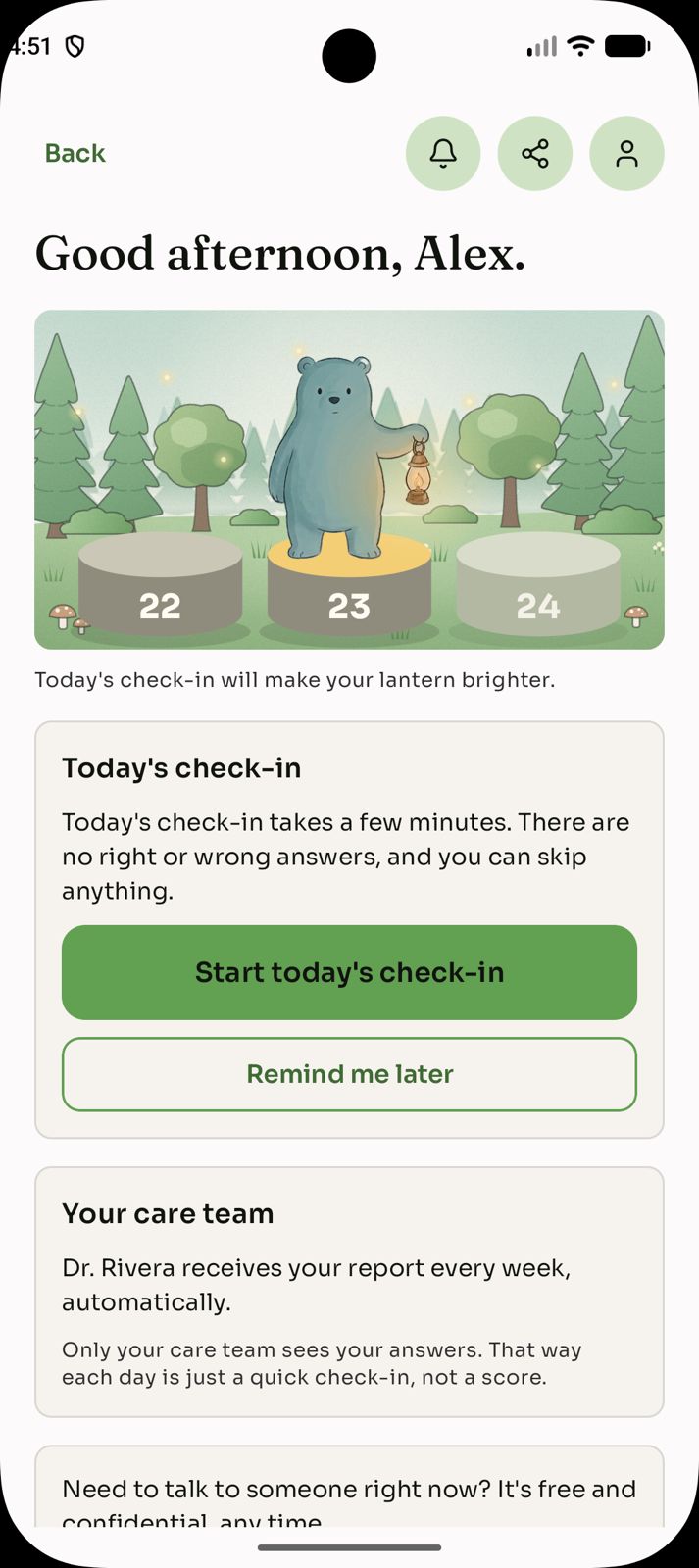
Mobile screen featuring a streak lantern graphic, check-in prompts, and care team sharing confirmation for automated weekly reports.
Video
Note that YouTube automatically reduces the video quality. Please go to settings to set it to 1080p60.
Version with subtitles integrated (accessible demo version): Open here
Version without subtitles: Open here
Inspiration
Medication response, especially for mental disorders and chronic diseases, is highly individual, but treatment decisions often rely on infrequent appointments and patient recall of past symptoms. ITER was created to provide clinicians with structured data collected between more accessible reports.
What it does
ITER monitors treatment response through short daily check-ins covering mood, anxiety, sleep, energy, adherence, side effects, and physical health.
Patients can respond through a written interface or an AI voice call. The platform analyzes changes over time and generates clinician reports with trends, medication events, and source-linked observations.
Its core differentiator is the AI Care Bridge, which converts one signal into three permission-based outputs:
- Clinician: Detailed analysis linked to dates, dosage changes, and source responses.
- Supporter: A redacted, practical suggestion based on patient-defined permissions.
- Patient: A supportive acknowledgment without scores or clinical conclusions.
A consent-based nudging system lets trusted supporters send reminders, contribute observations, and participate in shared consistency goals.
How we built it
ITER is organized around four structured data layers:
- Baseline Assessment: medical history, medication history, family history, symptoms, and initial measurements.
- Daily Check-In: patient-reported outcomes, adherence, side effects, and optional notes.
- Weekly Report: longitudinal trends, medication events, missing data, and AI-generated observations.
- Sharing Settings: field-level permissions for clinicians, supporters, and researchers.
The AI analysis pipeline processes structured check-in data and identifies correlations around medication starts, dosage changes, adherence, and symptom variation. Each output links back to its underlying dates and responses.
The AI Care Bridge applies audience-specific prompt templates and redaction rules to the same Weekly Report. Sharing Settings and Notification Detail determine what each role can receive.
The voice interface provides an alternative survey input method. Responses are converted into the same structured format as written submissions, allowing both channels to use one analysis pipeline.
Challenges we ran into
The main technical challenge was preventing cross-role data leakage while keeping each output useful. We addressed this with explicit permission boundaries, separate prompt templates, and structured outputs rather than a shared summary.
Other challenges included:
- Separating correlation from causation in AI-generated analysis.
- Preserving original patient responses for clinical verification.
- Handling missing or inconsistent daily data.
- Designing adaptive surveys without introducing leading questions.
- Supporting engagement without punitive streaks or intrusive notifications.
- Defining escalation behavior without implying continuous clinical monitoring.
Accomplishments that we're proud of
The AI Care Bridge demonstrates role-based interpretation of a single healthcare dataset while preserving consent and privacy boundaries.
We also created a channel-independent survey model: written and voice responses generate the same normalized data, reports, and visualizations.
Every AI observation remains traceable to its source data. Supporter observations are stored separately from patient reports, and medication events are explicitly annotated rather than inferred.
What we learned
AI-generated healthcare insights require provenance, permissions, and uncertainty labeling—not just accurate summaries.
We also learned that access control must extend beyond database records to generated language. Different roles require different levels of detail, terminology, and redaction.
Finally, engagement features for mental health must tolerate missed inputs and avoid converting adherence into pressure or judgment.
What's next for ITER
- Clinical validation of surveys, prompts, reports, and safety logic.
- Bias and reliability testing across demographic groups.
- Secure integration with hospital and clinical workflows.
- Encryption, audit logging, and granular consent management.
- Evaluation of HIPAA and medical-device requirements.
- Protected PDF and structured-data exports for clinical review and prior authorization.
- Expansion to other conditions requiring longitudinal medication monitoring, including anxiety and epilepsy.
Built With
- android-studio
- elevenlabsapi
- geminiapi
- kotlin

Log in or sign up for Devpost to join the conversation.