-
-
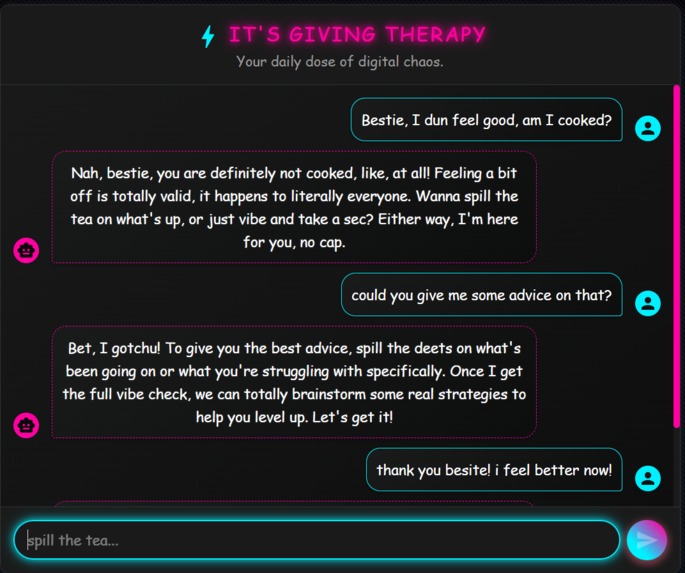
Chat Page
Inspiration
Joining the "AI VS Human Intelligence" hackathon, we were immediately drawn to the "Push the Limits: Beyond Automation" and "Make Anything, But Make it YOU" tracks. The idea of AI fumbling with human nuance, especially the ever-evolving, ironic, and often absurd communication style of Gen Z, sparked something. We envisioned a project that wasn't about AI perfectly mimicking human intelligence, but rather about its hilarious failure to do so, specifically when confronted with the delightful chaos of internet "brain rot."
What it does
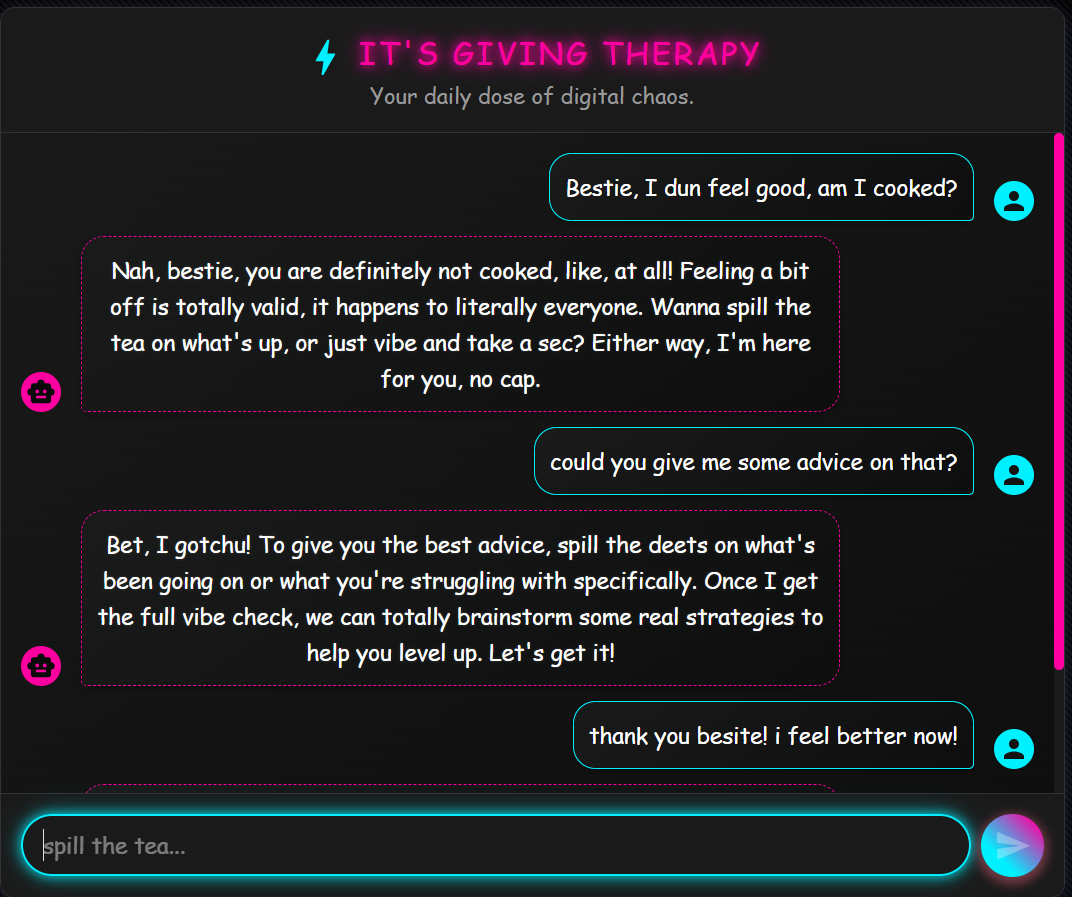
"It's giving therapy" is a single-page application that provides a unique, Gen Z-flavoured chatbot experience. It takes user input (a "problem" or concern) and, instead of offering standard therapeutic advice, it "glitches" into a brain-rotted response. This response is filled with internet slang, memes, and an ironically dismissive or absurd tone, reflecting the chaotic and nuanced coping mechanisms of Gen Z online culture. It's designed to be a playful commentary on AI's struggle to truly grasp human nuance and "vibe-based" communication.
How we built it
Frontend: React with Vite (for fast development) and Material-UI (MUI) for component styling.
The Frontend (React, Vite, MUI): We used MUI not for its typical clean, corporate aesthetic, but to subvert it. I created a custom MUI ThemeProvider to define a unique Gen Z palette:
Typography: We specifically chose fonts like "Comic Sans MS" (for its playful, often-maligned nature), "Press Start 2P" (for a retro-pixelated feel), and "Pixelify Sans" for titles, creating a deliberate clash that screams "internet weirdness."
Animations: For the AI's responses, we implemented CSS keyframe animations like spin-in and zoom-in-out. Each AI message randomly applies one of these animations, making the "glitch" feel dynamic and unpredictable. This was achieved by injecting style tags with keyframes directly into the component and applying them conditionally.
Backend: A simple Python Fast API script that interacts with the Gemini API.
The Backend (Python, Gemini API): The core "intelligence" lies in the Python backend's interaction with the Gemini API. The plan was to use a two-step prompting process (though for a 3-day hackathon, a well-crafted one-shot prompt could also work):
Initial Prompt: The user's input would be sent to the Gemini API with a prompt instructing it to act as a "calm, analytical, slightly generic AI therapist."
Brain Rot Transformation Prompt: The response from the first prompt (or even the original user input) would then be sent back to the Gemini API with a second, highly specific prompt.
Challenges we ran into
Prompt Engineering for Controlled Chaos: The biggest hurdle was consistently getting the LLM to produce the right kind of brain rot. Sometimes it was too generic, sometimes too offensive, and sometimes just not funny. It required constant iteration and refinement of the "brain rot" prompt to hit that sweet spot of absurd, ironic, and genuinely Gen Z humour. Balancing the "therapist" persona with the "glitch" was a delicate dance.
MUI Subversion: While MUI is powerful, making it look intentionally "ugly" or "chaotic" in a stylish way required overriding many default styles and carefully selecting component properties. It was a fun challenge to push the boundaries of a typically "clean" UI library.
Time Management: As a solo developer in the team, prioritising features was crucial. We had to resist the urge to add too many complex functionalities and instead focus on perfecting the core "glitch" experience.
Accomplishments that we're proud of
The Unique Concept: Successfully combining the idea of an AI therapist with Gen Z "brain rot" to create a novel and humorous commentary on AI's understanding of human nuance.
Dynamic Brain Rot: Leveraging the Gemini API to dynamically generate "brain rot" responses, making each interaction unique and unpredictable, rather than relying on static rules.
Aesthetic Cohesion: Achieving a distinct Gen Z, glitchy, and playful aesthetic using MUI, despite its conventional use cases, through custom theming and creative component styling.
Solo Execution: Building a functional and engaging prototype within the tight 3-day hackathon timeframe as a single developer in the team.
What we learned
This hackathon was a deep dive into the art (and science) of prompt engineering for specific, non-standard outputs. We learned that getting an LLM to be "helpful" is one thing, but getting it to be "hilariously unhelpful" or "ironically profound" in a specific, Gen Z voice is a whole different challenge.
We discovered the power of:
Persona Prompting: Clearly defining the AI's "therapist" persona, then layering on the "brain rot" persona.
Tone Control: Using adverbs, adjectives, and examples in prompts to steer the AI towards a specific, often contradictory, tone (e.g., "slightly gaslighting," "ironically dismissive").
What's next for It's giving therapy
For future development, we envision:
Expanding Brain Rot Vocabulary: Continuously updating the LLM's "knowledge" of new Gen Z slang and memes through prompt refinement.
More Diverse Glitches: Introducing more varied visual and textual "glitch" effects to keep the experience fresh.
User Customisation: Allowing users to choose different "brain rot" sub-genres or levels of absurdity.
Integration with Other Platforms: Exploring how this "glitch therapy" could be integrated into other messaging platforms or social media.
Built With
- fastapi
- gemini
- javascript
- material-ui
- python
- react
- vscode

Log in or sign up for Devpost to join the conversation.