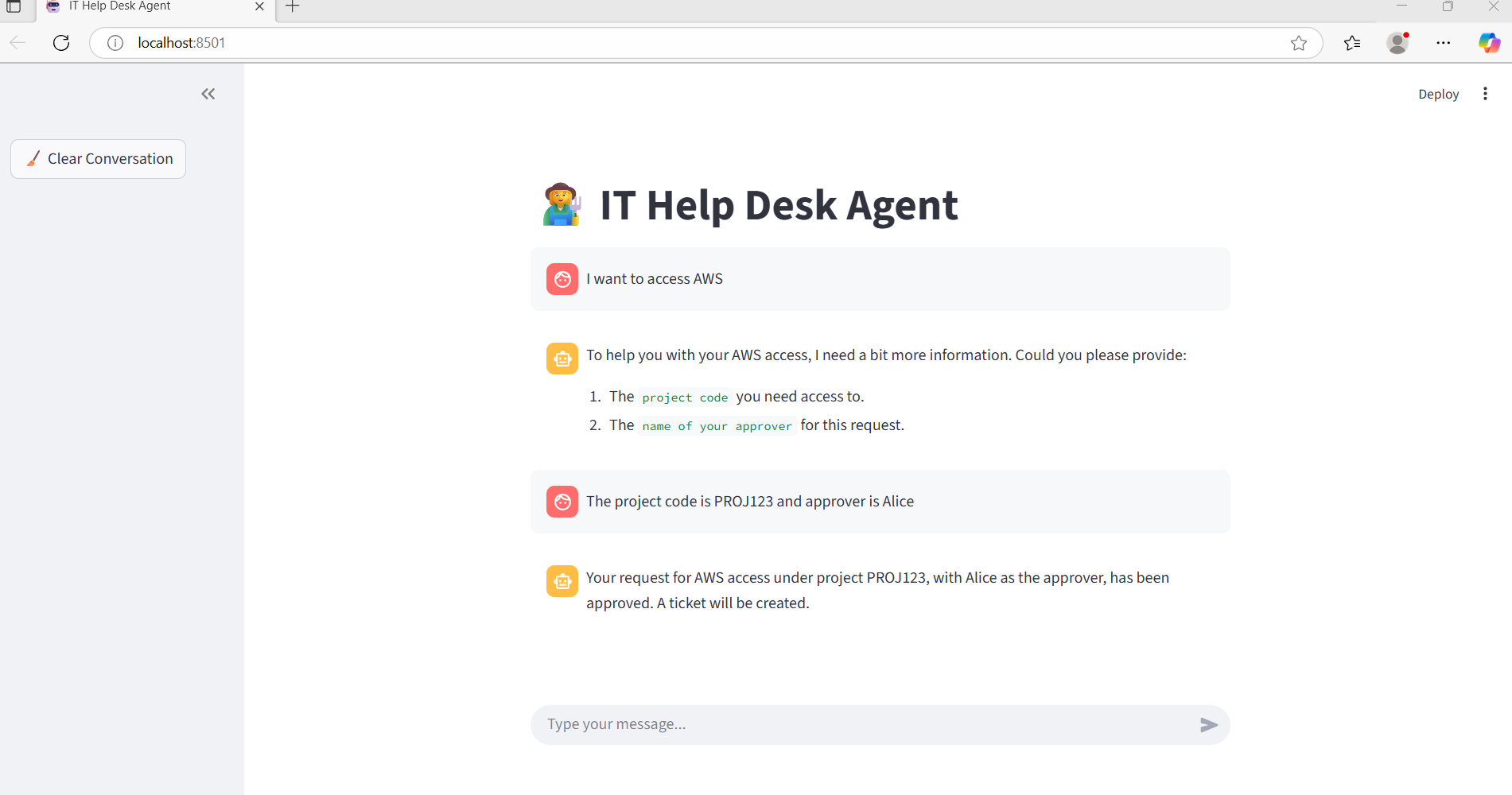
🧠 IT HelpGenie: Intelligent IT Helpdesk Automation Agent
💡 Inspiration
We’ve all faced the frustration of waiting days for simple IT requests — whether it’s access to a tool, password resets, or software installations.
During internal discussions with our IT support team, I realized how repetitive most of these requests are — yet they consume hours of manual effort daily.
That’s where HelpGenie was born — an intelligent, autonomous IT helpdesk agent that understands user intent from emails, performs the right actions using tools, and closes tickets automatically — with almost zero human intervention.
⚙️ What it does
HelpGenie acts as a virtual IT assistant that reads and understands employee emails and automatically performs end-to-end IT operations like:
- 🔐 Handling password resets securely
- 💻 Managing software access requests
- 🧾 Automating license validation & procurement
- 🖥️ Assisting with hardware support
- 🎟️ Integrating directly with ServiceNow / JIRA ticketing systems
It identifies intent, validates policies (like approvals), performs actions using pre-configured tools (Lambda APIs), and replies to the employee with updates — all autonomously.
🧩 How we built it
- 🧠 Core Framework: Built using Strands, an open framework for modular AI agents.
- 🗣️ Model: Powered by Anthropic Claude 3 Sonnet (for reasoning and classification).
- ☁️ Cloud Runtime: Deployed on AWS AgentCore, enabling stateful execution, memory, and observability.
- 🛠️ Tools Integration: Implemented tools such as:
handle_software_requesthandle_password_resetget_ticket_statushandle_hardware_issueget_user_info
- 🔗 External Systems: Connected to JIRA and ServiceNow via API endpoints.
- 🧱 Architecture: Serverless deployment with AWS Lambda, ECR for containerized agents, and S3 for persistent logs.
Mathematically, if we define:
[ T = N_r \times t_h ]
Where ( N_r ) = number of repetitive IT requests per day and ( t_h ) = average human handling time per request (in minutes),
HelpGenie reduces total time ( T ) by an estimated 85–90%, saving hundreds of hours monthly.
🚧 Challenges we ran into
- 🧩 Integrating external APIs: Ensuring smooth connection to ServiceNow/JIRA with the MCP protocol.
- 🔄 State management: Designing for continuity in conversations across multiple user sessions.
- ⚙️ Tool orchestration: Ensuring tools trigger the right Lambda without conflict.
- 💰 Cost optimization: Evaluating whether smaller models or asynchronous processing could reduce inference costs.
- 🔒 Security and role-based access: Managing approvals and identity validation for software/hardware requests.
🏆 Accomplishments that we’re proud of
- Built an end-to-end intelligent IT helpdesk agent powered by AWS Bedrock and Anthropic models.
- Successfully simulated complete email-to-resolution automation for IT requests.
- Created a modular, scalable, and deployable agent framework that integrates with enterprise APIs.
- Demonstrated the potential to cut IT resolution time by 70% and save thousands of dollars annually.
📚 What we learned
- How to build production-grade agents using AWS AgentCore and ECR deployments.
- Best practices for managing serverless workflows with Lambda.
- Real-world challenges in automating enterprise IT operations.
- How small context windows can be optimized with memory-based workflows.
🚀 What's next for IT HelpGenie
- 🔄 Integrate with AWS Kendra for contextual knowledge retrieval.
- 🧠 Enable memory-based conversations with long-term context.
- 💬 Add multi-channel support — Slack, Teams, and web chat.
- 📊 Build analytics dashboards for IT performance tracking.
- 💡 Explore multi-agent collaboration, where specialized agents handle procurement, access, and escalation separately.
Built With
- amazon-bedrock
- python
- strands

Log in or sign up for Devpost to join the conversation.