Inspiration
Product recalls are easy to miss. A warning may be buried on a regulator’s website, use a model number that is difficult to find, or appear months after someone bought the product. Most people do not search for recalls until something goes wrong.
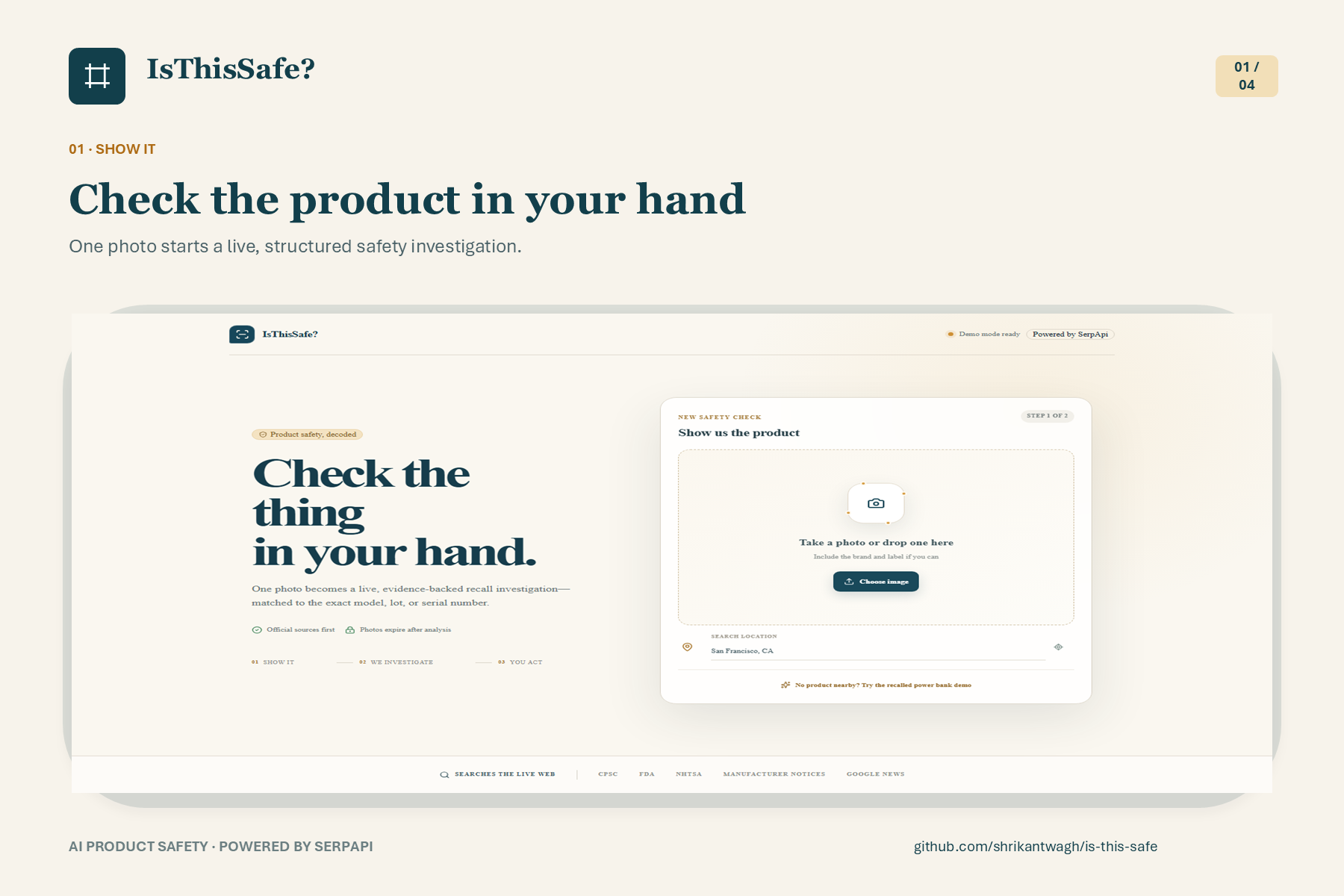
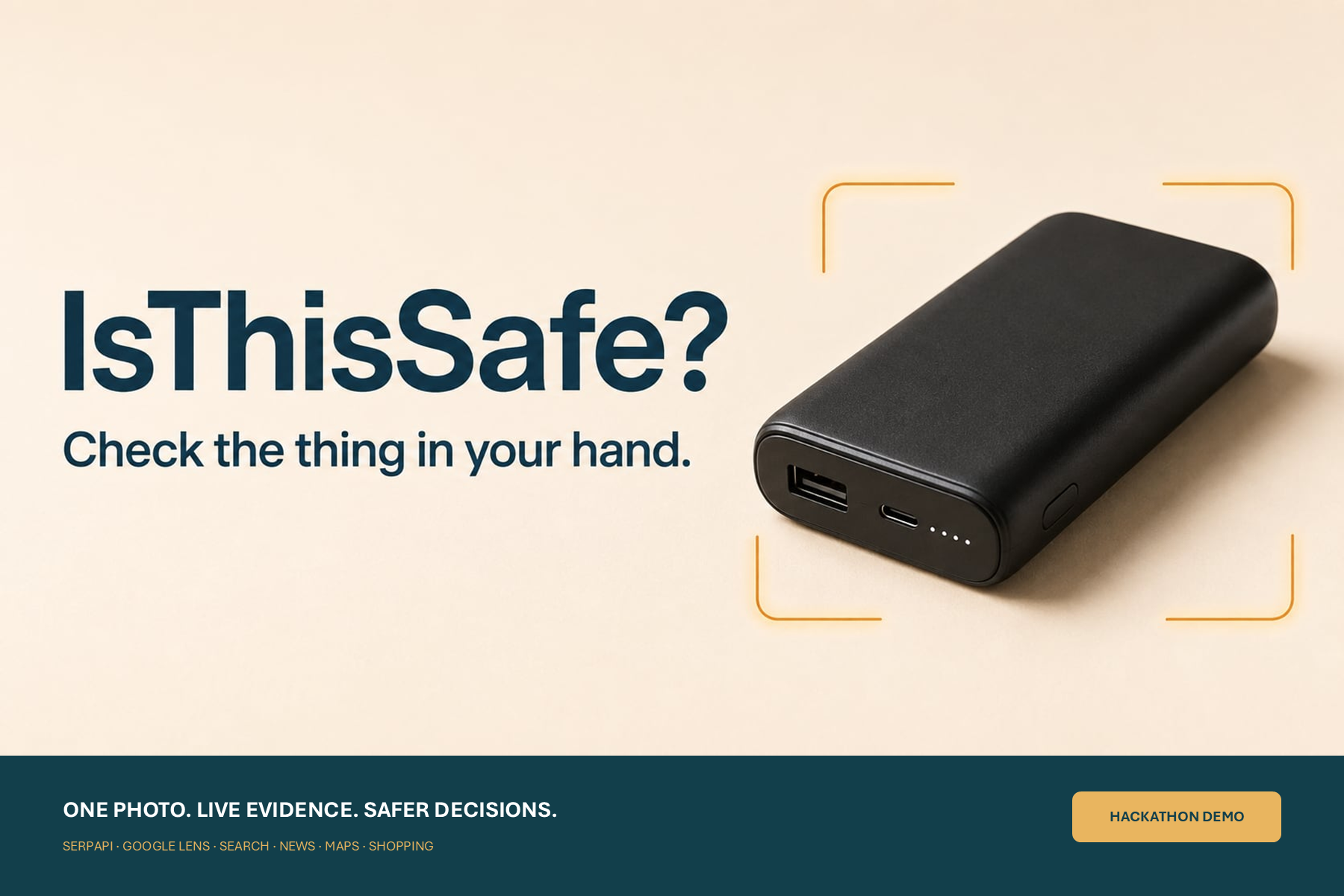
The idea behind IsThisSafe? is simple: instead of making people search through disconnected databases, let them photograph the product already in their hand and turn that photo into a live safety investigation.
What it does
IsThisSafe? is an AI-assisted product safety scanner powered by SerpApi.
A user photographs a product and optionally enters a model, lot, or serial number. The application then:
- Uses Google Lens through SerpApi to identify the product.
- Extracts likely brand and model identifiers.
- Searches official regulator domains such as CPSC, FDA, NHTSA, and USDA for current recalls and safety notices.
- Checks Google News for corroborating safety reports.
- Uses Google Maps to find nearby disposal or hazardous-waste facilities.
- Uses Google Shopping to suggest currently available alternatives.
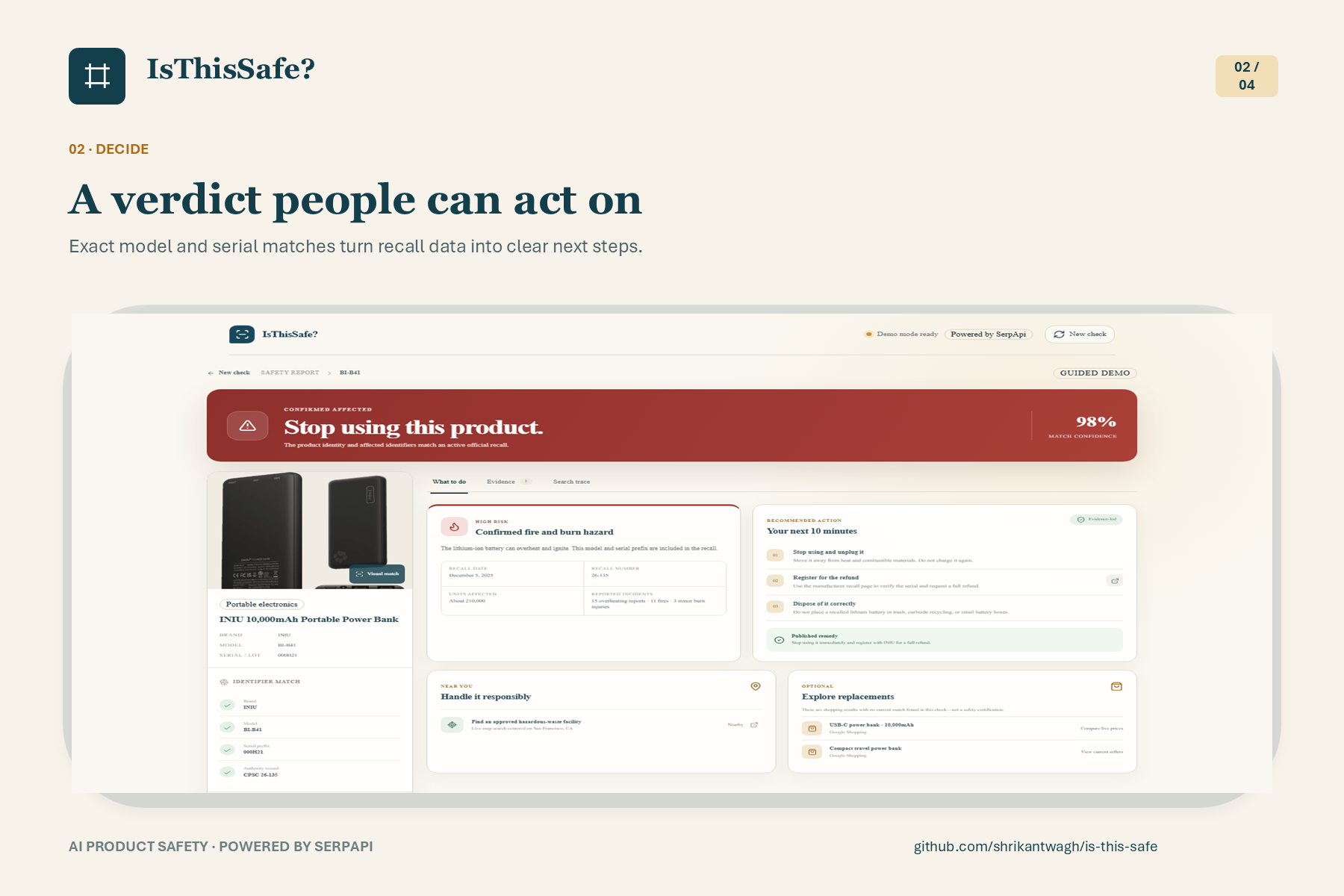
- Produces an evidence-backed verdict with matching identifiers, confidence, sources, and recommended next steps.
The result is not just a list of links. It explains what matched, why the product may be affected, what the user should do next, and which official sources support the conclusion.
Why SerpApi matters
Safety information changes continuously. A static dataset can become outdated as soon as a new recall is announced.
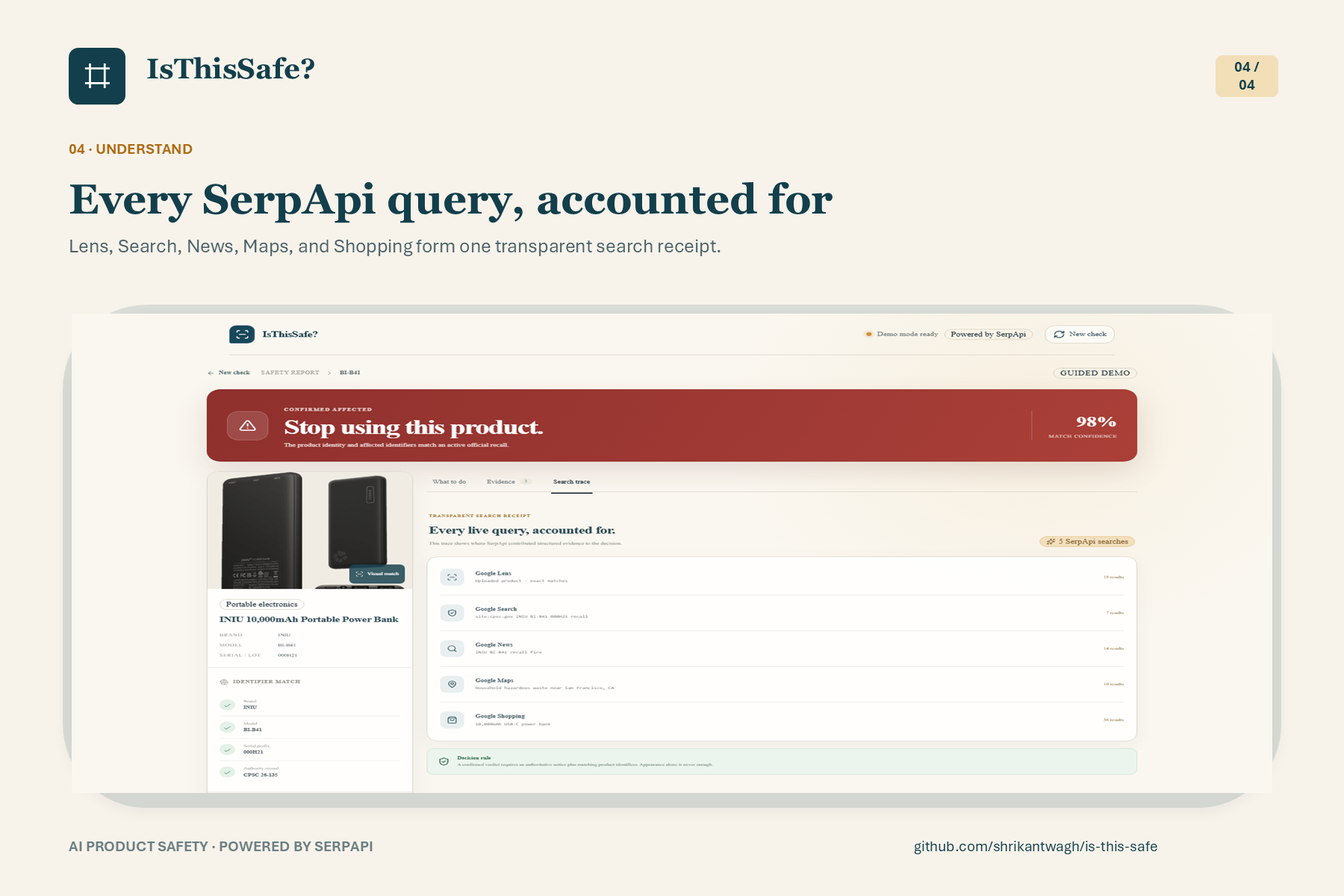
SerpApi gives IsThisSafe? structured, real-time access to several parts of the web through one consistent integration:
- SerpApi Image API for securely processing the uploaded image
- Google Lens API for visual product identification
- Google Search API for regulator and manufacturer notices
- Google News API for emerging safety signals
- Google Maps API for nearby disposal and service locations
- Google Shopping API for replacement options
Without live search data, the application could only report what was known when its database was last updated. With SerpApi, each scan becomes a fresh investigation.
How it was built
The frontend was built with React 19, TypeScript, Vinext, Tailwind CSS, shadcn/ui, and Lucide icons.
Images are compressed in the browser before upload to improve speed and meet the SerpApi Image API size limit. The server keeps the SerpApi key private, uploads the processed image, and sends its short-lived image ID to Google Lens.
After identifying the product, the backend runs recall, news, map, and shopping searches in parallel. Structured results are normalized into a single safety report containing:
- Product identity and model information
- Recall status and confidence
- Identifier-by-identifier matching
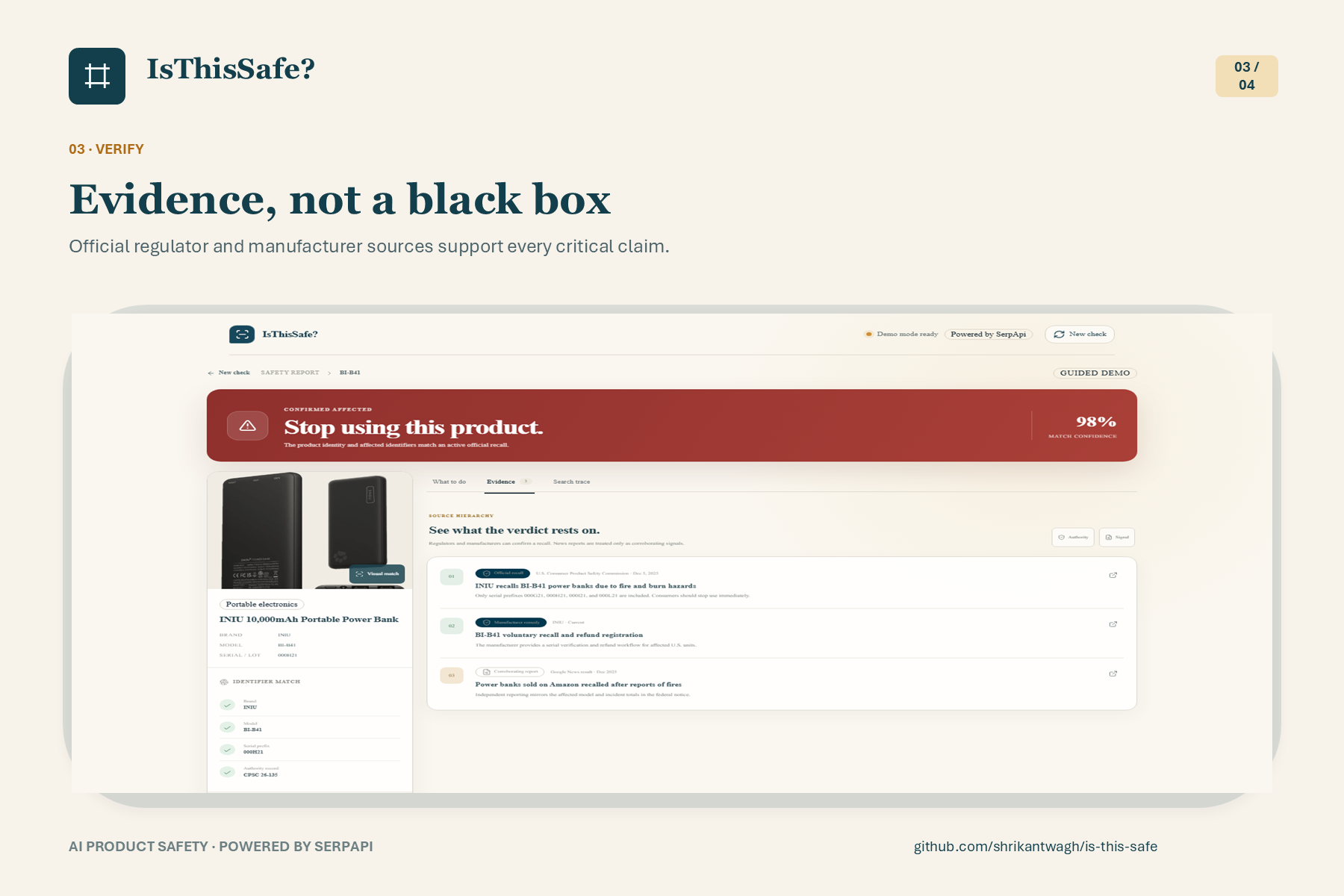
- Official evidence and supporting news
- Immediate safety actions
- Nearby disposal options
- Potential replacements
- A transparent record of every live search performed
The application is deployed on a Cloudflare-compatible runtime. It also includes a guided INIU BI-B41 power-bank recall scenario so the complete experience can be demonstrated without exposing API credentials.
Safety by design
A safety product must avoid both hallucinated danger and false reassurance.
IsThisSafe? therefore follows a conservative decision policy:
- Visual similarity alone never confirms a recall.
- News coverage alone never confirms a recall.
- A confirmed result requires an authoritative notice and matching product identifiers.
- Missing serial or lot information is clearly shown as needing verification.
- “No current match found” is never presented as proof that a product is safe.
- Every important claim links back to its supporting source.
This makes the system an evidence navigator rather than an automated safety authority.
Challenges
The hardest challenge was converting messy search results into a verdict people could act on safely. Product names vary across retailers, model numbers are often embedded in long titles, and recall notices may apply only to specific serial prefixes or production dates.
Another challenge was designing useful fallback behavior when an image is unclear or one search provider returns incomplete results. The application uses partial-result handling so one failed search does not destroy the entire investigation.
Finally, the interface had to communicate urgency without causing panic. The result separates confirmed matches, potential matches, unknown identifiers, and clear evidence so users can understand exactly why a warning appears.
What was learned
Building IsThisSafe? showed that AI identification becomes much more useful when it is connected to live, structured evidence. Computer vision can suggest what an object is, but trustworthy decisions require authoritative sources, identifier matching, uncertainty handling, and clear explanations.
It also demonstrated the value of combining multiple SerpApi engines. Search, Lens, News, Maps, and Shopping each answer a different part of the user’s real question: What is this, is it affected, why should I trust the result, and what should I do now?
What's next
Future versions will add barcode and OCR scanning, automatic serial-number extraction, recall monitoring, regional regulator support, saved household inventories, and notifications when a previously scanned product receives a new warning.
The long-term goal is to make checking a product’s safety as natural as taking a photo.
Built With
- cloudflare
- css
- lens
- lucide
- maps
- news
- node.js
- react
- search
- serpapi
- shadcn/ui
- shopping
- tailwind
- typescript
- vinext
- vite
- workers

Log in or sign up for Devpost to join the conversation.