-

Login page for TA's (Teaching Assistants) and TF's (Teaching Fellows)
-
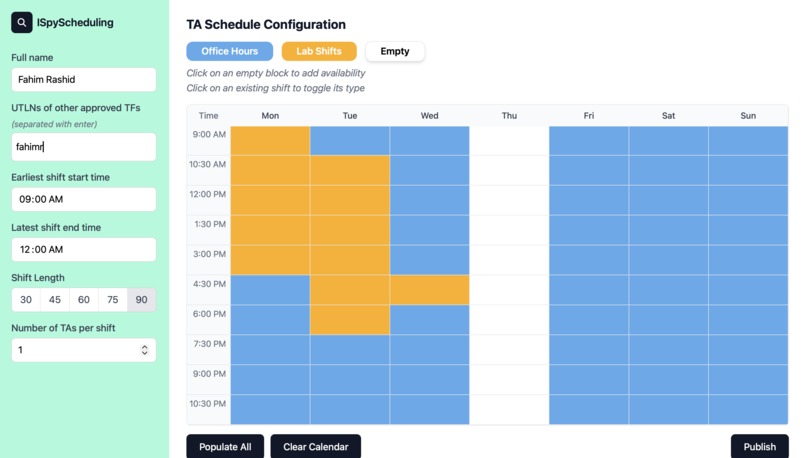
TA Scheduling Configuration
-
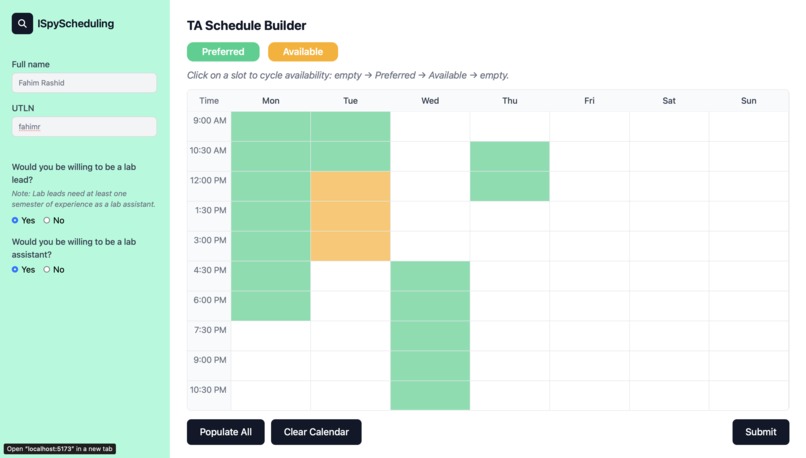
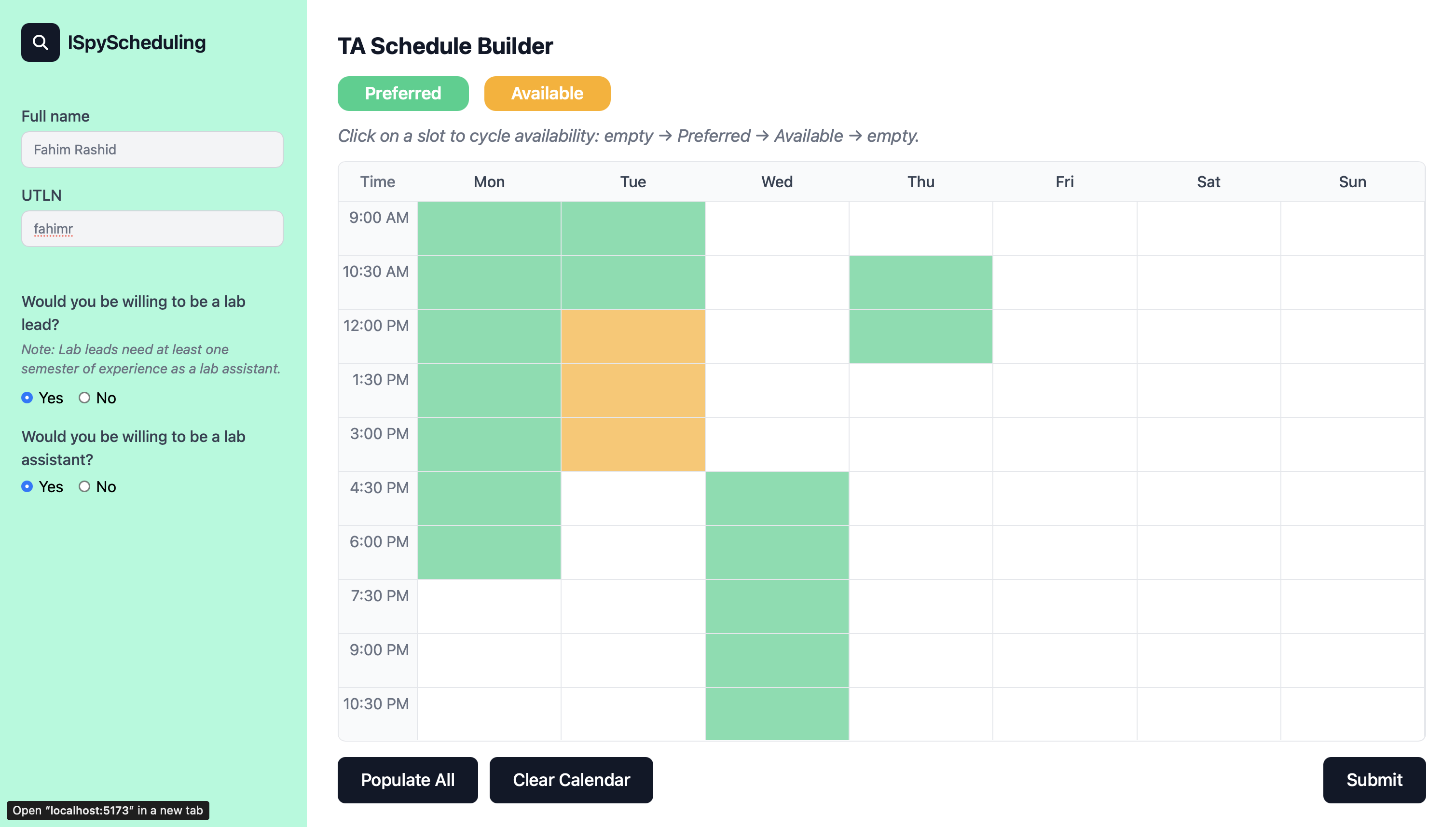
TA Scheduling page where TA's are allowed to schedule their own preferences and workflows throughout the week
-
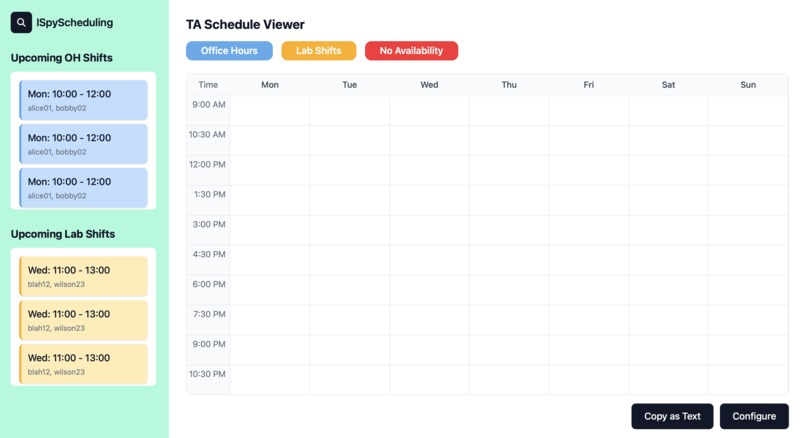
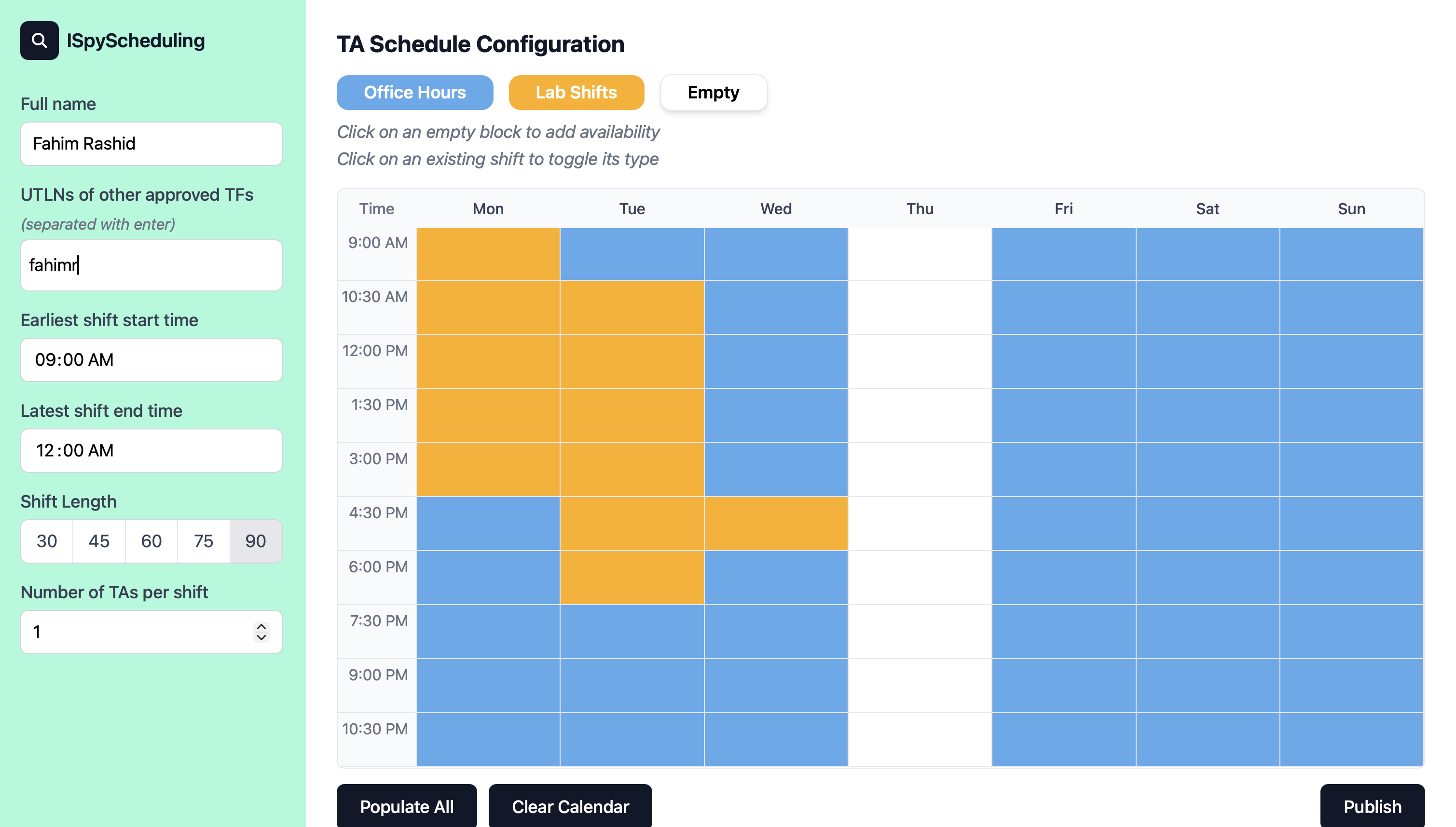
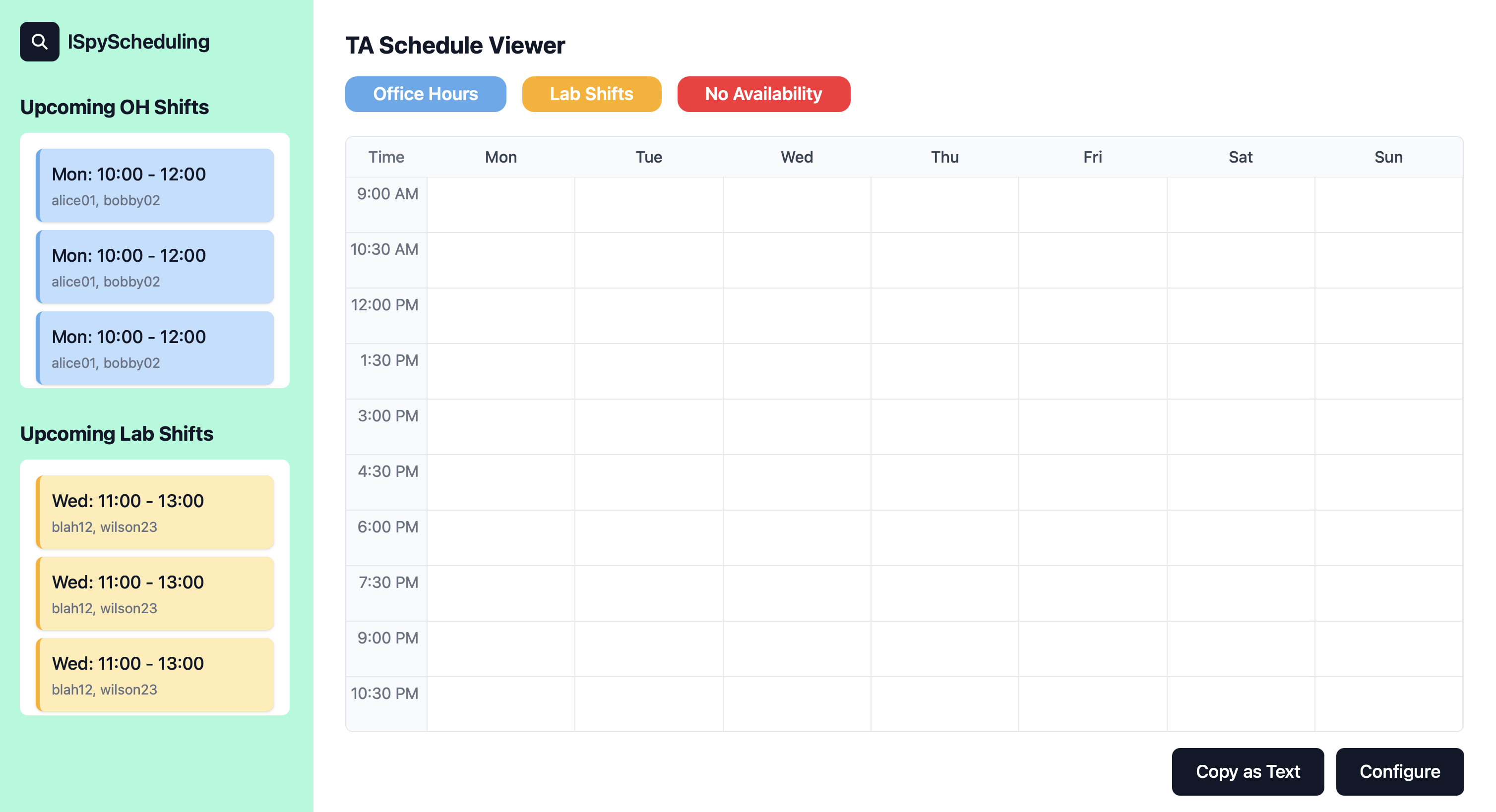
TF's view where they are able to manage schedules from the admin side

ISpyScheduling
Inspiration
TA scheduling is always a pain within Computer Science courses at Tufts University. Office hours shift constantly due to budgeting changes, uneven attendance, and last-minute conflicts. Existing systems are clunky, heavily manual, and don't properly account for TA preferences or staffing priorities.
We wanted to build something smarter — a system where TAs can express availability and ranked preferences, and an algorithm does the heavy lifting. That's how ISpyScheduling was born: a preference-driven, optimization-based scheduling system designed specifically for CS course staff.
What It Does
ISpyScheduling is a preference-based shift allocation system for teaching assistants. It automatically generates optimized office hour and lab schedules by balancing:
- Ranked time preferences (
yes/ok/no) - Companion preferences (who you want to work with)
- New vs. experienced TA pairing
- Lab role requirements (lab lead vs. lab assist)
- Shift capacity and priority
- Fair hour distribution
It also supports dynamic schedule reduction when courses need to cut hours due to budget or low attendance — without disproportionately hurting individual TAs.
Features
Preference Form
- Ranked availability input
- Companion/partner preferences
- Role selection (lab lead / lab assist)
Smart Schedule Generation
- Enforces fair minimum hours per TA
- Prioritizes critical time slots
- Ensures correct lab staffing
- Automatically pairs new and returning TAs
Optimization Engine
The optimizer works in two phases:
- Greedy initialization for baseline staffing
- Simulated annealing (10,000+ iterations) to improve fairness and preference satisfaction
The acceptance probability at temperature \(T\) follows:
$$ P(\text{accept}) = e^{\Delta S / T} $$
where \(\Delta S\) is the change in schedule quality score. Temperature decays over iterations to converge on a near-optimal solution.
Schedule Reduction Mode
- Target budget input
- Priority-based shift removal
- Fairness-aware removal scoring
- Maintains minimum-hour guarantees
Clean Schedule View
- Dynamic updates when changes occur
- Designed to replace manual spreadsheets
How We Built It
Backend (Node.js + MongoDB)
- Stores TA metadata, shift metadata, and preference matrices
- Represents shifts with structured metadata (day, time, capacity, lab flags, staffing arrays)
- Validates and parses structured preference strings
- Maintains schedule state in a format optimized for algorithmic evaluation
Scheduling Algorithm
The algorithm computes a minimum required hours threshold, then scores each assignment using a weighted function:
$$ \text{Score}(s, t) = w_1 \cdot P(s,t) + w_2 \cdot E(s,t) + w_3 \cdot L(s,t) + w_4 \cdot F(s,t) $$
where:
- \(P(s,t)\) = time preference score for TA \(t\) at shift \(s\)
- \(E(s,t)\) = experience pairing score
- \(L(s,t)\) = lab role compatibility
- \(F(s,t)\) = fairness/hour-balance score
Greedy assignment provides initial feasibility, then simulated annealing maximizes global schedule quality.
Frontend Interface
- Availability selection inspired by When2Meet-style grids
- Clear schedule visualization
- Reduced-hours configuration
- Coverage request support
Challenges We Ran Into
- Designing a scoring function that meaningfully balances fairness and preference satisfaction
- Preventing local optima in schedule optimization
- Structuring shift and TA metadata to support both greedy and annealing phases
- Handling edge cases (duration mismatches, staffing constraints, lab requirements)
- Making schedule reduction fair without breaking minimum-hour guarantees
Accomplishments That We're Proud Of
- Built a full-stack scheduling optimizer capable of generating and improving schedules algorithmically
- Implemented simulated annealing in a real-world staffing context
- Designed a flexible system that adapts to both expansion and budget cuts
- Created a tool that meaningfully reduces manual administrative overhead
What's Next for ISpyScheduling
- Coverage request automation and swap optimization
- Multi-course scalability
- Predictive staffing based on historical attendance
- Improved UI for real-time schedule adjustments
- Advanced weighting customization for course administrators
Built With
- express.js
- mongodb
- node.js
- python
- react
- tailwind
- vercel


Log in or sign up for Devpost to join the conversation.