-
-
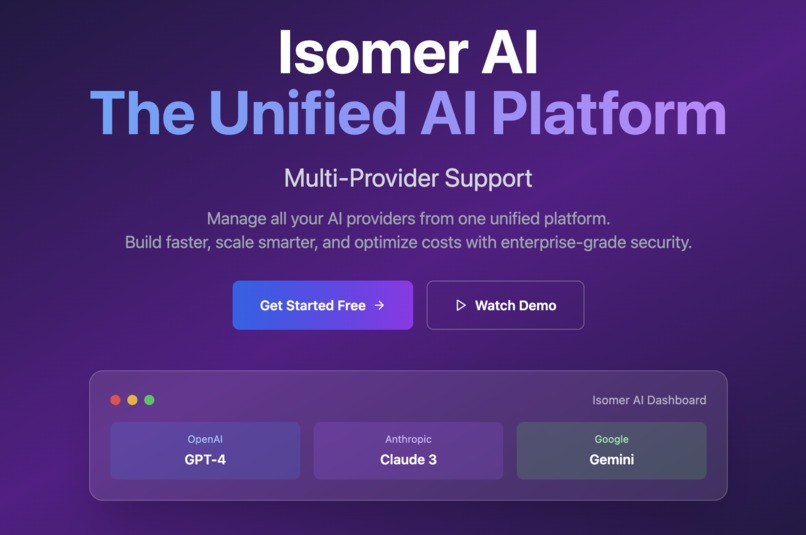
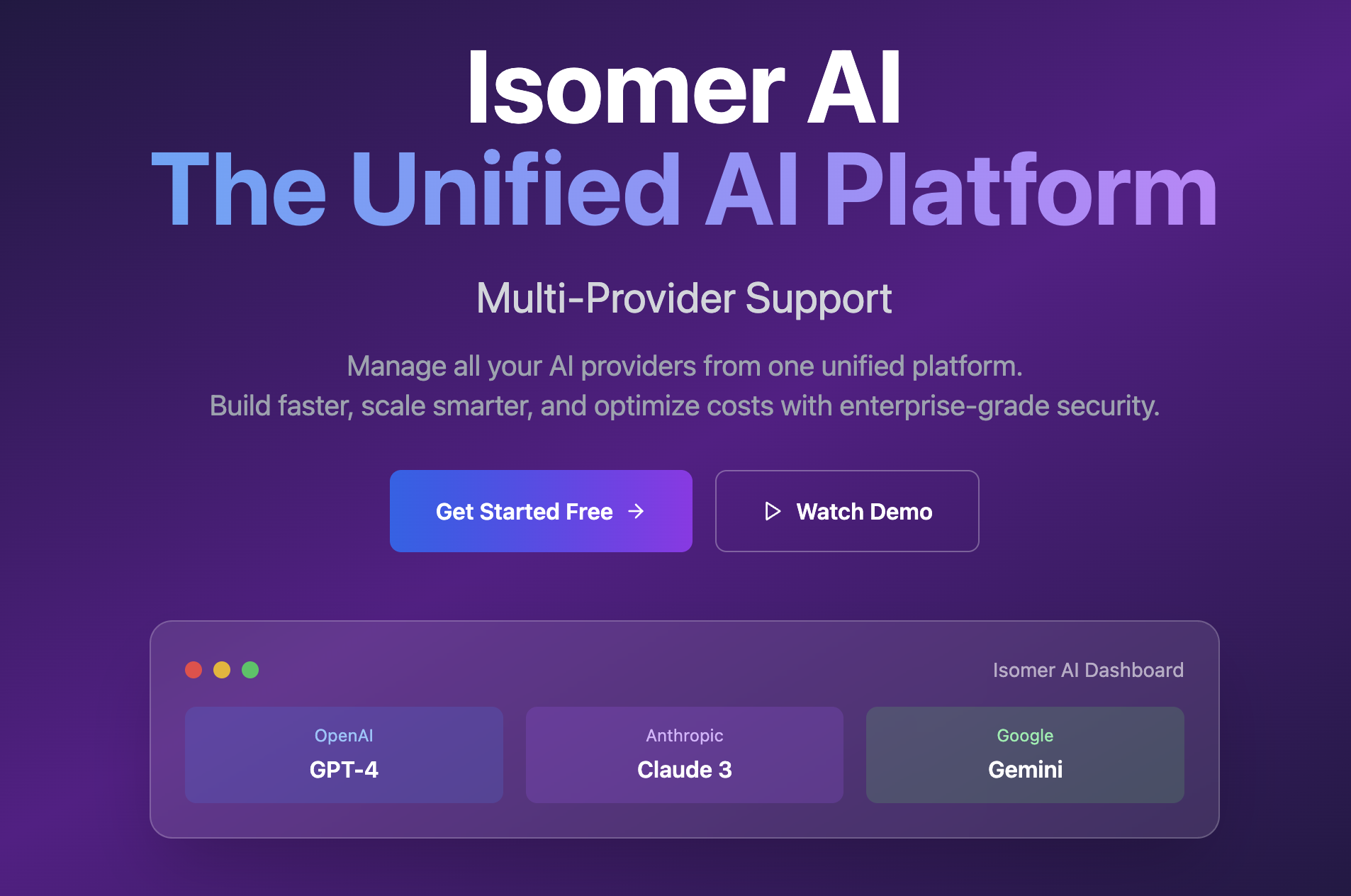
The Unified AI Platform
-
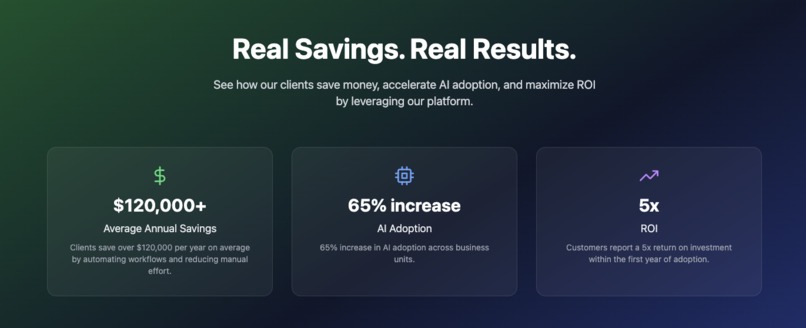
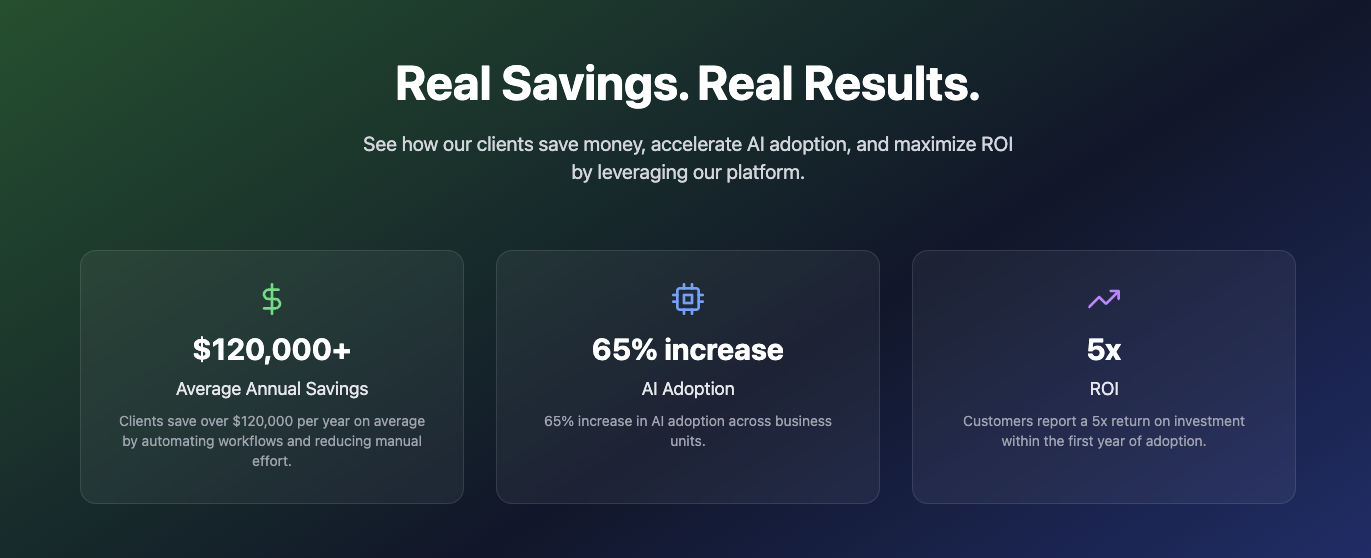
Cost Savings
Inspiration
As teams and startups rapidly adopt AI tools, we noticed a huge problem — everyone was using multiple AI providers, but no one had a good system to manage them.
From borrowing API keys to unpredictable bills, the chaos was real. Developers, designers, PMs, and even leadership were all using AI — but usage was fragmented, costs were spiraling, and governance was missing.
That’s what inspired us to build Isomer AI — a single place to manage, scale, and track all your AI usage with smart tools, team roles, and sustainability insights.
What it does
- 🔑 Manage API keys acting as a vault for all your keys. Access them all using one unique Isomer Key instead of juggling multiple credentials.
- 👥 Create teams with granular roles (Owner, Admin, Developer) — bringing full control and visibility over who can use which API keys, how often, and for what purpose.
- 💬 Chat with multiple models in one thread (e.g. start with Gemini, continue with Claude)
- 📊 Track usage, cost & performance per team, model, and API
- 🌍 Monitor sustainability metrics like energy consumption and carbon footprint
- 🧠 Use a built-in local model to recommend the best AI model for cost/speed/efficiency
- 🧰 Integrate quickly with our lightweight SDK
How we built it
Languages
- JavaScript (frontend and backend)
- TypeScript (frontend, for type safety)
- SQL (for Supabase/Postgres database)
Frontend
- React (main UI framework)
- Vite (build tool and dev server)
- Tailwind CSS (utility-first CSS framework)
- Framer Motion (animations)
- React Router (routing)
- Lucide React (icon library)
- Other React libraries (e.g., react-icons, react-syntax-highlighter)
Backend
- Node.js (runtime)
- Express.js (web server and API framework)
- Supabase (authentication, database, and storage)
- PostgreSQL (database, managed by Supabase)
- Render (cloud platform for backend deployment)
Database
- Supabase (PostgreSQL as a service, with authentication and storage)
Cloud Services & Platforms
- Netlify (frontend hosting and serverless functions)
- Render (backend hosting)
- Supabase (cloud database, auth, and storage)
APIs
- Custom REST APIs (for authentication, teams, users, keys, chats, analytics, etc.)
- Third-party AI APIs (OpenAI, Anthropic, Google Gemini, etc. via unified backend endpoints)
- Supabase API (for auth and database operations)
Other Technologies
- ESLint (linting)
- PostCSS (CSS processing)
- Git (version control)
- GitHub (repository hosting and collaboration)
- SVG/PNG/WebP (for provider logos and avatars)
Challenges we ran into
- Normalizing provider APIs: Every LLM service has a different format, error style, and pricing model — abstracting them wasn’t easy.
- Security of keys: Some keys have massive usage caps — securing them while enabling team sharing took careful design.
- Accurate usage + sustainability tracking: Token tracking is complex, and energy estimates are still evolving.
- UX: Making something powerful for devs, but simple enough for PMs or marketing folks, required a lot of iteration.
Accomplishments that we're proud of
- 🎯 One-click setup for multi-model access using a single unified key
- 📈 Visual analytics for cost, usage, and emissions — across teams
- 🔒 Secure, role-based sharing of AI keys inside large orgs
- 🧠 Built a local model to intelligently recommend the best LLM for each use case
- 💡 Designed with both startups and enterprises in mind — with SDKs to boot
What we learned
- AI usage isn't just for devs — designers, marketers, and leadership are all AI users now.
- Teams need both freedom and control — sharing access without losing visibility.
- Sustainability is becoming a real concern — tracking emissions is the next evolution of responsible AI.
- Building a multi-provider platform means constantly adapting to new APIs and models.
What's next for Isomer AI
- 💼 Billing automation – generate invoices based on usage per team
- 🧪 A/B testing across models – compare OpenAI vs Anthropic performance live
- 🔐 Org-wide audit logs & alerts
- 🪄 More providers – Mistral, Cohere, open-source LLMs
- 🔄 Bring-your-own-model – plug in your own local LLM with the same SDK
- 🌱 Real-time energy scoring & offset tracking
🚀 Our Vision
We want to eliminate the hassle of hunting down different LLM providers, creating multiple accounts, and managing dozens of API keys.
Instead, with Isomer AI, you simply use one Isomer Key.
Just tell us which model you want — GPT-4, Claude, Gemini, Mistral, anything — and we’ll handle the rest behind the scenes.
One key. All models. Unified billing, security, and control.
No setup chaos. No credential sprawl.
Just one clean API to rule them all.
Built With
- bolt
- javascript
- netlify
- node.js
- react-native
- render
- sql
- supabase
- typescript


Log in or sign up for Devpost to join the conversation.