-
-
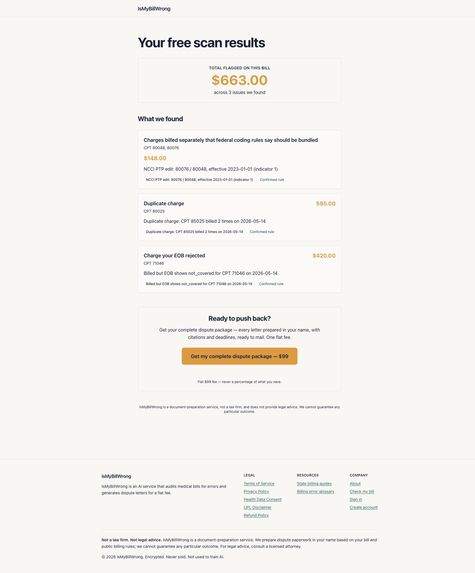
Live IsMyBillWrong public homepage and guided medical-bill review experience.
-
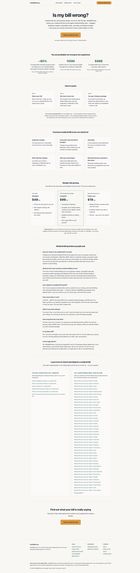
Synthetic sample bill results with line-by-line findings and plain-English explanations.
Why this matters
A medical crisis should not become a financial crisis simply because a patient cannot understand the bill.
Imagine recovering from surgery while caring for your family, then receiving a bill filled with unfamiliar codes and charges you cannot verify. You may be frightened to question the hospital, unsure whether the insurer made a mistake, and unable to afford a professional advocate. Paying the bill could mean sacrificing rent, groceries, medication, or savings. Ignoring it could mean collections and years of financial harm.
The system currently gives the advantage to whoever understands the paperwork. IsMyBillWrong is designed to return some of that power to the patient.
It gives ordinary people a calm, private place to understand what they were charged, identify potential errors, and prepare an evidence-based request for answers. It does not promise that every bill is wrong. It promises that no patient should have to confront a confusing medical bill completely alone.
Our long-term social mission is to make expert-level bill scrutiny accessible regardless of income, education, language, or insurance experience—turning confusion into understanding and fear into a practical next step.
What it does
IsMyBillWrong is an AI-assisted medical-bill audit and dispute-document platform. The competition demonstration uses fully synthetic billing information. It extracts structured bill and EOB facts, runs deterministic checks for duplicates and conflicting insurer dispositions, and explains potential issues without claiming that every flag is conclusive. Where authorized data is available, the architecture also supports effective-dated CMS NCCI checks.
Gemini through Vertex AI handles contextual reasoning and drafts the guarded narrative portions of self-help correspondence. Locked templates, source citations, structured output schemas, confidence thresholds, and review gates constrain the model. Users review, sign, and decide whether to send every document. IsMyBillWrong is a document-preparation and billing-advocacy tool, not a law firm and not a substitute for professional advice.
How we built it
Google Cloud Document AI provides document extraction. Gemini through Vertex AI performs contextual analysis and narrative drafting. A deterministic audit layer runs first so directly testable billing relationships are not left to a language model. PostgreSQL persists cases, extractions, findings, entitlements, packages, and append-only agent events. Durable worker jobs assemble documents and create follow-up deadlines. The web application and APIs enforce ownership, rate limits, retention, commercial-launch gates, and isolated judge-demo access.
Every AI stage records operational evidence: model, prompt version, timestamp, one-way input hash, token use, estimated cost, latency, and status. The XPRIZE judge flow uses an expiring capability token, creates an isolated synthetic case, grants a nonpayment judge entitlement, and exposes only that session's read-only AI evidence. It never provides administrator access or arbitrary patient uploads.
Challenges
The largest challenge was separating what AI should reason about from what the software should prove deterministically. A second challenge was designing a useful demonstration without exposing patient data, administrative credentials, or a fake commercial transaction. We also built explicit launch controls around payments and CPT/NCCI-dependent processing while commercial licensing is pending.
Accomplishments
- A deployed consumer experience and synthetic sample workflow.
- Real Google Document AI and Gemini/Vertex AI integration behind one auditable provider abstraction.
- Deterministic checks that cannot be silently overridden by the model.
- Append-only AI event evidence with tokens, cost, latency, model, and prompt version.
- Time-limited, isolated, read-only judge access without payment or admin access.
- Privacy, retention, deletion, consent, and commercial-launch controls designed for sensitive consumer documents.
What we learned
Trustworthy AI products need more than a capable model. They need deterministic boundaries, provenance, observable decisions, narrow permissions, honest failure states, and a clear division between machine assistance and human judgment. We also learned that operational and licensing readiness must be treated as product features, not paperwork deferred until after launch.
What's next
The next milestones are completing commercial coding-data authorization, finishing the controlled production launch, validating the workflow with permissioned users, and measuring whether supported findings lead to clearer provider responses and reduced disputed balances. The planned business model combines a free front-door scan with transparent one-time consumer packages and, later, partnerships with patient advocates, benefits programs, and nonprofit financial counselors.


Log in or sign up for Devpost to join the conversation.