-
-
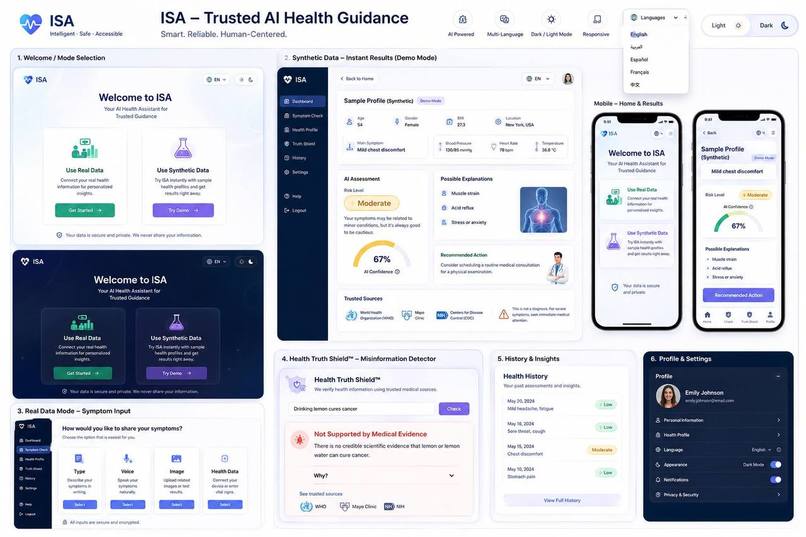
UI/UX
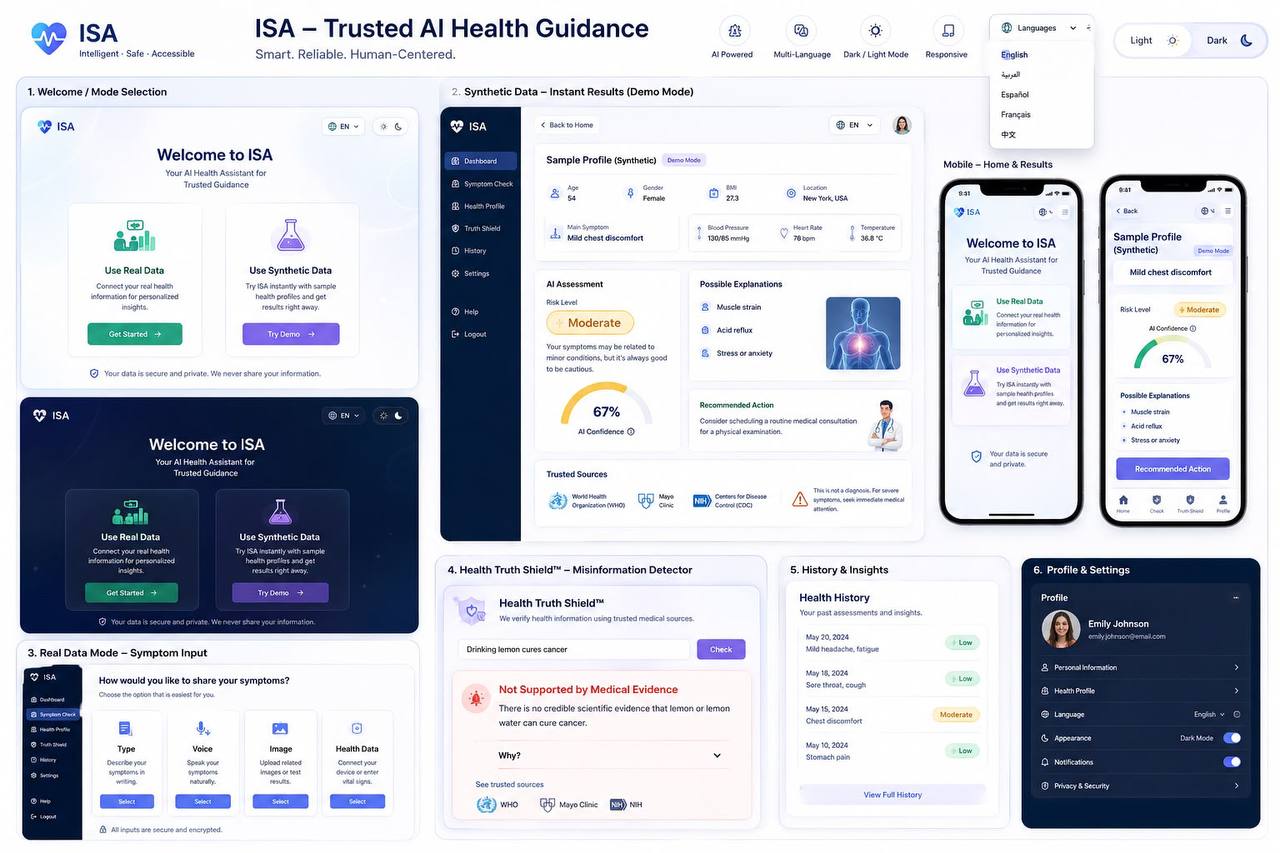
In our digital age, health information is abundant, yet often misleading or inaccurate We observed how searching for symptoms or health conditions online or even interacting with some general AI models can lead to what is known as "Cyberchondria" the fear and anxiety caused by unreliable information This phenomenon particularly affects vulnerable groups in our society: seniors who struggle to distinguish credible sources, children who are easily influenced by false information and parents seeking accurate health guidance for their kids This real problem where the search for health reassurance turns into a source of anxiety, was the spark that ignited the ISA project What we learned: Throughout our journey in building ISA, we realized that the problem isn't just a lack of information, but the quality and reliability of what's available We learned that users aren't looking for an AI to diagnose them, but rather a trusted assistant that can simplify complex health information, present it in clear and appropriate language, and guide them towards the right steps and credible sources We also developed a firm conviction in the paramount importance of having a "Human-in-the-Loop", ensuring that AI functions as a powerful enabling tool, not a replacement for wise human medical care How we built our project: We designed ISA as an interactive AI powered platform built on accuracy and reliability To achieve this, we relied on advanced technologies: Natural Language Processing (NLP): This technology enables ISA to understand complex user queries about symptoms or health conditions, even if phrased unclearly Retrieval-Augmented Generation (RAG) System: This is the backbone of ISA's reliability. Instead of the AI freely generating answers, the RAG system retrieves information from globally and locally accredited and trusted medical databases (like WHO, CDC) It then generates accurate, simplified responses based only on these verified sources This ensures that the information provided is entirely free from "digital hallucinations" or unreliable content Summarization and Personalization: We use these capabilities to simplify complex information and transform it into easily digestible content, while tailoring the presentation and language to suit each age group, whether seniors, children, or parents. Text-to-Speech (TTS) and Speech to Text (STT): To support full voice interaction, making the platform user-friendly and accessible to everyone, especially those who find typing or reading challenging. Challenges we faced Along our path, we encountered several significant challenges, most notably: Ensuring Data Reliability: The biggest challenge was building a system that guarantees every piece of information ISA provides is 100% reliable and free from any errors that could cause anxiety or misinformation We overcame this by relying entirely on the stringent RAG system and globally accredited medical sources Building Trust: Convincing users that AI can be a trustworthy source of health information, especially after the proliferation of misinformation We addressed this through complete transparency in citing sources, providing clear disclaimers, and continuously emphasizing the pivotal role of human decision making Designing an Intuitive User Experience: We meticulously designed a user friendly and engaging interface to ensure ease of access and use for all age groups, particularly seniors and children We believe ISA is more than just a technological platform it is a crucial step towards empowering individuals with reliable health information, putting an end to the fear of misinformation, and building a more informed and healthier community
Built With
- bult
- canva
- from


Log in or sign up for Devpost to join the conversation.