Inspiration
We are all familiar with the COVID-19 pandemic and have had to quarantine for extended periods of time to avoid spreading the disease. Research has shown that COVID-19 spreads at social gatherings, and spreads faster when people are in close proximity without protection.
https://www.erinbromage.com/post/the-risks-know-them-avoid-them
Many of us have been playing Among Us during quarantine, where we guess which of our friends are imposters based on suspicious behavior. Many of us are also spending more time on social media, and finding ways to entertain ourselves with online quizzes such as the infamous Rice Purity Test. The Rice Purity Test asks several questions about risky behaviors and is designed “for students to track the maturation of their experiences throughout college.” As college students ourselves, we observe that students often become involved in risky behaviors through friend groups or parties, much like how COVID-19 spreads.
In the Among Us game, impostors sabotage the ship and kill teammates who are working together to maintain the ship. We’ve analogized imposter behavior as toxic online behavior in which their actions create conflict and spread chaos.
What it does
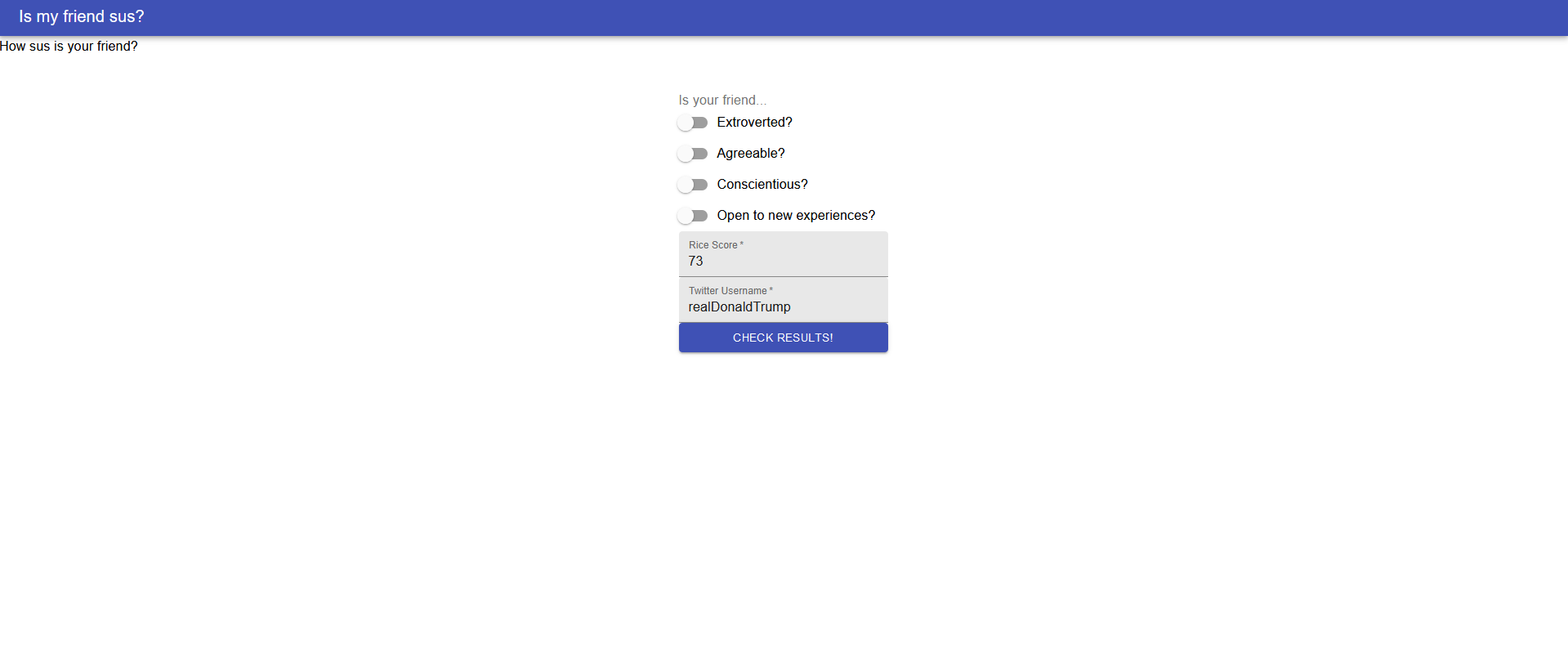
Using IBM’s MAX Toxic Comment Classifier, we analyze the friend in question’s social media posts for threatening, hateful, or offensive language. The friend in question’s social media posts are scored among 6 toxicity types: toxic, severe toxic, obscene, threat, insult, identity
How I built it
We originally drew our inspiration from a trending game called Among Us in which impostors sabotage missions and kill teammates. By analogizing imposter behavior as toxic online behavior, we found IBM’s MAX Toxic Comment Classifier which we’ve used to quantitatively score a person’s social media posts. Due to time constraints, we’ve currently implement IBM’s MAX Toxic Comment Classifier to only score the most recent tweets.
Challenges I ran into
As a team with little experience in hackathons and limited coding experience, the challenges we ran into were mainly due to integrating the various components used in this project including Tweepy for Twitter user scraping and Docker for utilizing IBM’s MAX Toxic Comment Classifier.
Accomplishments that I'm proud of
Despite the difficulties we’ve faced, we’re proud to have learned how to integrate Tweepy and Docker as part of our projects.
What I learned
We gained so much experience with many technologies in such a short amount of time, that it is hard to include everything. Firstly, none of us had used Docker or the Twitter API prior to this project, or linked a machine learning model in Pytorch to a web page. None of us had experience making apps with Node.js either. This was also as much a crash course in web development as it was in teamwork and perseverance.
What's next for Is my friend sus?
Built With
- docker
- ibm-max-models
- javascript
- node.js
- react

Log in or sign up for Devpost to join the conversation.