-
-
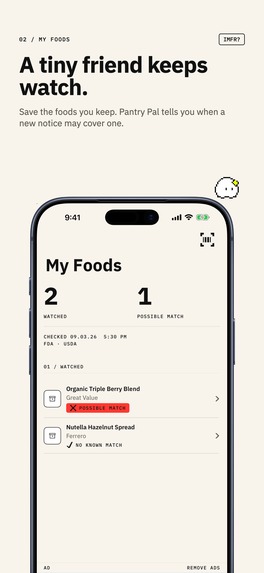
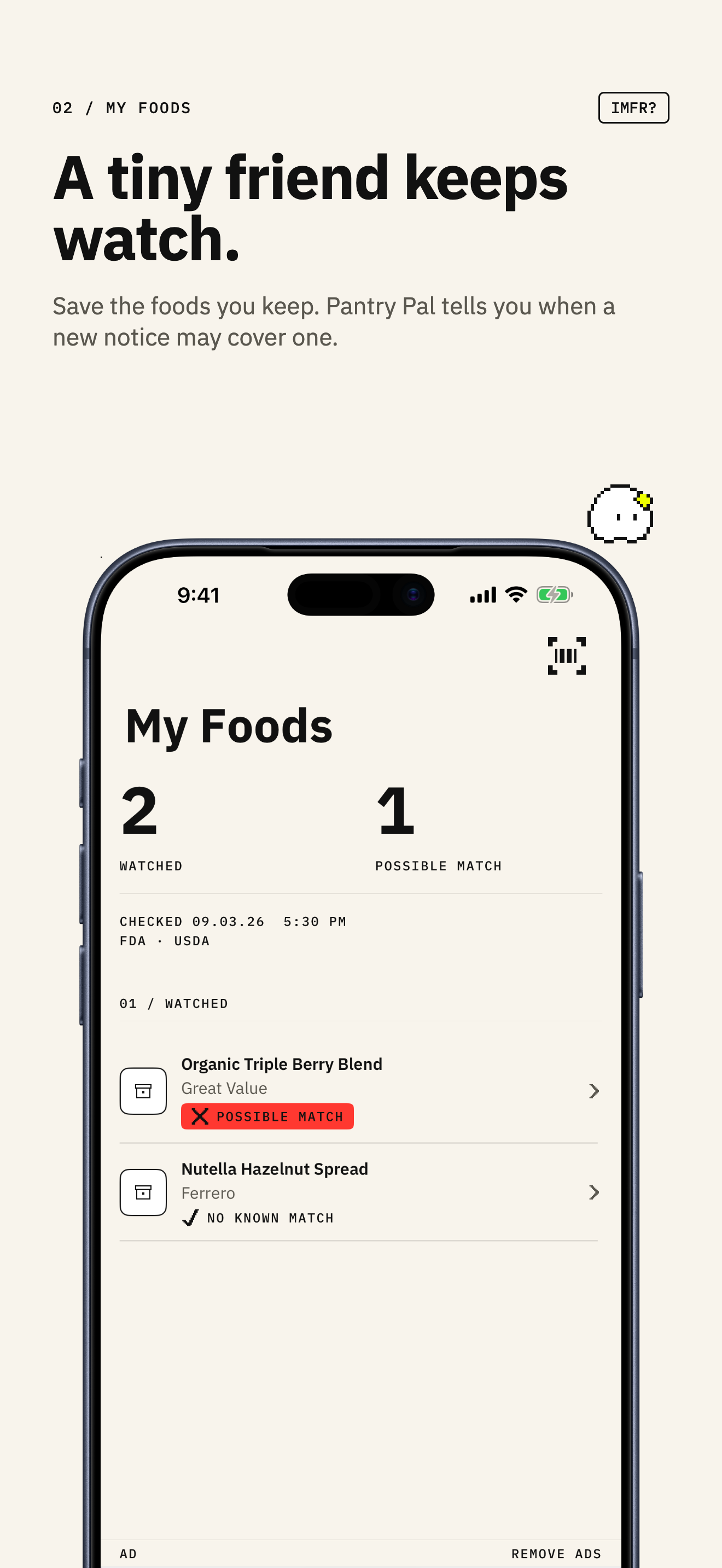
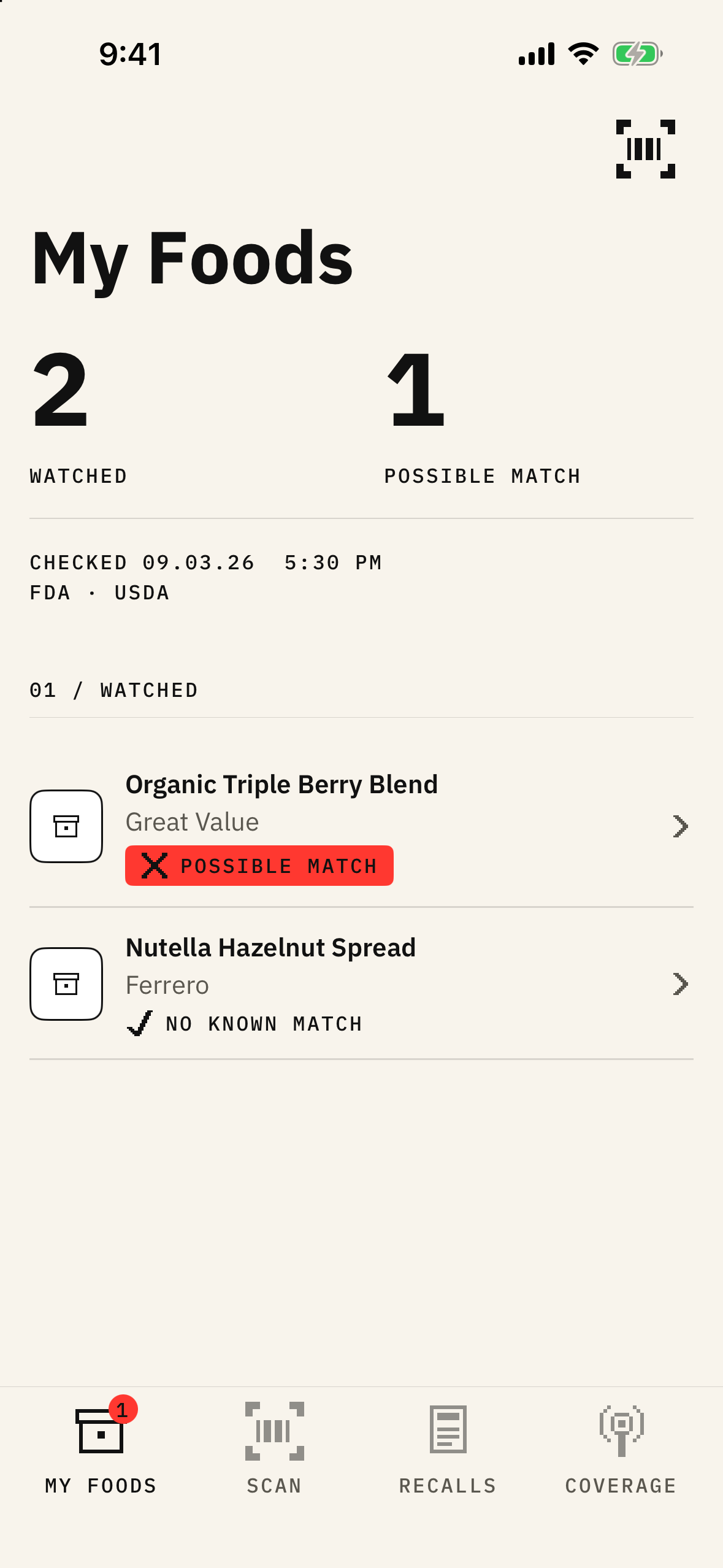
My Foods: every saved food gets the same label, a checked-at stamp, and keeps being rechecked.
-
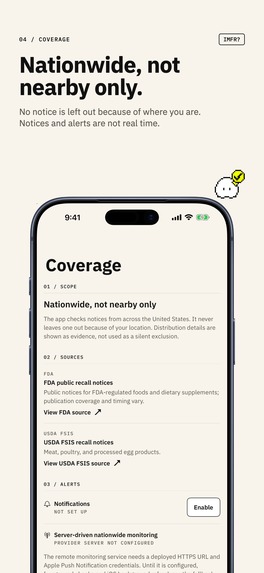
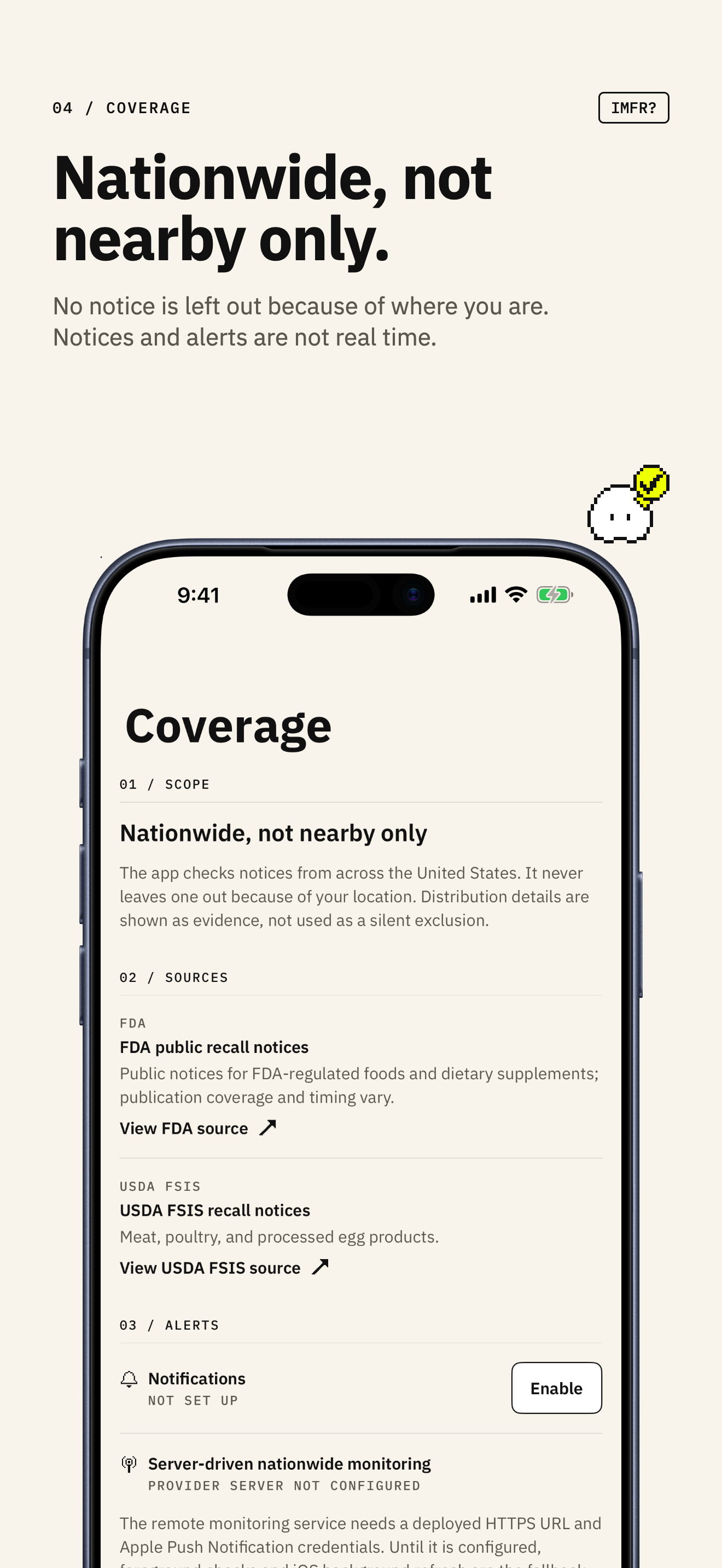
Coverage: FDA and USDA FSIS nationwide, opt-in monitoring and daily digest.
-
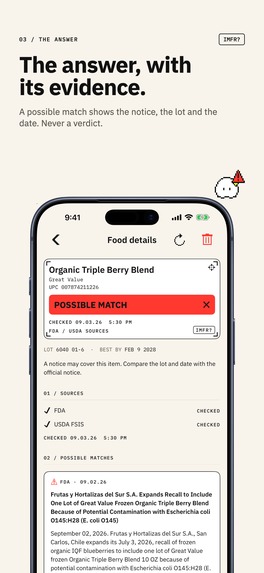
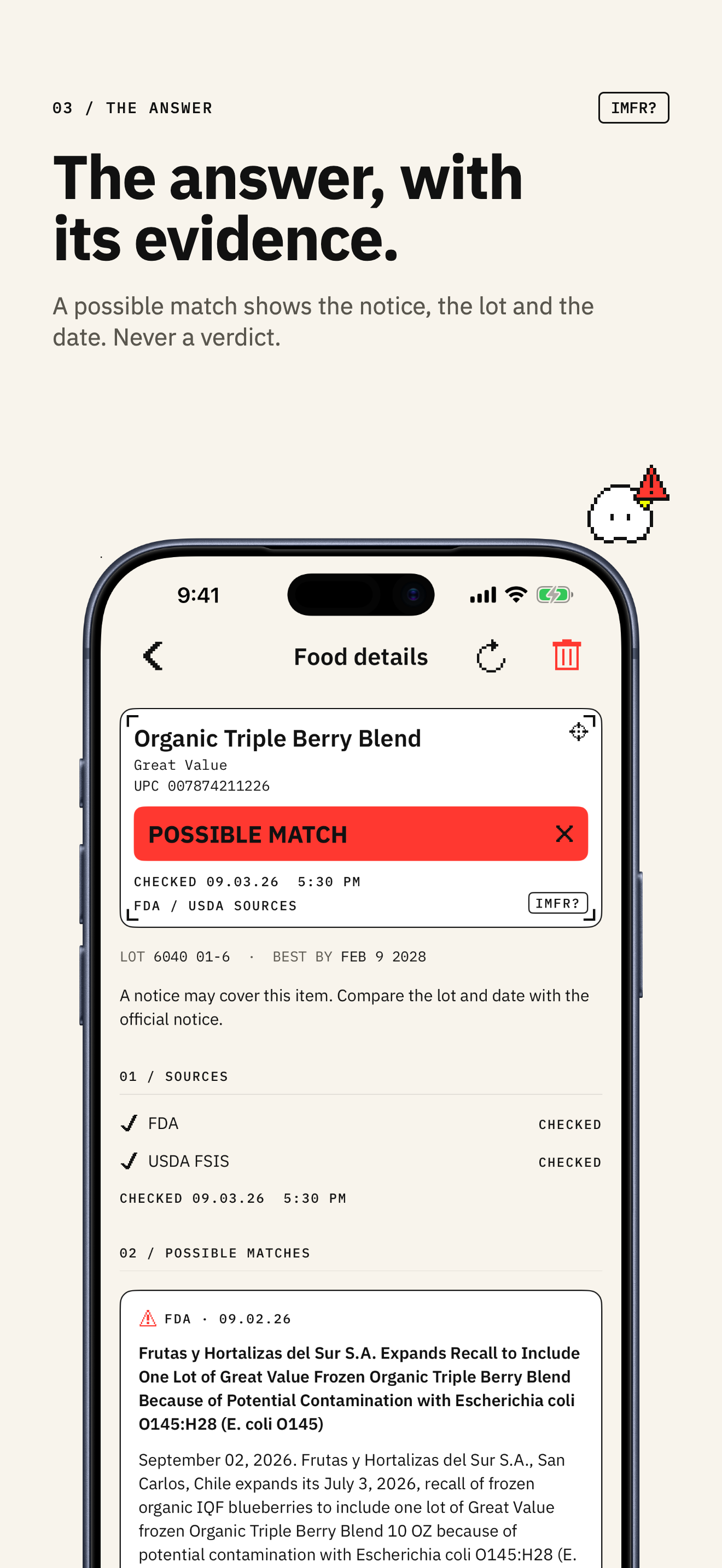
Food details: a possible match with its evidence and a link to the official notice.
-
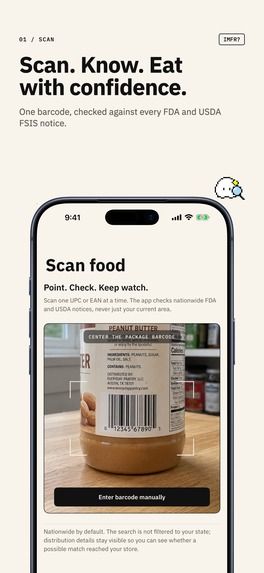
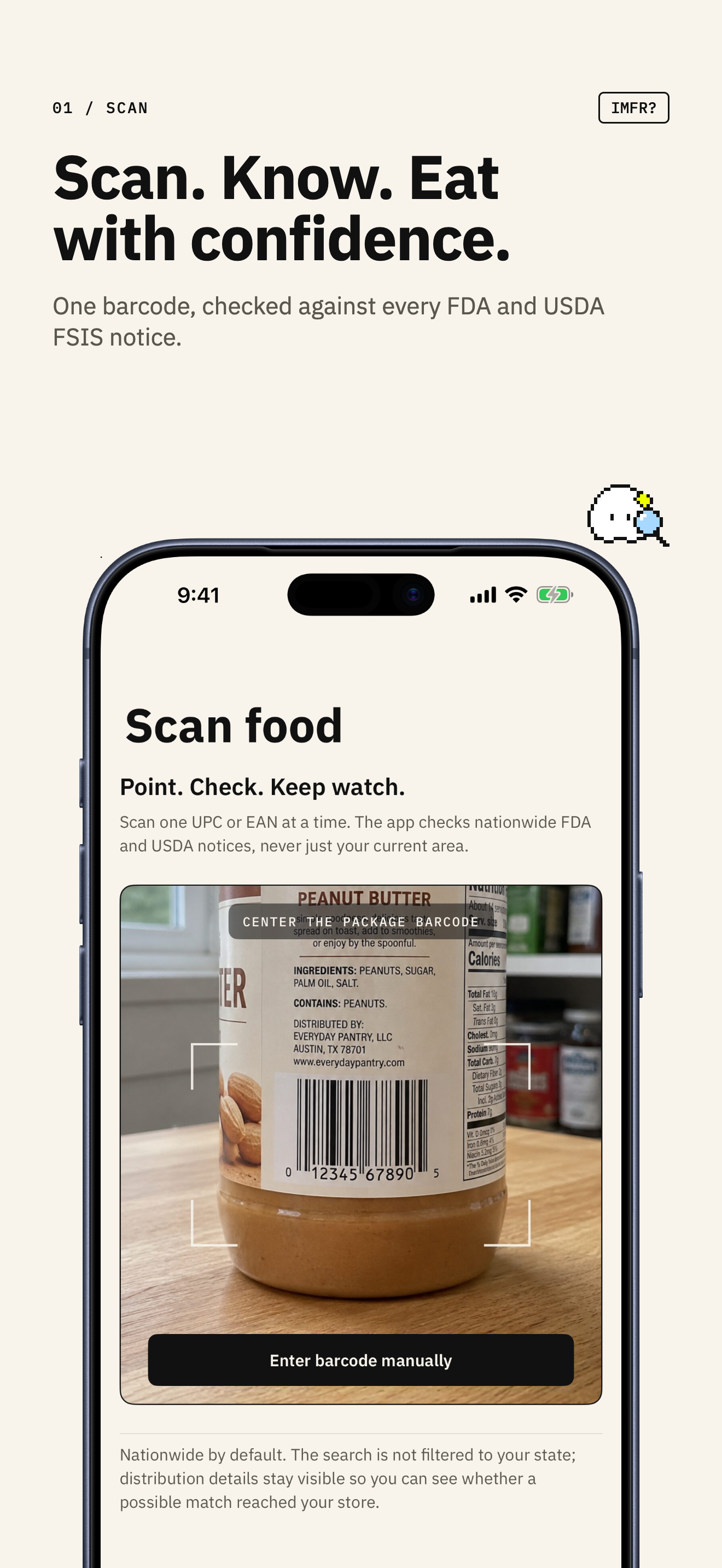
Scan: point the camera at a barcode and the product fills in from Open Food Facts.
-
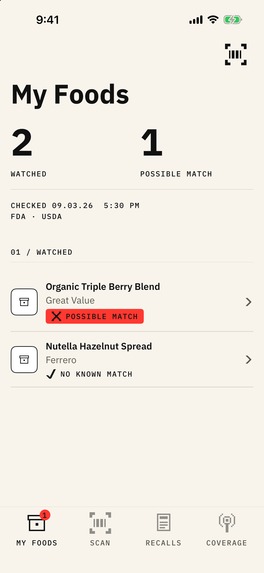
My Foods, 1179x2556, no device frame.
-
App icon, 1024x1024.
What it does
Is My Food Recalled? does one thing: it tells you whether the packaged food in your hand shows up in a recall notice. Point the camera at the barcode (or type it in) and the app checks it against everything FDA and USDA FSIS have published. Nationwide, no location needed. If you save the food to My Foods, the app keeps checking it. Turn on remote monitoring and a small server rechecks both agencies every fifteen minutes, then sends a push only when a new or changed possible match turns up. There is also an optional daily digest of what both agencies published that day, which works whether or not you are watching anything.
Why it never says "recalled"
The app never says "recalled" and never says "safe." It says "possible match" or "no known match," and it shows you why. Government notices often have no barcode in them at all. A recall usually covers specific lots rather than every package with that UPC, and notices show up late and get amended later. So every match lists its evidence (barcode, product name, brand, lot code), keeps the distribution text on screen, and links to the official notice so you can compare the package, the lot, and the date yourself.
Failures get the same treatment. If USDA times out, the result says "partial coverage" instead of quietly showing a clean result.
Privacy
No account, no analytics SDK, no location, and no tracking prompt. Your watch list stays on the phone until you turn on remote monitoring, and turning it back off asks the server to delete it. Camera frames never leave the device; the camera only reads the barcode.
How it makes money
Every recall check is free and stays free. The free version shows one small non-personalized banner at the bottom of the My Foods and Recalls lists. It never appears next to a scan result or a possible match. One subscription, Ad-free Monthly ($1.99) or Ad-free Annual ($9.99, with a one-week free trial), removes the banners and changes nothing else.
How I built it
SwiftUI on iOS 17, VisionKit for scanning, Open Food Facts for product names and images, FDA's Food Safety Recalls feed and the USDA FSIS Recall API for notices. A zero-dependency Node 22 monitor on Fly.io with an atomic JSON store. RevenueCat for the subscription and ad-revenue tracking, Google AdMob for the banners, OneSignal for push delivery in front of APNs. The brand is a DTCG token file that generates the Swift theme, the landing page CSS, and the design boards, so the app, the site, and the docs draw from one set of values.
Judge access
Every feature is free. Ad-free Annual carries a one-week free trial in every region, so the ad-free state can be tested without a code. Scan a packaged food or enter its barcode manually, then review the available recall evidence and save it to My Foods. Matching depends on the product and current source data; the video demonstrates a possible-match result.
RevenueCat Peace Prize
Food recalls are public information that almost nobody reads. FDA and USDA publish hundreds of notices a year as prose, on websites most people never visit, and the notices rarely include a barcode. Somewhere between "the government published a warning" and "the person with that box in their pantry found out" is where people get sick. I built this to close that gap for one household at a time: scan what you bought, keep it on a list, and let the list watch the notices for you. The part that matters is free and needs no account. And it never claims more certainty than the data supports, because a false "safe" would be worse than no app.
RevenueCat Design Award
The design is a label maker, not a dashboard. Every saved food gets the same small label: product name, UPC in mono, a status block filled Safety Yellow for "no known match" or Alert Red for "possible match," and a checked-at stamp. Six colors, two typefaces (IBM Plex Sans for sentences, Plex Mono for facts), an 8-point grid, and a 1-pixel ink outline on every fill so nothing floats. Pantry Pal, a 28-cell pixel character, changes pose with the app's state: scanning with a magnifier, watching, all clear, alert. The app icon is the "IMFR?" tag on a yellow tile with the Pal peeking in from behind. The pixel art is rendered from text grids, so it stays exact at every size. Motion is tuned springs, never stock fades, and Reduce Motion drops to opacity. Look at My Foods for the labels, Food details for the evidence card, and the scan screen for the recognition frames that appear the instant the camera locks on.
Catvertising Award
Ads live in exactly two places: the bottom of the My Foods list and the bottom of the Recalls list. Not on the scan screen and not next to a result, because a safety verdict with an ad under it reads as sponsored. Every request is non-personalized, the app never shows the App Tracking Transparency prompt, and the ads SDK is initialized lazily from the first banner slot, so a subscriber's phone never even loads it. Impression-level revenue flows to RevenueCat through its AdMob adapter, which puts the ad line and the subscription line in one dashboard. The subscription's only job is to remove the banners, and the paywall says so in one sentence.
HAMM Award
The strategy is small on purpose: a free, complete product with two banner placements, and one subscription whose entire value is the absence of those banners. No gated features and no lifetime unlock. Monthly at $1.99 for the person who wants the banners gone this week; annual at $9.99 with a one-week trial for the person who keeps a pantry list year-round. Entitlement state is cached, so a subscriber never sees a banner flash while offline. Results: the app went live on September 16, 2026 after one App Review round; verified ad-impression, trial, conversion and revenue results are not yet available for this submission.
Keep Them Coming Back (OneSignal)
OneSignal delivers every push, sitting in front of APNs with an automatic fallback. Three kinds of message, all opt-in: a possible-match alert when a watched food's recall status changes, a daily digest of newly published FDA and USDA notices, and a Journey that sends each new install one push two days later pointing at the Recalls tab, so people see what the agencies published during their first week. Deep links route each notification to the right screen (the affected food, or the Recalls list). No marketing pushes and no re-engagement nags; every message is a fact the person asked for.
Grand Prize
Shipped to the App Store on September 16, 2026, submitted the moment the design system and the safety copy were settled rather than waiting for more features. Post-launch work includes the app landing page and a public product demonstration: https://youtu.be/zBlYVek3_NE. Verified download, monitoring opt-in, digest opt-in, push-delivery and trial results are not yet available for this submission.
Demo footage
The berry-package scanner footage is AI-generated illustrative footage composited into the app UI. App results and walkthroughs are recorded app footage; the notification and ad sequences use a demo/test setup.

Log in or sign up for Devpost to join the conversation.