Inspiration
You are three weeks into a $38 serum, standing at the bathroom mirror. Is your skin better, or is it just the lighting today?
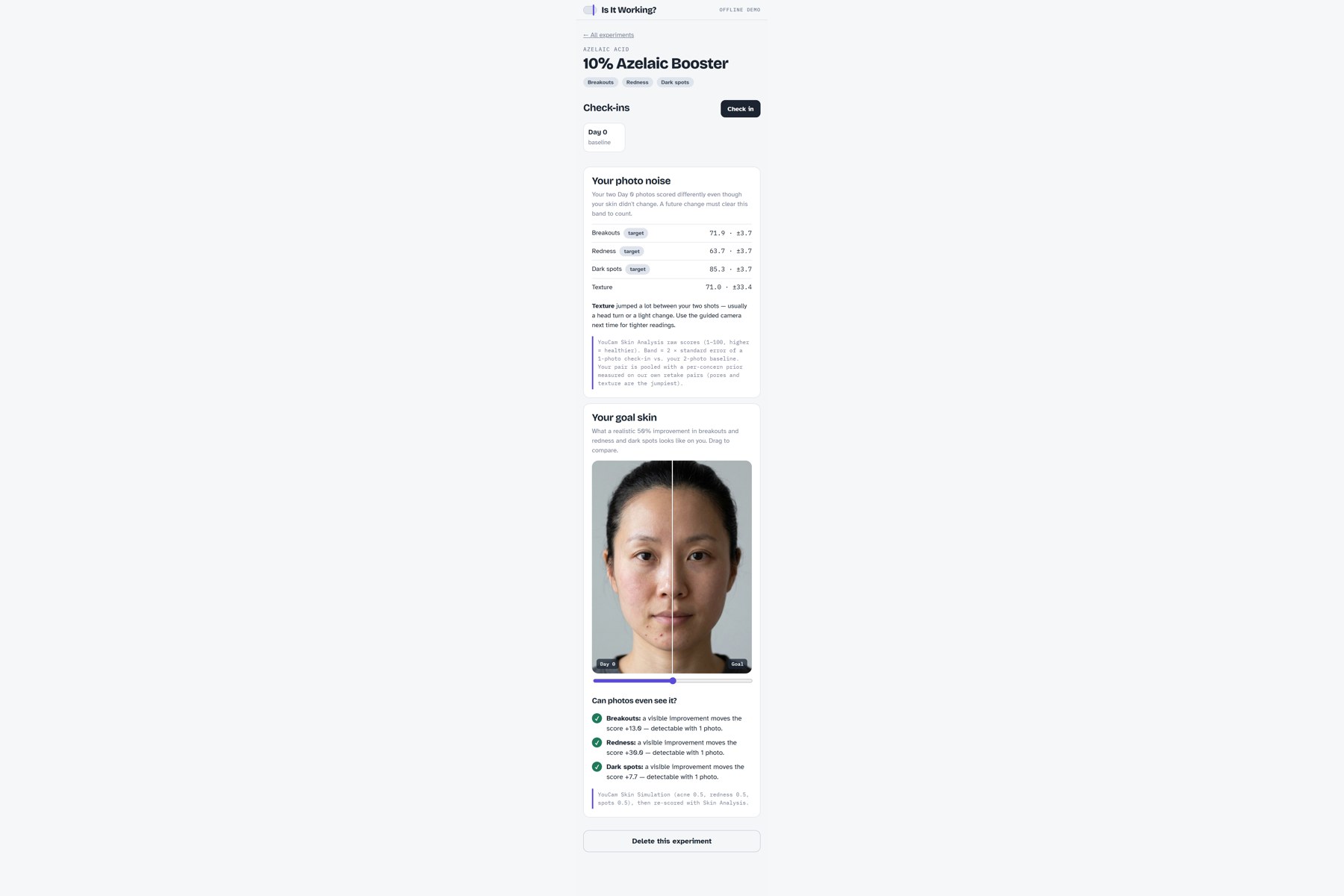
We tried it with the YouCam Skin Analysis API on one synthetic face. Two photos taken a minute apart scored 38 and 50 on pores. Nothing about the skin changed, yet the score moved 11.7 points. Most before/after apps would show a gap like that as progress. We wanted something that knows how much photos wobble before it says anything.
What it does
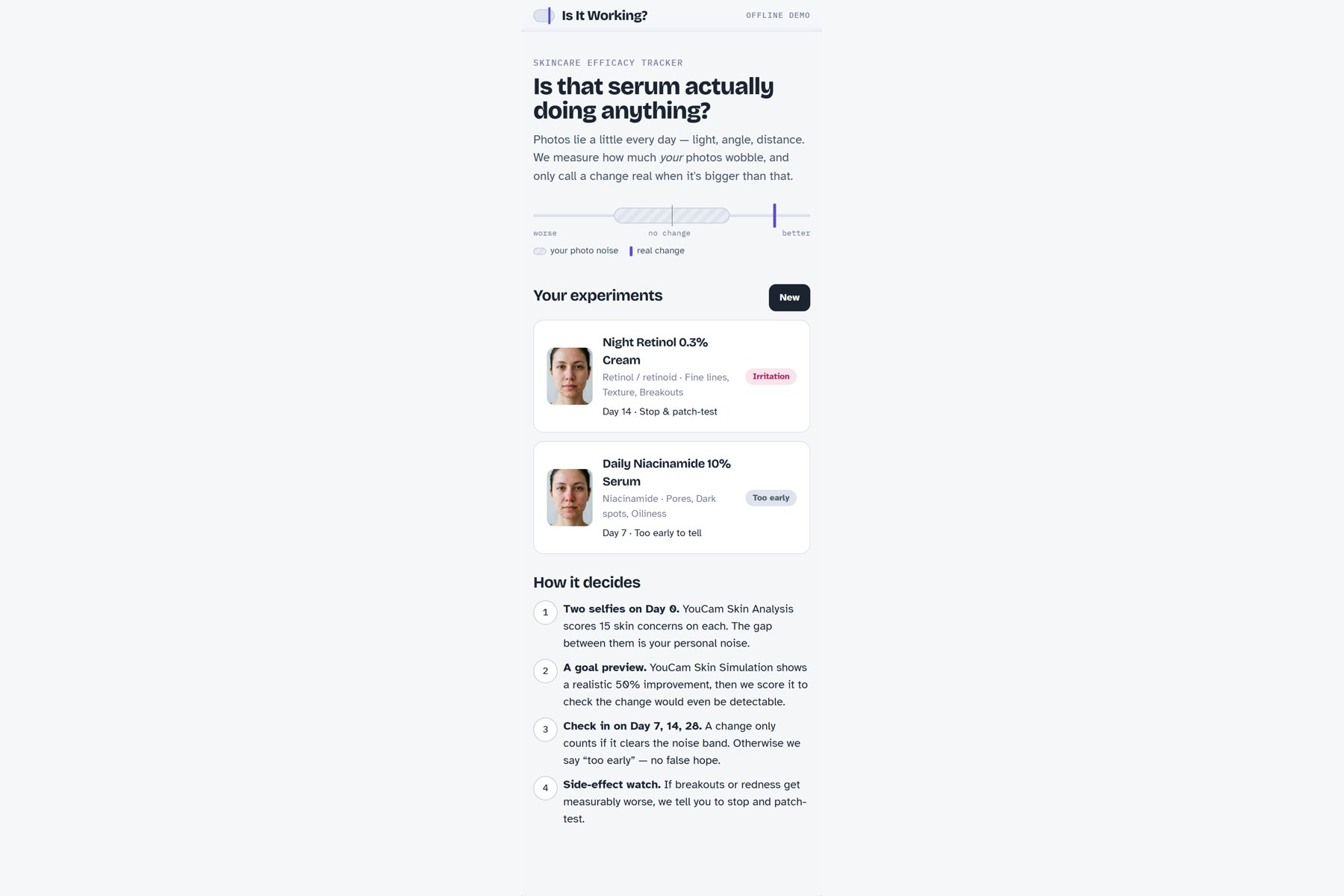
Is It Working? treats every skincare product as a small experiment.
- You register a product and its key active (azelaic acid, niacinamide, retinol and so on). The app pre-selects the concerns that ingredient targets.
- On Day 0 you take two selfies a minute apart. The gap between their scores is your personal noise band.
- YouCam Skin Simulation renders a 50% improvement on your own face. We score that image too, so the app can tell whether a real improvement would even show up in a photo, or whether you need two photos per check-in.
- On Day 7, 14 or 28 you check in. A change only counts when it is larger than the noise band.
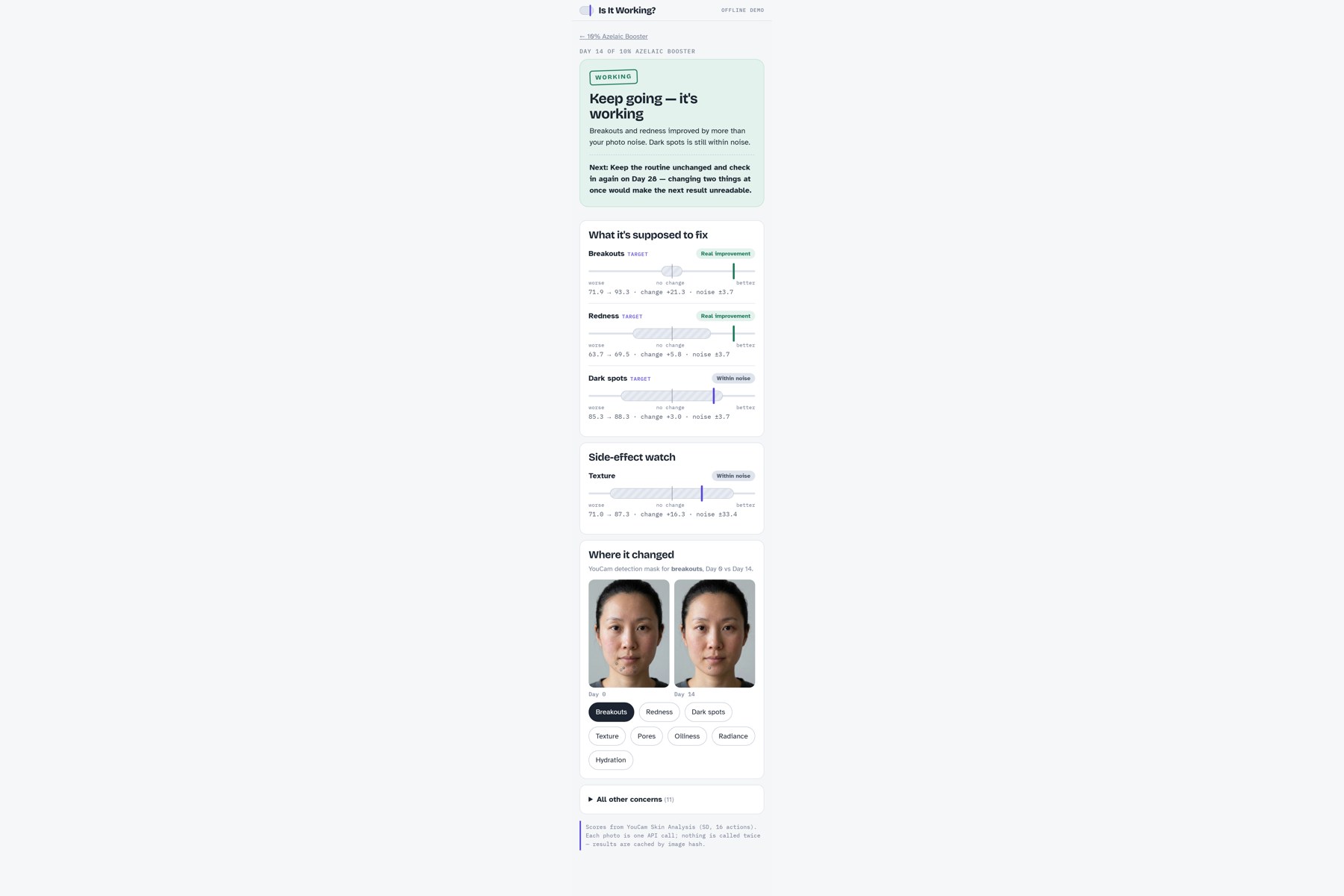
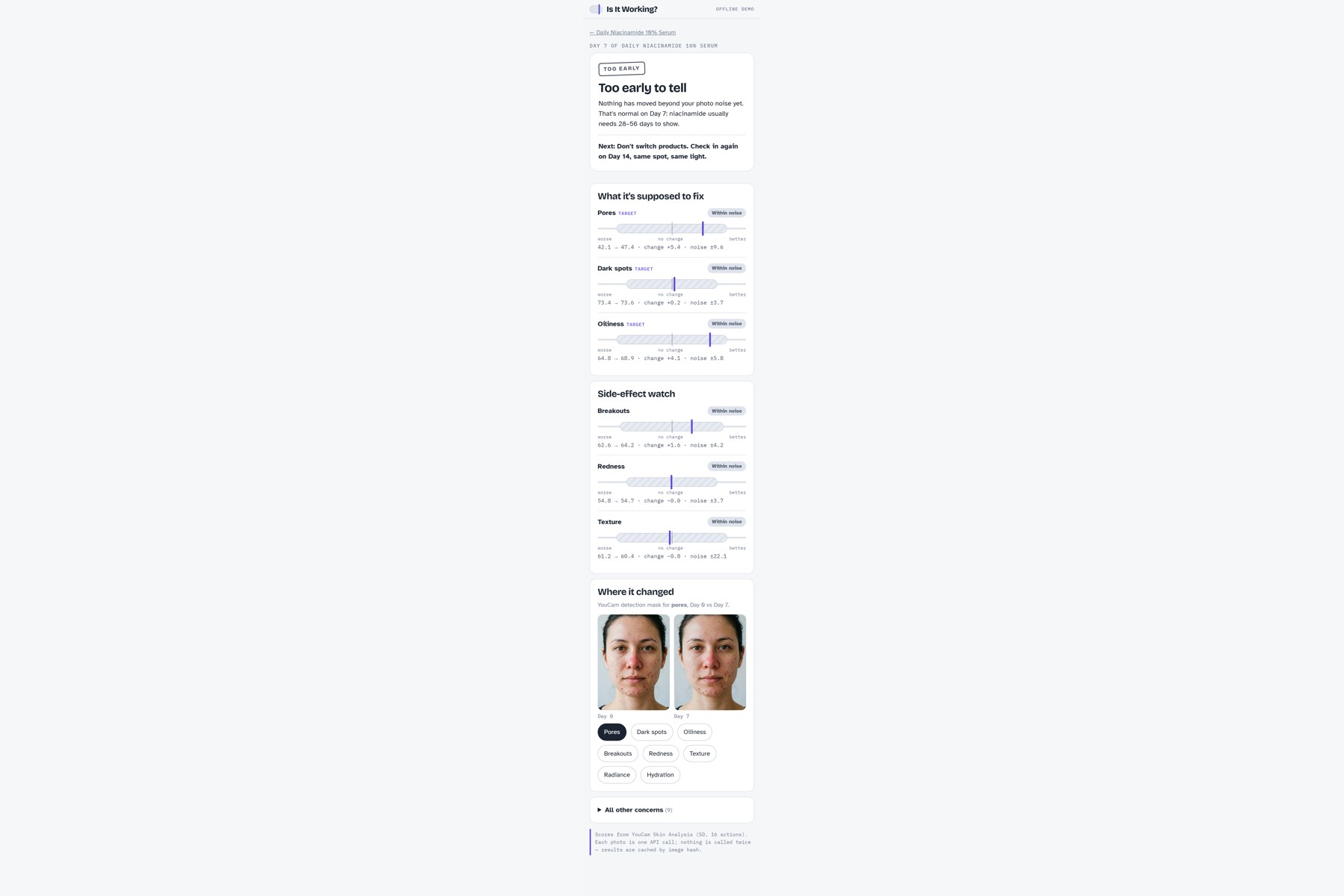
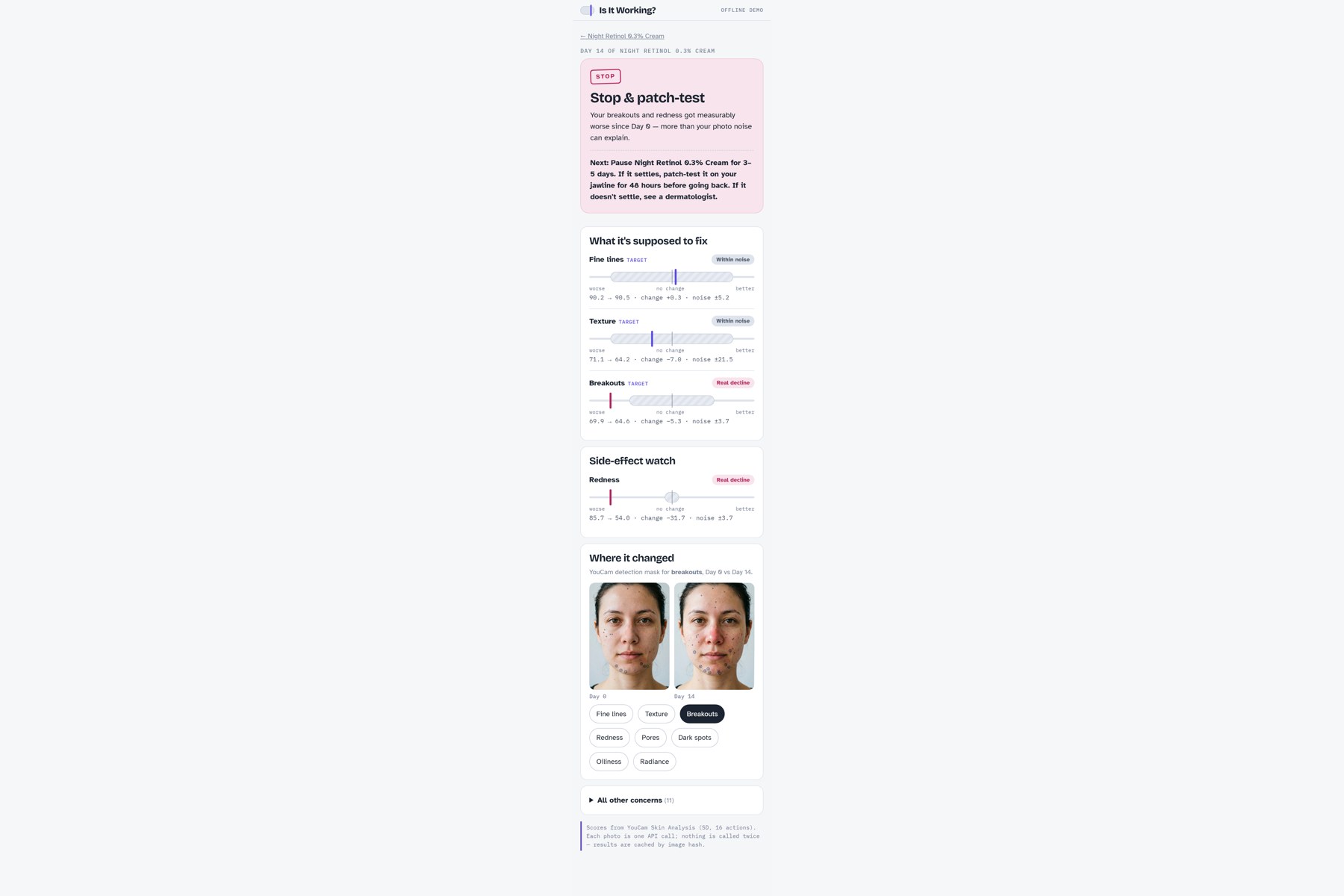
You get one of four answers: Keep going, Too early to tell, Stop and patch-test (breakouts or redness got measurably worse), or Probably not working. "Too early" is a normal answer, not an error.
How we built it
Node and Express on the server, a single-page vanilla JS front end, Playwright for end-to-end runs. The API key stays on the server.
YouCam APIs used:
- File API (
POST /s2s/v2.0/file, then a PUT to the signed URL): uploads every photo. - AI Skin Analysis (
/s2s/v2.0/task/skin-analysis, and v2.1 withpf_camera_kit): 15 concerns plus skin type, and the detection masks for the "where it changed" view. - AI Skin Simulation (
/s2s/v2.0/task/skin-simulation): the goal preview, and the expected score change used for the detectability check. - AI Image Generator (
/s2s/v2.0/task/text-to-image/youcam): generated the synthetic face behind the sample experiments, so no real person appears. - JS Camera Kit (skincare mode): wired in for optional guided capture, but not yet tested on a real camera.
Every analysis is cached by a hash of the image bytes, so a photo is never billed twice and the recorded demo replays cached responses offline.
The rule is simple on purpose: a change is real when it is at least 2 standard errors, with the noise taken from your Day 0 pair pooled with a per-concern prior.
Challenges we ran into
- The noise prior is thin. It comes from three same-day retake pairs of synthetic images. That stops one lucky pair from looking falsely stable, but it is not a calibrated population estimate and needs real, consented data.
- Texture and pores swing the most when the head turns or the light shifts (texture band about ±21 in one sample), so many concerns end up "within noise". We kept that result instead of hiding it.
- Our sample "retakes" are re-crops and exposure shifts of one generated image, and the retinol "irritation" case is a constructed scenario. Both are labelled in the README and the demo.
- Making the app honest about uncertainty was harder than computing a score.
Accomplishments that we're proud of
- On the bundled samples the rule separates the answers: breakouts +21.3 against a ±3.7 band reads as real, while pores +5.4 against ±9.6 on Day 7 reads as too early instead of a false "it's working".
- The app is willing to say it can't tell yet.
- Every face, screenshot and the demo video are synthetic and labelled that way.
What we learned
AI skin scores are noisy at the scale people care about, so the useful move is to tell the user how big the noise is, not to polish the score. The detectability check also changed our advice: for some concerns one photo cannot settle the question, and saying so beats printing a number.
What's next
Ideas, not features that exist today:
- Calibrate the noise prior on consented real photos across skin tones and cameras.
- A retailer-side widget on product pages ("is this serum working?").
- Reminders for same-spot, same-light check-ins.
AI disclosure
Claude (an AI assistant) proposed the concept and wrote most of the code and text; the entrant reviewed and approved them.
Built With
- express.js
- node.js
- playwright
- sharp
- youcam-api
