Skincare takes weeks to work, and photos wobble. We measure whether a product beats the wobble.
Inspiration
Skincare works over 6 to 12 weeks, but people judge it in the mirror, by feel. Some drop a good product after 10 days. Others keep using one that does nothing, or irritates them, for months. Both waste money.
Most skin analysis tools treat the score from one photo as a fact. But a photo score moves with lighting, angle, distance and camera. So we asked a different question: how much of a change is real, and how much is photo noise?
What it does
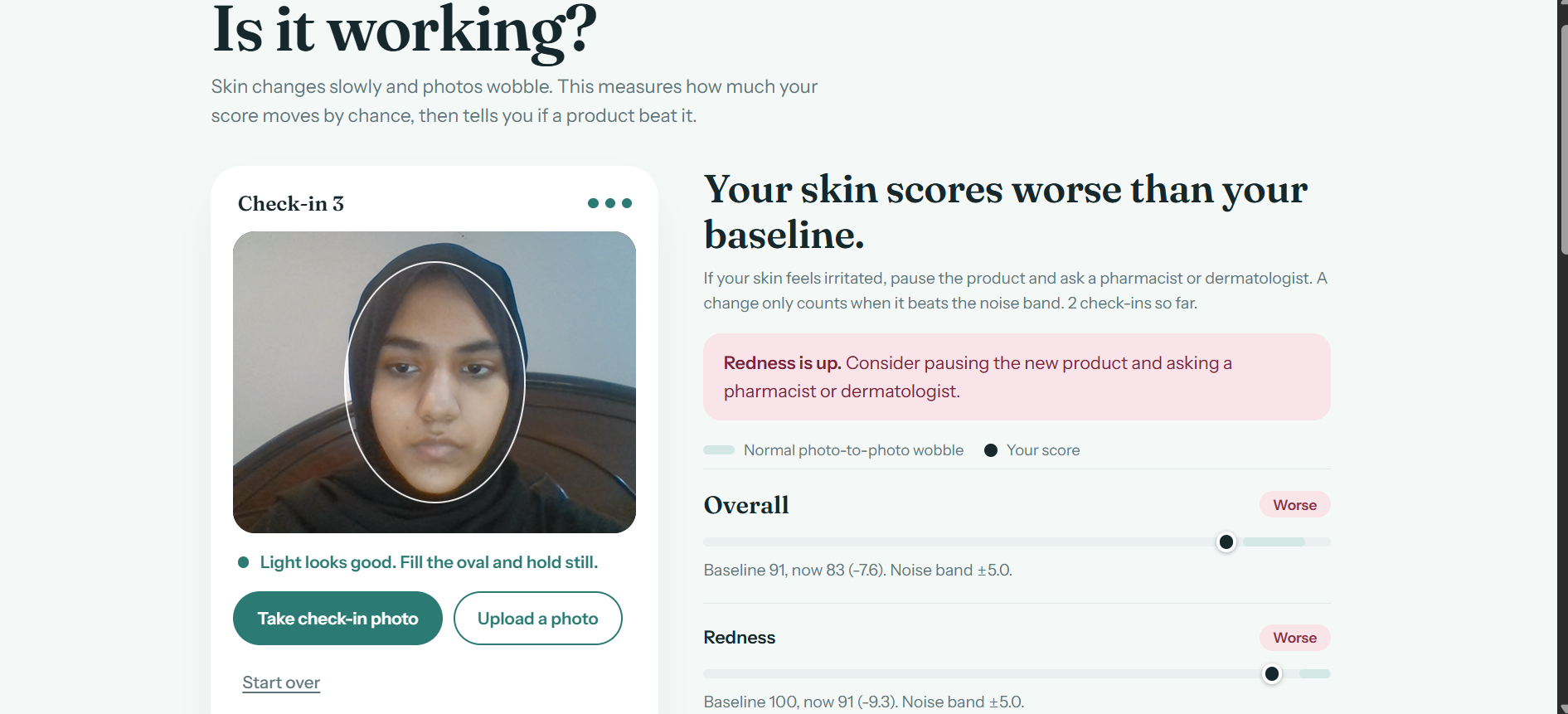
Is it working? tracks a skincare product against your own photo-to-photo noise.
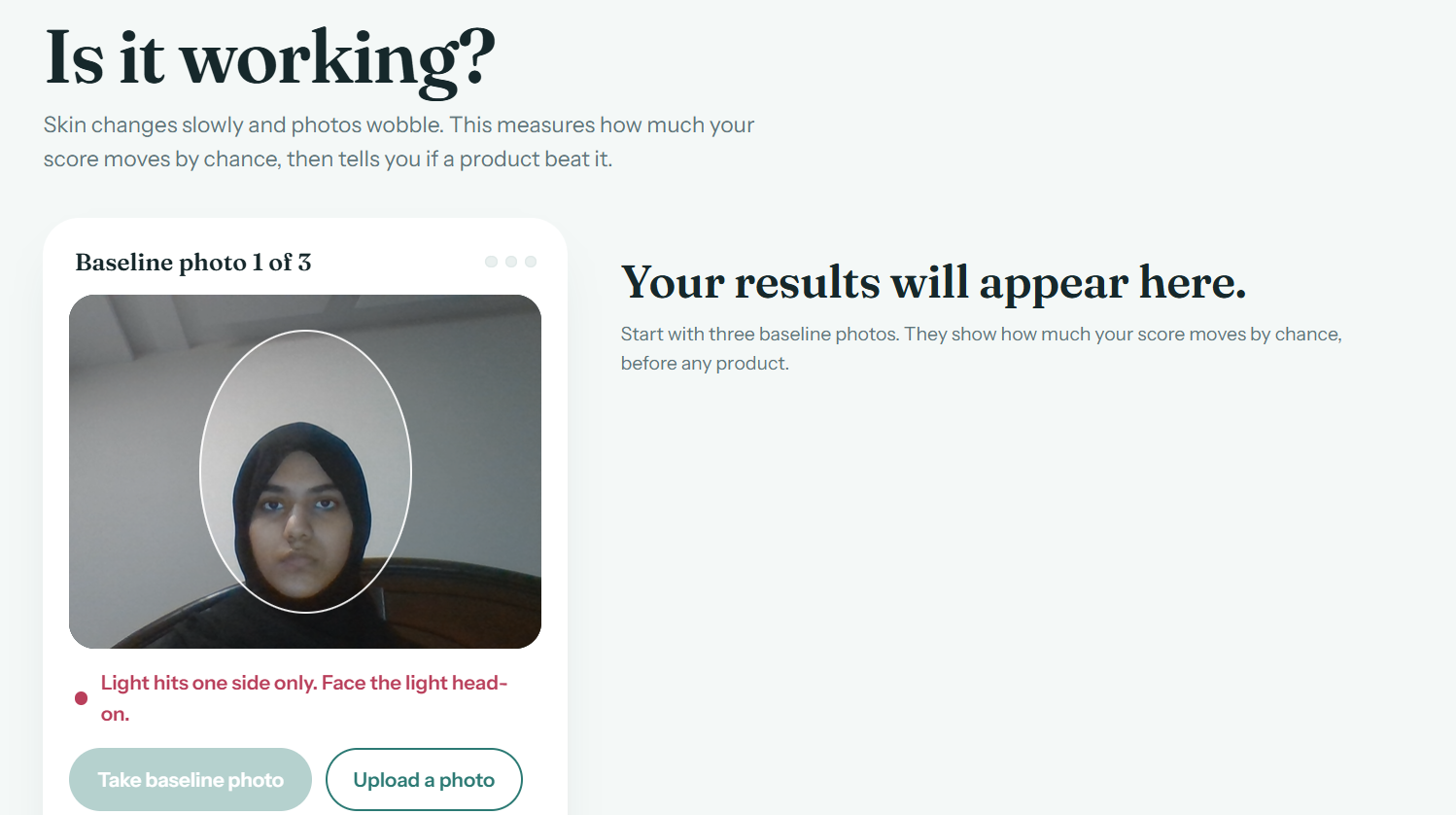
- Lighting check. The browser checks lighting before upload, so we avoid wasting API units on dark photos.
- Baseline. Three photos are analyzed with the YouCam Skin AI API. The spread between them becomes your personal noise band for each metric.
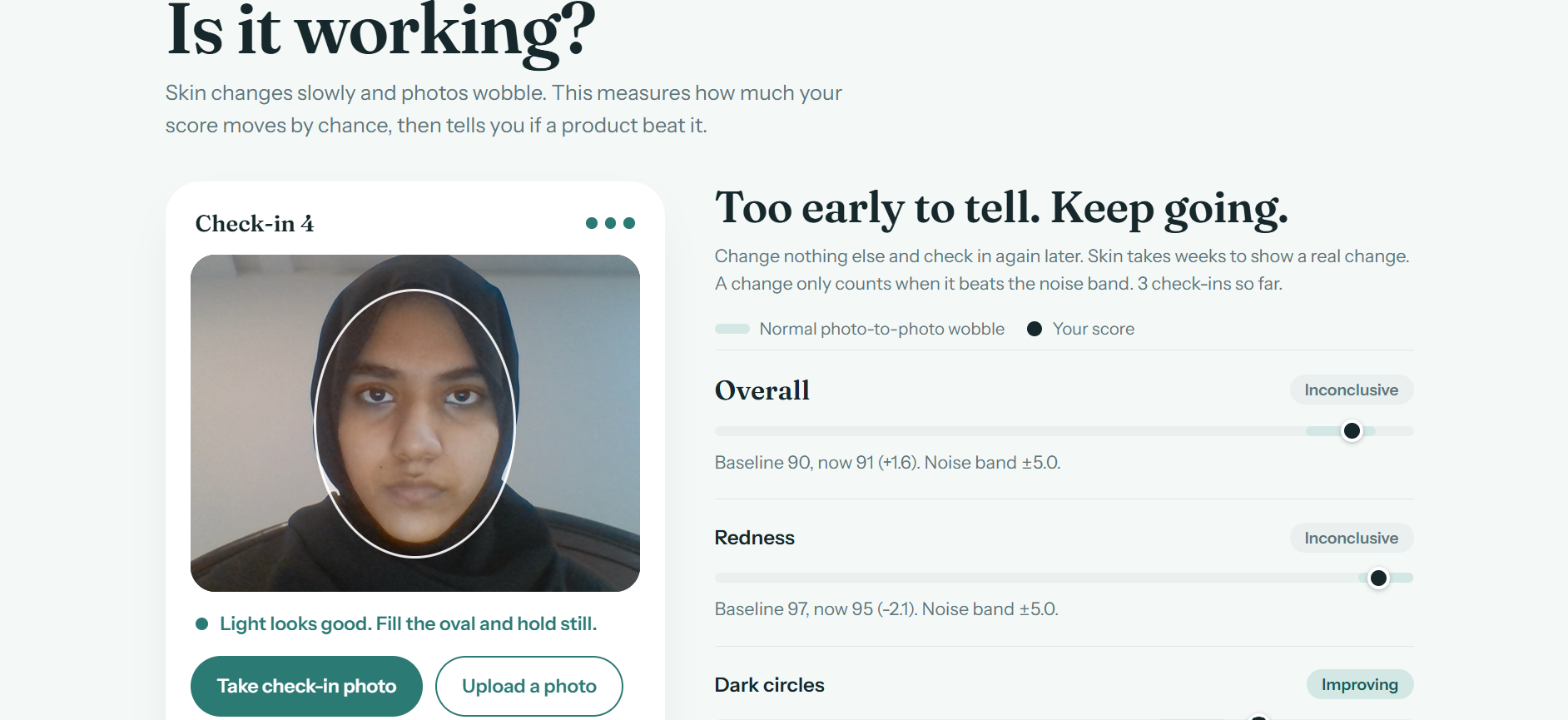
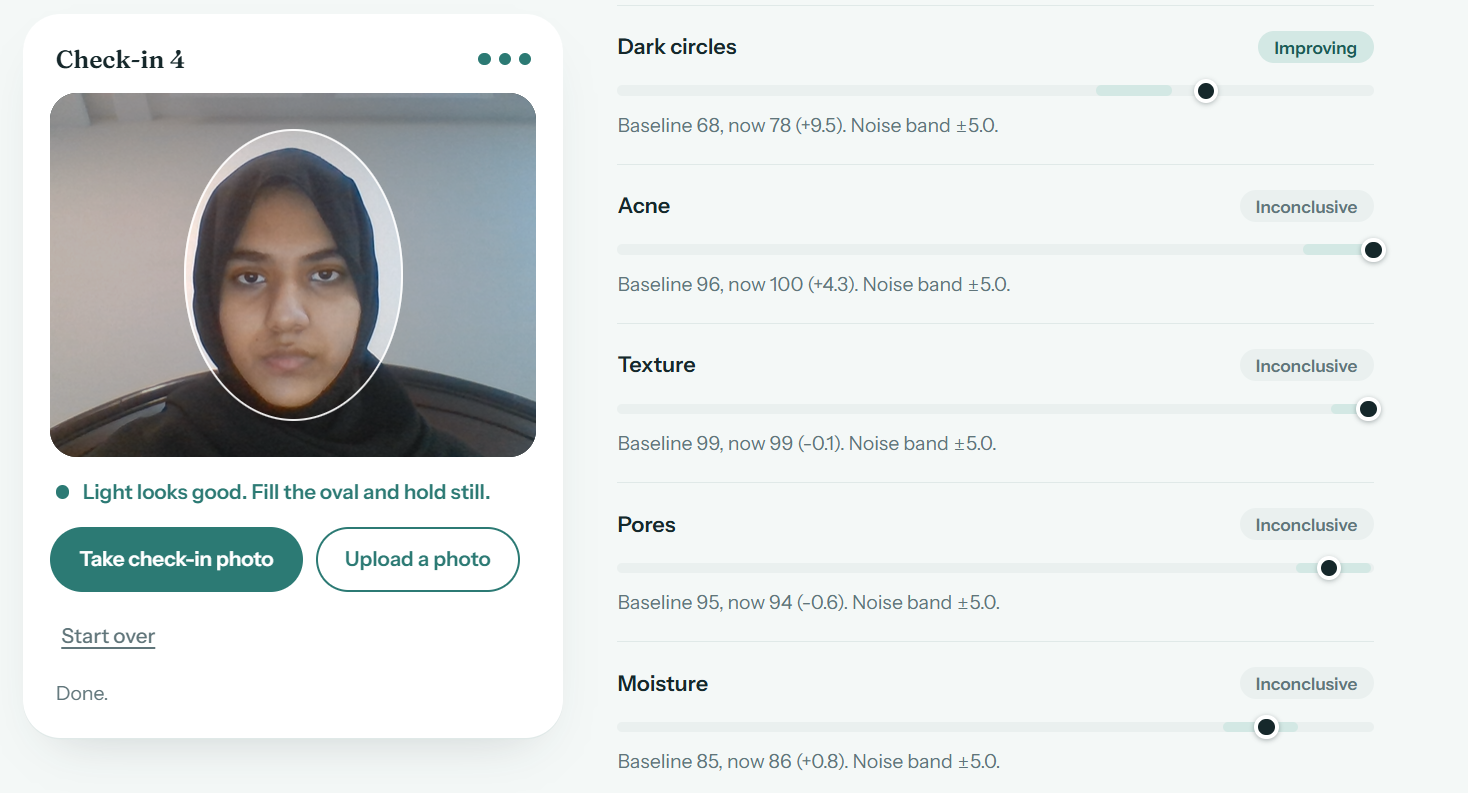
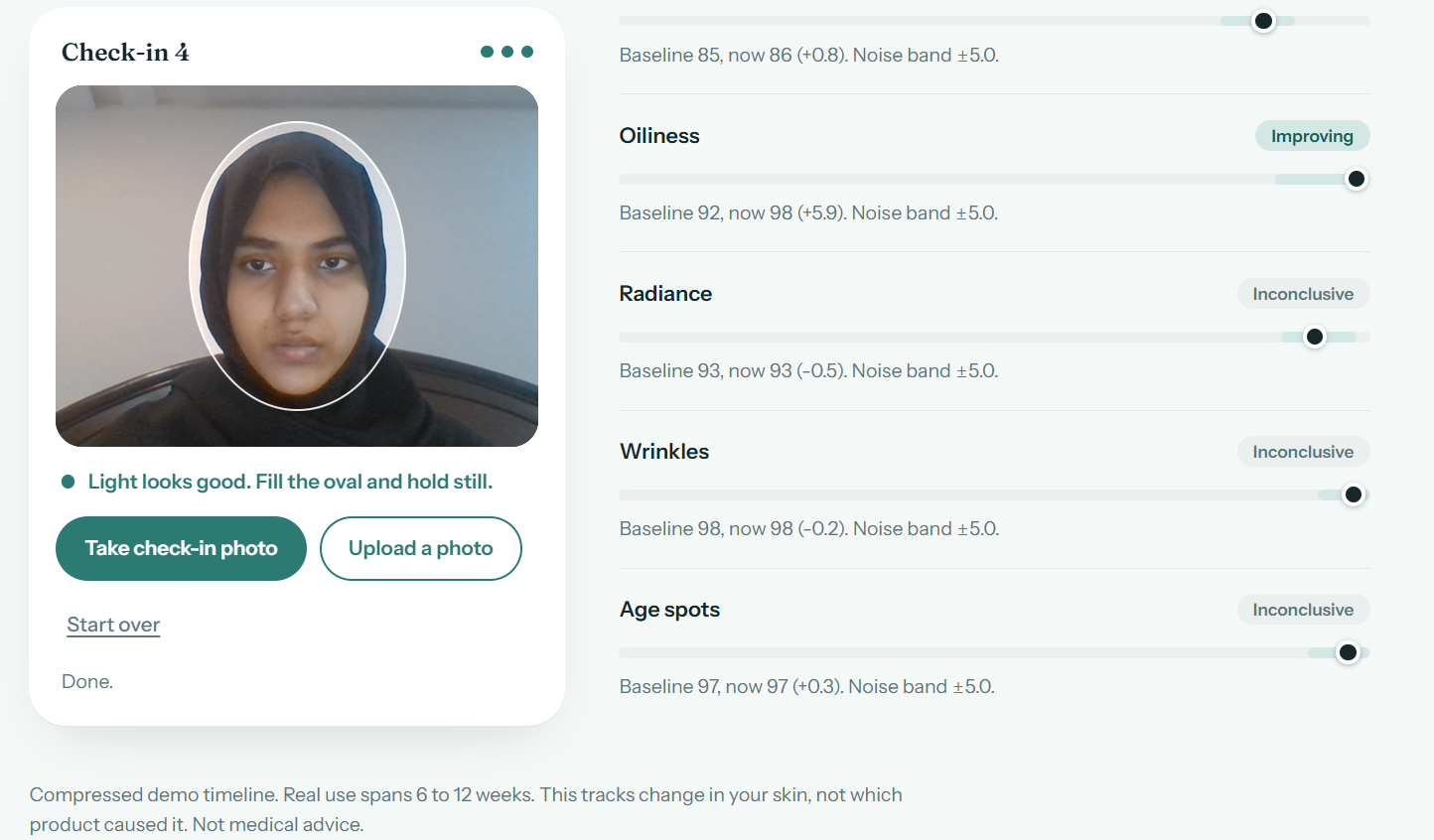
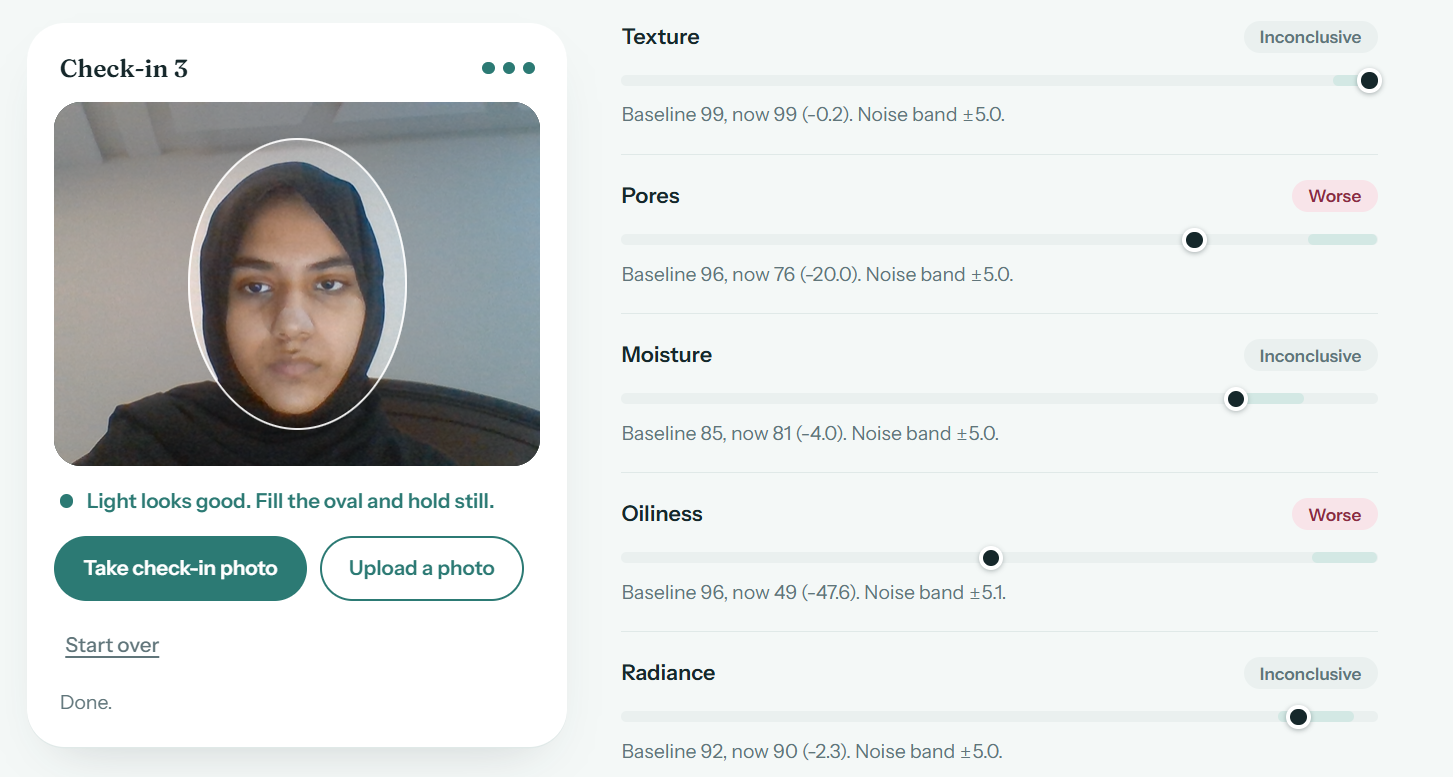
- Check-in. A new photo is compared with your baseline median. A change counts as Improving or Worse only if it beats the noise band. Otherwise the verdict is Inconclusive.
- Too noisy to judge. If a metric swings too much across near-identical photos, the app gives no verdict for it.
- Redness alert. If redness worsens beyond the noise band, the app suggests pausing and asking a pharmacist or dermatologist. It makes no medical claims.
We deliberately do not recommend products. Scores this noisy cannot justify it.
How we built it
- YouCam Skin AI API. We upload the photo, start a skin-analysis task, poll until it finishes, and read the per-concern scores (we use
raw_score). - A small Node.js server with no dependencies keeps the API key out of the browser, handles upload and polling, unzips the result file, and returns only the scores.
- A single-page HTML and JavaScript front end with the lighting check, the baseline and check-in flow, and a noise-band chart. Data stays in the browser. No accounts, no database.
Challenges we ran into
- YouCam rejected many laptop webcam photos (
error_lighting_dark,error_large_face_angle,error_src_face_too_small). We added center cropping, a face guide, a stricter lighting check, and photo upload. - Results arrived as a ZIP file holding JSON keyed by concern name. We wrote a small ZIP reader.
- Real noise is large. In our baseline, oiliness varied by about 29 points between photos, so the app refuses to judge it.
- Different faces score very differently. When we mixed in a photo of another face, the scores jumped. Every user needs their own baseline.
- Ceiling effects. Redness, texture, wrinkles and age spots sit near 100, so they can mostly show "worse," not "better."
- Limited API units. Each analysis costs 16 units, so we tested carefully.
Accomplishments that we're proud of
- A working end-to-end pipeline built in about a day, tested with real photos.
- A personal noise band for every metric, instead of treating a skin score as a fact.
- An app that says "too noisy to judge" instead of inventing a verdict.
What we learned
- A skin score is a noisy measurement, and an honest product should show that noise.
- Capture quality matters as much as the model.
- "Inconclusive" is more useful than a confident wrong answer.
What's next for Is it working?
- A real 6 to 12 week trial. Our demo timeline is compressed.
- More photos per baseline. Three is a small sample. More would let us tune the 12 and 5 point thresholds, which are starting guesses today.
- Stronger capture checks for face angle and distance, not just lighting.
- One product at a time. Guide users to change one thing, so a change can be tied to one product.
- Known limits. We assume higher scores mean healthier skin. We tested on a small set of photos, not across many skin tones or phones.
We will keep one rule as we grow: no product recommendations until the measurement is trustworthy enough to justify them.
