-
-
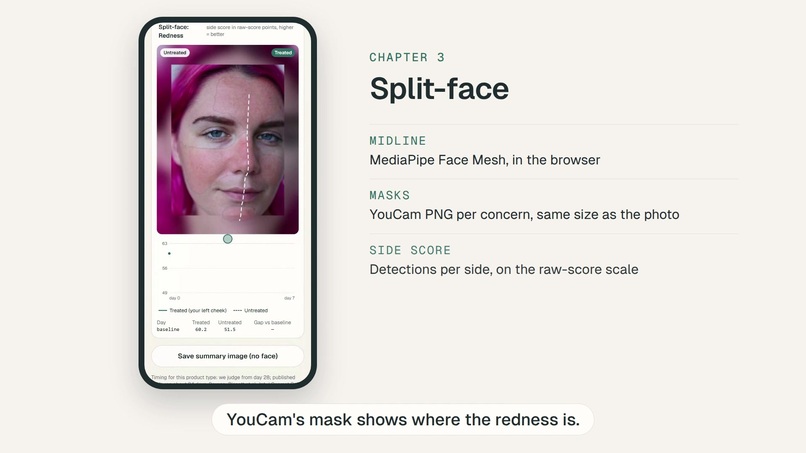
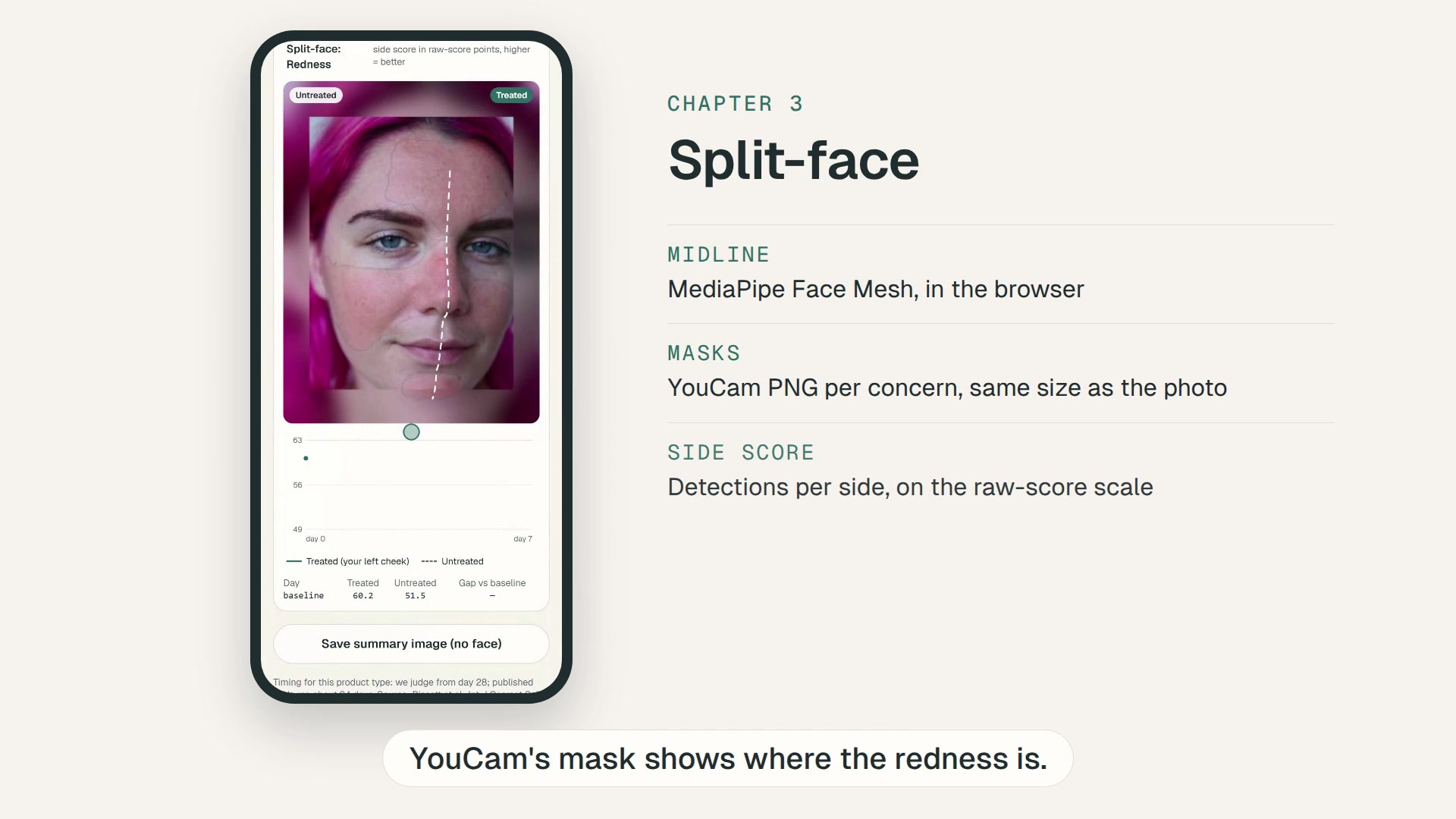
Split-face: Face Mesh midline + YouCam's redness mask, each side scored from the same photo
-
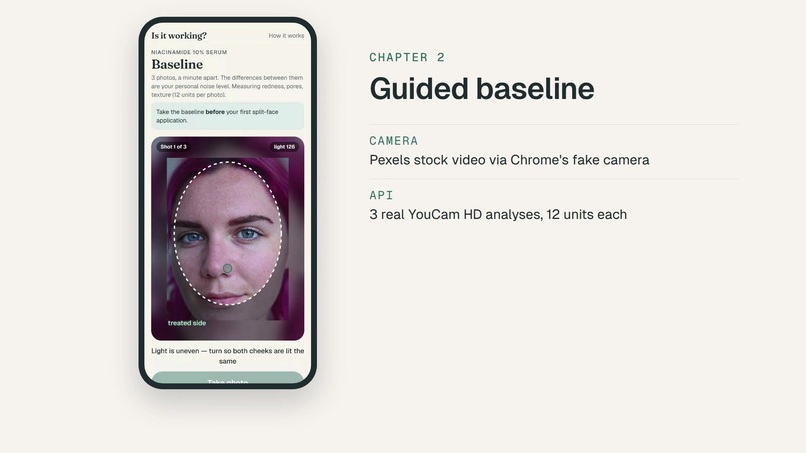
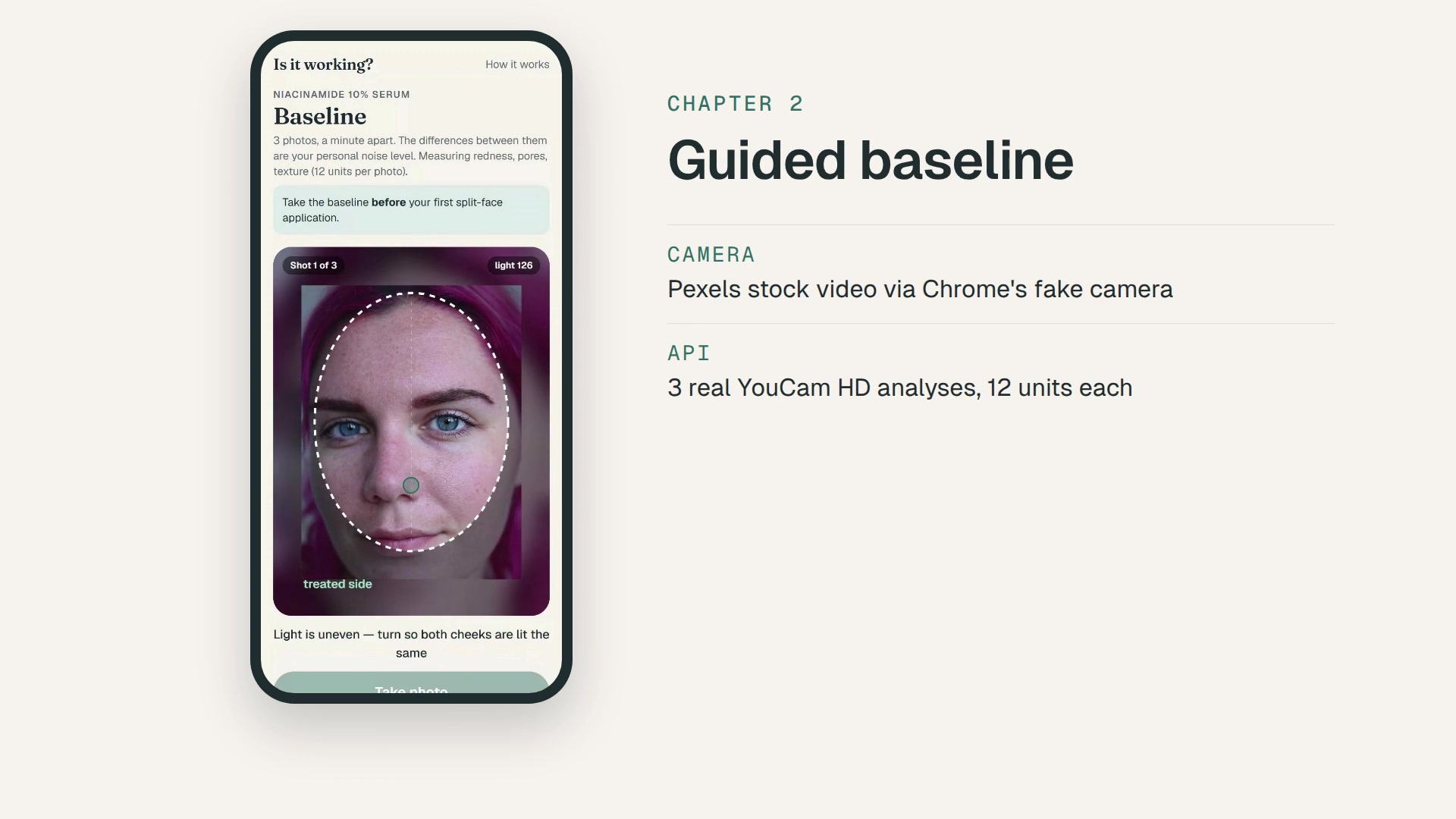
Guided baseline: live checks for face size, angle, even light and stillness
-
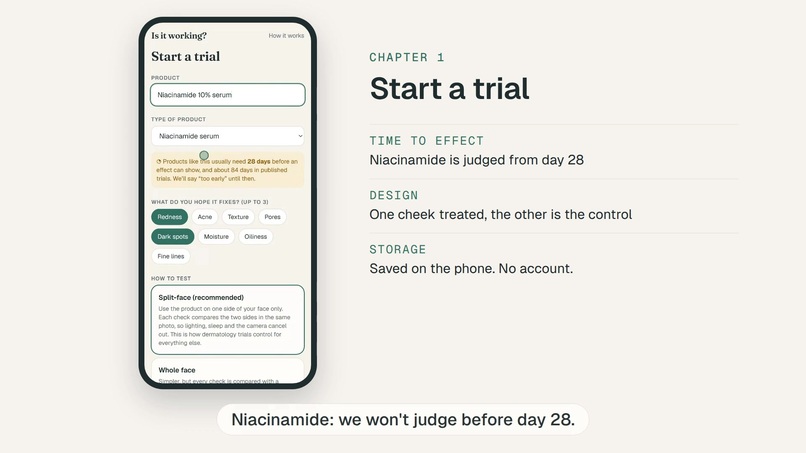
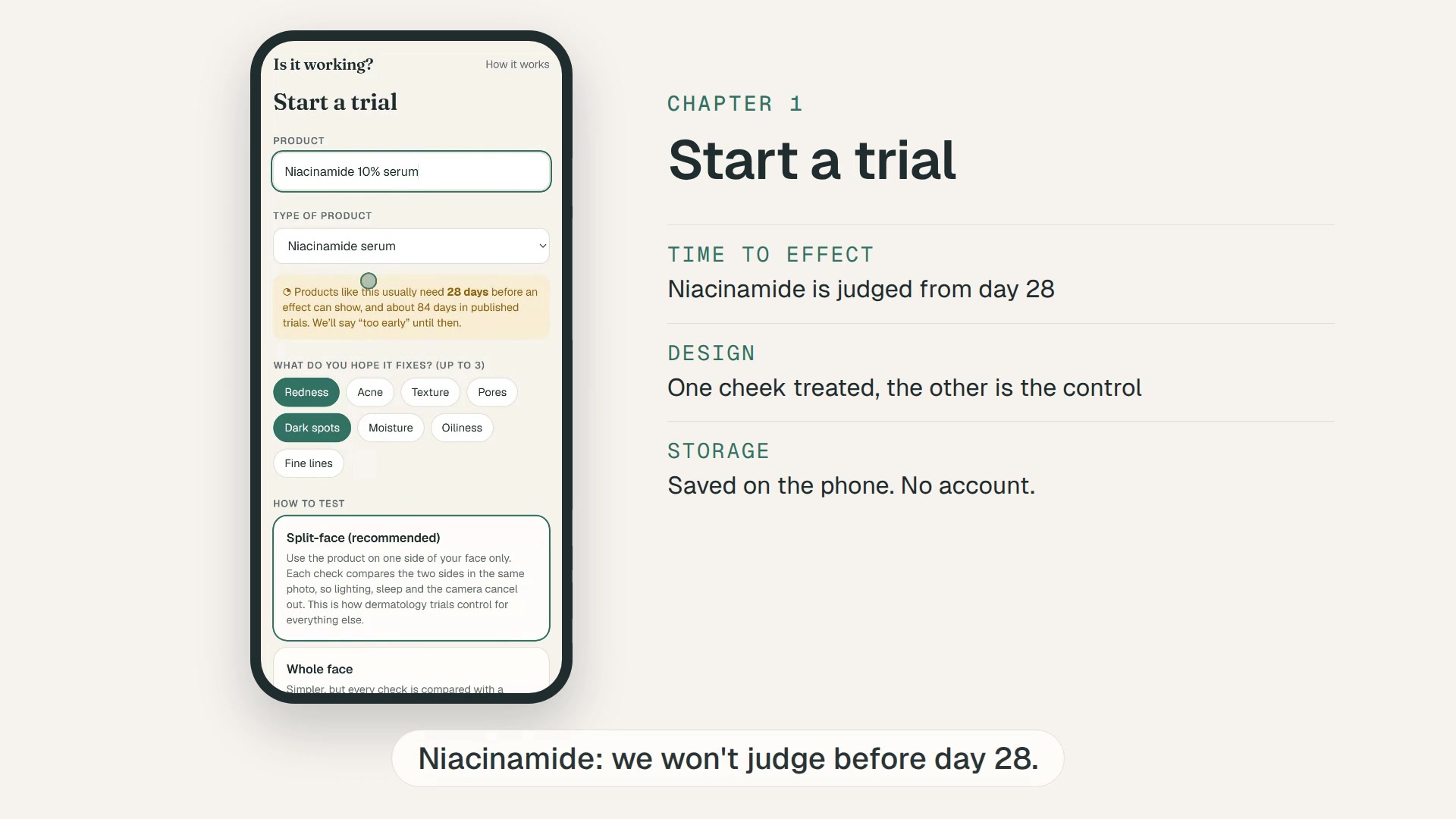
Start a trial: product type sets the time-to-effect (niacinamide: day 28)
-
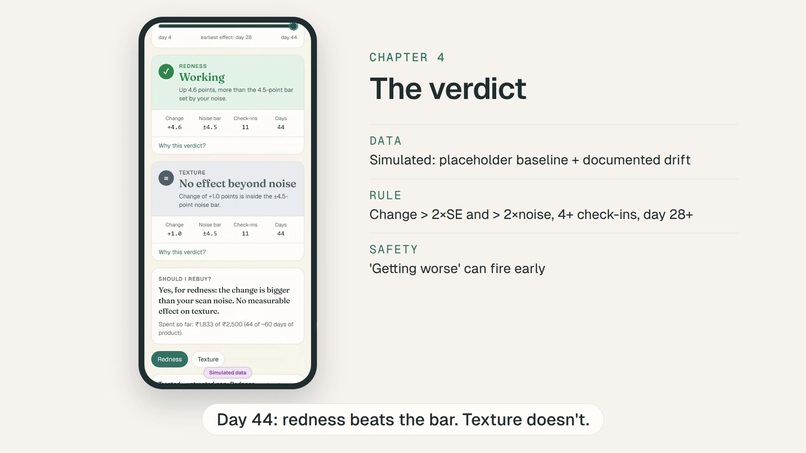
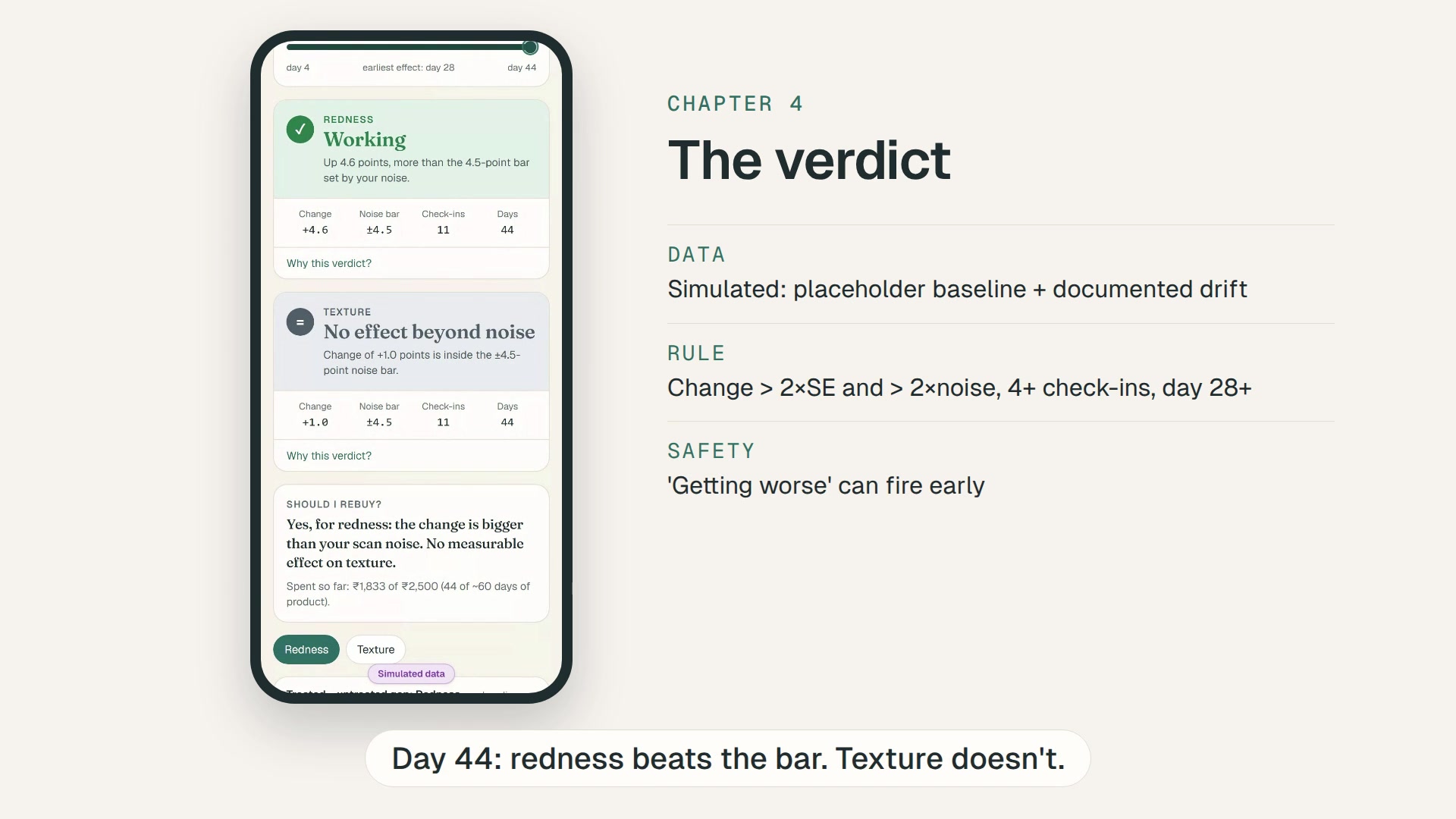
Verdicts with their evidence (simulated demo trial, labelled in the app)
-
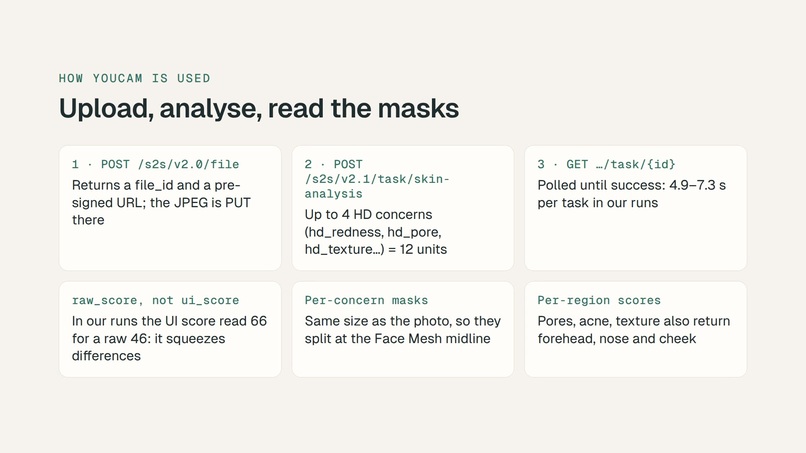
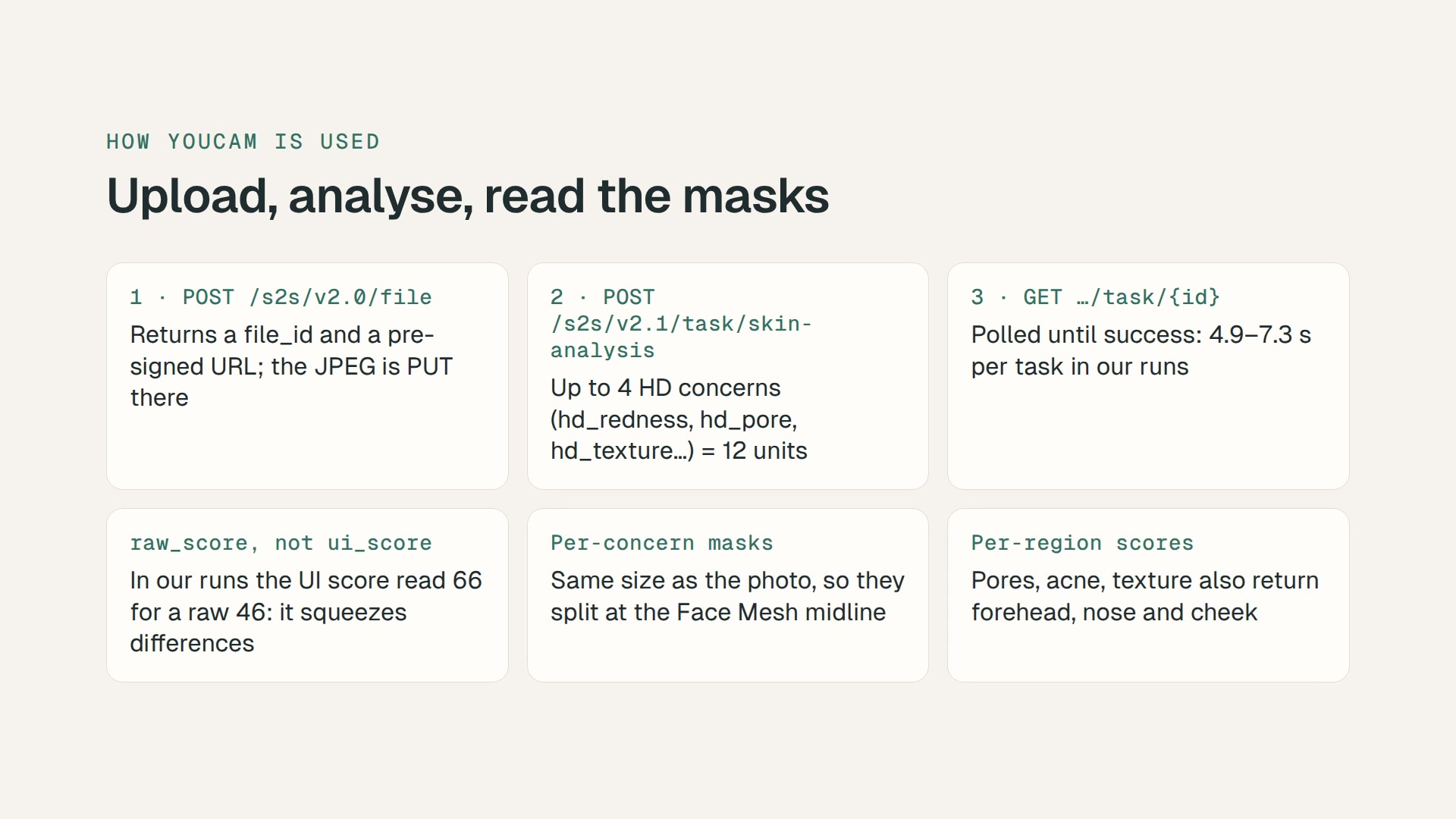
How the YouCam Skin Analysis API is used: upload, HD task, poll, raw scores + masks
-
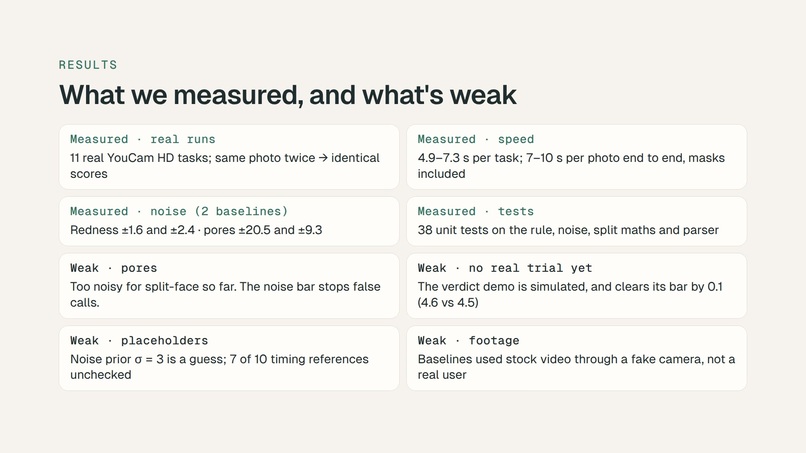
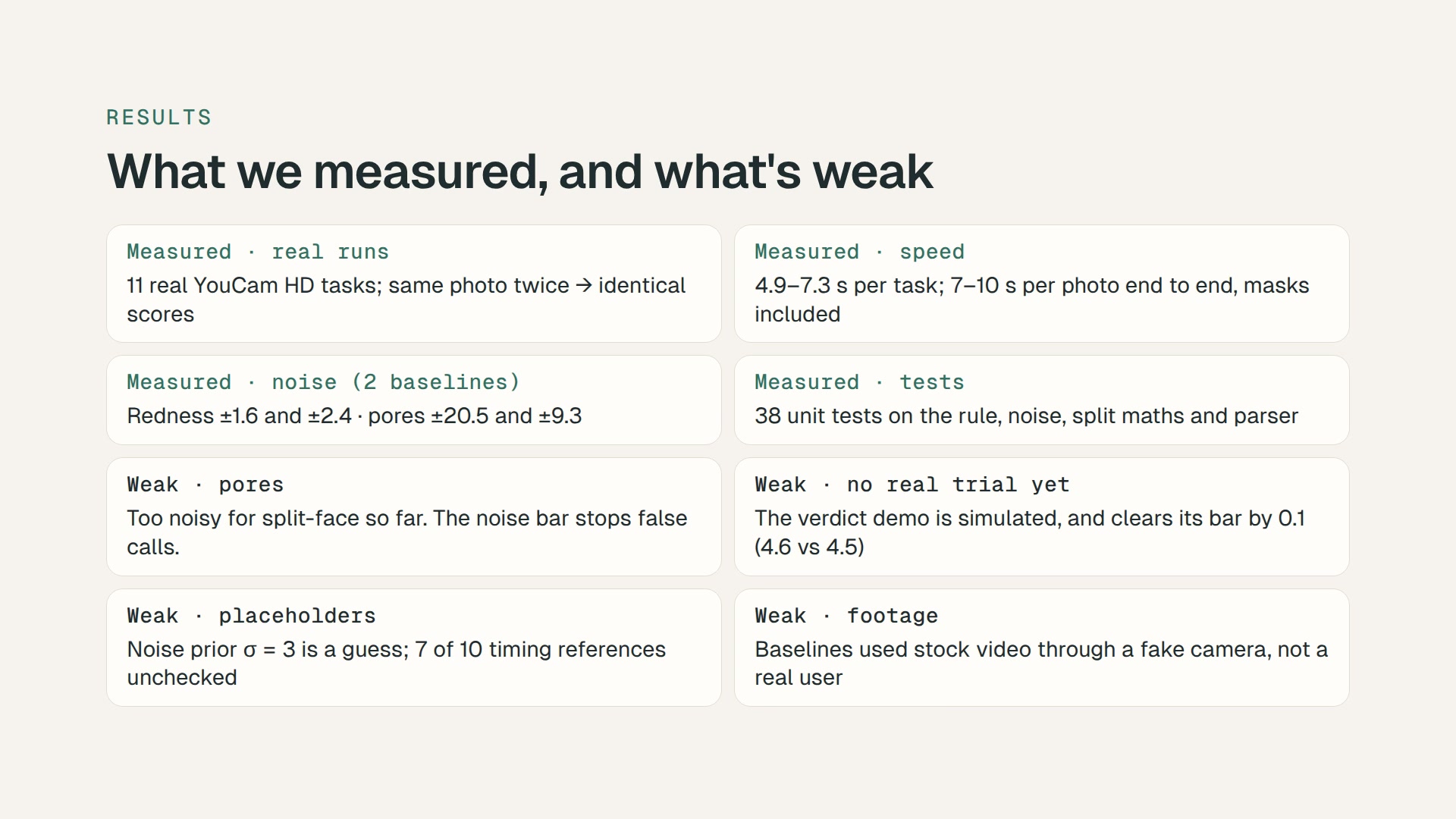
Measured results from real runs, and what's still weak
Inspiration
You spend ₹2,500 on a serum. Four weeks in, you're at the mirror asking: is this doing anything, should I buy it again? The mirror is a bad instrument. Lighting, sleep, mood and the money you've already spent all push the answer around. A skin-analysis score alone doesn't fix it either: two selfies taken a minute apart don't score the same.
What it does
Is it working? runs a small, honest trial of one product on your own face:
- Start a trial. The product, what you hope it fixes (redness, acne, pores, texture, dark spots…) and the product type. Each type has a time-to-effect: niacinamide is judged from day 28 (published trials run 12 weeks, e.g. Bissett et al. 2004), retinol from day 56.
- Split-face (recommended). Apply the product to one cheek only. Every photo then holds its own control: the other cheek, under the same light, on the same day. Sleep, lighting and the camera hit both sides equally and cancel out. Published trials use this design for the same reason.
- Guided baseline. A face outline and live checks (face size, angle, even light, holding still), then 3 photos about a minute apart. The spread between them is your own scan noise, per concern.
- Check-ins every 3–7 days, then a verdict per concern: Working, No effect beyond noise, Too early to tell, Getting worse: consider stopping, or Not enough data. Every verdict shows its evidence: change, noise bar, check-ins, days, and the rule.
- "Should I rebuy?" in plain words, with the money spent so far and a Reorder button when it's working. There's also a summary image with the numbers and no face, to show a dermatologist.
The verdict is plain, tested TypeScript, not an LLM: a change counts only if it beats both 2× its standard error and 2× your measured noise, after at least 4 check-ins and not before the product's time-to-effect. "Getting worse" can fire earlier, because stopping early is the safe side. Split-face is chosen per concern: if your own repeat shots show a concern's left/right gap is more than twice as noisy as its whole-face score, that concern is judged on the whole-face trend instead, and its card says so.
How we use the YouCam API
YouCam AI Skin Analysis (HD), called server-side from Next.js route handlers (the key never reaches the browser):
POST /s2s/v2.0/file, then PUT the JPEG to the pre-signed URLPOST /s2s/v2.1/task/skin-analysiswith up to 4 HD concerns (the trial's targets plus redness and texture as controls) = 12 units per photo,format: json, separate masks- Poll
GET …/task/{id}until success: 4.9–7.3 s per task in our runs, 7–10 s per photo end to end including upload and masks
We use raw_score, never ui_score: in our runs the UI score read 66 for a raw 46, which squeezes real differences together. We also use the per-concern masks. They come back at exactly the photo's size, so we find the face midline with MediaPipe Face Mesh in the browser and count YouCam's detection pixels on each side. Each side gets a score on the raw-score scale, from the same photo. The masks reach the browser through a same-origin proxy that only accepts URLs our server signed.
Does it actually detect a change? (real YouCam calls)
We ran the real app through Chrome's fake camera with a licence-free stock face (Pexels 13770894): two untreated 3-shot baselines, then a third with a known soft red tint on one cheek, the side marked as treated. This tests the measurement, not a skincare product.
| Redness | Pores | |
|---|---|---|
| Treated − untreated gap, spread over 6 untreated shots | ±1.4 | ±13.0 |
| Shift caused by the one-cheek tint | −17.2 points (≈ 22× its standard error) | +0.9 (no change, as it should be) |
| Split-face stability check | pass | fail → judged whole-face |
So split-face picks up a one-sided redness change clearly, on the right side and in the right direction. The tint doesn't move pores, so the side score isn't reacting to any change in the image. Pores' left/right split is too unstable, though their whole-face score is steady (±2.0), which is exactly why the app chooses the design per concern.
Also measured: the same photo sent twice returned identical scores, so all scan-to-scan noise comes from the capture (light, angle, camera), which is what the repeat-shot baseline measures.
How we built it
Next.js (App Router) + TypeScript on Vercel; MediaPipe Face Landmarker in the browser; IndexedDB storage (no account; export/import JSON); hand-drawn SVG charts; Vitest (41 tests covering the verdict rule, the per-concern design choice, noise estimation, split-face maths, the response parser and unit budgeting). The demo video was recorded with a scripted Playwright browser driving the real app through Chrome's fake camera, edited in Hyperframes and narrated with Kokoro TTS, all rendered on Kaggle. The validation run is demo/positive_control.py in the repo.
Challenges
- YouCam's real response differs from the docs example: pores, acne and texture come back once per region (forehead, nose, cheek, whole). We score on "whole" and keep the rest.
- The masks are drawn overlays (a grey dimming layer, outlines, coloured detections), not severity maps. We count only detection pixels and map each side onto the raw-score scale, so the two sides average to YouCam's own score.
- Our first capture thresholds rejected straight-on faces. We recalibrated them from measured values instead of guessing.
Limitations (said plainly)
- No real multi-week trial yet. The verdict demo in the app and the video is simulated and labelled as such, and it clears its bar by just 0.1 (4.6 vs 4.5).
- Our validation is one stock face through a fake camera, with a digital tint, not a real person in bathroom light over several weeks.
- The noise starting guess (σ = 3) is a placeholder until more people do repeat scans. 7 of the 10 time-to-effect references are not yet checked against the papers.
- Not medical advice.
What's next
A live dermatologist share view, real multi-week trials to calibrate the noise prior, and brand-side efficacy panels built from opt-in split-face data.
Built With
- indexeddb
- mediapipe
- next.js
- playwright
- react
- typescript
- vercel
- vitest
- youcam-api
