-
-
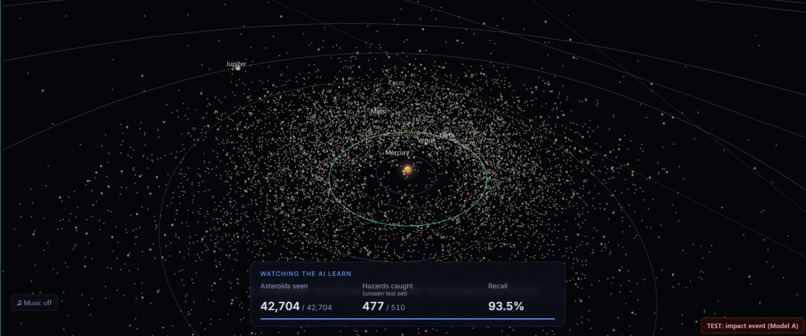
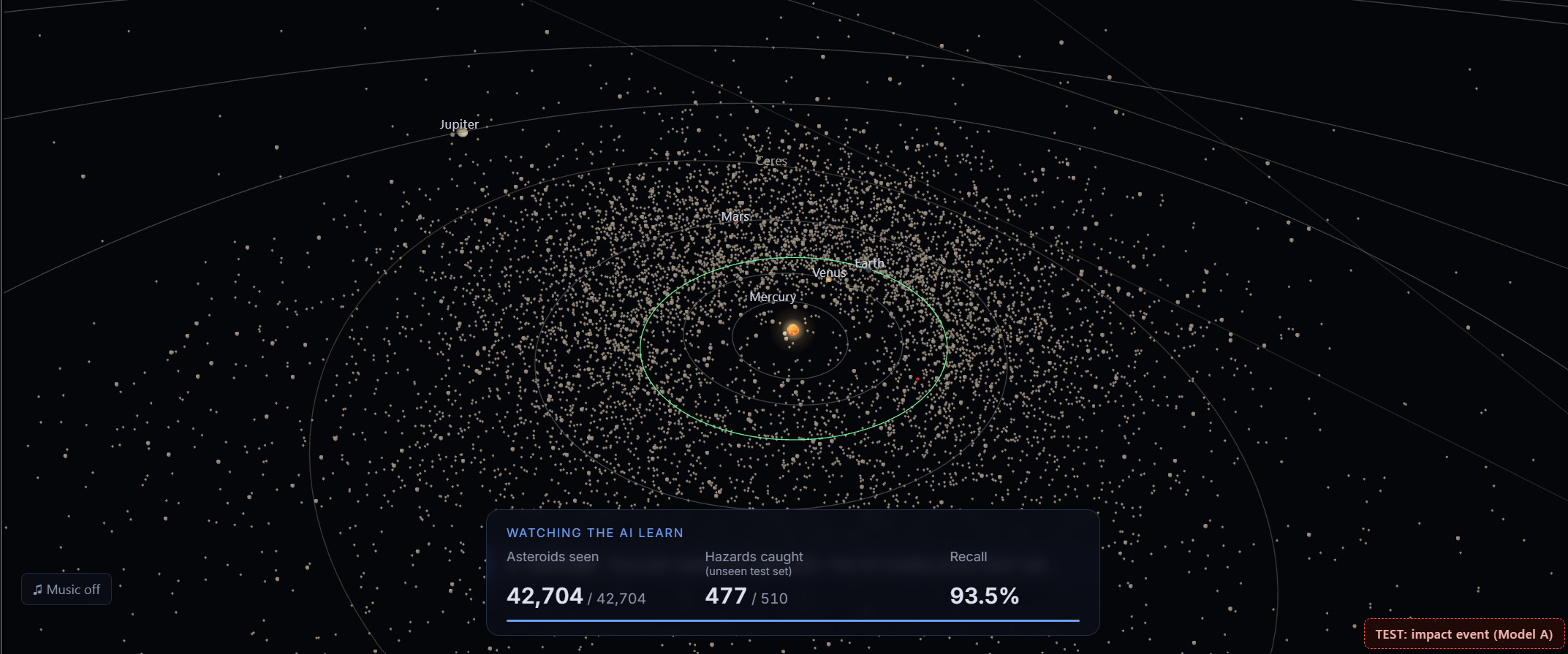
Shows the results of the AI learning
Inspiration
Apophis is going to pass closer to Earth than some of our satellites in 2029, and that got us curious about how NASA decides which asteroids are dangerous. Its rule depends on brightness to guess size, since most asteroids have never been measured. We wanted to see if a model could learn that rule, and if any big asteroids were being missed.
What it does
It shows all 42,704 near-Earth asteroids on their real orbits in 3D, colored by how risky our model thinks they are. Click one and the camera zooms in, a card explains the prediction, and a mission control duo voiced by ElevenLabs reacts to it. You can also see the model’s mistakes, the 34 big asteroids we found that aren’t on NASA’s hazard list, and a what-if impact scenario.
How we built it
We cleaned NASA/JPL’s asteroid database down to 42,704 near-Earth asteroids and trained LightGBM models in Python: one with all the data, and one without the closest-approach distance (MOID). We tested on 8,541 asteroids the models never saw. The site is built with React and Three.js, the models run in the browser, and the voices come from ElevenLabs.
Challenges we ran into
Our first model scored almost 100%, but only because NASA’s label is based on the same columns we gave it. So we removed MOID to make it a real test. Accuracy was also misleading, since saying “safe” every time already gets 94%. And merging three people’s code the night before the deadline was rough.
Accomplishments that we're proud of
Our decision tree figured out NASA’s hazard rule on its own. Without MOID, Model B still caught 95% of hazardous asteroids. We also found 34 asteroids that NASA measured at 140 m or bigger, with orbits close to Earth’s, that still aren’t labelled hazardous.
What we learned
We learned that accuracy isn’t enough when the thing you’re looking for is rare, so recall and precision matter more. Space data is shaped by what telescopes can detect. And sharing a result that didn’t work out made our project stronger, not weaker.
What's next for Is It Coming For Us?
We want to share our list of 34 asteroids with planetary defense researchers and flag the other 428 candidates for follow-up observations. We would also like the model to retrain automatically as NASA discovers new asteroids.
Team Members
Jean-Paul Saliba, Abdalla Shaldam, Alexander Philippopoulos,
Built With
- chart.js
- claude
- elevenlabs
- github
- gsap
- javascript
- lenis
- lightgbm
- m2cgen
- nasa-jpl
- node.js
- numpy
- pandas
- python
- react
- scikit-learn
- three.js
- vite

