Inspiration
With the rapid rise in urbanization and industrialization, air pollution has become one of the major environmental threats to human health. We were inspired by the need for a real-time, accessible, and intelligent system that could help people understand the quality of the air they breathe and forecast upcoming pollution trends. Our goal is to empower communities and decision-makers with accurate insights to take preventive measures before pollution levels spike.
What it does
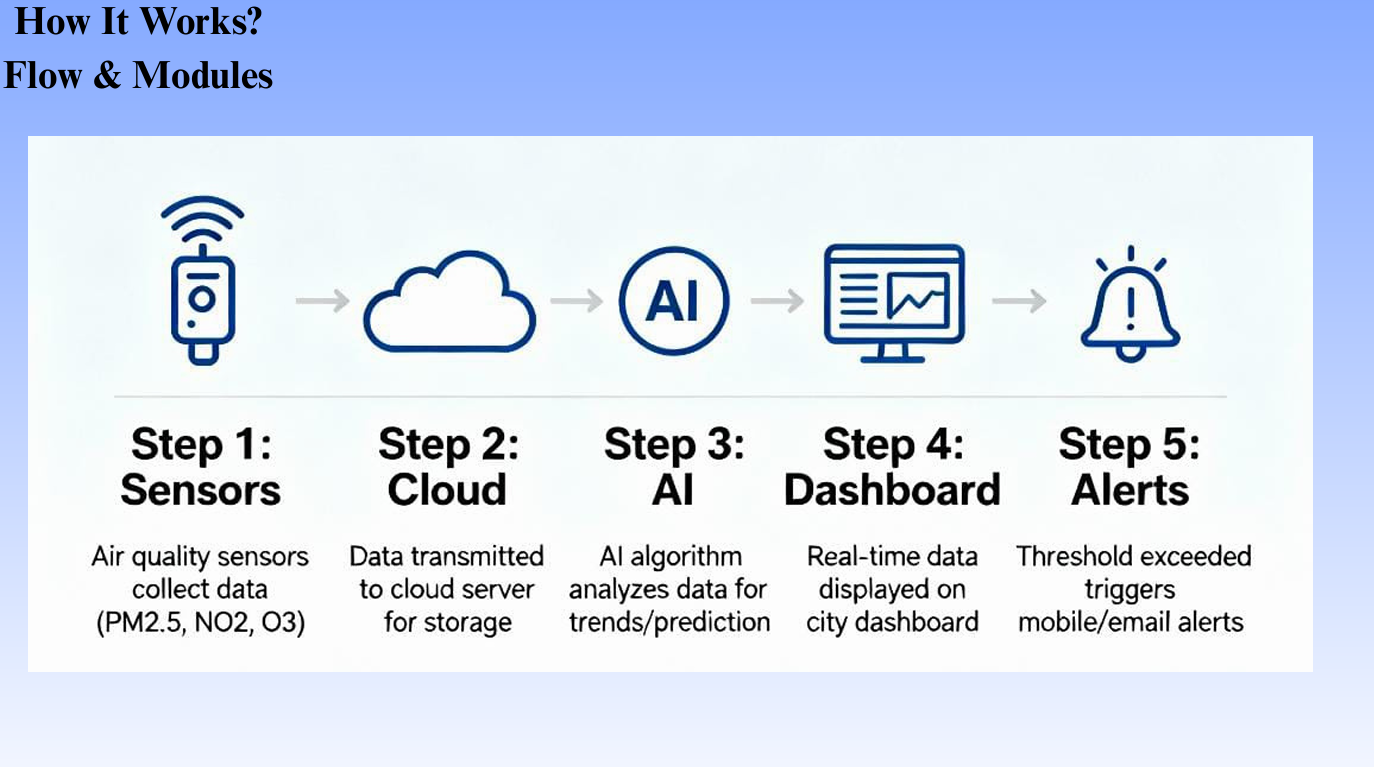
Our system continuously monitors real-time air quality data such as PM2.5, PM10, CO₂, NO₂, and O₃ levels using IoT sensors or API feeds. It then applies machine learning models to forecast future air quality trends. The data is visualized in a user-friendly dashboard that:
Displays current AQI levels
Predicts future air quality conditions
Provides health and safety recommendations
Sends alerts when air quality reaches hazardous levels
How we built it
Frontend: Built an interactive dashboard using React.js / HTML / CSS to visualize air quality data dynamically.
Backend: Developed REST APIs using FastAPI / Flask to manage data collection and serve forecast results.
Data Handling: Used Python (Pandas, NumPy) to process and clean data collected from open APIs like OpenWeather or government sources.
Machine Learning Model: Trained a regression-based forecasting model (like LSTM / Random Forest) to predict AQI for the next few hours or days.
Database: Used MongoDB / Firebase for real-time data storage and retrieval.
Deployment: Hosted the application on Docker / Render / AWS, ensuring scalability and reliability.
Challenges we ran into
Collecting reliable real-time air quality data across different regions.
Ensuring the forecasting model remained accurate under varying environmental conditions.
Integrating multiple modules (sensors, ML, and dashboard) smoothly in real-time.
Managing API rate limits and latency issues during data fetching.
Accomplishments that we're proud of
Successfully created an end-to-end system that can monitor and forecast air quality in real time.
Developed an accurate prediction model that forecasts AQI with minimal error.
Built a clean, responsive, and informative dashboard for users to visualize live data and forecasts.
Raised awareness about air pollution and its health impacts through our project.
What we learned
How to handle and preprocess environmental time-series data effectively.
Techniques for forecasting using machine learning and evaluating prediction accuracy.
Importance of UI/UX design in making technical data accessible to non-technical users.
Working collaboratively under time constraints and integrating multiple technologies seamlessly.
What's next for irock
Integrating AI-based pollution source detection to identify causes of poor air quality.
Expanding to more geographical locations using low-cost IoT sensors.
Implementing mobile app notifications for real-time air quality alerts.
Collaborating with local authorities and schools to promote awareness and preventive actions.
Exploring predictive maintenance for industrial areas to reduce emissions proactively.

Log in or sign up for Devpost to join the conversation.