-
-
IRIS Metal: Agentic AI powered by TinyFish
Inspiration
The inspiration behind IRIS Metal came from the limitations of traditional automation systems. Most tools rely on rigid scripts, predefined selectors, and fragile workflows that break as soon as a website changes. At the same time, modern AI models are powerful but largely passive, they respond to prompts but do not act.
We wanted to bridge this gap by building a system that could think and act. The idea was to create an agent that treats the web as an interactive environment, where a simple natural language goal could translate into real execution. TinyFish’s approach to agentic browsing provided the perfect foundation to explore this vision.
What it does
IRIS Metal is an agentic AI system that autonomously interacts with websites to complete tasks. Instead of writing step-by-step automation scripts, users provide a goal, and the agent handles the execution.
It can:
- Navigate across web pages dynamically
- Extract structured data in real time
- Perform multi-step workflows
- Adapt to changes in web interfaces
The system outputs clean, structured results, making it suitable for integration into larger pipelines such as analytics, automation, or decision systems.
Note
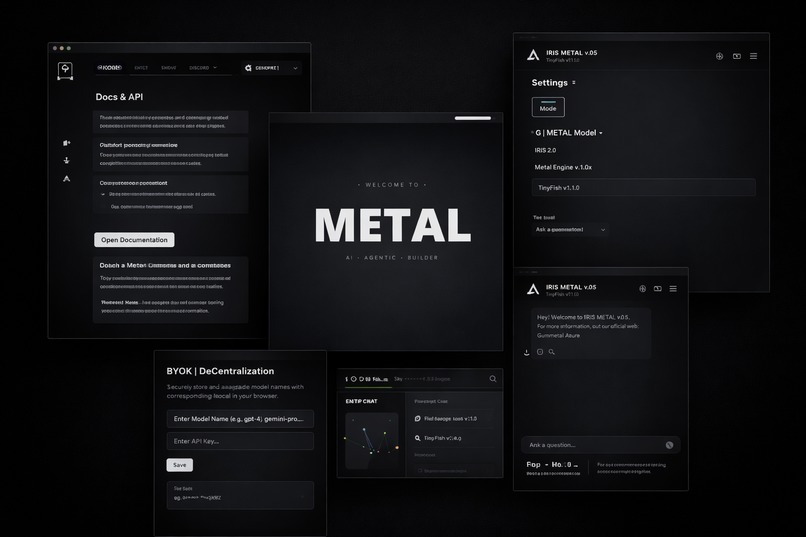
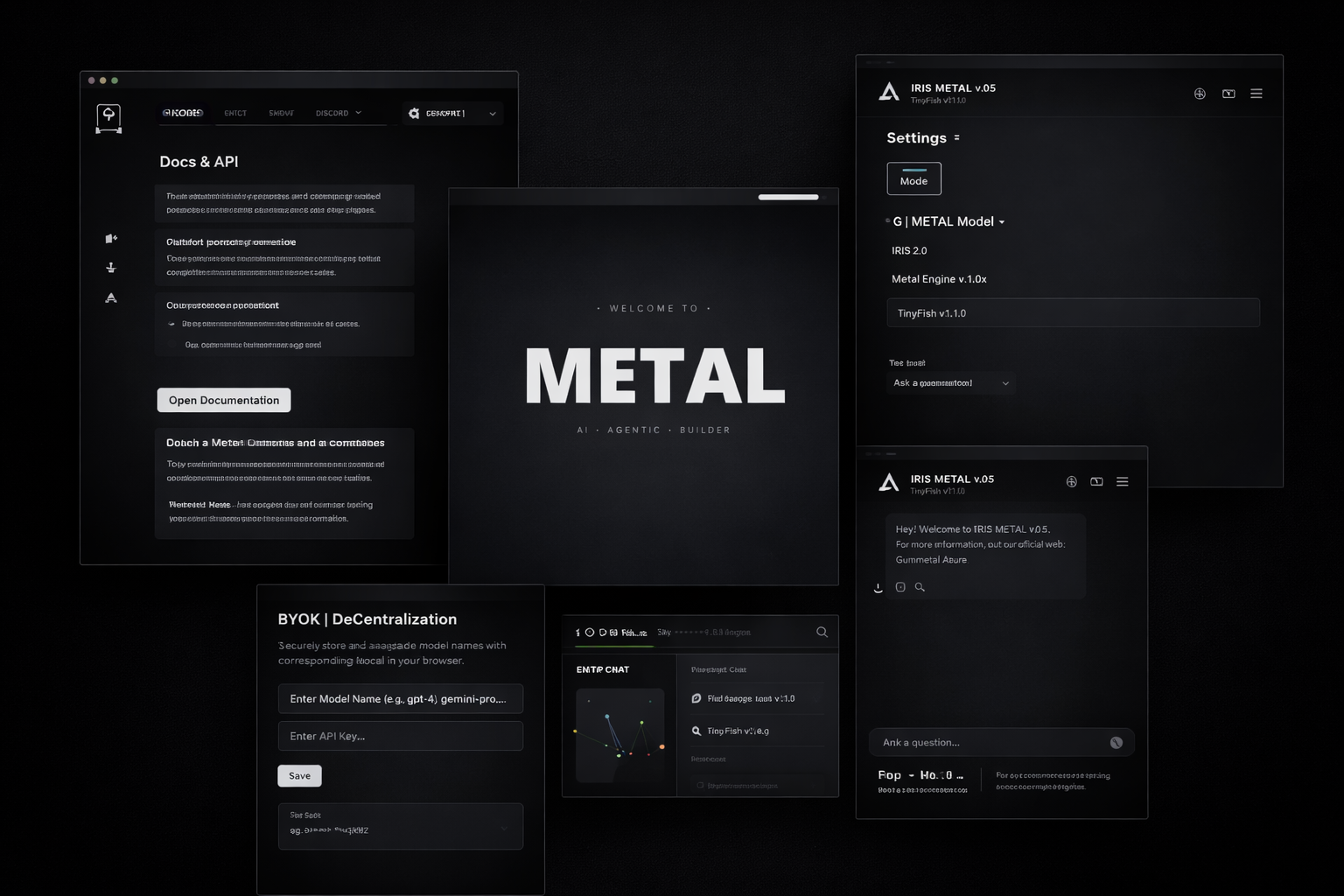
This project follows a BYOK (Bring Your Own Key) setup. Users are required to provide their own API keys in the designated BYOK section to power the system. This ensures that all agent operations, model interactions, and external service calls are executed using the user's own credentials, giving full control over usage, security, and cost management.
How we built it
We designed IRIS Metal around an agent-first architecture.
At the core is a goal-driven execution loop:
- A user provides a high-level objective
- The agent interprets and plans actions
- It interacts with the website step by step
- Results are structured and returned as JSON
We leveraged TinyFish-style web agent concepts to abstract away low-level browser control. The system uses API-driven execution, allowing it to handle dynamic pages and complex workflows without relying on brittle logic.
The stack includes Python/TypeScript for orchestration, structured data pipelines for output handling, and modular components to allow extensibility.
Challenges we ran into
One of the biggest challenges was dealing with the unpredictability of the web. Every site behaves differently, and even small UI changes can disrupt execution.
Ensuring agent reliability was another major hurdle. The agent needed to not only understand tasks correctly but also execute them without deviating or producing inconsistent results.
We also faced tradeoffs between speed and accuracy. More reasoning improves outcomes but increases latency, which affects real-time usability.
Finally, setting up a stable execution environment with APIs and handling edge cases across different workflows required continuous iteration.
Accomplishments that we're proud of
We successfully built a system that shifts from script-based automation to goal-driven execution. The agent can independently navigate and extract information without predefined instructions.
Another key achievement is the consistency of structured outputs. The system produces clean and usable data, making it practical for real-world applications.
We are also proud of how adaptable the system is. Instead of breaking under changes, it demonstrates the ability to adjust its behavior based on context.
What we learned
This project helped us understand the true potential of agentic AI systems. Unlike traditional models, agents require careful design around decision-making, execution flow, and constraints.
We also learned that building for the real world introduces unpredictability that cannot be fully controlled, only managed.
Another important takeaway was the importance of structured outputs. Reliable downstream usage depends heavily on how well the data is organized.
Agentic-TinyFish: Category
Agentic-TinyFish falls under Artificial Intelligence and Machine Learning as its primary category, since it is built around agentic AI that performs autonomous reasoning and decision-making.
It also comes under Developer Tools and APIs as a secondary category, because it functions as an infrastructure layer that developers can integrate into applications for intelligent automation.
What's next for IRIS Metal: Agentic AI powered by TinyFish
The next phase of IRIS Metal focuses on scaling and intelligence.
We plan to introduce multi-agent coordination, where multiple agents collaborate to solve more complex tasks. Adding memory and learning capabilities will allow the system to improve over time.
We are also working toward integrating IRIS Metal with broader systems such as analytics platforms, automation pipelines, and real-time decision engines.
Ultimately, the goal is to evolve IRIS Metal into a fully autonomous digital operator capable of executing complex workflows across the web with minimal human intervention.

Log in or sign up for Devpost to join the conversation.