💡 Inspiration
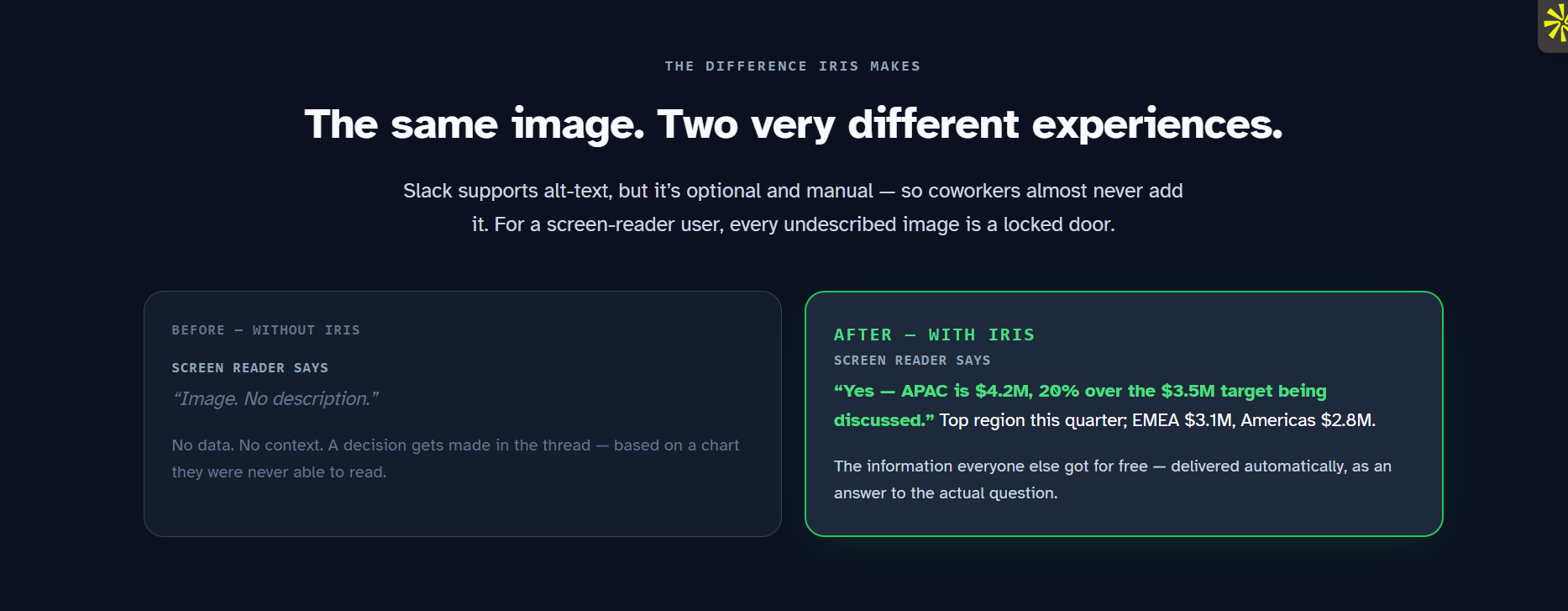
Slack runs on images — charts, dashboards, screenshots, diagrams get dropped into channels all day. But for a blind or low‑vision teammate using a screen reader, every one of those images is a locked door. The screen reader hits the image and says three words: "Image. No description." No data, no context. A decision gets made in that thread based on a chart they were never able to read.
Slack does support alt‑text — but it's optional and manual, so almost nobody adds it. The accessibility feature exists; the accessibility does not.
And this isn't only a moral problem anymore — it's a legal and organizational one. The European Accessibility Act became enforceable in June 2025, and the ADA and Section 508 already require accessible workplace tools. Yet the burden today falls on the disabled employee to compensate — DM‑ing a colleague "what's in that image?" over and over.
We wanted to flip that: make accessibility the platform's job, not the disabled person's daily burden.
👁 What it does
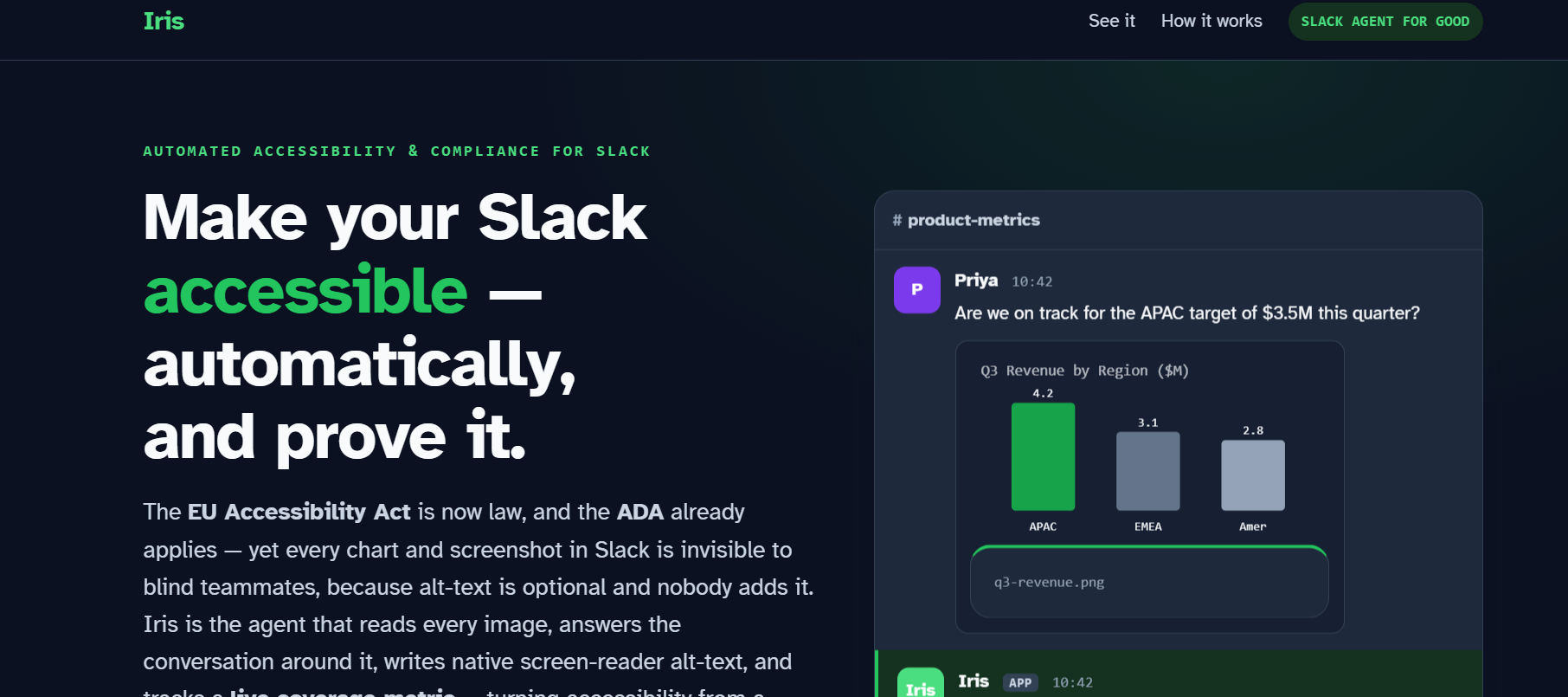
Iris is a Slack agent that makes every image accessible — automatically — and proves it.
The moment an image is posted, Iris replies with a rich, screen‑reader‑ready description, and it goes far beyond captioning:
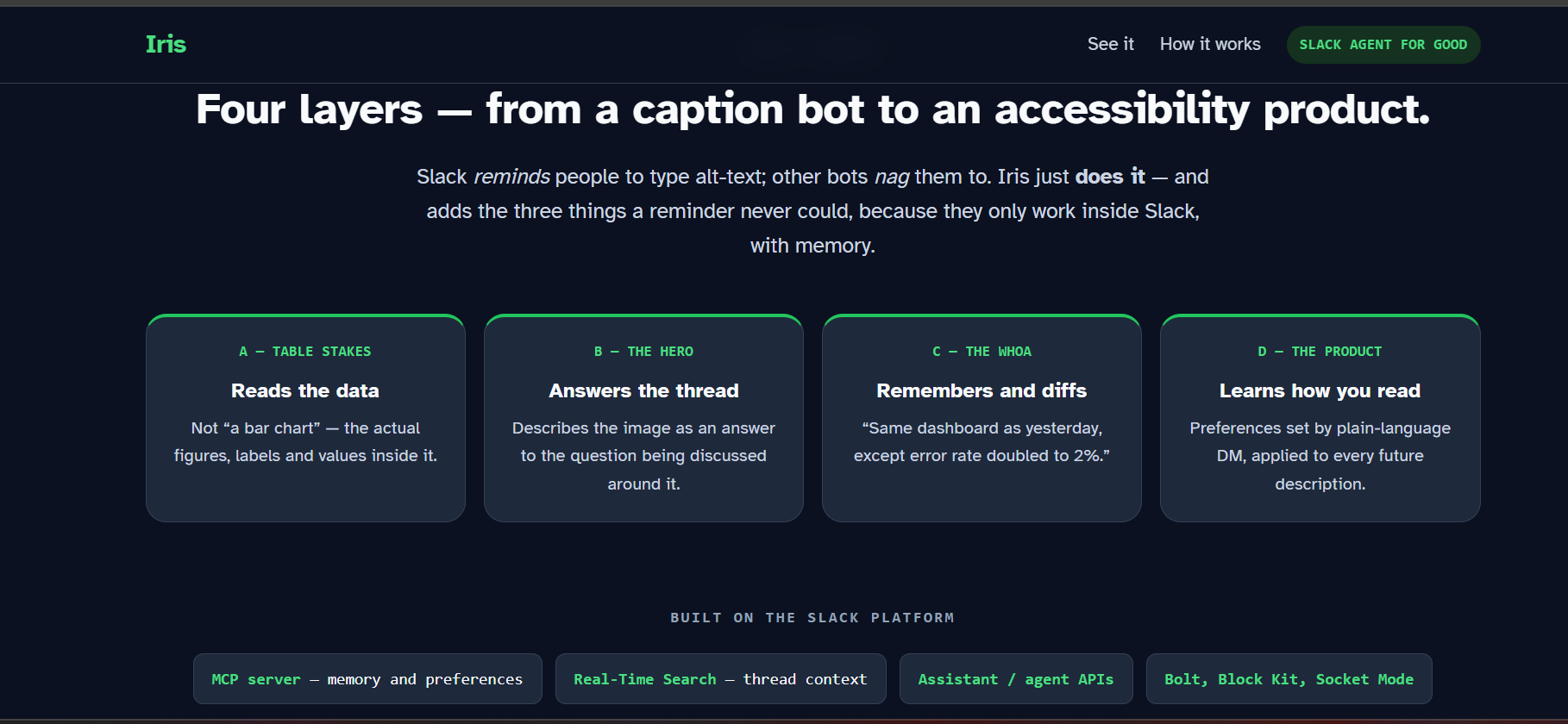
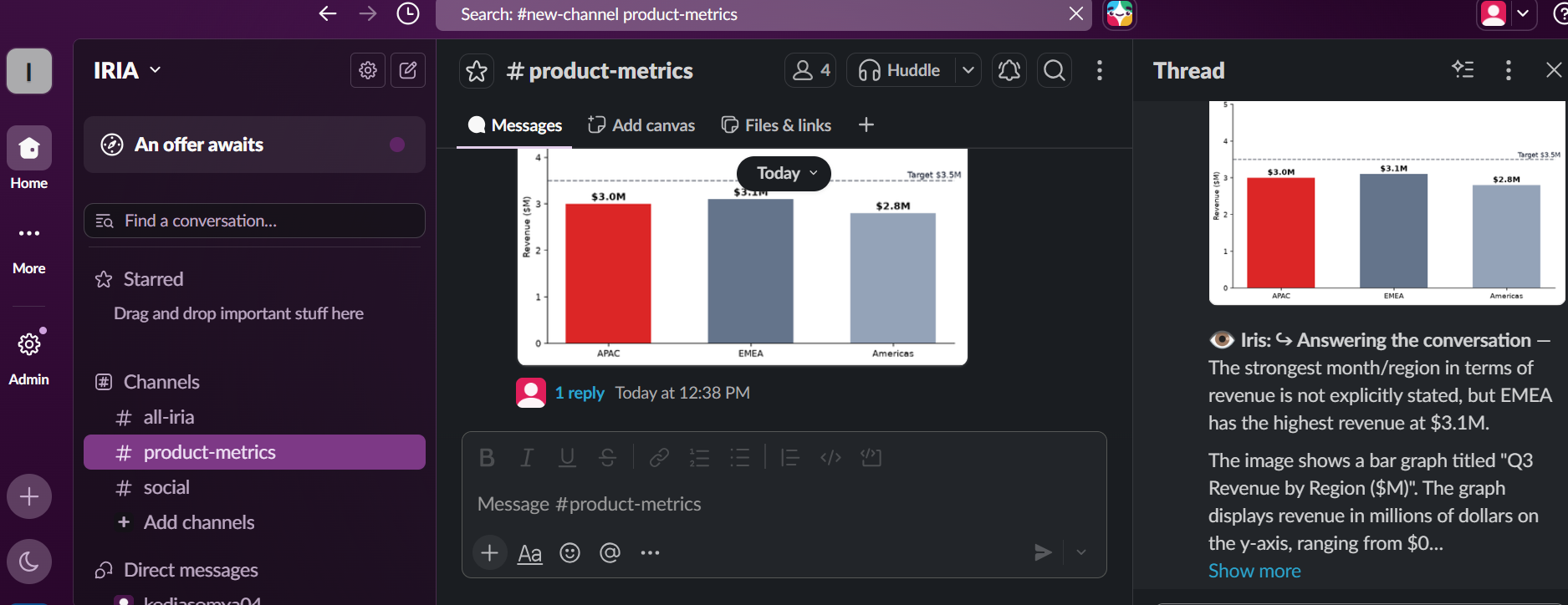
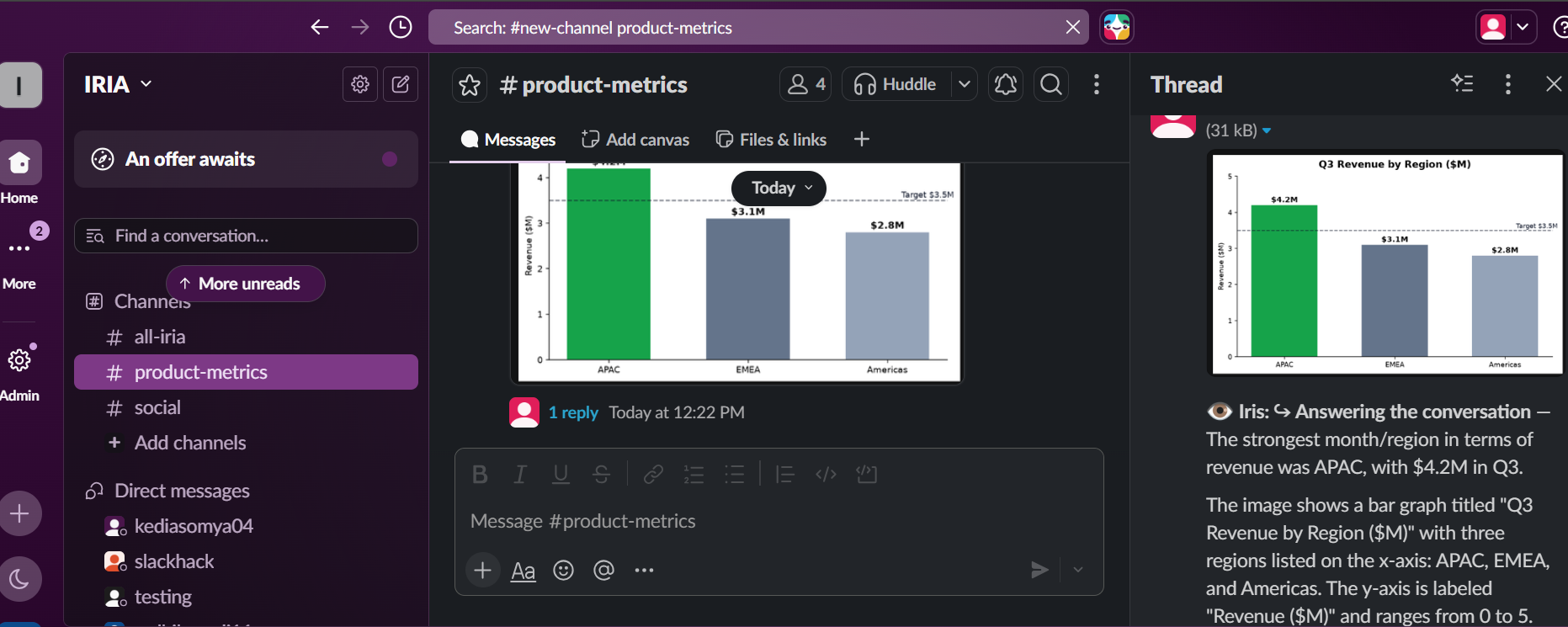
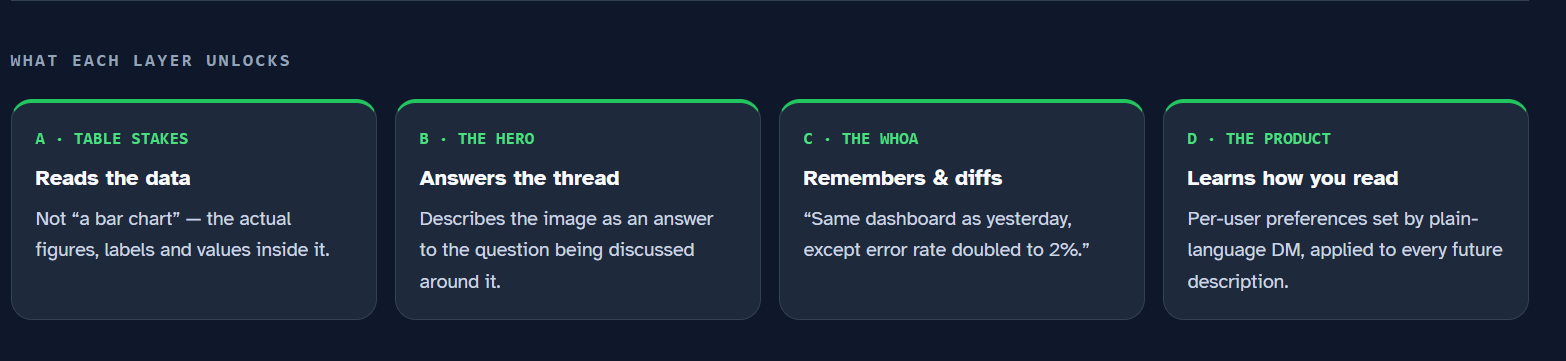
- Reads the data — not "a bar chart," but the actual figures, labels, axis values, and error text inside it.
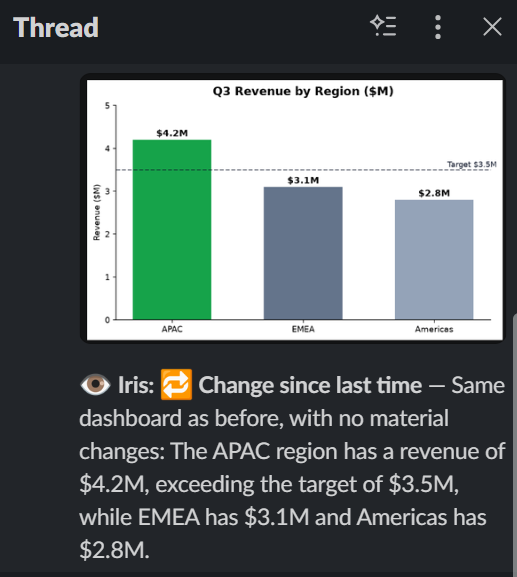
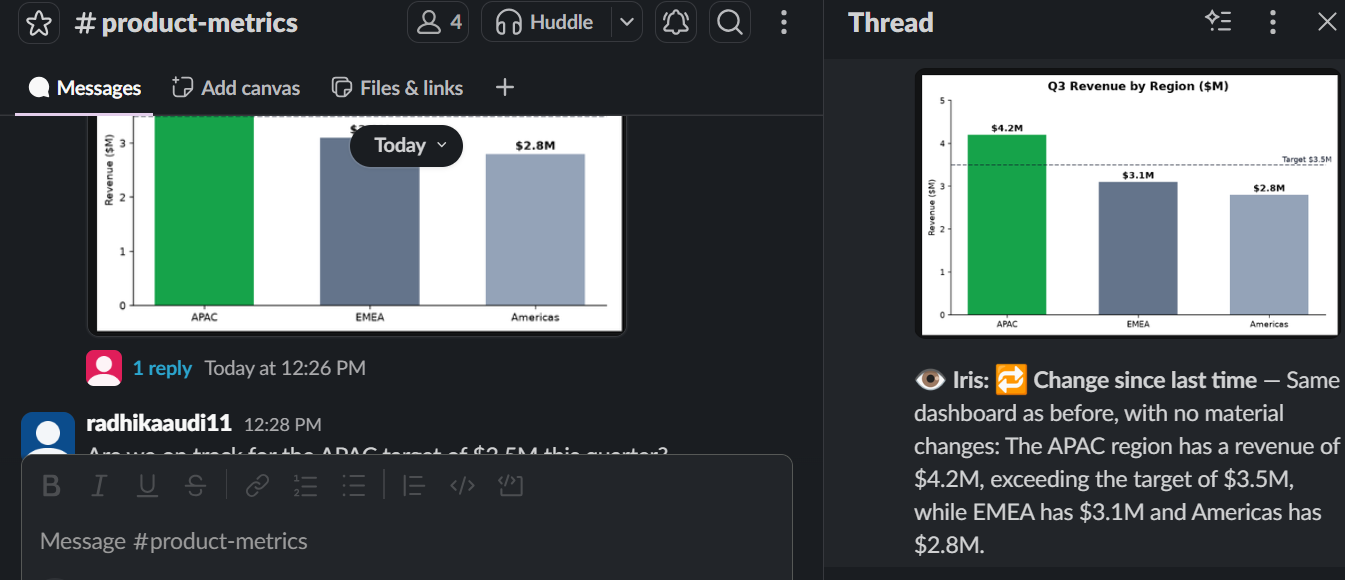
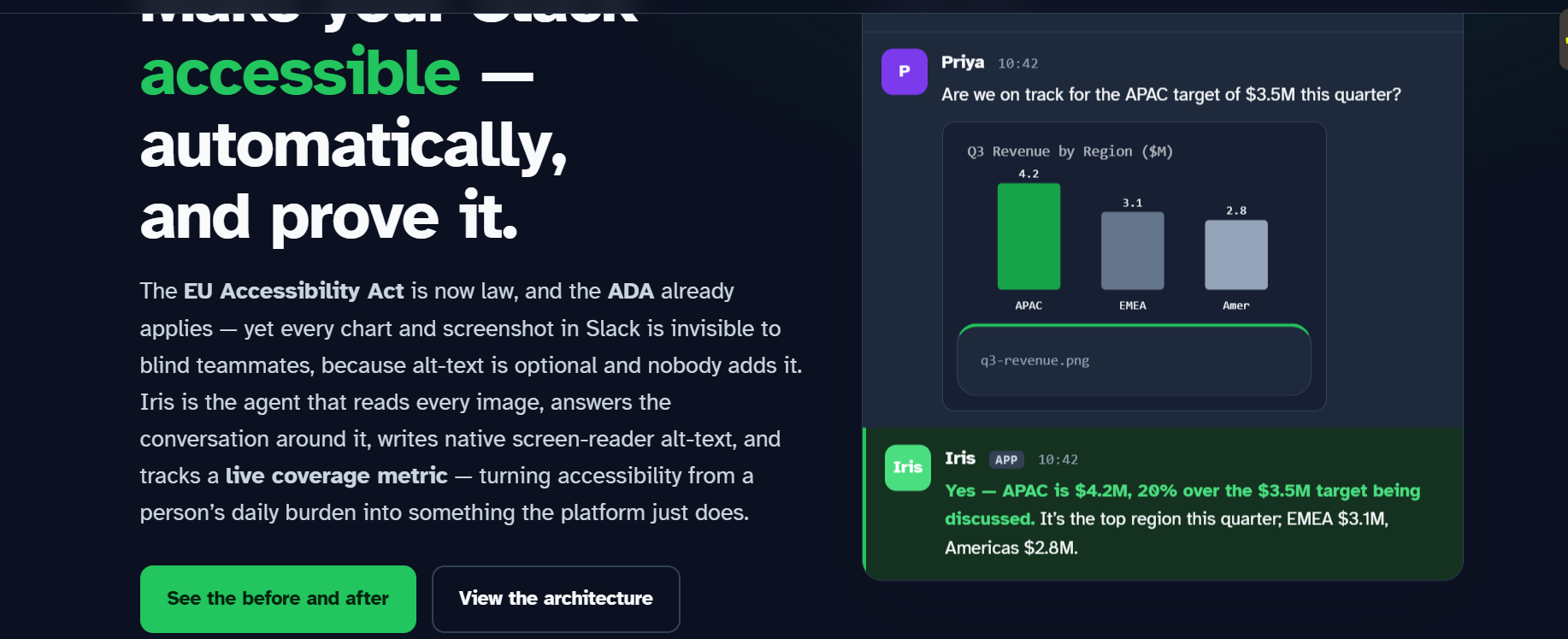
- Answers the conversation — it reads the surrounding thread and describes the image as an answer to what's being discussed. Ask "are we hitting the APAC target?", drop a chart, and Iris replies "Yes — APAC is $4.2M, 20% over target," not a neutral caption.
- Remembers and diffs — for recurring dashboards it reports only what changed: "Same dashboard as yesterday, except APAC dropped from $4.2M to $3.0M — now below target."
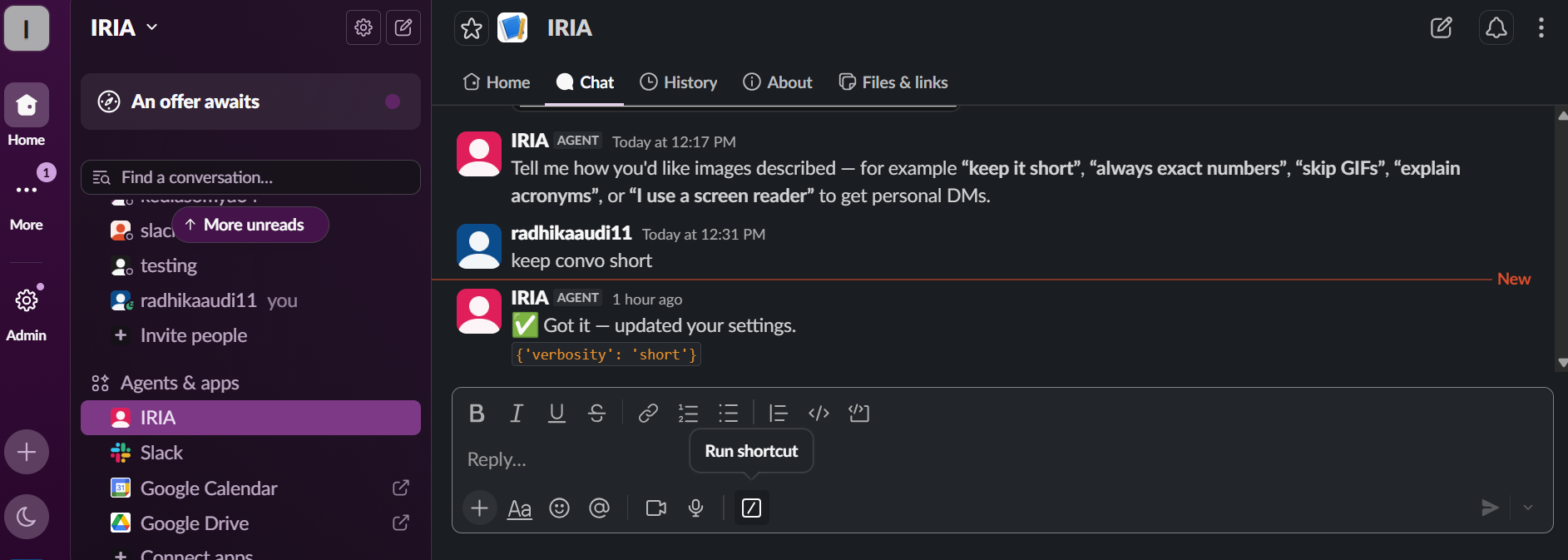
- Learns how you read — DM Iris "keep it short" or "always exact numbers," and every future description respects it. Screen‑reader users can opt in to personalized descriptions delivered by DM.
- Writes native alt‑text — descriptions are attached as standards‑compliant screen‑reader alt‑text, not just chat prose.
- Proves impact — a live counter tracks images made accessible and manual alt‑texting time saved, viewable in the App Home and via the Assistant ("show me the accessibility report").
The result: a blind teammate finally participates as an equal, and the organization makes automated, measurable progress toward its accessibility obligations.
🛠 How we built it
Iris is built end‑to‑end on the Slack platform:
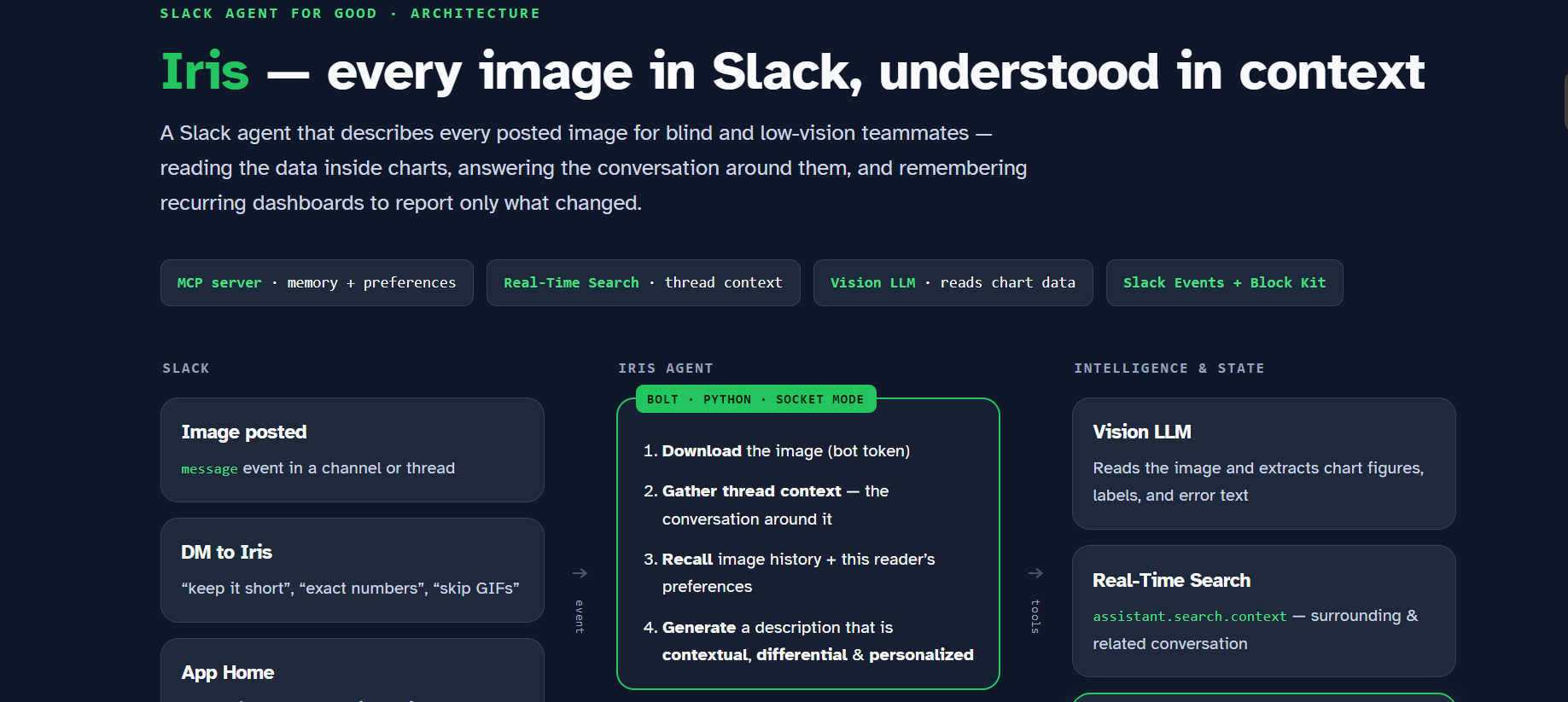
- Slack Bolt (Python) + Socket Mode — the agent core; no public endpoint needed.
- Slack Assistant / Agent APIs — Iris lives in the AI side‑panel with suggested prompts and a thinking status, so it's a first‑class agent, not a legacy bot.
- MCP server (custom) — a Model Context Protocol server, backed by SQLite, exposing tools for per‑user preferences, per‑image history (for diffs), and impact stats. The agent talks to it over the MCP protocol.
- Real‑Time Search API (
assistant.search.context) — pulls related cross‑channel conversation for context, alongside the Conversations API for the immediate thread. - Block Kit — the App Home control panel and preference toggles.
- Vision — a multimodal model (Llama‑4 via Groq) reads the image content; the description is delivered as clean text (best for screen readers) plus native alt‑text.
- Deployment — hosted 24/7 on Render so it runs without a laptop.
Accessibility‑by‑design, in the product itself: descriptions are plain text (optimal for screen readers, not decorative Block Kit), and all our materials use Atkinson Hyperlegible — a typeface engineered by the Braille Institute for low‑vision readability — with reduced‑motion‑safe animations.
🧗 Challenges we ran into
- Getting the conversation, reliably. Our first version listened to the
file_sharedevent, whose thread data is unreliable — so in a thread Iris couldn't see the question. We switched to themessageevent (which carriesthread_tsdirectly) and made context‑gathering robust by reading both the thread and recent channel history. - "Isn't this just an image captioner?" Raw captioning is commodity. The real work was making it not a wrapper: reading thread context, remembering images to diff them, and building a per‑user model — things only possible inside Slack, with state.
- Trust for an accessibility tool. A blind user can't verify a description, so a confidently‑wrong reading is worse than none. We added a confidence hedge: low‑certainty reads are flagged, never presented as fact.
- The reader‑vs‑poster problem. A channel message is one‑to‑many, so "personalized per reader" doesn't work for a public post. We made channel replies neutral and deliver personalized descriptions to opted‑in screen‑reader users by DM.
- Data governance. Sending workplace images to a model is sensitive. We use inference‑only processing (no training), store no image bytes (only a one‑line summary + preferences), run with zero‑data‑retention, and kept the vision engine swappable for enterprise data‑residency.
🏆 Accomplishments we're proud of
- It actually works and is deployed — not a demo‑ware mockup.
- It uses all three hackathon technologies (Slack AI/Assistant, MCP, Real‑Time Search), each doing real work.
- It's a genuine accessibility product — coherent right down to an accessible marketing site and an accessibility typeface.
- It turns a niche‑sounding idea into an organization‑wide, regulation‑relevant tool with a measurable impact number.
📚 What we learned
- Blind people read with their ears (or a Braille display). Text is fully accessible to them via screen readers — images are the one thing that isn't. Iris is fundamentally a translator from image to text.
- Context is the difference between captioning and comprehension. The same image means different things depending on the question around it.
- Slack's agentic platform (MCP + RTS + Assistant APIs) is genuinely powerful for grounding an agent in real conversational data without hoarding it.
🚀 What's next
- Native alt‑text at upload and an admin weekly accessibility‑coverage digest to a channel.
- On‑demand retrieval ("Iris, read me every chart posted in #metrics this week").
- Beyond images: huddle captions, voice‑note transcription, and canvas accessibility — the same pattern applied across every visual/audio surface in Slack.
Accessibility isn't a feature. It's the difference between being in the conversation and being shut out of it. Iris puts every teammate in the conversation.


Log in or sign up for Devpost to join the conversation.