Inspiration
We believe that technology should adapt to people, not force people to adapt to it.
For individuals living with ALS, spinal cord injuries, cerebral palsy, or other conditions that affect motor control, everyday digital interactions can become significant challenges. Simple actions like clicking a button, navigating a website, or sending a message may require considerable effort or assistance from others.
We were inspired by the possibility of making hands-free computing more accessible without relying on expensive, specialized equipment. We wanted to create a solution that uses technology people may already have—a webcam and a microphone—to help users navigate their digital world more independently.
Our goal with Iris is simple: to make technology more accessible, intuitive, and empowering, so that everyone can interact with their devices on their own terms.
What it does
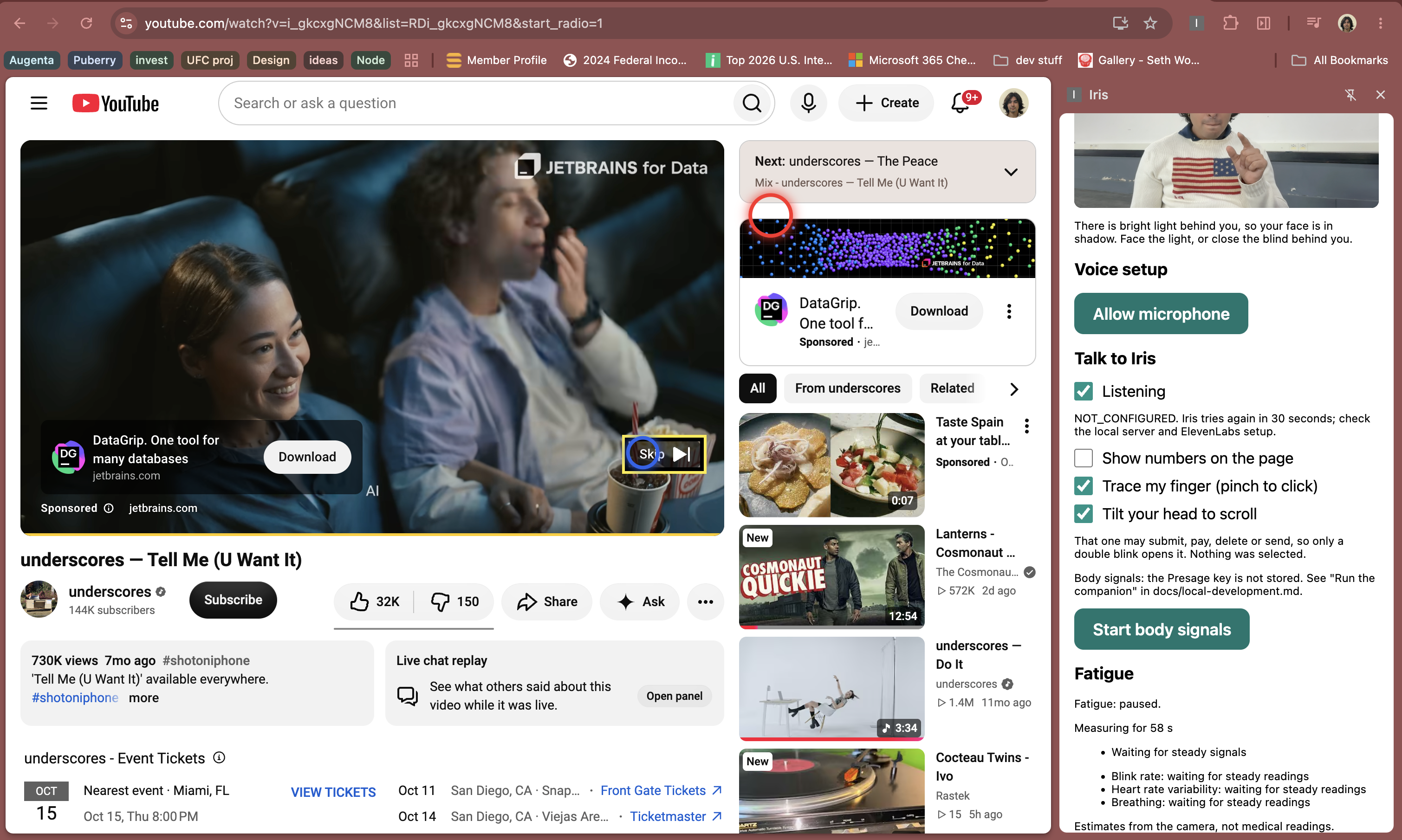
Iris is an accessibility-focused interface that enables users to navigate digital devices using eye movements, intentional blinking, and voice assistance.
Using a camera, Iris tracks the user's gaze to help them navigate on-screen elements and select options without relying on traditional mouse or touchscreen interactions. Blink-based confirmation provides another way to interact, while a voice assistant allows users to request guidance, find content, and navigate digital experiences through natural conversation.
Rather than simply moving a cursor, Iris aims to make digital navigation more intuitive by combining visual input with conversational assistance.
Our vision is to help people browse the web, access information, communicate with others, and complete everyday digital tasks with greater independence.
How we built it
We approached Iris as a multimodal accessibility system, combining computer vision, input processing, and voice-based assistance.
Eye tracking: We use camera input to estimate gaze and help users identify on-screen targets. Blink detection: We use blink-based interactions to support intentional selection and hands-free control. Voice assistance: A conversational assistant helps users navigate, request guidance, and interact with digital content using natural language. Interaction design: We focus on making navigation understandable and reducing unnecessary actions, with the goal of preventing accidental selections. Accessibility-first thinking: We designed the experience around the user's intent, comfort, and independence rather than assuming conventional mouse-and-keyboard interaction.
By bringing these capabilities together, Iris explores how multiple input methods can create a more flexible and accessible way to interact with technology.
Challenges we ran into
One of our biggest challenges was translating natural human behavior into reliable digital commands.
Eye movements are not always intentional. People naturally look around, blink frequently, and shift their gaze while reading. Distinguishing a deliberate selection from an ordinary glance is essential to creating an interface that users can trust.
We also had to consider the balance between responsiveness and accuracy. An interface that reacts too quickly may trigger unintended actions, while one that requires too much effort can become frustrating or tiring.
Another challenge was bringing eye-based navigation and voice assistance together into a cohesive experience. Both need to complement each other so that users can move between visual control and conversational guidance without adding complexity.
These challenges reinforced an important lesson: accessibility is not just about making an interaction possible; it is about making it practical, reliable, and comfortable to use.
Accomplishments that we're proud of
We are proud to have developed Iris around a meaningful accessibility challenge and explored how everyday hardware can support alternative ways of interacting with technology.
We brought together the concepts of gaze-based navigation, blink-based selection, and voice-guided assistance into one unified vision rather than treating them as separate accessibility features.
Most importantly, we focused on the experience behind the technology. Every interaction represents an opportunity to reduce friction, give users more control, and make digital experiences more inclusive.
Iris represents our belief that assistive technology should not only help people access devices, but also help them participate more independently in the digital world.
What we learned
Building Iris taught us that accessibility requires designing for real human behavior, not idealized inputs.
A glance is not always a command, a blink is not always a selection, and a technically functional interface is not necessarily an accessible one. Small details such as confirmation, feedback, adjustable sensitivity, and recovery from mistakes can make a meaningful difference.
We also learned that combining input methods can offer greater flexibility than relying on a single interaction technique. Eye tracking can support visual targeting, while voice assistance can provide context, guidance, and an alternative way to express intent.
Above all, we learned to approach accessibility as a fundamental part of product design rather than an additional feature.
What's next for Iris
Our next step is to make Iris more reliable, adaptable, and useful in everyday situations.
We want to improve gaze calibration and selection accuracy, strengthen safeguards against accidental clicks, and explore personalized settings that accommodate different abilities and preferences.
We also envision expanding the voice assistant so that users can ask it to explain what's on a page, locate specific links or controls, summarize information, and guide them through more complex digital tasks.
Other priorities include exploring fatigue-aware interaction, improving privacy through on-device processing where feasible, and testing Iris with people who have different motor and accessibility needs.
Ultimately, we want to move beyond a prototype and build an accessible interface that helps people communicate, learn, work, and navigate the web with greater confidence and independence.
Our long-term vision is a world where access to technology depends less on how you move and more on what you want to accomplish.
Built With
- chrome
- cloudflare-workers
- css
- elevenlabs
- google-gemini
- html
- javascript
- mediapipe
- node.js
- postgresql
- presage-smartspectra
- sql
- tiger-data
- typescript
- vite
- webassembly
- websocket


Log in or sign up for Devpost to join the conversation.