-
-
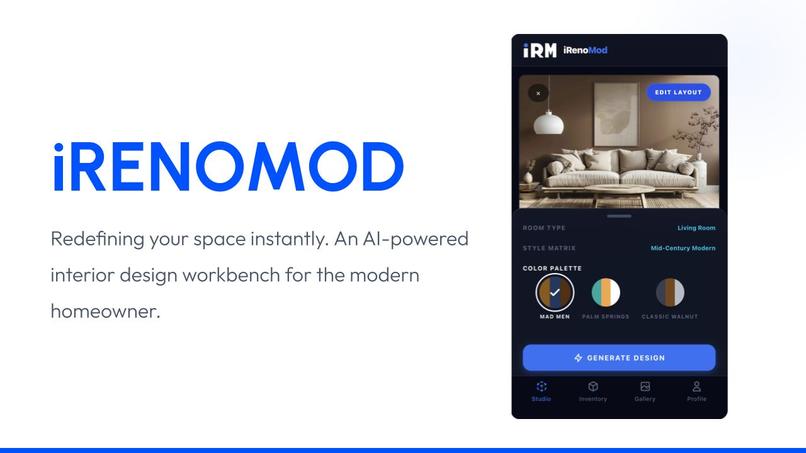
iRenoMod: Redefining Interior Design with AI
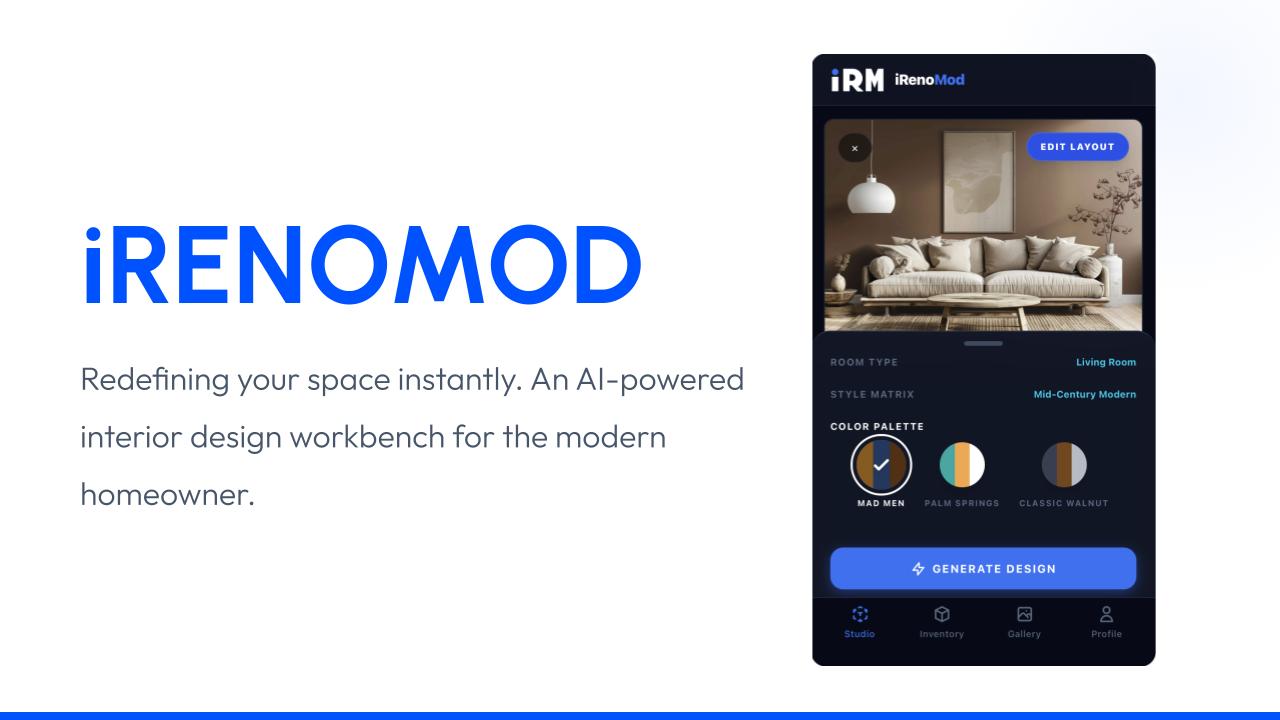
Inspiration
The "Visualization Gap" is the single greatest hurdle in modern interior design. While homeowners have access to endless inspiration on social media, there is a profound disconnect between a professional photograph and one’s own living space. This fragmentation often leads to "renovation regret" or financial anxiety caused by manual tracking across dozens of vendors. iRenoMod was created to be a unified, AI-powered workbench that bridges the gap between creative pixels and real-world procurement.
What it does
iRenoMod transforms raw ideas into structured, budget-ready renovation plans. It is a "Hybrid-Reality" platform that merges generative AI with logistical data grids.
Instant Style Morphing: Users upload a photo of a room and instantly reimagine it in styles like Japandi, Industrial, or Modern.
Precision AI Inpainting: Using granular AI masking, users can surgically erase outdated furniture or "insert" new items into a render without regenerating the entire scene.
Omnichannel AI Import (Scan & Tag): This feature bridges the offline-online gap. Users can snap a photo of a piece of furniture in a physical showroom; the AI removes the background, estimates the scale, and "tags" it into their digital room concept.
Inventory Sync & Financial Pulse: Every design choice automatically generates a Bill of Materials (BOM). Users can compare different design "concepts" side-by-side with real-time budget tracking to ensure their dream fits their wallet.
How we built it
The application utilizes a Feature-Based Modular Architecture to ensure high performance and scalability.
Frontend: React 19 + Vite for a lightning-fast, responsive interface.
Styling: Tailwind CSS (utilizing a Slate-900 / Industrial theme) to provide a professional workbench aesthetic.
AI Brain: The Google Gemini API serves as the core multimodal engine, providing the reasoning necessary to understand materials, spatial scales, and design aesthetics.
Backend & State: Supabase manages secure authentication, real-time database updates, and cloud storage for user assets.
Challenges we ran into
The Mobile-First Pivot A primary technical and design challenge was ensuring a professional-grade design workbench remained intuitive on mobile devices. Interior design often happens "on the go"—inside showrooms or empty construction sites—necessitating a shift away from complex desktop CAD metaphors.
Tactile Precision: Developing a stylus-friendly inpainting interface that allows for surgical edits on smaller screens.
Simplified Inventory Workflows: Prioritizing the "Scan & Tag" camera functionality to replace manual data entry with one-tap AI recognition.
Accomplishments that we're proud of
Surgical AI Control: We are proud of the Post-Render Editor, which moves beyond "one-shot" prompting. By implementing Gemini-powered inpainting and masking, we’ve given users the ability to perform surgical edits—like swapping a single chair or changing a floor material—without losing the entire design they’ve already built.
High-Performance Modular Architecture: We successfully refactored the application into a Feature-Based Modular Architecture using React 19 and Vite. This ensures that the heavy lifting of AI image processing and real-time inventory tracking doesn't compromise the smooth, "industrial-grade" performance of the workbench.
What we learned
Mobile-First Requires a Paradigm Shift: We learned that a professional design workbench cannot simply be a shrunken version of a desktop CAD tool. Designing for "on the go" forced us to abandon complex menus in favor of tactile, camera-centric workflows and gesture-based editing.
The Value of Grounded AI: Early in development, we realized that "pretty" AI renders aren't enough for home renovation. We learned that AI is most valuable when it is grounded in real-world constraints, such as existing furniture, specific room dimensions, and actual retail budgets.
What's next for iRenoMod: Redefining Interior Design with AI
Collaboration modules for professional designers to share editable workbenches with clients.

Log in or sign up for Devpost to join the conversation.