IRC 2.0: Classic Chat, Modern Intelligence
Inspiration
The inspiration for IRC 2.0 came from a deep nostalgia for the golden age of internet communication. As someone who grew up witnessing the evolution of online chat from IRC's command-driven efficiency to today's feature-rich but often bloated messaging platforms, I wanted to bridge that gap. The OSDHack 2025 "Blast from the Past" theme provided the perfect opportunity to revive the authentic IRC experience while addressing its limitations with modern technology.
The core inspiration was simple: What if IRC had evolved alongside AI and modern web technologies? Instead of abandoning the elegant simplicity of slash commands and channel-based communication, what if we enhanced it with intelligent assistance, real-time reactions, and contemporary UX design? This project represents that vision - honoring IRC's legacy while making it relevant for today's users.
What it does
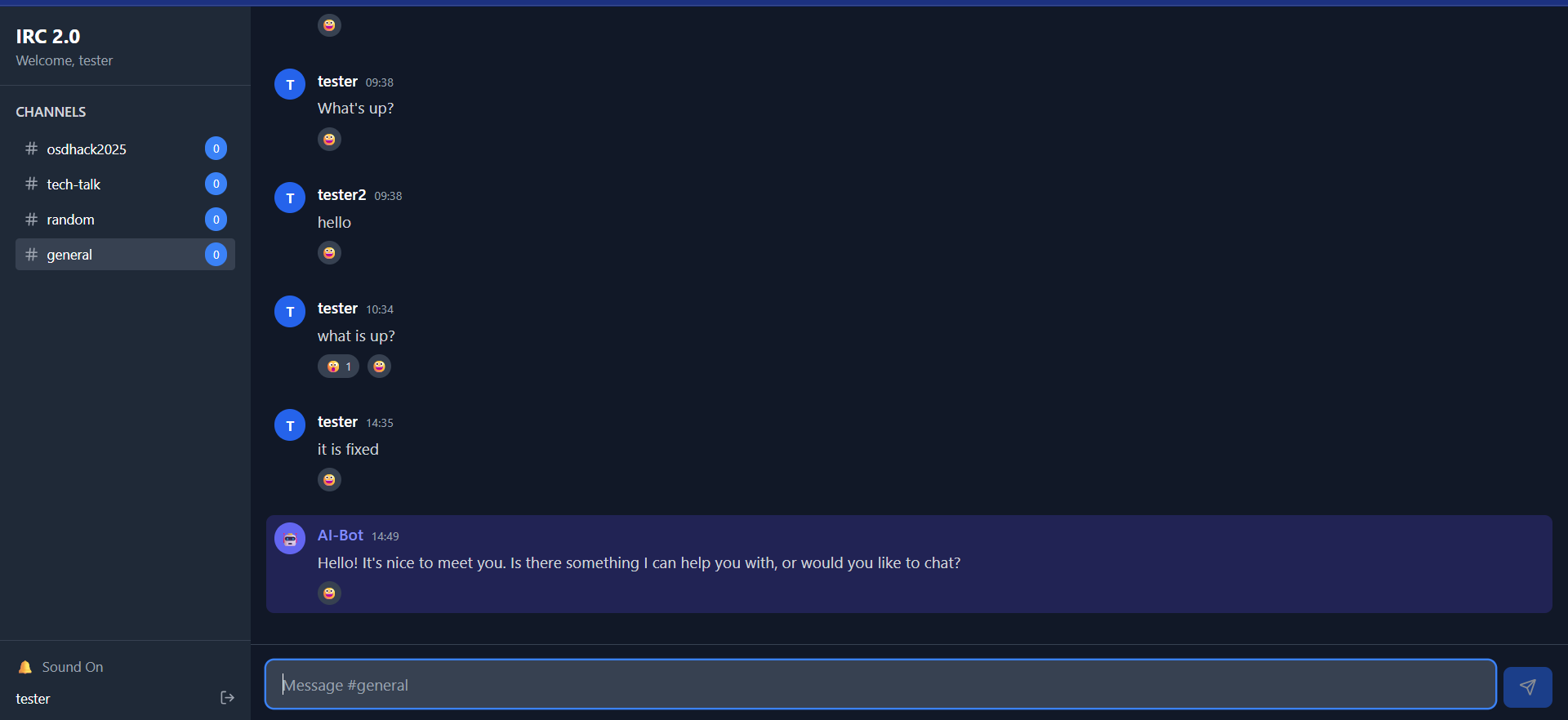
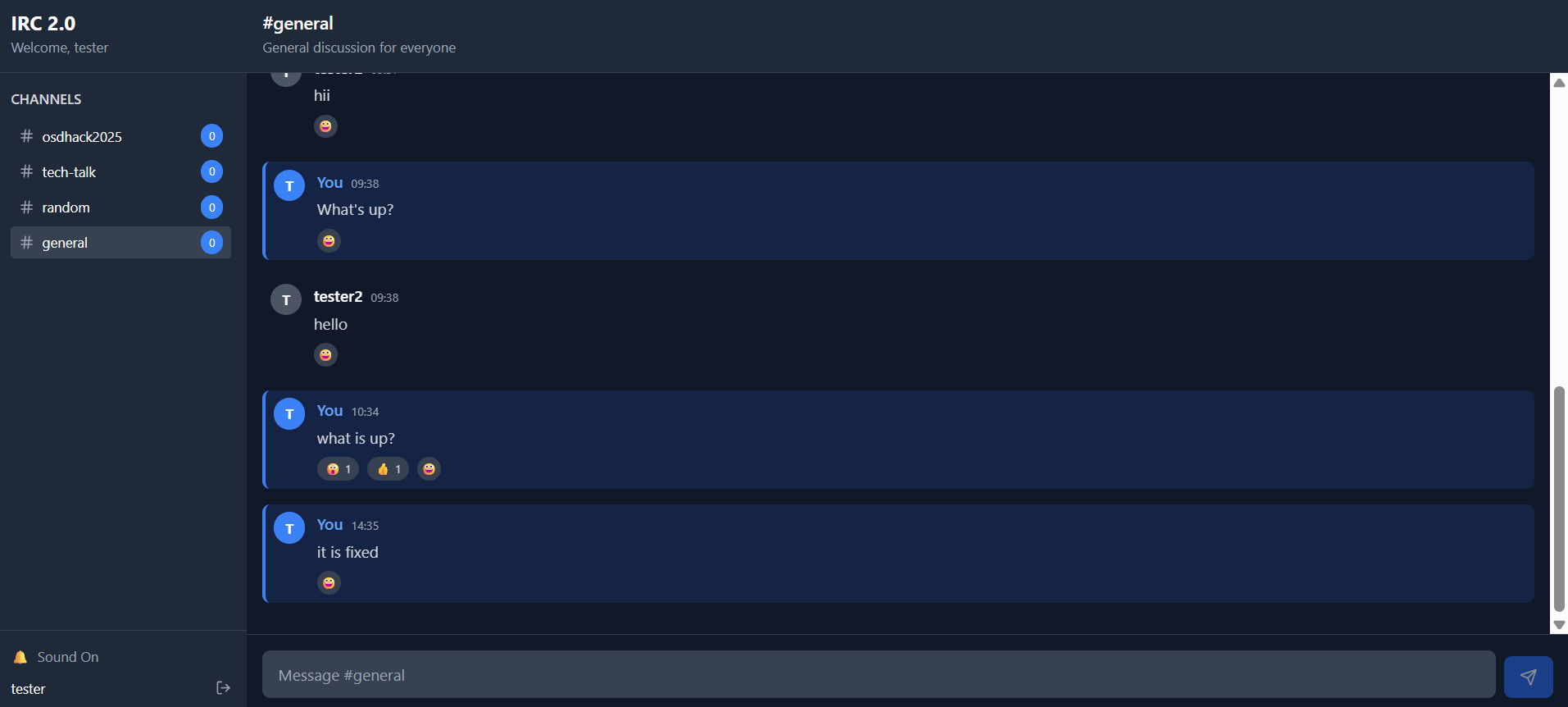
IRC 2.0 is a modern chat application that seamlessly blends classic IRC functionality with cutting-edge AI capabilities and contemporary features:
Core IRC Features
- Authentic command system supporting
/join,/list,/help,/nickcommands - Real-time channel switching with persistent message history
- User presence indicators showing online/offline status
- Live member counts for each channel with real-time updates
- Typing indicators for enhanced communication flow
Modern Enhancements
- Local AI assistant powered by Ollama and Llama3 model, accessible via
/aicommand - Emoji reactions system with real-time synchronization across all clients
- Sound notifications with user-controlled toggle functionality
- Message timestamps for better conversation context
- Responsive dark theme optimized for both desktop and mobile
Technical Capabilities
- Real-time messaging using Socket.io for instant communication
- JWT-based authentication for secure user management
- MongoDB Atlas integration for scalable message storage
- Privacy-focused AI processing that runs entirely on your local machine
How we built it
Architecture & Tech Stack
We built IRC 2.0 using a modern full-stack approach:
Frontend:
- React 19 with Vite for fast development and hot reloading
- Tailwind CSS for responsive, utility-first styling
- Zustand for lightweight state management
- Socket.io Client for real-time communication
- Axios for API requests and AI integration
Backend:
- Node.js with Express framework for robust server architecture
- Socket.io for WebSocket management and real-time features
- MongoDB Atlas for cloud-based message and user storage
- JWT for secure authentication and session management
- Bcrypt for password hashing and security
AI Integration:
- Ollama for local AI model hosting
- Llama3 model for intelligent chat responses
- Custom REST API bridge between chat interface and AI model
Development Process
The development followed a structured approach over the hackathon timeline:
- Foundation : Set up core infrastructure, authentication, and basic messaging
- IRC Commands : Implemented command parser and classic IRC functionality
- Real-time Features : Added reactions, typing indicators, and sound notifications
- AI Integration : Integrated Ollama with custom
/aicommand - UI/UX Polish : Fixed responsive design and improved user experience
- Testing : Bug fixes, optimization, and final deployment
Key Implementation Details
- Socket Event Architecture: Designed efficient event handling for messages, reactions, and user presence
- State Synchronization: Implemented Zustand store with real-time socket listeners
- Command Processing: Built flexible command parser supporting both classic IRC and modern AI commands
- Responsive Design: Used Tailwind's utility classes for mobile-first responsive layout
Challenges we ran into
Real-time State Synchronization
The biggest challenge was ensuring that emoji reactions updated in real-time across all connected clients. Initially, reactions would only appear after page refresh or channel switching. The issue was a missing socket listener in the frontend store - the backend was correctly emitting reaction-updated events, but the frontend wasn't listening for them. This required careful debugging of the Socket.io event flow and proper state management in Zustand.
CSS Layout and Text Overflow
We encountered significant horizontal overflow issues where long messages would break the chat layout, extending beyond the screen width. This was particularly problematic with AI responses and long URLs. The solution involved implementing proper CSS constraints with min-w-0 on flex containers, break-words for text wrapping, and overflow-hidden on parent containers.
AI Integration Complexity
Integrating Ollama with the chat interface presented several challenges:
- Proxy Configuration: Setting up Vite to properly proxy API requests from frontend to backend
- Command Parser Logic: Merging the existing IRC command system with the new asynchronous AI command processing
- Response Time Management: Handling the natural delay of local AI inference while maintaining good user experience
Socket Connection Management
Managing socket connections across different components and ensuring proper cleanup on disconnection required careful attention to prevent memory leaks and duplicate event listeners.
Accomplishments that we're proud of
Seamless AI Integration
Successfully integrated a local AI model (Llama3) into a chat interface while maintaining the authentic IRC experience. The /ai command feels natural alongside traditional IRC commands, and the local processing ensures privacy and offline capability.
Real-time Feature Implementation
Built a comprehensive real-time system including:
- Instant message delivery with deduplication
- Live emoji reactions with toggle functionality
- User presence indicators and typing notifications
- Dynamic member count updates per channel
Authentic IRC Experience
Maintained the classic IRC feel while adding modern conveniences:
- Command-driven interface with
/join,/list,/helpsupport - Channel-based communication with persistent history
- Clean, terminal-inspired dark theme design
Technical Excellence
- Sub-second message delivery through optimized Socket.io implementation
- Responsive design that works seamlessly on mobile and desktop
- Error handling with user-friendly toast notifications
- Memory-efficient state management using Zustand
Privacy-First AI
Unlike most AI chat integrations that rely on cloud APIs, our solution runs entirely locally, ensuring user privacy and eliminating API costs.
What we learned
Real-time Application Architecture
Gained deep understanding of WebSocket management, event-driven architecture, and the complexities of synchronizing state across multiple clients. Learning to debug socket events and manage connection lifecycles was crucial.
Modern State Management
Discovered the power of Zustand for React applications - its simplicity compared to Redux while maintaining powerful features like middleware and persistence made it ideal for real-time applications.
AI Integration Patterns
Understood how to integrate local AI models into web applications, including proxy configuration, asynchronous command processing, and user experience considerations for AI response times.
Hackathon Development Strategy
Learned the importance of:
- MVP-first approach: Getting core features working before adding enhancements
- Time-boxed development: Allocating specific time blocks for each feature
- Continuous testing: Regular testing to catch issues early
- Documentation as you go: Maintaining clear project structure and documentation
Socket.io Best Practices
Mastered event naming conventions, proper error handling, room management, and efficient broadcasting strategies for real-time applications.
What's next for IRC 2.0
Immediate Enhancements
- File Sharing System: Drag-and-drop image and document upload with preview functionality
- Private Messaging: Direct user-to-user communication with
/msgcommand implementation - Advanced AI Models: Support for different Ollama models (phi3, codellama) with model switching
- Channel Moderation: Admin roles, user permissions, and channel management tools
User Experience Improvements
- Message Search: Full-text search across message history with filters
- Custom Themes: Light mode and customizable color schemes
- Keyboard Shortcuts: Power-user shortcuts for common actions
- Message Threading: Reply-to-message functionality for better conversation organization
Technical Scaling
- Database Optimization: Message pagination and efficient query patterns
- Caching Layer: Redis integration for improved performance
- Load Balancing: Support for multiple server instances
- API Rate Limiting: Proper rate limiting and abuse prevention
Mobile & Desktop Apps
- Progressive Web App: Offline support and native app-like experience
- Electron Desktop App: Native desktop application with system integration
- Mobile Apps: Native iOS and Android applications
Advanced AI Features
- Context-Aware AI: AI that remembers conversation context across messages
- Custom AI Personalities: Different AI assistants for different channels
- AI Moderation: Automated content moderation and spam detection
- Voice Integration: Voice-to-text and text-to-speech capabilities
Enterprise Features
- Team Workspaces: Organization-level channel management
- Integration APIs: Webhooks and third-party service integrations
- Analytics Dashboard: Usage statistics and engagement metrics
- Backup & Export: Message history export and backup functionality
Community & Open Source
- Plugin System: Allow community-developed extensions
- Open Source Release: Make the project available for community contributions
- Documentation Site: Comprehensive API documentation and user guides
- Community Server: Public IRC 2.0 server for testing and community building
The future of IRC 2.0 lies in becoming the definitive modern IRC client that bridges the gap between nostalgic simplicity and contemporary functionality, while maintaining its core philosophy of privacy-first, command-driven communication enhanced by intelligent assistance.

Log in or sign up for Devpost to join the conversation.