Inspiration
As a pharmacy student training in UAE healthcare settings, I kept witnessing the same problem — not a lack of clinical knowledge, but a failure of communication. Physicians, pharmacists, nurses, and allied health professionals were working in completely separate systems, making individual decisions without a shared view of the patient. Up to 50% of preventable medication errors globally are linked to these communication gaps. I could not accept that this was inevitable. That frustration became the foundation of IPE Connect.
What it does
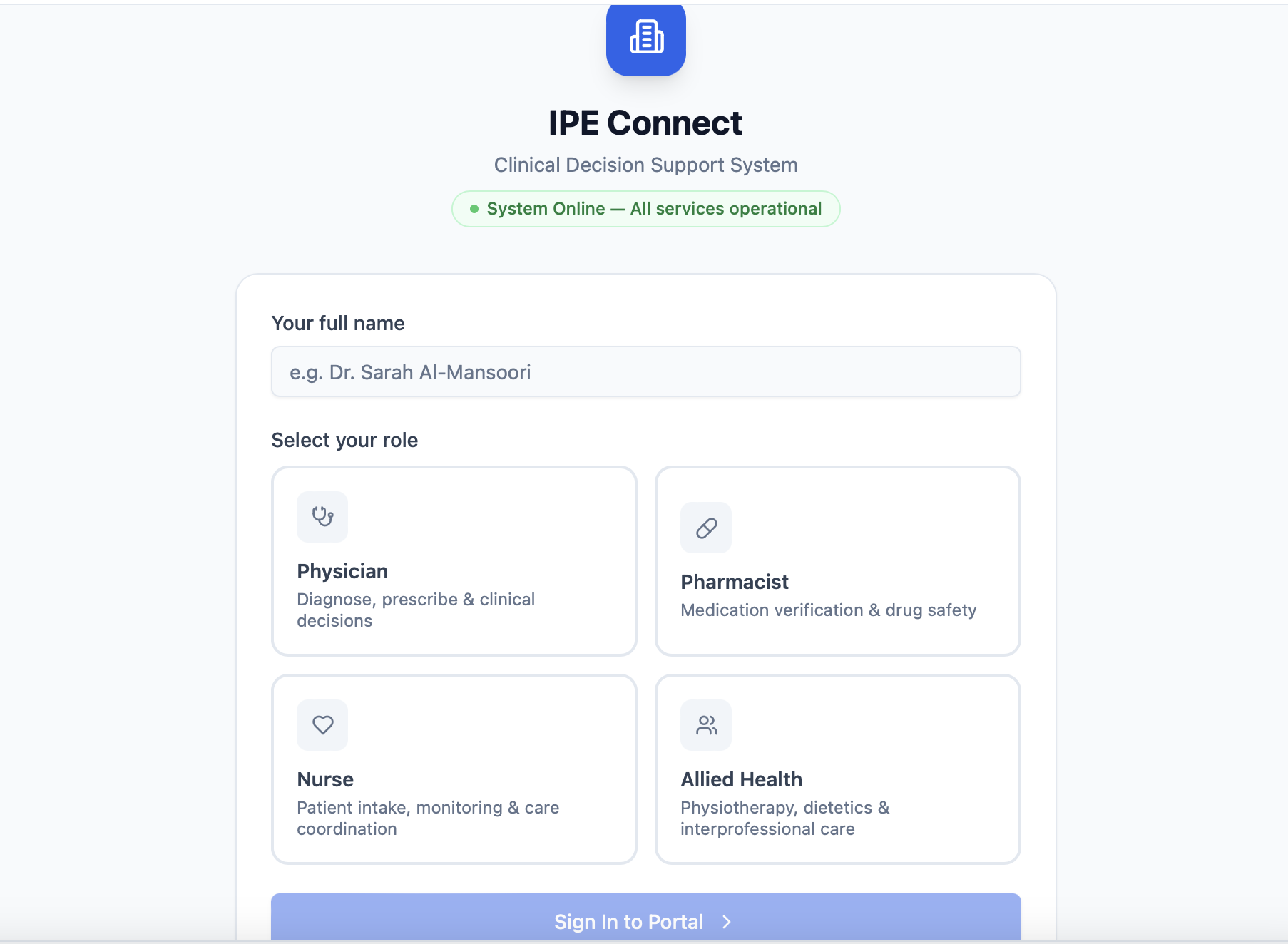
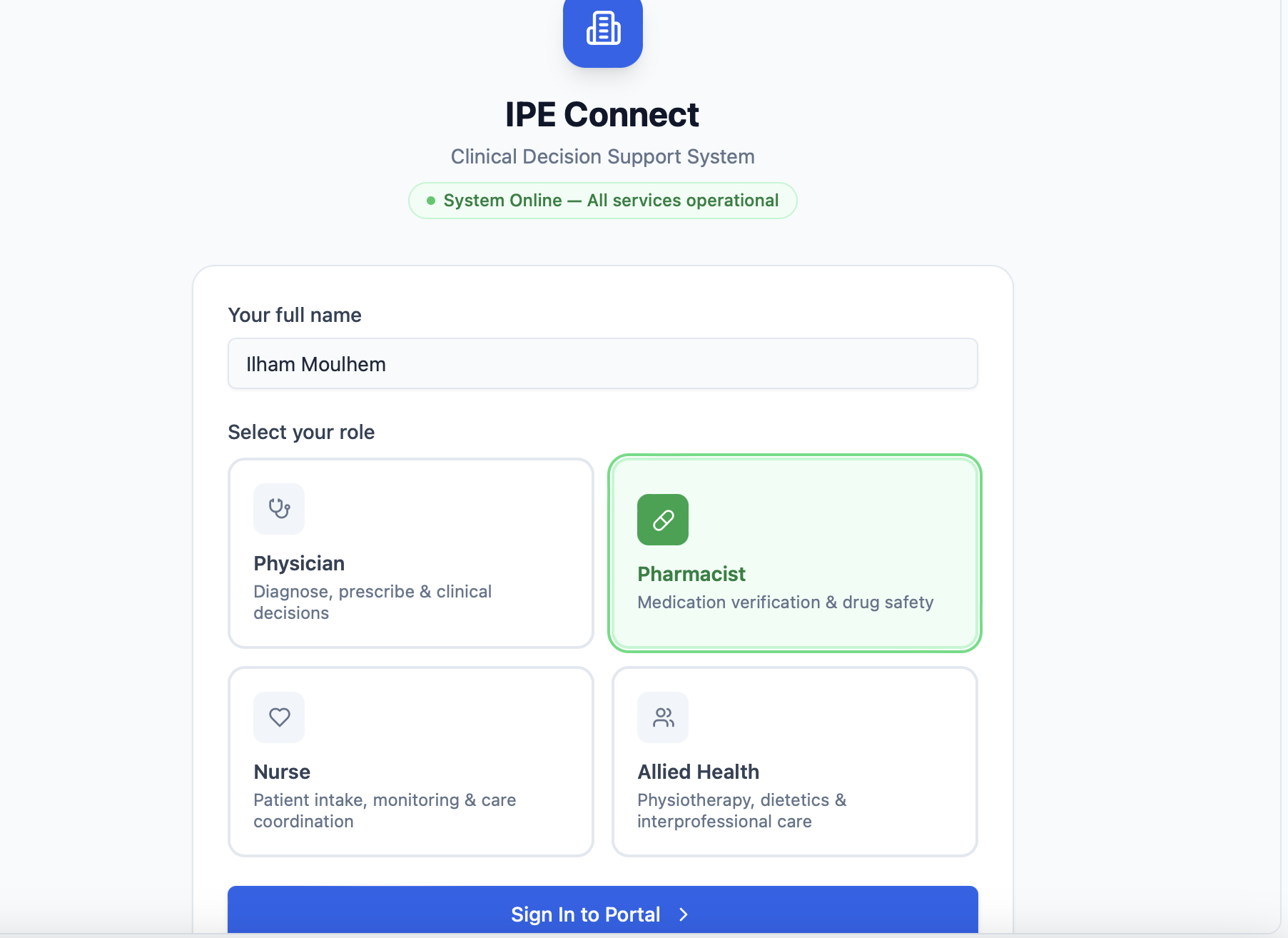
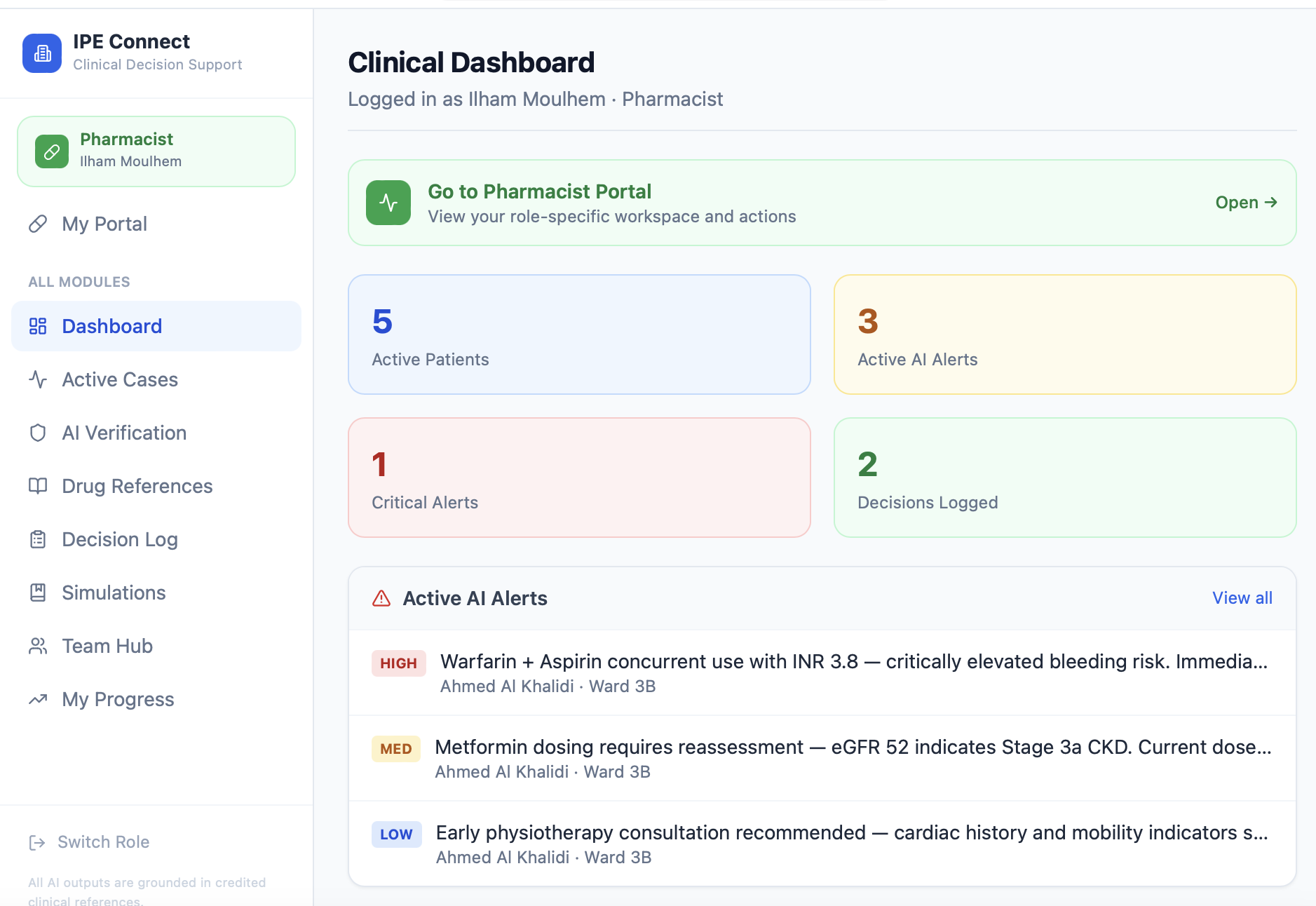
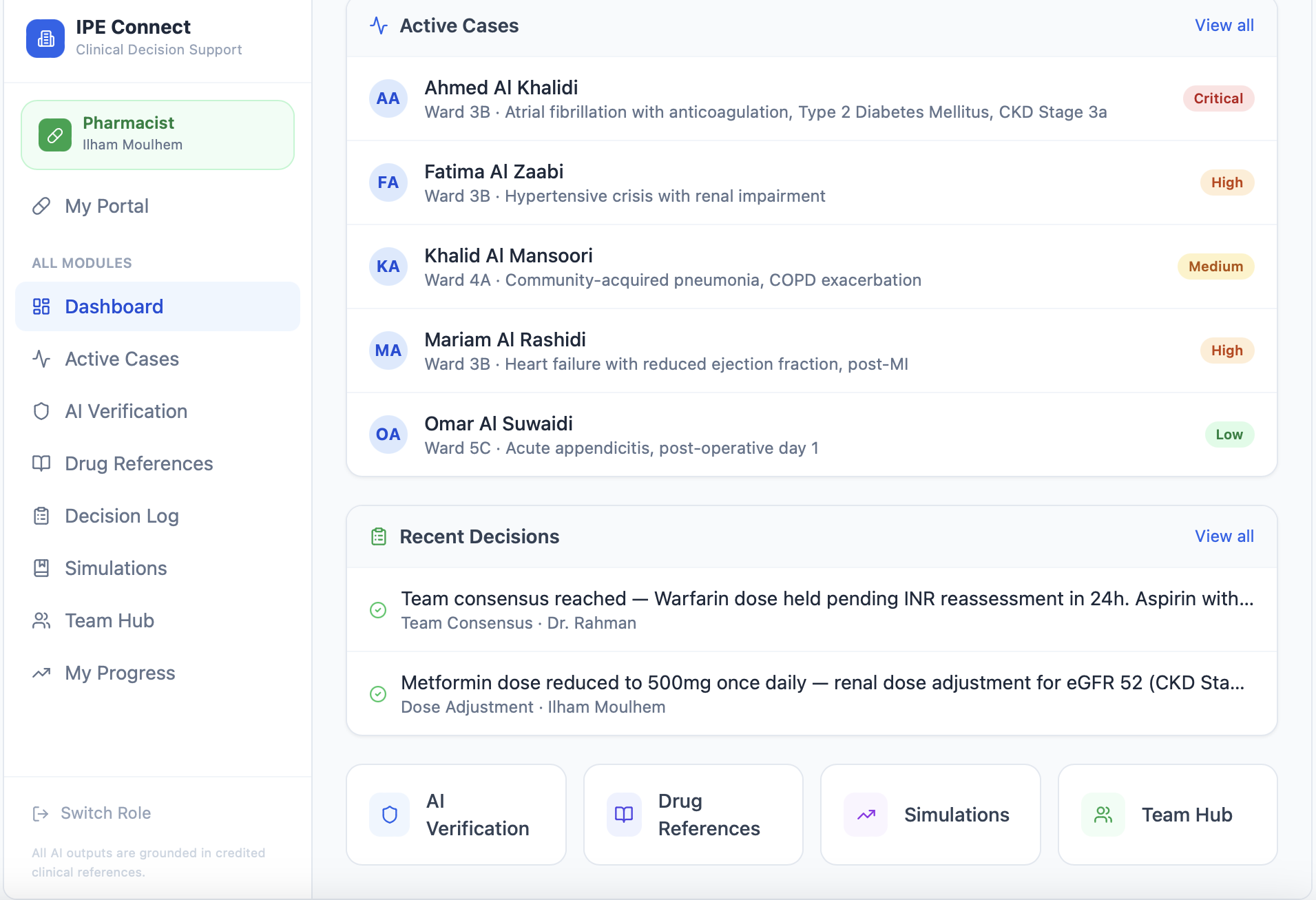
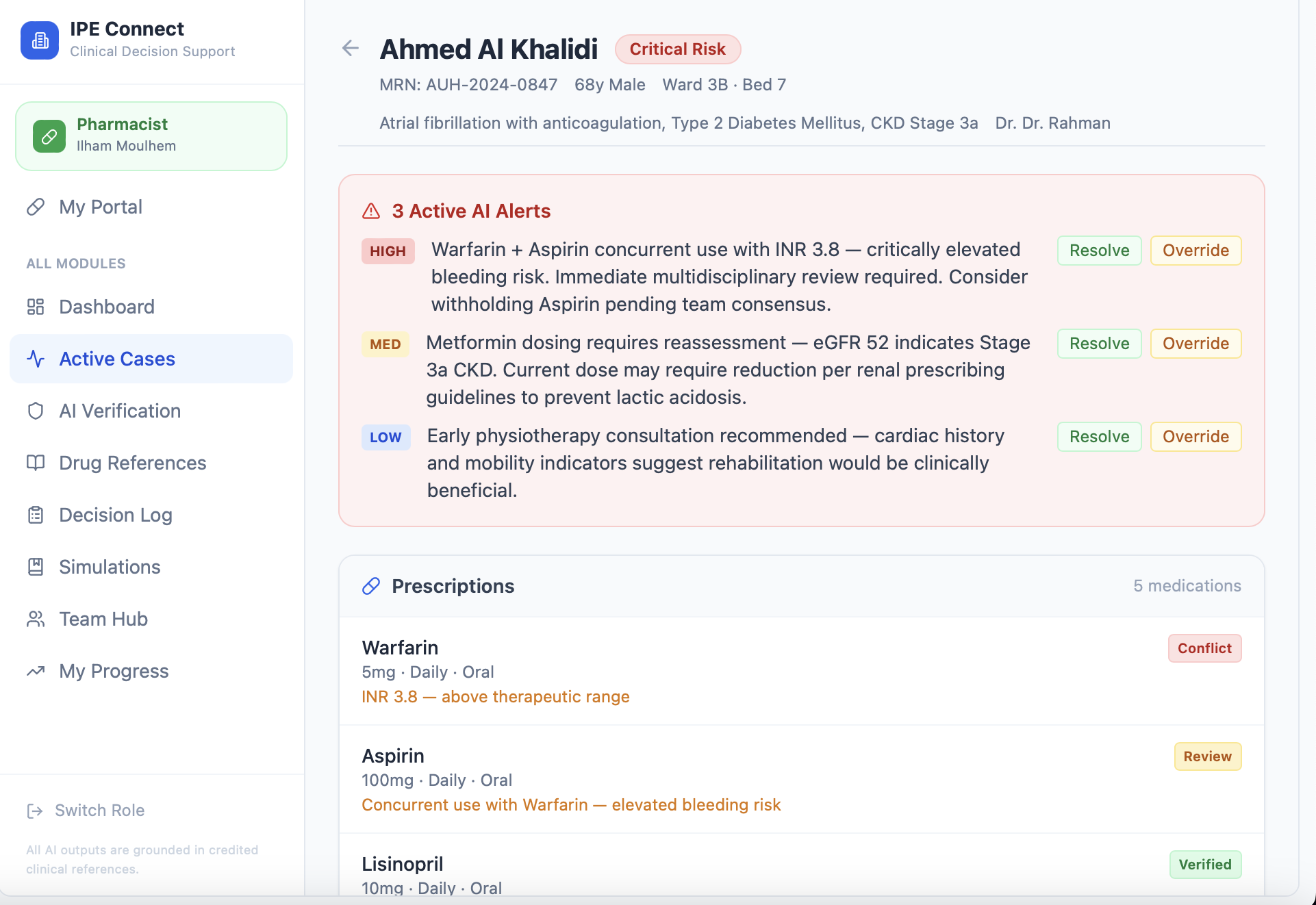
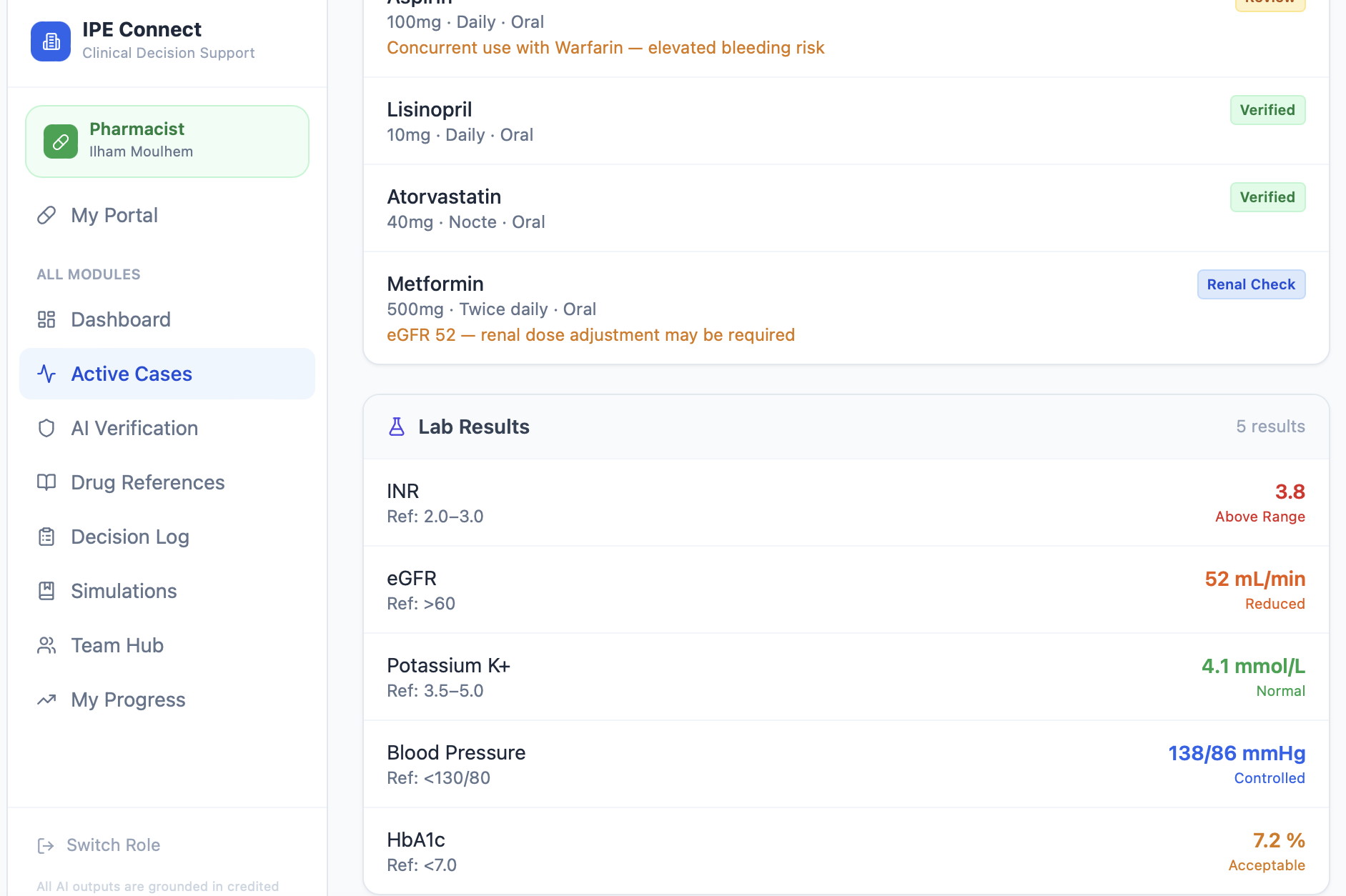
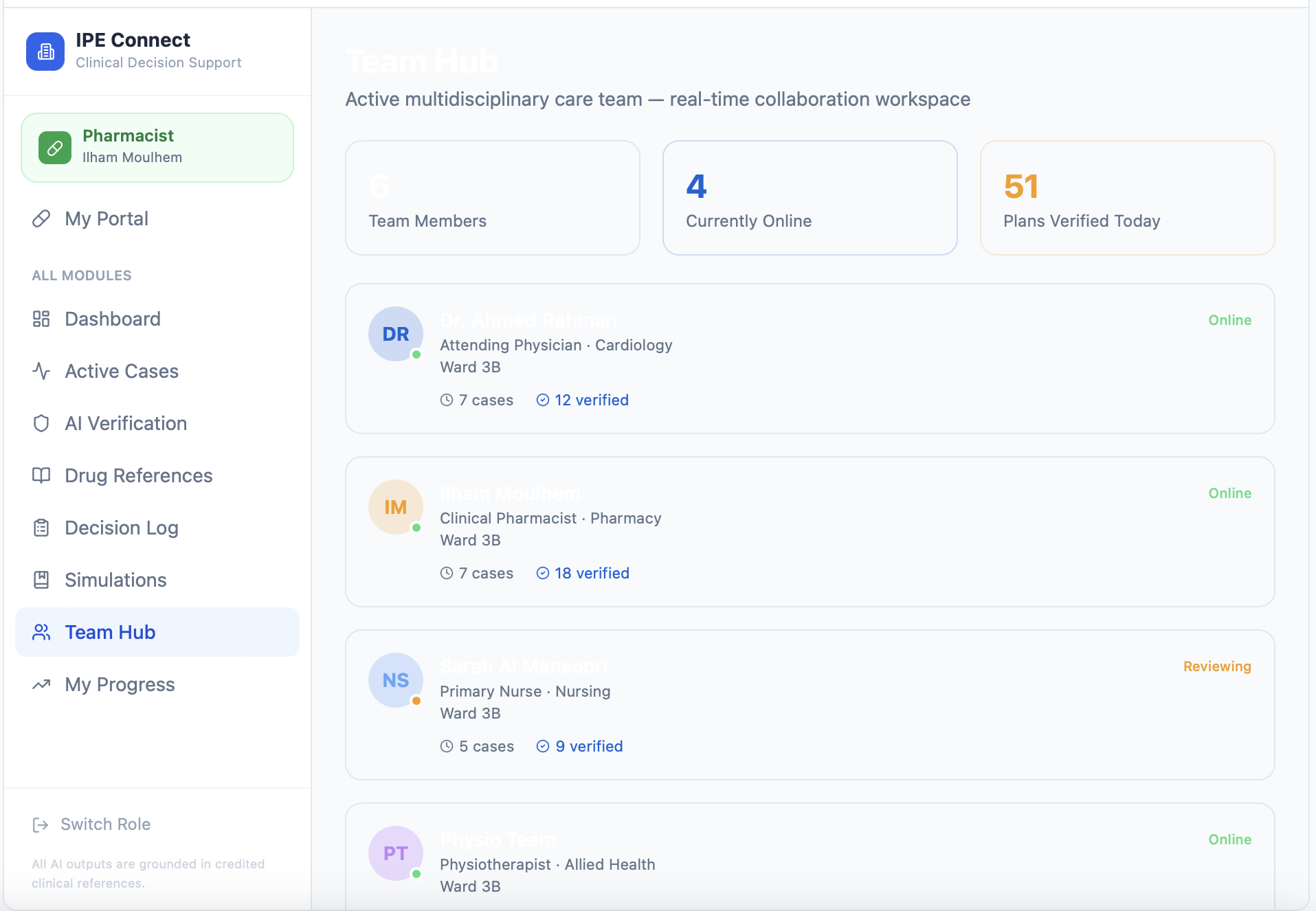
IPE Connect is an AI-enabled interprofessional collaboration platform that brings the entire healthcare team together around one shared, verified clinical workspace in real time.
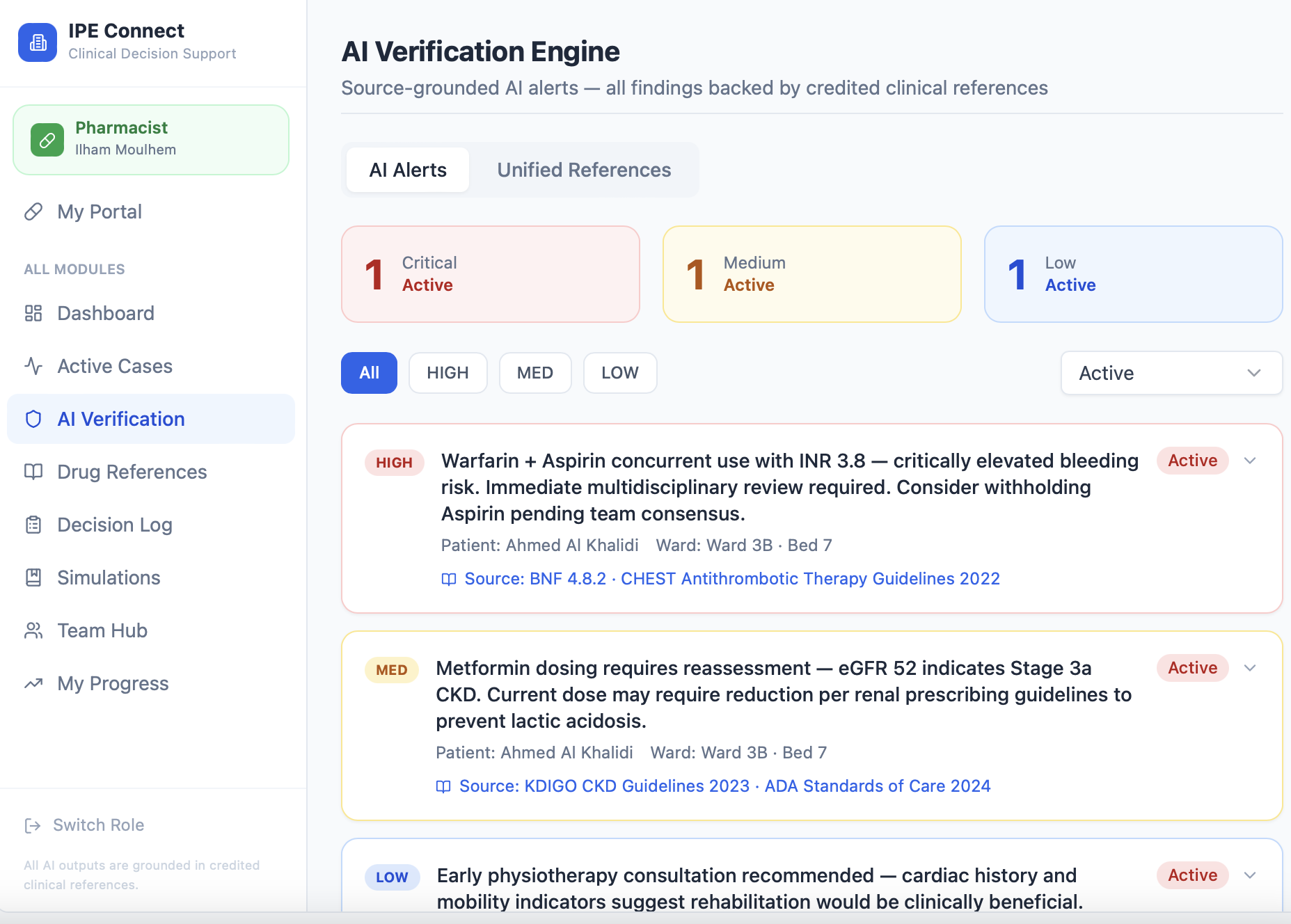
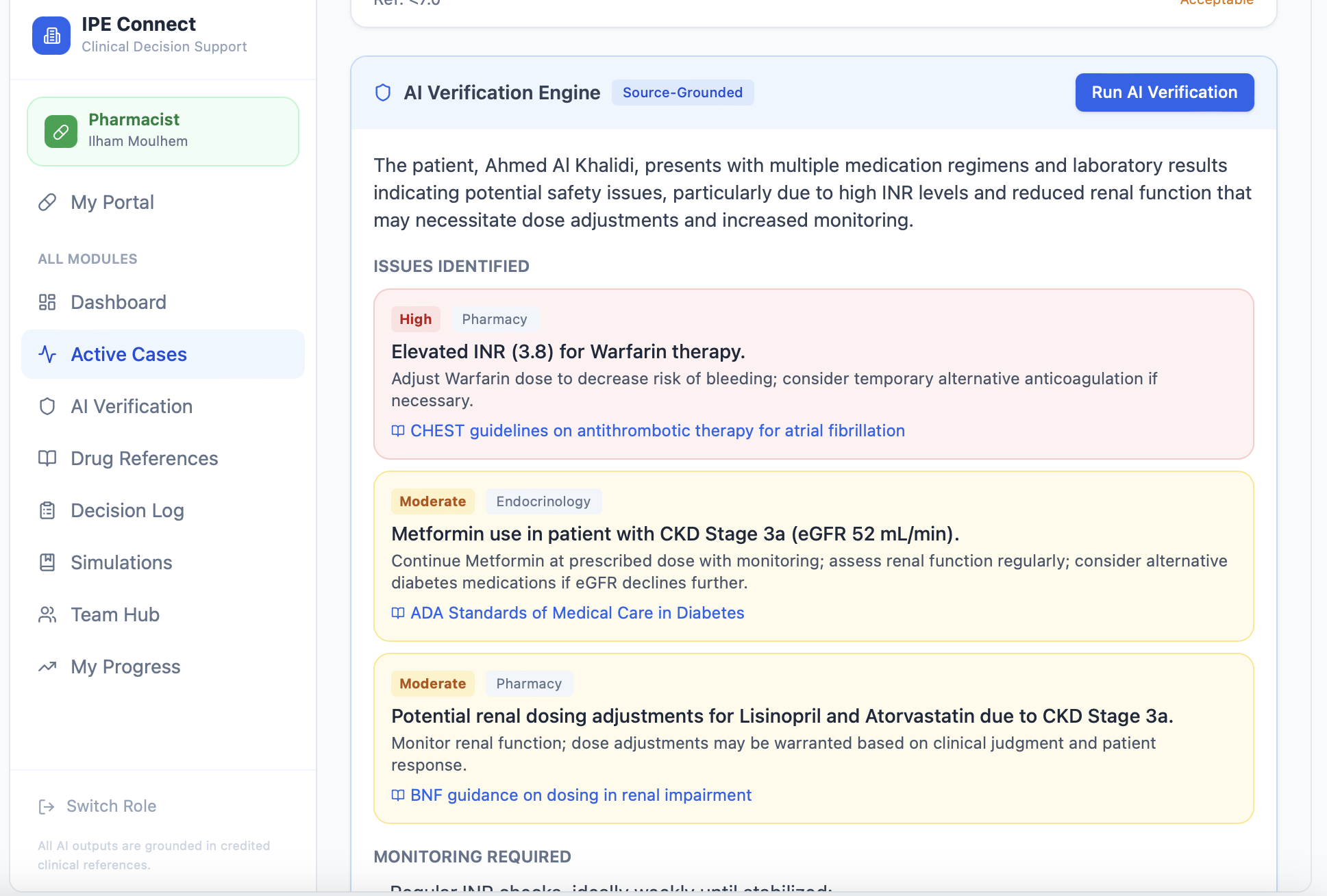
- AI Verification Engine automatically scans prescriptions against unified, credited clinical references and flags drug interactions, dosing conflicts, and safety concerns simultaneously across all team members
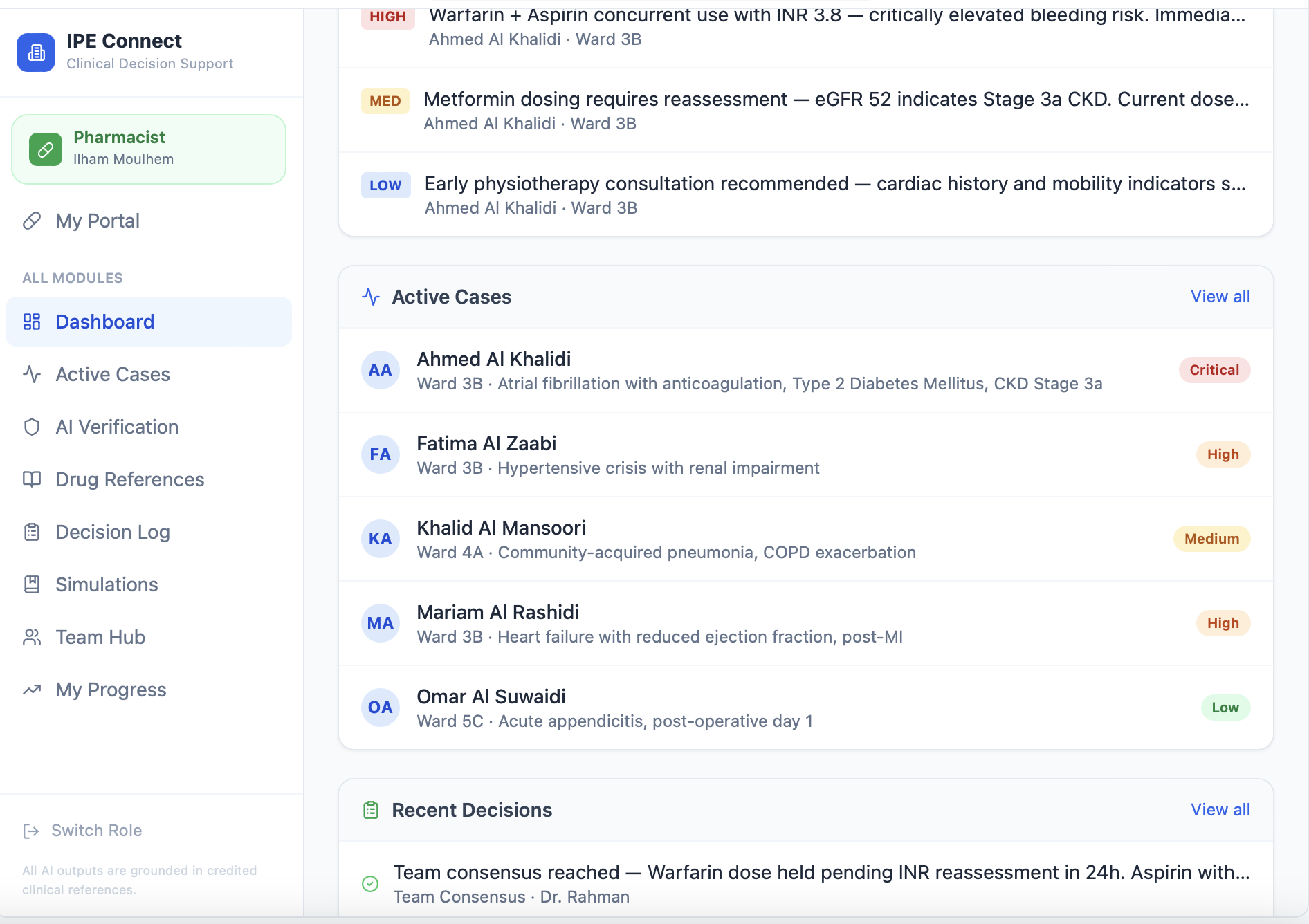
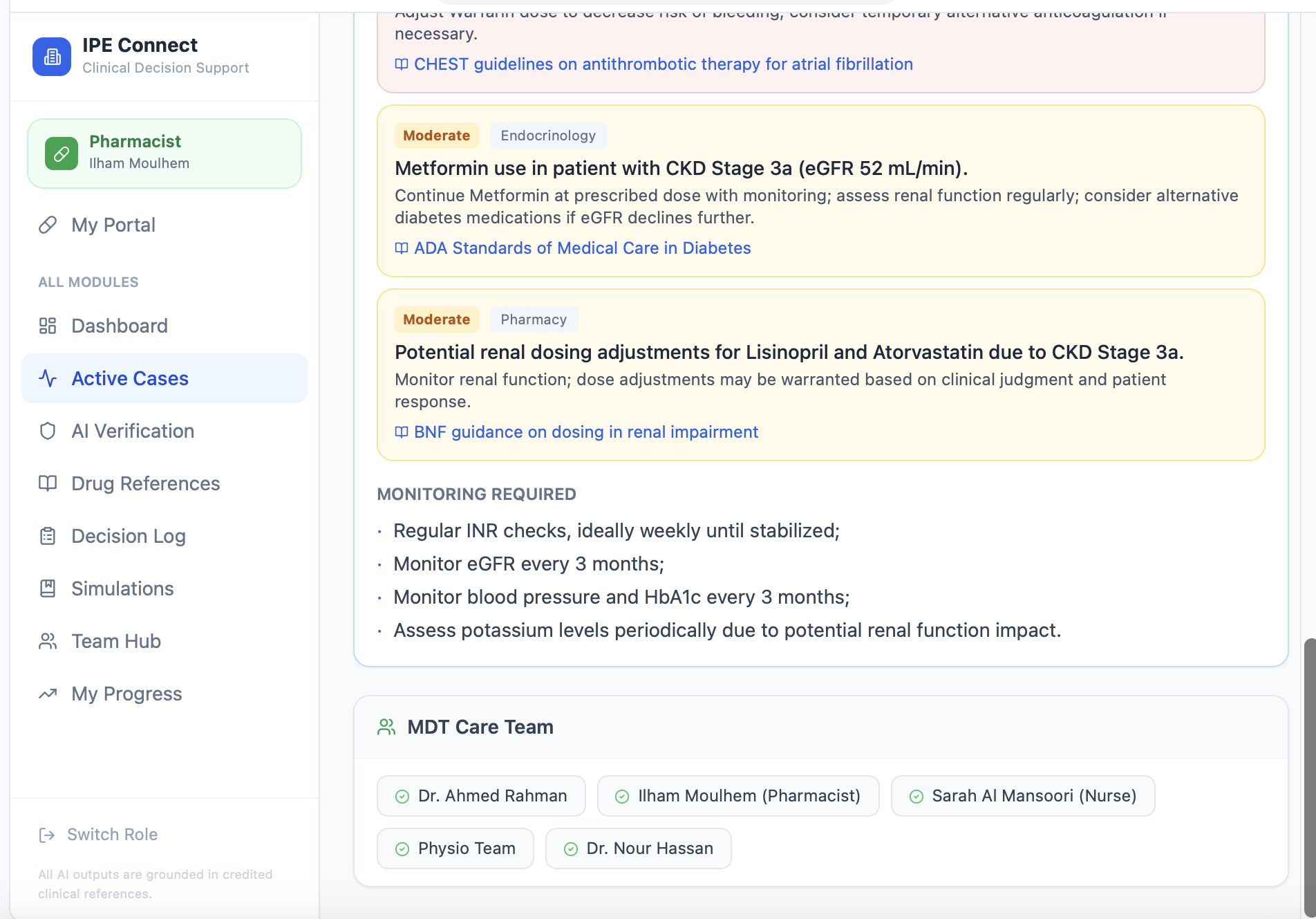
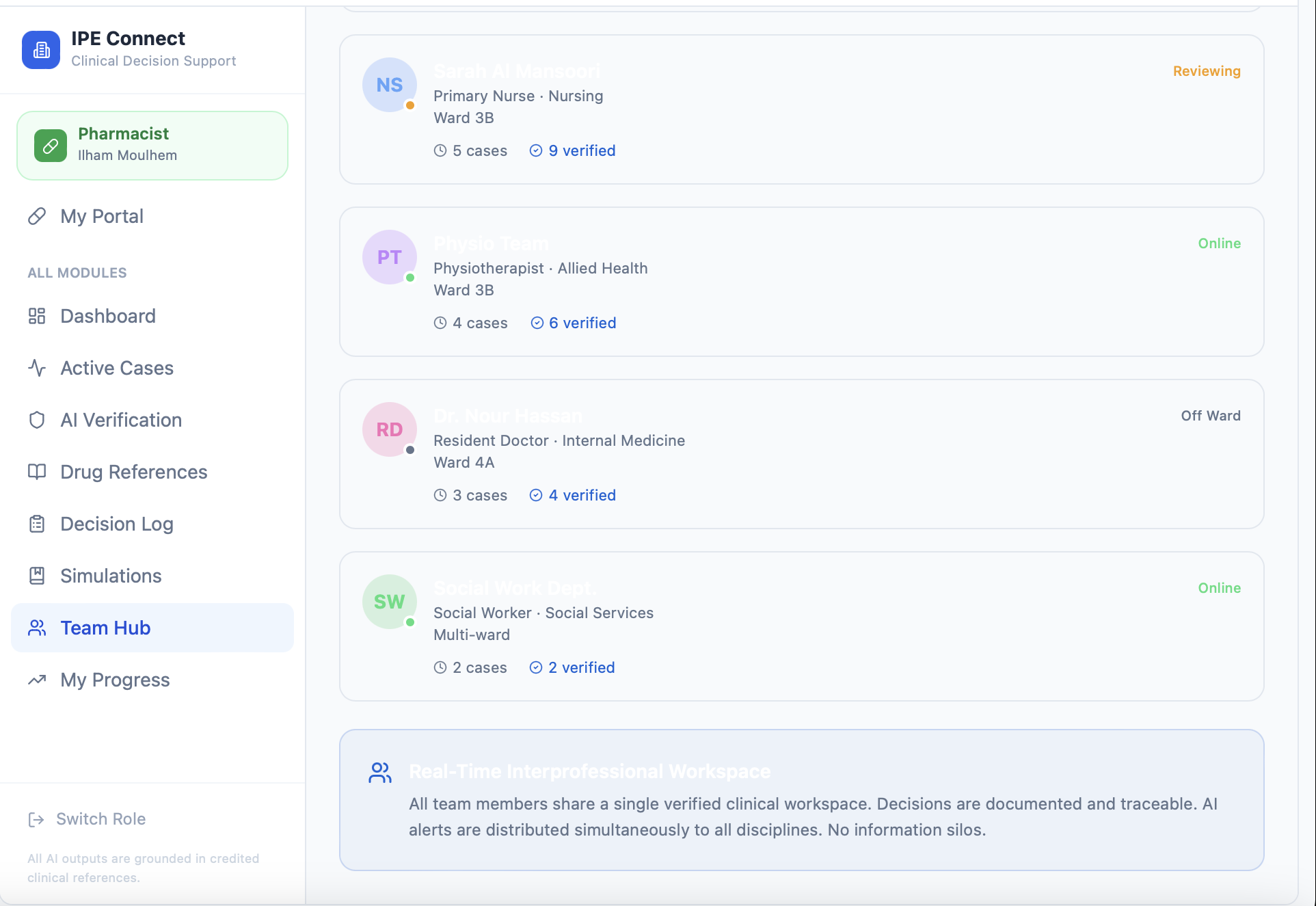
- Live interprofessional communication connects physicians, pharmacists, nurses, physiotherapists, and allied health professionals in one shared dashboard so every team member sees the same alerts, the same patient data, and the same recommended actions at the same time
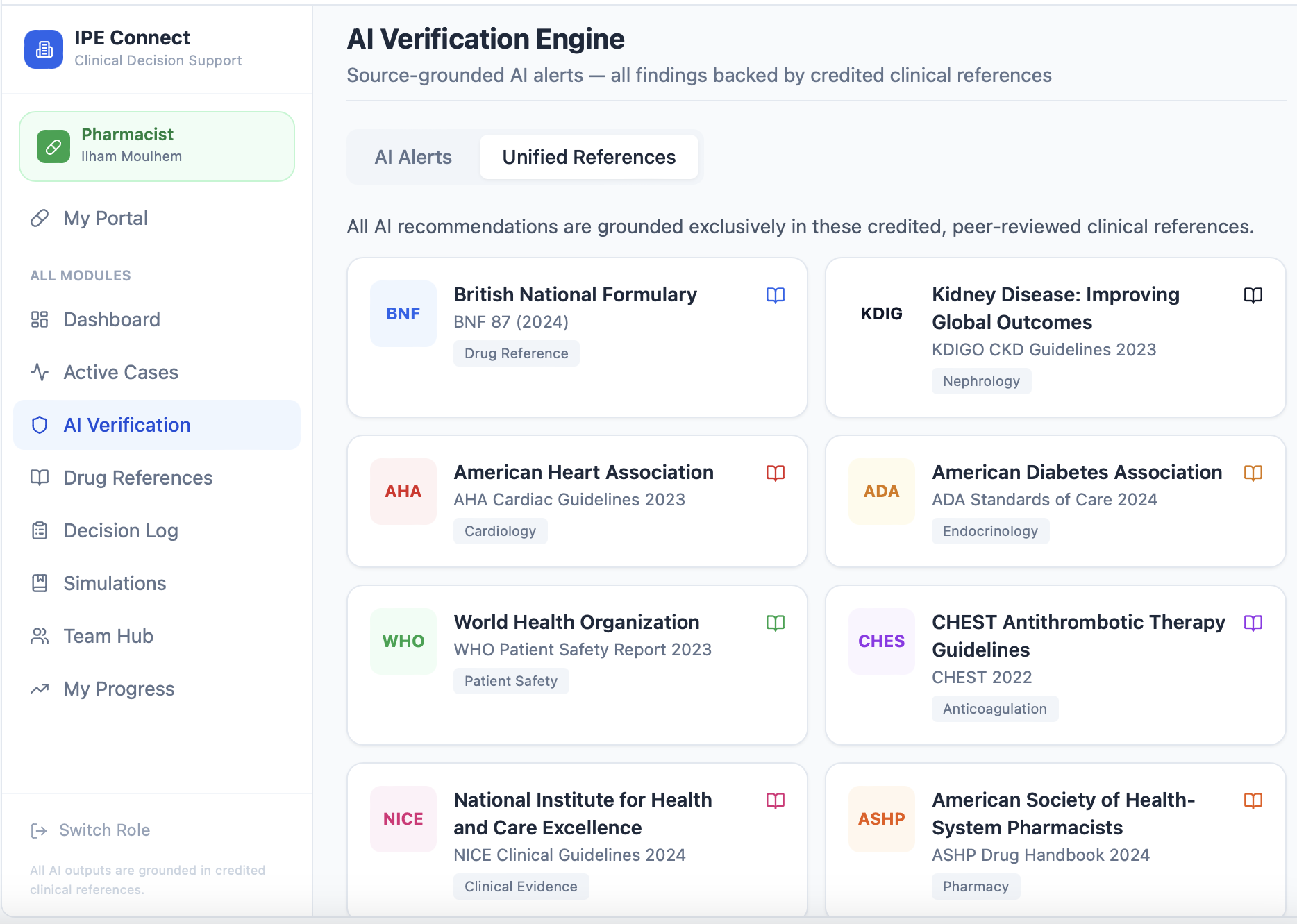
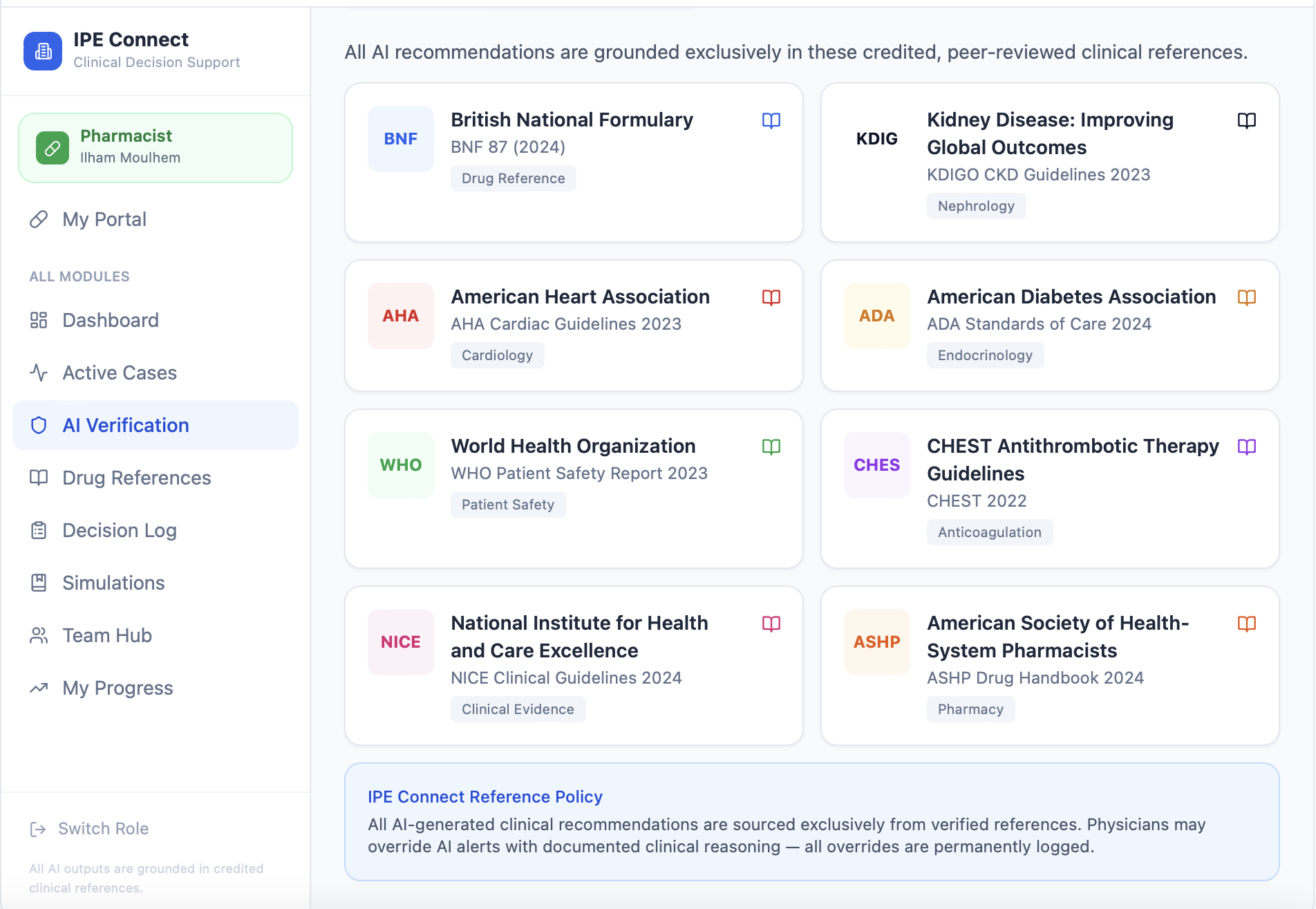
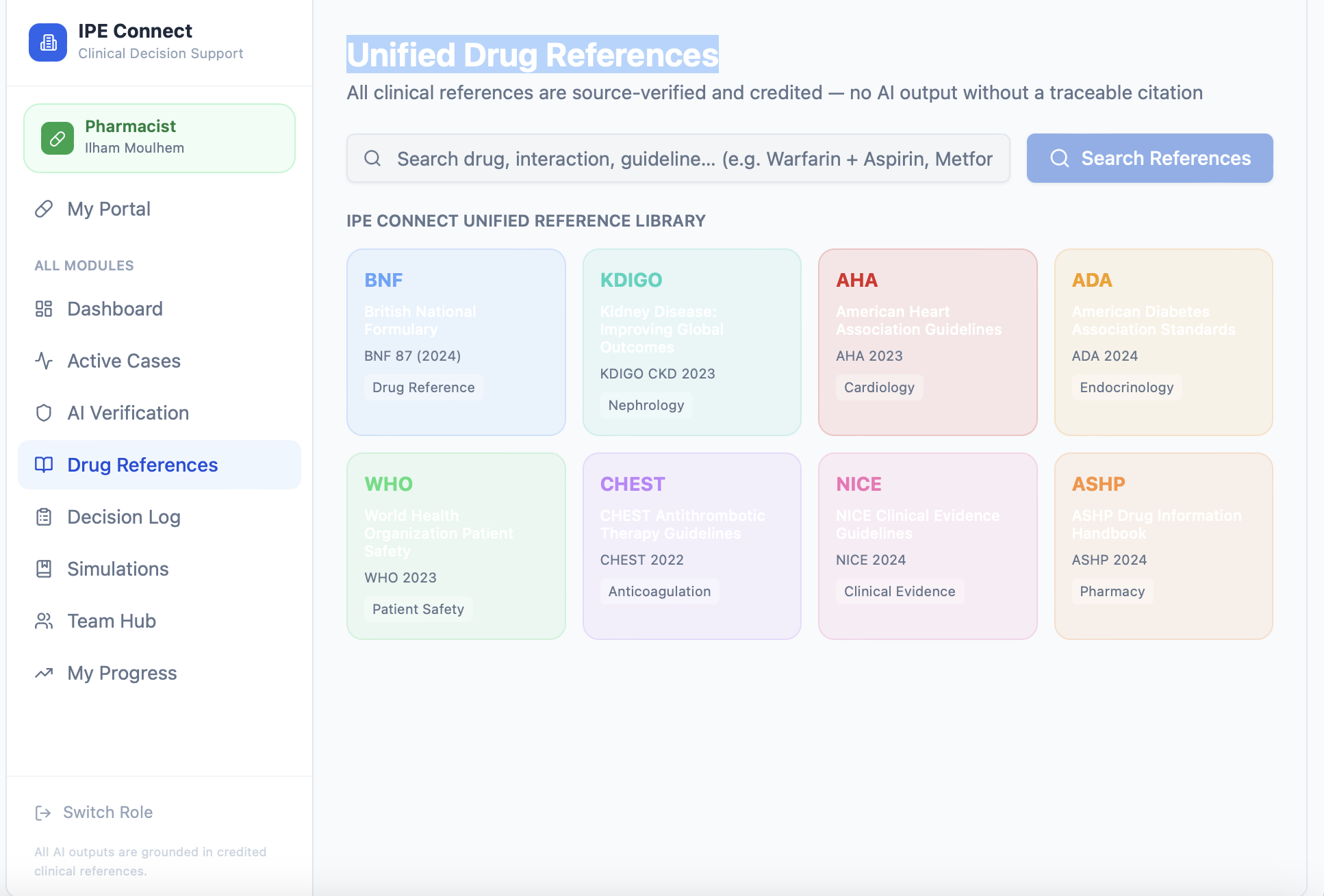
- Unified credited references ensure every AI recommendation is source-grounded and traceable — not generative guesswork, but clinically trustworthy guidance backed by verified guidelines
- Shared decision documentation logs every clinical decision transparently, including intentional deviations, creating accountability across the team
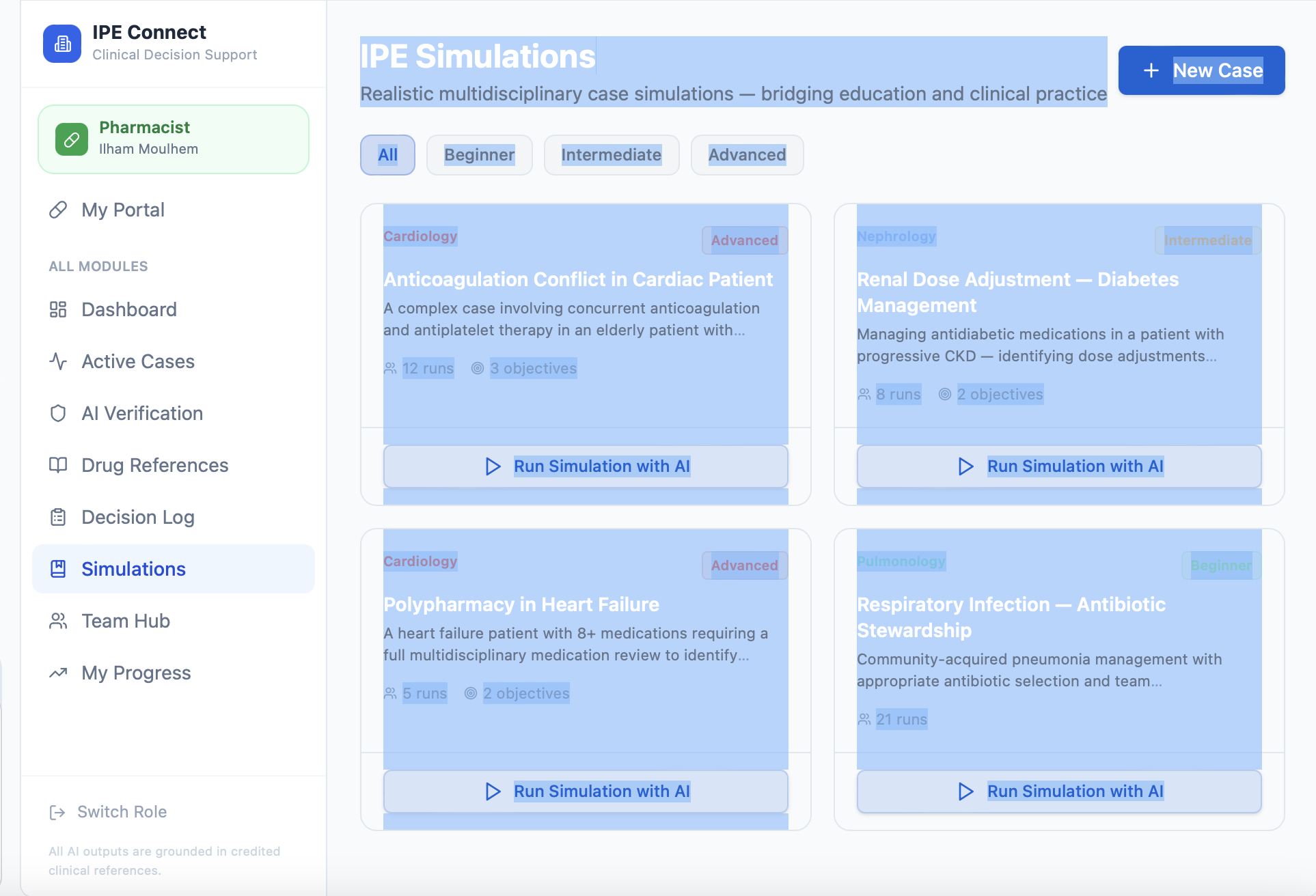
- Academic training pathway integrates directly into university curricula, allowing students at academic institutions to simulate realistic multidisciplinary clinical cases that mirror live hospital workflows — graduating professionals who are genuinely prepared for collaborative practice
- Prompt Opinion A2A Agent — IPE Connect is published and fully operational on the Prompt Opinion Marketplace as an A2A-enabled agent, discoverable and invokable within the platform, supporting interoperable healthcare workflows at the intersection of A2A and FHIR standards
How we built it
IPE Connect was developed through a research-driven process grounded in clinical reality. The foundation was a cross-sectional Knowledge, Attitudes, and Practices survey conducted among physicians, pharmacists, nurses, physiotherapists, and allied health professionals across UAE healthcare institutions — validating both the problem and the appetite for this solution before a single line of code was written.
The platform architecture was designed around a source-grounded AI model that draws exclusively on unified, credited clinical references rather than open-ended generation. The interface was built to reflect actual clinical workflows, ensuring the tool fits into how healthcare professionals work rather than demanding they adapt to the technology.
The platform was built using Base44 and configured as an A2A-enabled agent on the Prompt Opinion platform with Gemini AI integration, making it discoverable and invokable directly within the Prompt Opinion ecosystem. The agent architecture is designed with FHIR-aligned data structures, enabling future integration with FHIR-compliant EHR systems and supporting the interoperability standards required for real-world clinical deployment. All data used in the platform is synthetic and fully de-identified — no real Protected Health Information is included at any stage.
A functional prototype was developed and demonstrated to academic and clinical stakeholders, and a UAE patent was filed to protect the novel interprofessional AI-verification architecture.
Challenges we ran into
The most significant challenge was designing an AI system that healthcare professionals would genuinely trust. In clinical settings, an answer that sounds confident but lacks a verifiable source is dangerous. Building a source-grounded model that is both clinically accurate and explainable required careful architectural decisions at every stage.
A second challenge was bridging two very different user needs — practicing clinicians who need speed and precision at the point of care, and students who need depth, simulation, and feedback. Designing a single platform that serves both without compromising either required significant iteration.
Navigating the regulatory and institutional landscape of UAE healthcare also presented complexity. Rather than treating this as a barrier, we built our go-to-market strategy around the academic pathway — entering through university partnerships first, generating published evidence, and earning hospital trust through demonstrated outcomes rather than cold adoption.
A third challenge was ensuring the platform respected data privacy and regulatory constraints from the ground up. IPE Connect addresses this through exclusive use of synthetic and de-identified patient data, a source-grounded AI model with fully traceable credited clinical references, and an academic institutional framework that provides IRB ethics oversight for future clinical deployments. The platform is designed to complement existing EHR infrastructure rather than replace it — making adoption feasible within current UAE healthcare regulatory constraints and aligned with the UAE National Strategy for Wellbeing 2031.
Accomplishments that we're proud of
- UAE patent filed protecting the interprofessional AI-verification architecture
- Functional prototype built and demonstrated to clinical and academic stakeholders
- Cross-sectional KAP research study conducted across UAE healthcare institutions confirming high acceptance of AI-supported interprofessional collaboration
- Successfully published as an A2A-enabled agent on the Prompt Opinion Marketplace — discoverable and invokable within the platform
- Accepted into the 13th Undergraduate Research and Innovation Competition at Abu Dhabi University
- Submitted to the UAE Hackathon 2026 and Ajman Excellence Awards 2026
- Academic institutional support secured from Ajman University College of Pharmacy
- Supervised by Dr. Nihal Ibrahim, Associate Professor — bringing academic credibility and clinical network access to the project
What we learned
Building IPE Connect taught me that the most important innovations in healthcare are not always the most technically complex — they are the ones that solve problems people have learned to accept as normal. Fragmented communication between healthcare teams has caused preventable harm for decades, not because solutions were impossible, but because no one built a tool specifically designed for the team rather than the individual.
I also learned that in healthcare, trust is the product. Everything else — the AI, the interface, the references, the documentation — exists to earn and maintain the trust of the professionals using it and the patients depending on it.
I learned that a research-validated problem with a patent and a working prototype is a stronger foundation than technical complexity alone. Judges, investors, and healthcare leaders respond to evidence — and building that evidence base from the very beginning was the most important decision made in this project.
What's next for IPE Connect
- Phase 2: Pilot deployment in academic institutions across the UAE, IRB ethics approvals, security infrastructure build, and clinical workflow refinement based on real user feedback
- Phase 3: Hospital pilot program, full EHR integration, commercial rollout across UAE healthcare institutions, and GCC market expansion
- Prompt Opinion integration: Deepen the A2A agent capabilities within the Prompt Opinion platform to support multi-agent healthcare workflows, enabling IPE Connect to collaborate with other specialized healthcare agents for a fully interoperable clinical decision support ecosystem
- Long term: Establish IPE Connect as the standard collaboration and verification layer across interprofessional healthcare teams throughout the Gulf region and beyond — making preventable communication-related harm a problem of the past.
Built With
- anthropic-claude-ai
- base44-(no-code-ai-app-builder)
- cloud-infrastructure
- figma
- framer-motion
- hl7-fhir
- javascript
- machine-learning
- natural-language-processing
- node.js
- postgresql
- react
- rest-api
- tailwind-css

Log in or sign up for Devpost to join the conversation.