-
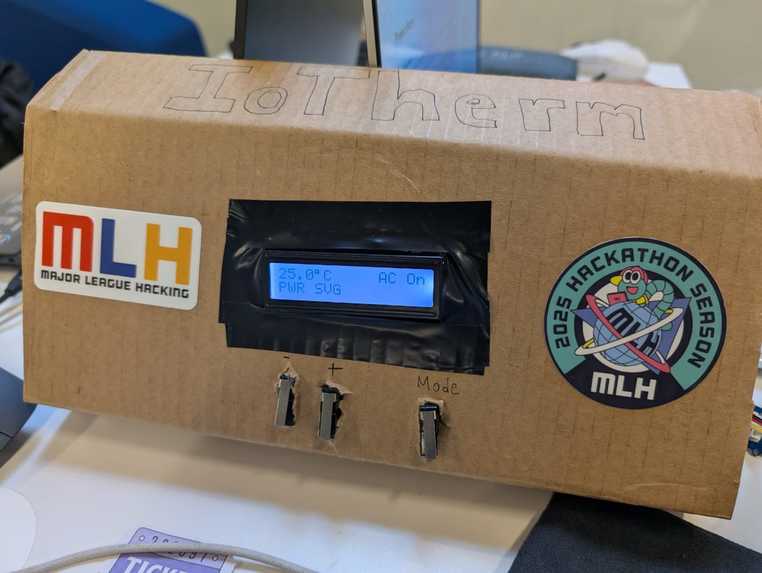
Physical Interface
-
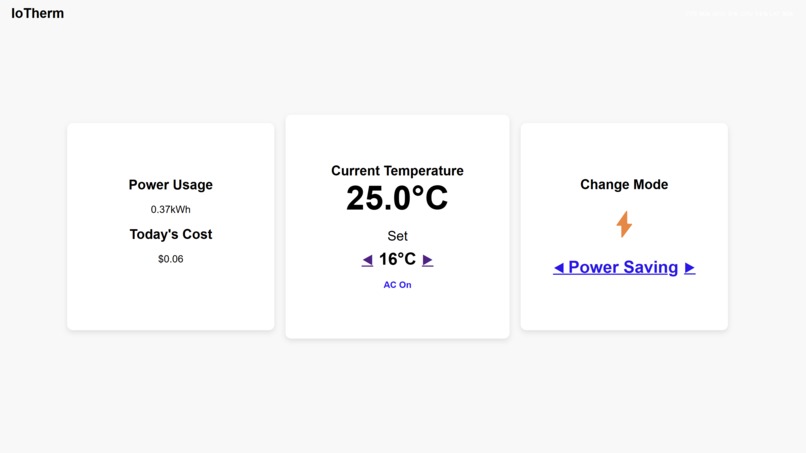
Web UI Interface
Inspiration
In Canada, an average home consumes 11,135 kWh of energy annually, with significant variation across provinces. For instance, an average household in Alberta uses 7,200 kWh, largely offset by natural gas usage, while Ontario households consume around 9,500 kWh annually. Remarkably, 40% of energy consumption in Canadian households is attributed to AC and heating systems.
To reduce household carbon footprints in Canada, we believe the first step is to optimize AC and heating efficiency. This inspired us to create IoTherm, a solution designed to not only conserve energy but also empower users with real-time insights and control over their energy usage.
What it does
IoTherm transforms household AC and heating systems into smarter, more efficient devices by:
- Tracking Energy Usage: Accurately calculating the power consumption of AC and heating units.
- Cost Estimation: Estimating the cost of electricity used based on low-peak and high-peak pricing.
- Mode-Based Optimization: Dynamically adjusting heating and cooling intensity across three user-selected modes:
- Comfort: Prioritizes user comfort with standard energy usage.
- Eco: Balances comfort and efficiency.
- Power Saving: Focuses on minimizing energy usage, even at the cost of reduced comfort. IoTherm empowers users to make informed decisions about their energy consumption, directly contributing to cost savings and a reduced carbon footprint.
How we built it
We combined hardware and software to bring IoTherm to life:
- Temperature Monitoring: Used a Grove Temperature Sensor to monitor real-time room temperature.
- Control System: Leveraged the ESP8266 microcontroller to process temperature data and control heating and cooling based on the selected mode.
- Energy Calculations: Developed an algorithm to measure energy usage (kWh) and estimate costs based on electricity pricing tiers.
- Web App & LCD Display: Built a web app for remote control and real-time monitoring while integrating a physical LCD screen for direct interaction. IoTherm intelligently decides when and how AC and heating units should operate to maintain the desired temperature while minimizing energy costs.
Challenges we ran into
Building IoTherm wasn't without its hurdles:
- Hardware Constraints: The ESP8266 posed significant challenges, crashing repeatedly throughout the development process. In hindsight, an ESP32 would have been a better choice due to its superior performance and reliability.
- Troubleshooting: Debugging hardware issues consumed a significant portion of our time, slowing down overall progress. Despite these obstacles, we persevered and successfully delivered a fully functional prototype within the tight constraints of the hackathon.
Accomplishments that we're proud of
- Completing IoTherm in Under 24 Hours: Despite being a team of just two, we achieved our goal of building both a web app and integrating physical buttons to control the system.
- Energy Efficiency Innovation: Successfully implemented features like real-time energy tracking, cost estimation, and mode-based temperature adjustment, laying a foundation for real-world application. ## What we learned
- Always Bring Backup Hardware: We learned the importance of carrying spare parts, especially microcontrollers like the ESP32, to avoid delays caused by hardware limitations.
- Time Management in Hardware Projects: Troubleshooting takes up a significant amount of time in hardware projects. Future projects should allocate more time for debugging.
- Adaptability: It's okay to adjust the scope of a project midway if the original plan proves infeasible. This flexibility allowed us to focus on delivering a working prototype.
What's next for IoTherm
We envision IoTherm evolving into a practical, scalable solution:
- Smart Plug Integration: Incorporate IoTherm into smart plugs, allowing it to work seamlessly with existing AC and heating units.
- Advanced Central Systems: Develop a more sophisticated version compatible with centralized AC and heating systems.
- Machine Learning: Implement predictive analytics to forecast energy usage patterns and further optimize efficiency.
- Mobile App: Extend the web app to a mobile platform for greater accessibility and convenience. IoTherm has the potential to redefine how households manage energy consumption, reducing costs and carbon footprints for a more sustainable future.

Log in or sign up for Devpost to join the conversation.