


Inspiration
We were inspired to create this project after going through the hassle of getting locked out of our dorm, as we only get 10 temporary cards for free.
What it does
Through a series of knocks or button presses, we will send a wifi signal that triggers a mechanical arm to open the door from inside.
How we built it
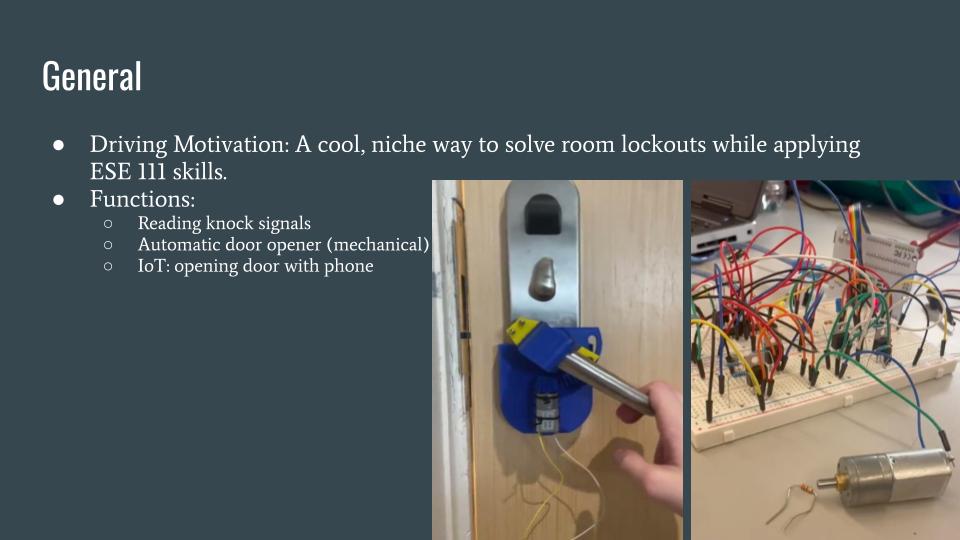
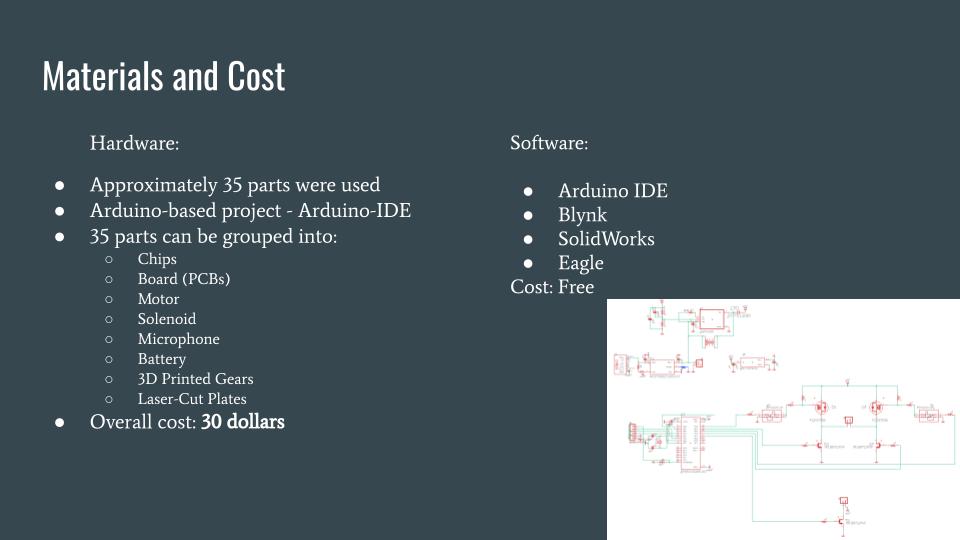
Mechanical: 3D printed the door opener part fit to the door handle using CAD. Electrical: Built an H-bridge to turn the DC motor back and forth. Used Node MCU to control the motor via the Blynk app (IoT). Software: Coded in the Arduino IDE.
Challenges we ran into
One of the pins of the Node MCU wasn't working and it took us a couple of hours to figure out that it was a hardware problem and not a software problem. The DC motor also didn't always behave according to the way we coded it, as it sometimes rotated too much or too little even though the code did not seem to have any bugs. We also had a lot of issue getting our sensor to read knocks properly. In general, we ran into a lot of issues with figuring out if bugs were an issue with the equipment/environment we were working in, or if it was an actual software or hardware problem.
Accomplishments that we're proud of
When knocking a specific pattern, the door opener was actually able to turn the handle of a Hill door and successfully unlock it. It worked almost exactly the way we intended it to. We were also able to implement IoT into the project as simply pressing a button on Blynk would turn the handle as well.
What we learned
We learned that hardware can be very finicky at times and that segmenting the project into smaller, more manageable parts is important because we can isolate what works and what doesn't work. At the end, we can combine all the working parts together. For instance, the Node MCU part was developed completely independently of the complex circuit that drove the motor and managed input signals. This allowed multiple parts of the project to advance at once, and it made it much easier for us to isolate errors.
What's next for IoT Door Opener
In the process of making a PCB so that the circuit can fit inside the mechanical door opener part. Of course, another consideration would be to minimize the input costs of the equipment. Right now, each additional temporary card costs $35 dollars, but by a quick estimate, our equipment could cost in that range as well.

Log in or sign up for Devpost to join the conversation.