-
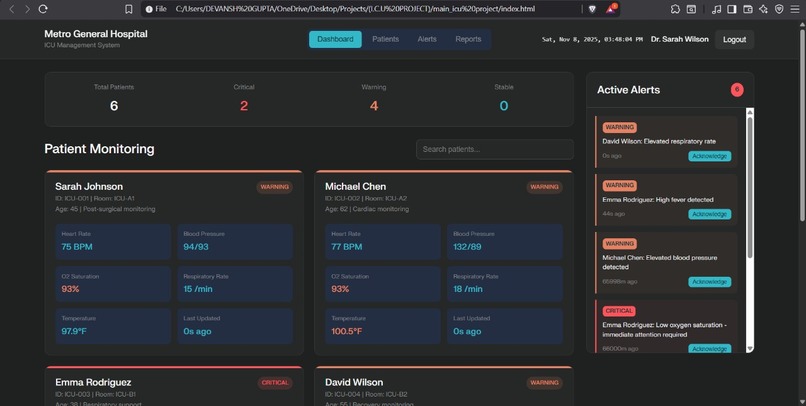
Full-stack IoT dashboard visualizing real-time fever data, alert triggers, and patient health metrics.

Inspiration
Fever is one of the earliest and most critical indicators of infection, sepsis, or postoperative complications in ICU patients. Early recognition of abnormal temperature patterns is essential, yet many hospitals still depend on periodic manual checks or outdated systems, which delay intervention and reduce monitoring accuracy.
This challenge inspired us to develop a Real-Time Fever Detection and Emergency Alert System — an IoT-based solution designed to automate continuous patient monitoring, provide instant alerts, and visualize data trends in real time. Our goal was to enhance patient safety and enable healthcare professionals to respond faster, especially in high-risk ICU and isolation ward environments.
What It Does
The system continuously tracks patient temperature and related vitals such as heart rate and SpO₂ using IoT sensors connected to microcontrollers like ESP32 or Arduino. The collected data is transmitted to a cloud-based backend, where it is processed, stored securely, and analyzed for abnormal or rising temperature trends.
Whenever the system detects a threshold breach, it automatically triggers emergency alerts (SMS, email, or dashboard notifications) to medical staff, ensuring immediate intervention.
A web-based dashboard provides real-time visualization of patient data, trend graphs, and alert indicators. It supports multi-bed monitoring, allowing ICU staff to supervise multiple patients simultaneously and respond proactively.
How We Built It
IoT Layer: Utilized ESP32/Arduino microcontrollers integrated with temperature, pulse, and SpO₂ sensors for continuous data acquisition via Wi-Fi. Backend: Developed with Node.js and Express.js, featuring APIs for real-time data handling and secure cloud storage using MongoDB/Firebase. Frontend: Designed an interactive React.js dashboard using Chart.js / D3.js for dynamic data visualization and historical trend tracking. Alert Mechanism: Implemented automated notifications using Twilio API, MQTT/HTTP protocols, and backend logic for real-time event triggering. Deployment: Hosted the system on AWS/Firebase for scalable and reliable access to live monitoring features across multiple devices.
Challenges We Faced
1.Maintaining real-time synchronization between IoT sensors and the web dashboard with minimal latency. 2.Filtering noisy sensor data and calibrating readings for medical accuracy. 3.Managing backend data pipelines efficiently under continuous high-frequency data flow. 4.Ensuring the alert system remains reliable even with unstable network connectivity.
What We Learned
1.Designing and deploying scalable IoT architectures capable of handling multi-patient monitoring. 2.Integrating hardware and full-stack software components seamlessly for real-time systems. 3.Implementing effective data visualization and analytics for health monitoring. 4.Understanding the importance of reliable alert mechanisms and user-centric dashboards in healthcare systems.
Impact and Innovation
The system improves ICU responsiveness by enabling early detection of abnormal temperature patterns and potential infection risks. Real-time alerts empower clinicians to act quickly, reducing the risk of complications. The unified dashboard offers continuous monitoring of temperature, heart rate, and SpO₂, supporting faster and data-driven medical decisions.
This project integrates IoT sensors, cloud infrastructure, and intelligent visualization into one platform, making it scalable for multi-bed ICU setups. Its architecture is designed to accommodate AI-based predictive analytics in the future, which could forecast fever progression or infection risk even before symptoms escalate.
Future Scope
We plan to extend the system with AI-driven health prediction models, support for multi-sensor integration (ECG, BP, etc.), and hospital management system (HMS) integration for a fully automated emergency response ecosystem.
Built With
- chart.js
- css
- dht11-sensor
- esp8266
- express.js
- firebase
- html
- javascript
- mongodb
- node.js
- react.js
- render-cloud
- twilio
