Inspiration
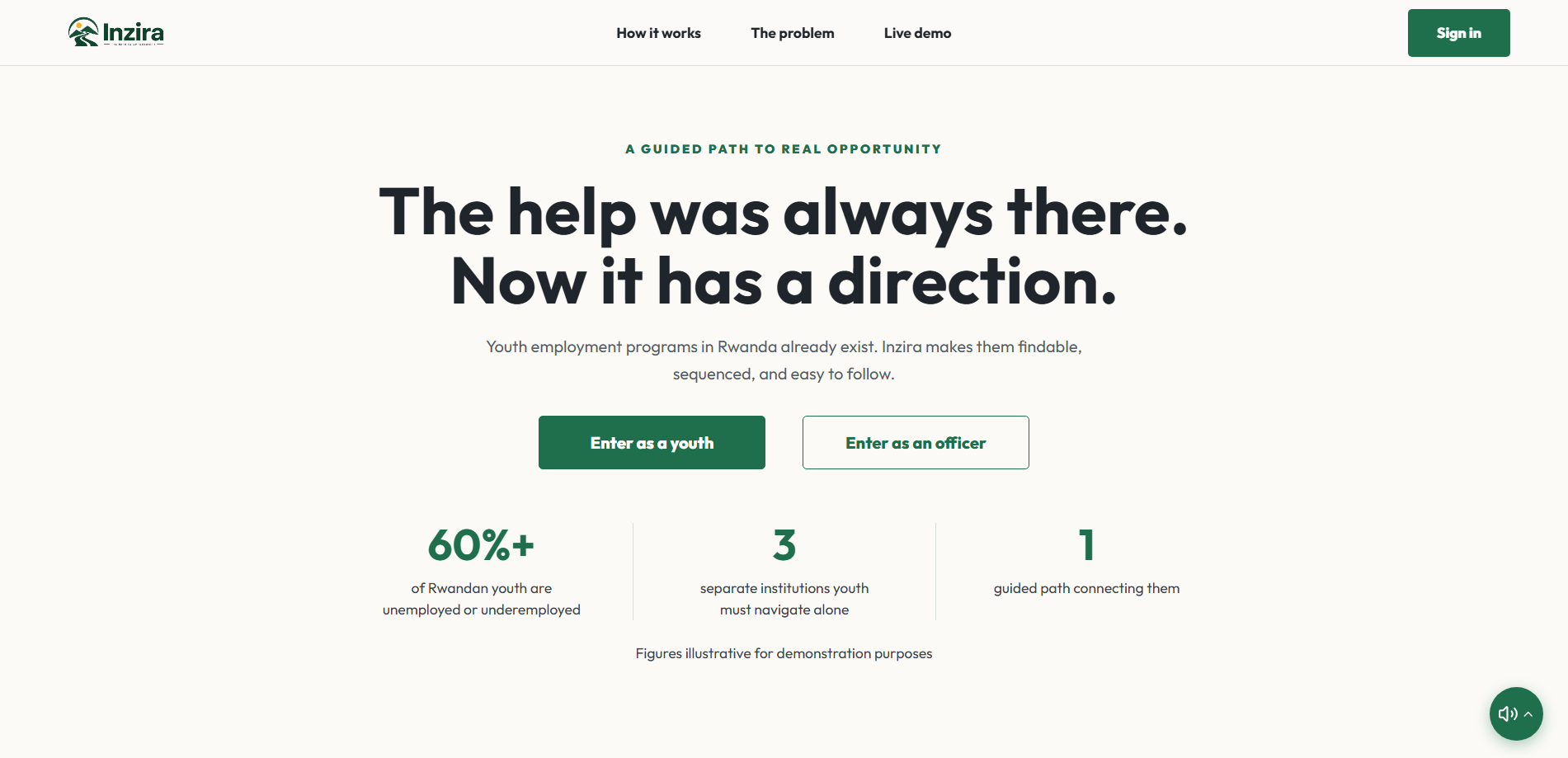
I was inspired by a massive operational bottleneck: many young people do not lack socio-economic opportunities; they lack a unified, accessible pathway to navigate them. In Rwanda, excellent public programs for business registration, vocational training, and financing exist, but they are highly fragmented across separate institutions. A motivated youth can easily get lost in administrative friction. I realized that public institutions lack the specialized administrative software to guide citizens at scale. I set out to build a specialized GovTech/B2G SaaS platform that streamlines case management for youth officers, using reliable AI to augment human workflows rather than replace them.
What it does
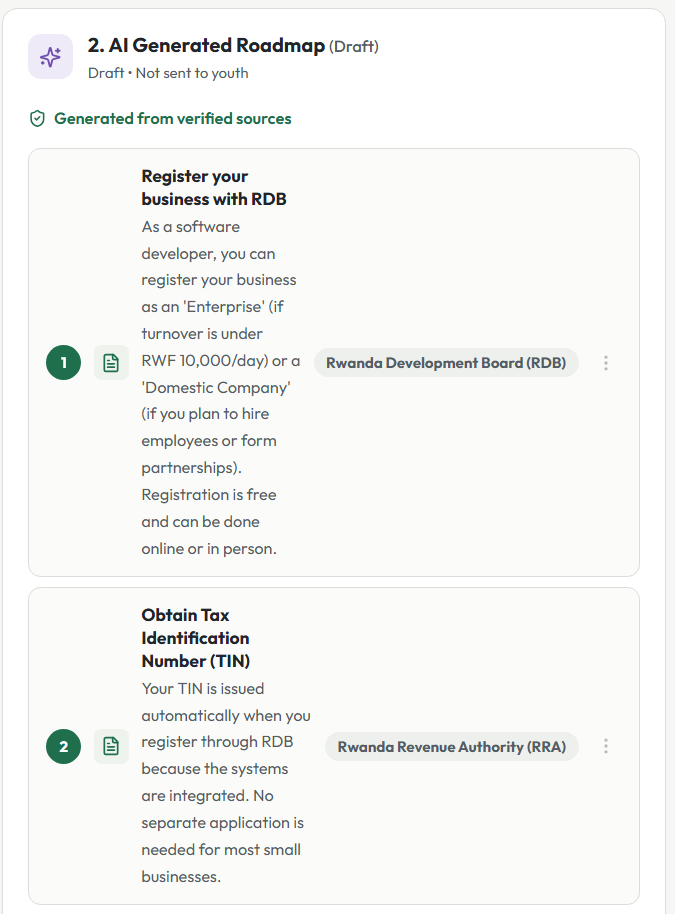
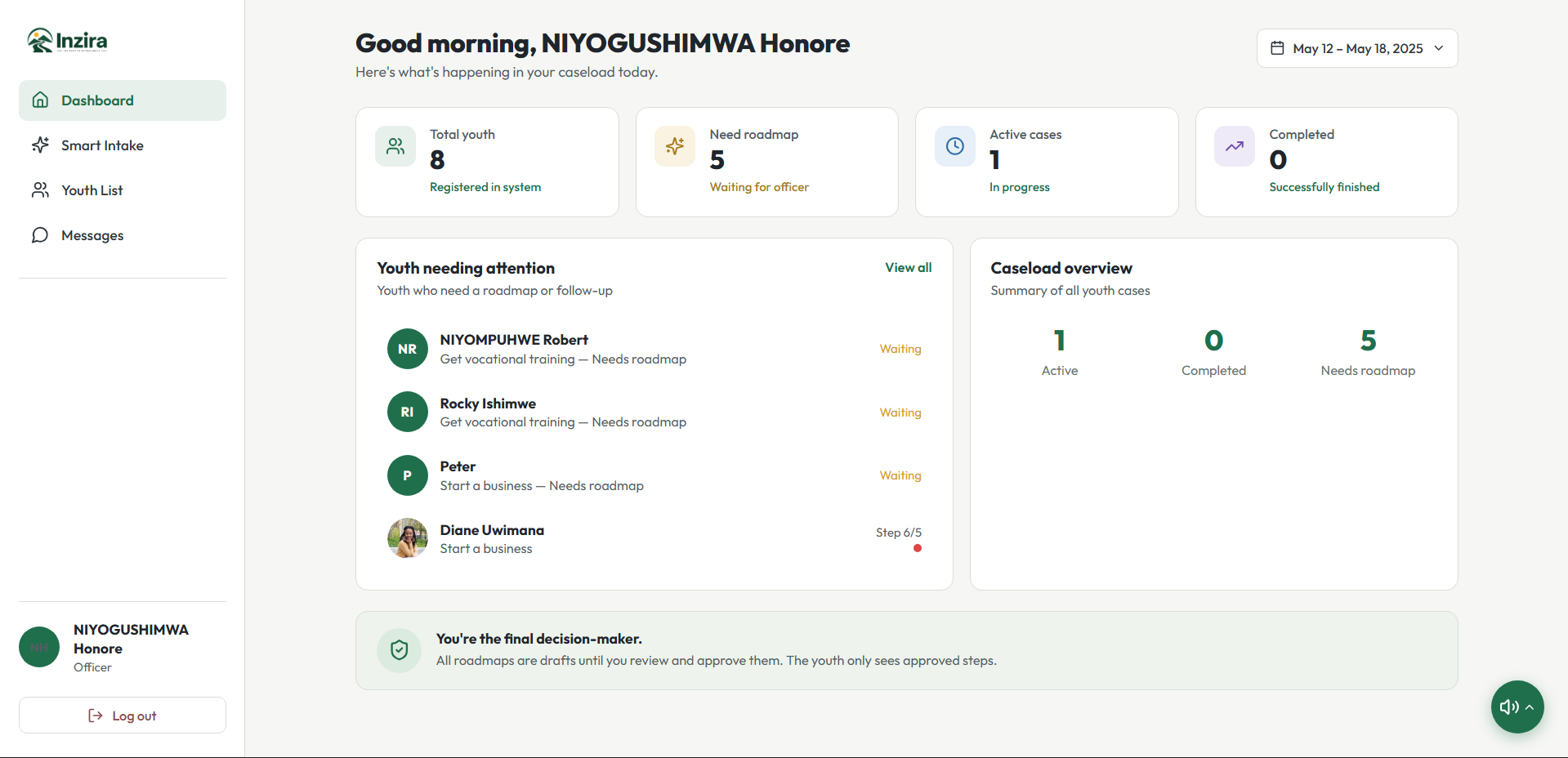
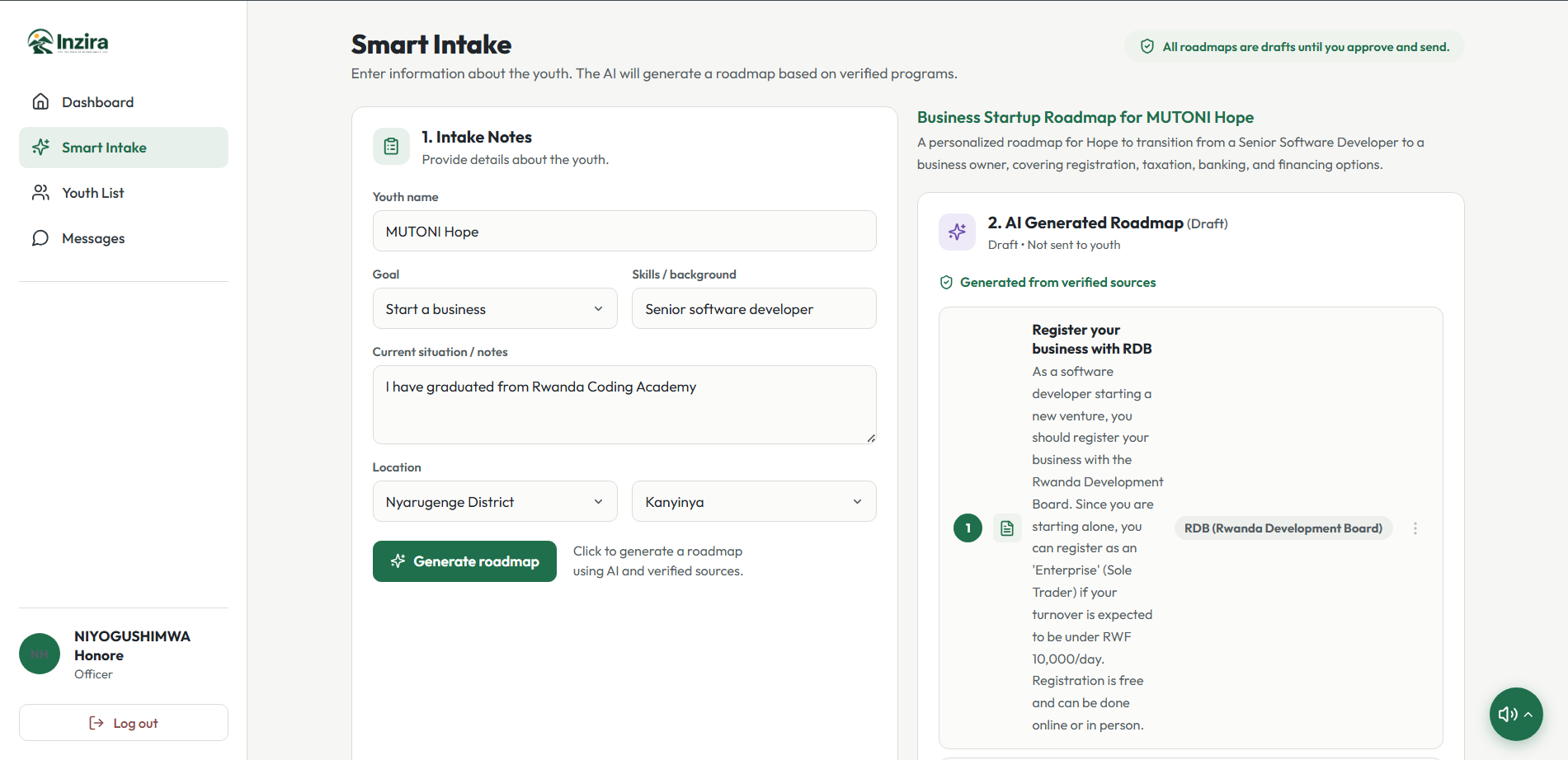
Inzira is a multi-tenant, workflow-automation SaaS platform that helps public institutions and NGOs guide youth toward employment or entrepreneurship. The platform features a dual-sided architecture: The Client Portal: A simplified, mobile-friendly interface where youth input their skills and career goals, track personalized milestones, and query a secure AI assistant. The Case Management Dashboard: An enterprise-grade backend where youth officers manage assignees and review AI-generated materials. When a user submits their profile, the backend automatically generates a comprehensive, context-aware roadmap based on verified institutional data. Following strict human-in-the-loop compliance, this roadmap remains an unapproved draft until the assigned officer reviews, edits, and officially publishes it to the user's dashboard.
How I built it
Inzira is architected as a cloud-hosted, multi-tenant web application featuring robust data isolation boundaries. Database & Security: I use Supabase with Row Level Security (RLS) to ensure strict multi-tenant data privacy, meaning different districts or institutions can operate on the same software without accessing each other's citizen records. AI Knowledge Engine: To prevent AI hallucinations, i built a proprietary Retrieval-Augmented Generation (RAG) pipeline. I store high-dimensional text embeddings of verified government regulations and institutional requirements using pgvector. Model Orchestration: When a roadmap or answer is requested, the system queries relevant context chunks out of the vector database and passes them to a hosted LLM via OpenRouter to generate factual, source-backed drafts.
Challenges I ran into
Building a highly reliable AI product within a public sector context introduced unique product design and engineering hurdles: The Cost of Hallucinations: In a B2G SaaS application, a single hallucinated requirement can cause a citizen to miss a business registration or visit the wrong physical center. Prioritizing strict context-matching and deterministic data structures over general LLM conversational abilities was critical. Interface Asymmetry: I had to design and balance two fundamentally different user experiences - a minimalist, low-cognitive-load frontend for young jobseekers, and an information-dense, high-efficiency tabular interface for case officers. Resource Optimization: Implementing a multi-stage RAG pipeline using limited compute infrastructure and free API tiers required rigorous optimization of token usage and efficient embedding caching.
Accomplishments that i am proud of
Functional End-to-End SaaS Pipeline: I successfully built and validated a fully working multi-sided software pipeline, seamlessly connecting public registration with administrative review workflows. Enterprise Compliance Design: I achieved a true human-in-the-loop architecture. By enforcing a draft-and-approval gateway, we created an AI system that public sector institutions can safely trust, dramatically accelerating officer productivity without sacrificing human oversight. Production-Ready RAG Infrastructure: We successfully deployed a functioning vector search foundation, shifting the LLM's role from an unreliable knowledge source to an efficient text-synthesis engine.
What I learned
The Over-AI Trap: The most viable SaaS products are not those that use the most AI, but those that position AI strategically. In civic infrastructure, verifiable data accuracy and predictable workflows matter far more than open-ended chatbot conversational intelligence. Problem-First Architecture: Technology choices must always serve the underlying workflow. Inzira’s core commercial value isn't its chat interface; it is the underlying data sequence, tracking mechanics, and the connection between automated workflows and human approval. Abstracting Complexity: Elite software engineering means swallowing technical complexity on the backend so the frontend user experience feels incredibly simple.
What's next for Inzira
Live Pilot & Validation: My immediate goal is to launch a controlled pilot with local youth centers and officers to gather real-world usage metrics, tracking reductions in case processing time. Infrastructure Optimization: I intend to refine our embedding strategies, build automated pipelines for continuous institutional document syncing, and engineer the client portal to support robust offline capabilities for low-connectivity environments. Commercialization & Scaling: I plan to transition the platform into a commercial subscription model for municipal governments, employment agencies, and global development NGOs looking to modernize their citizen tracking systems.
The goal is simple: when a young person asks, “I want to move forward, but I don't know where to start,” Inzira should be able to help them find the next right step.
Built With
- gamma
- next.js
- tailwind
- typescript


Log in or sign up for Devpost to join the conversation.