-
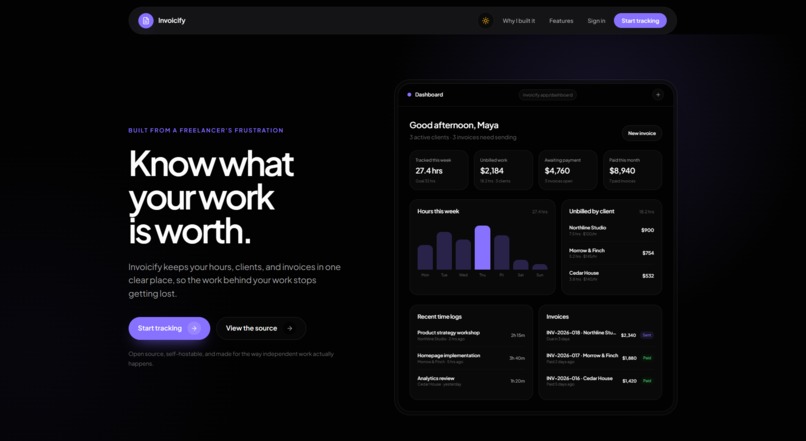
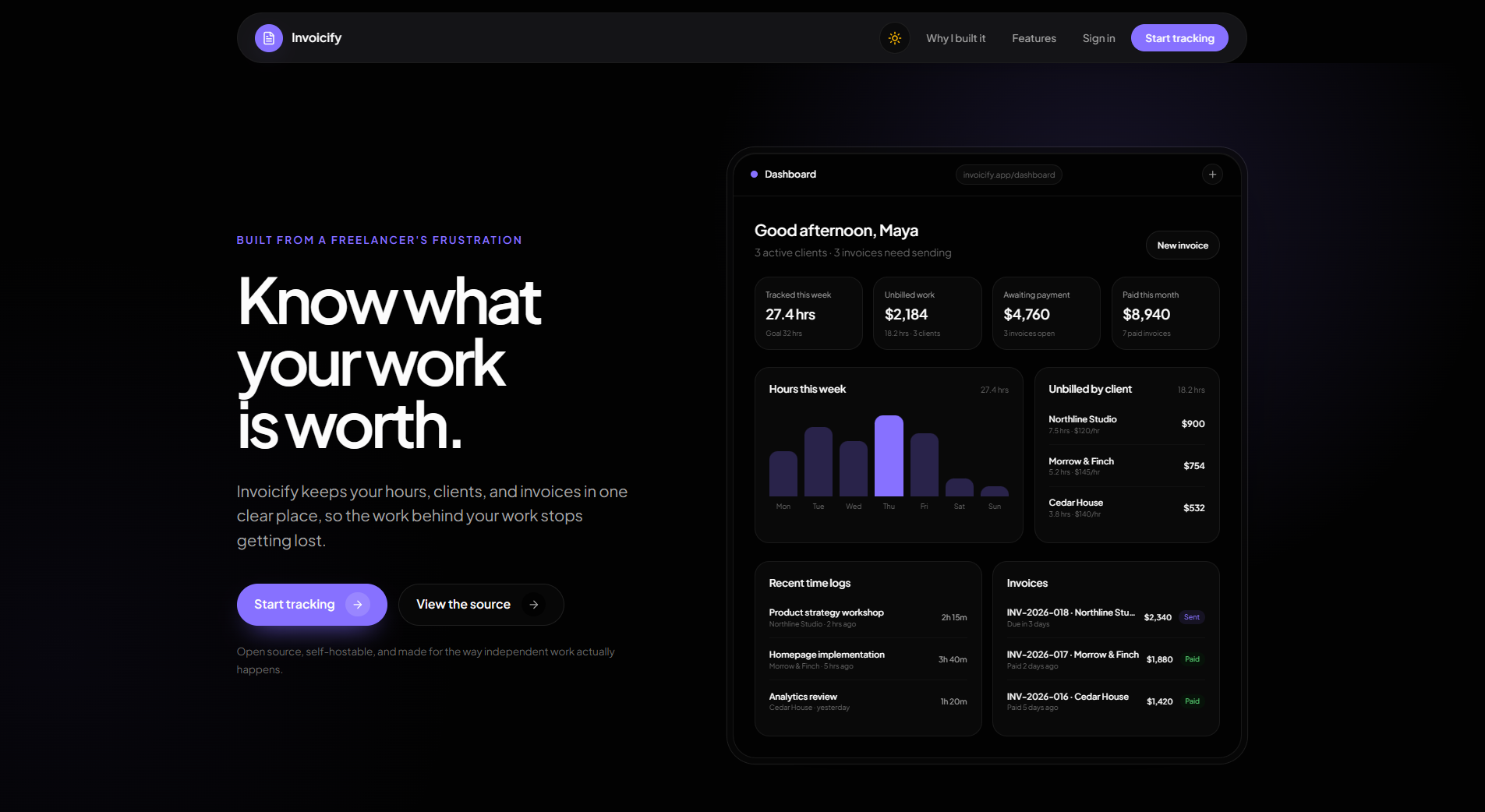
Landing Page
-
-
-
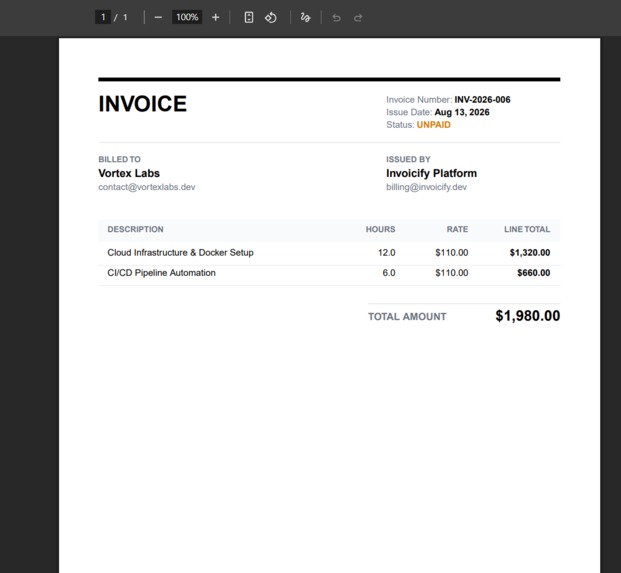
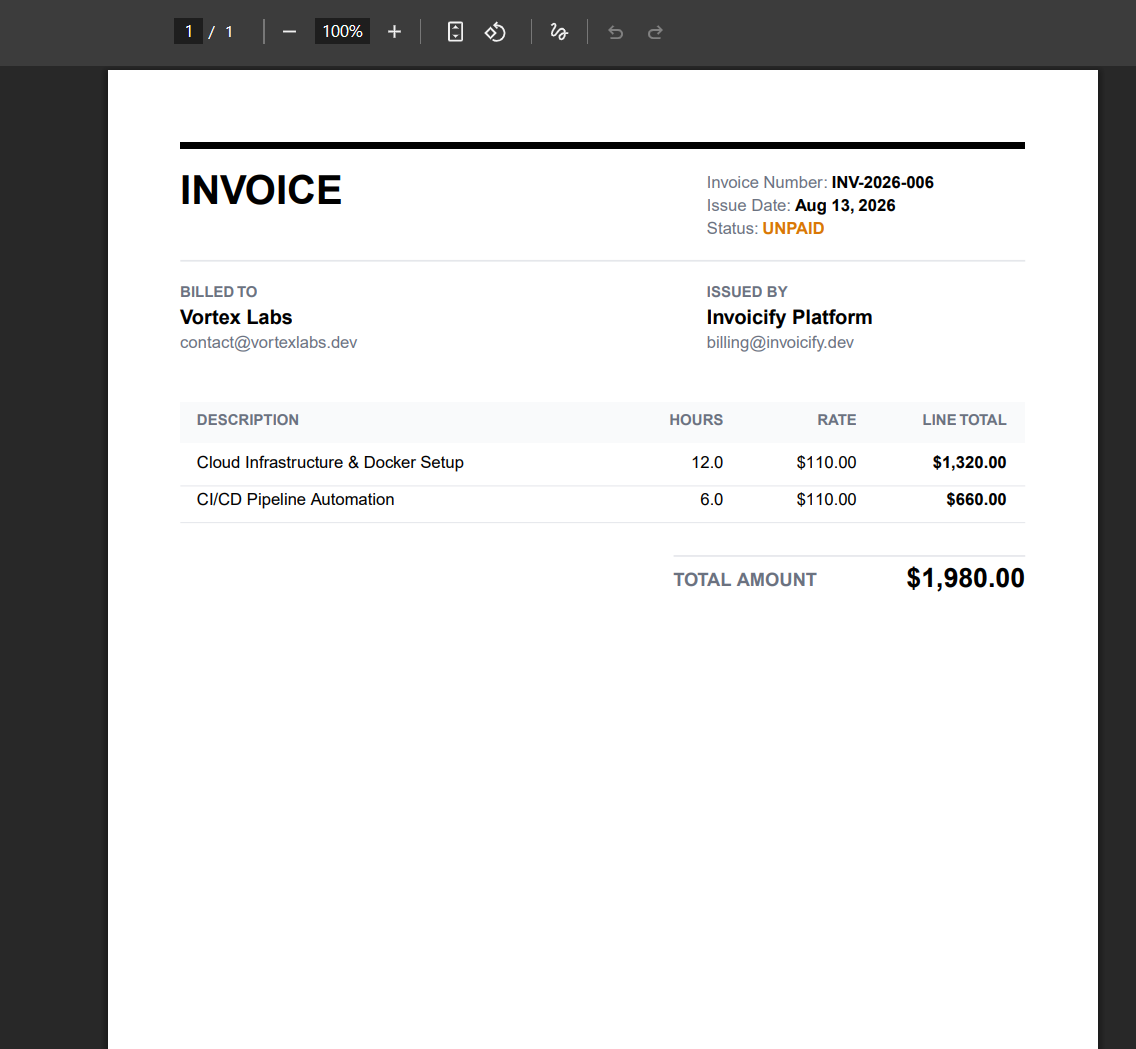
An example but legitimately made invoice prepared from the app
⚡ Invoicify
Freelance Time Tracking & Automated Invoicing Platform
I built Invoicify because I was tired of losing money.
As a freelancer juggling multiple clients, I was tracking hours in spreadsheets, manually calculating totals, and generating invoices in Google Docs at 2 AM. I missed billable hours. I forgot to follow up on unpaid invoices. I had no visibility into how much revenue I'd actually collected versus how much was sitting unbilled.
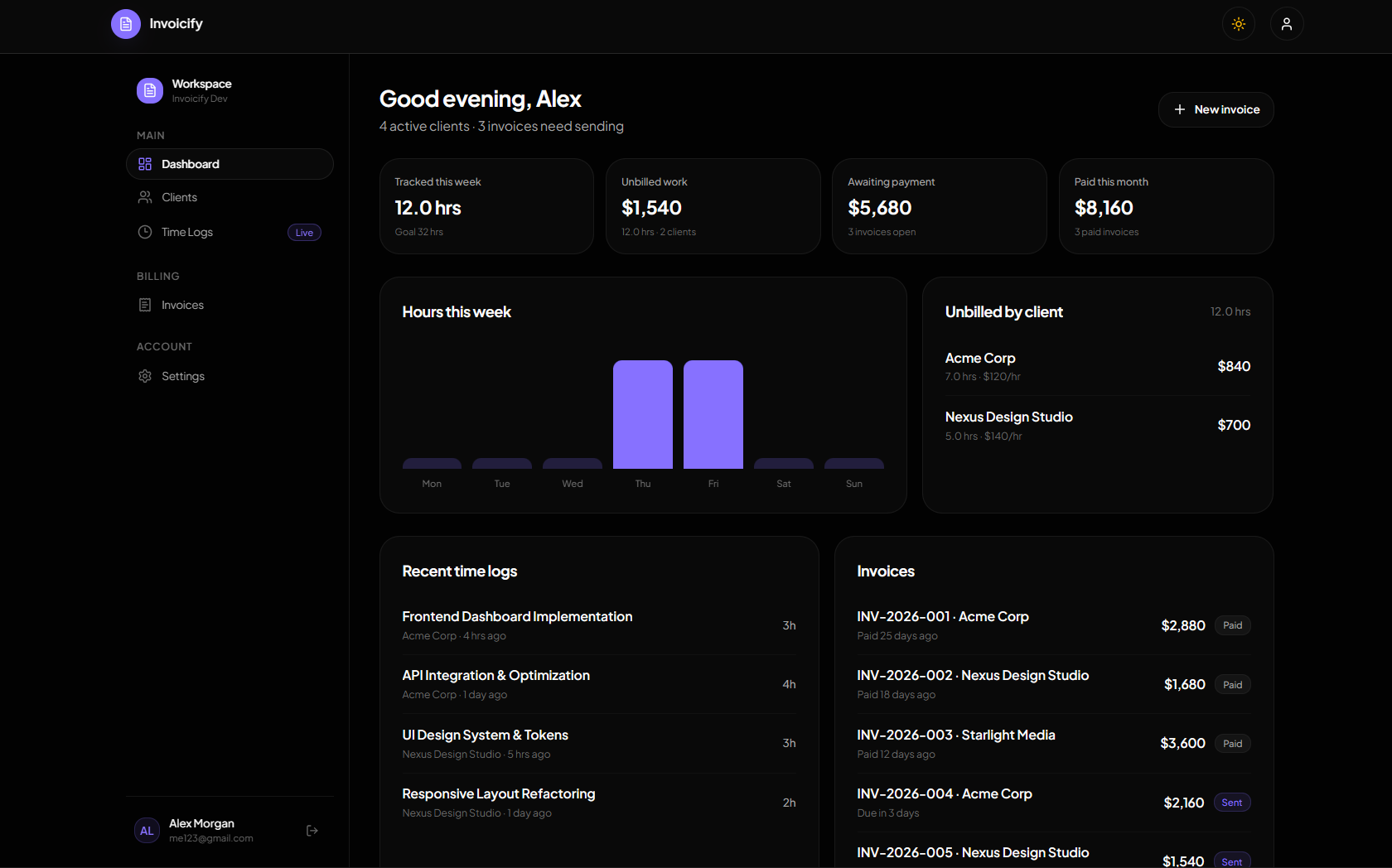
So I built the tool I wished existed — a single dashboard where I log time, generate pixel-perfect PDF invoices with one click, and share them via secure expiring links. No spreadsheets. No guesswork. Just clarity.
The Problem I Solved
| Pain Point | What Invoicify Does |
|---|---|
| Hours tracked in spreadsheets, easy to forget or miscount | Live time tracker with per-client session logging and automatic duration calculation |
| Manual invoice creation in docs/templates | One-click PDF invoice generation from selected unbilled time logs using PDFKit |
| No way to share invoices securely with clients | 24-hour HMAC-signed shareable links with tamper-proof token verification |
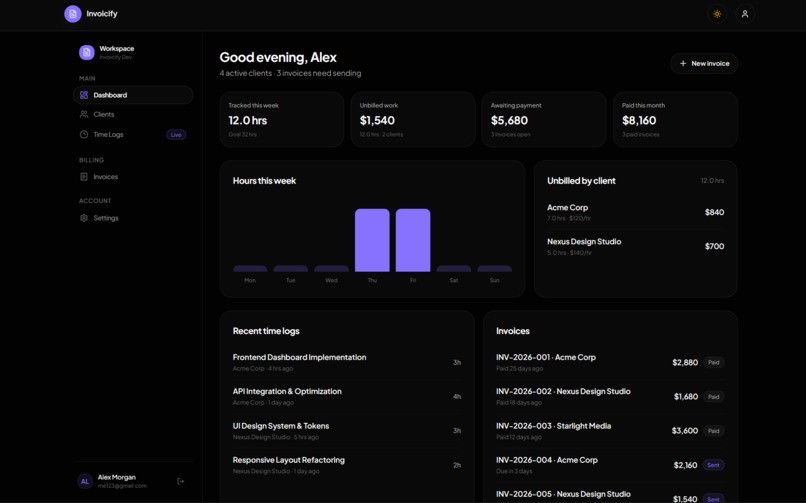
| Zero visibility into cash flow | Real-time financial dashboard with 12-month revenue trajectory charts and unbilled accrual metrics |
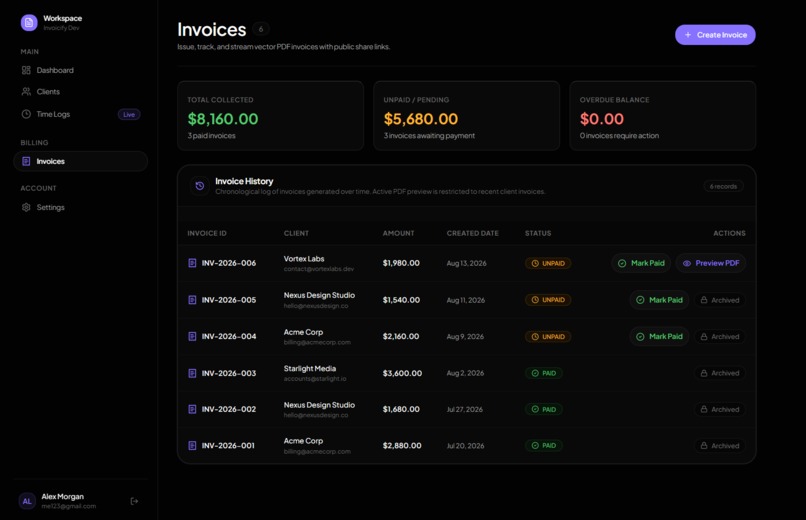
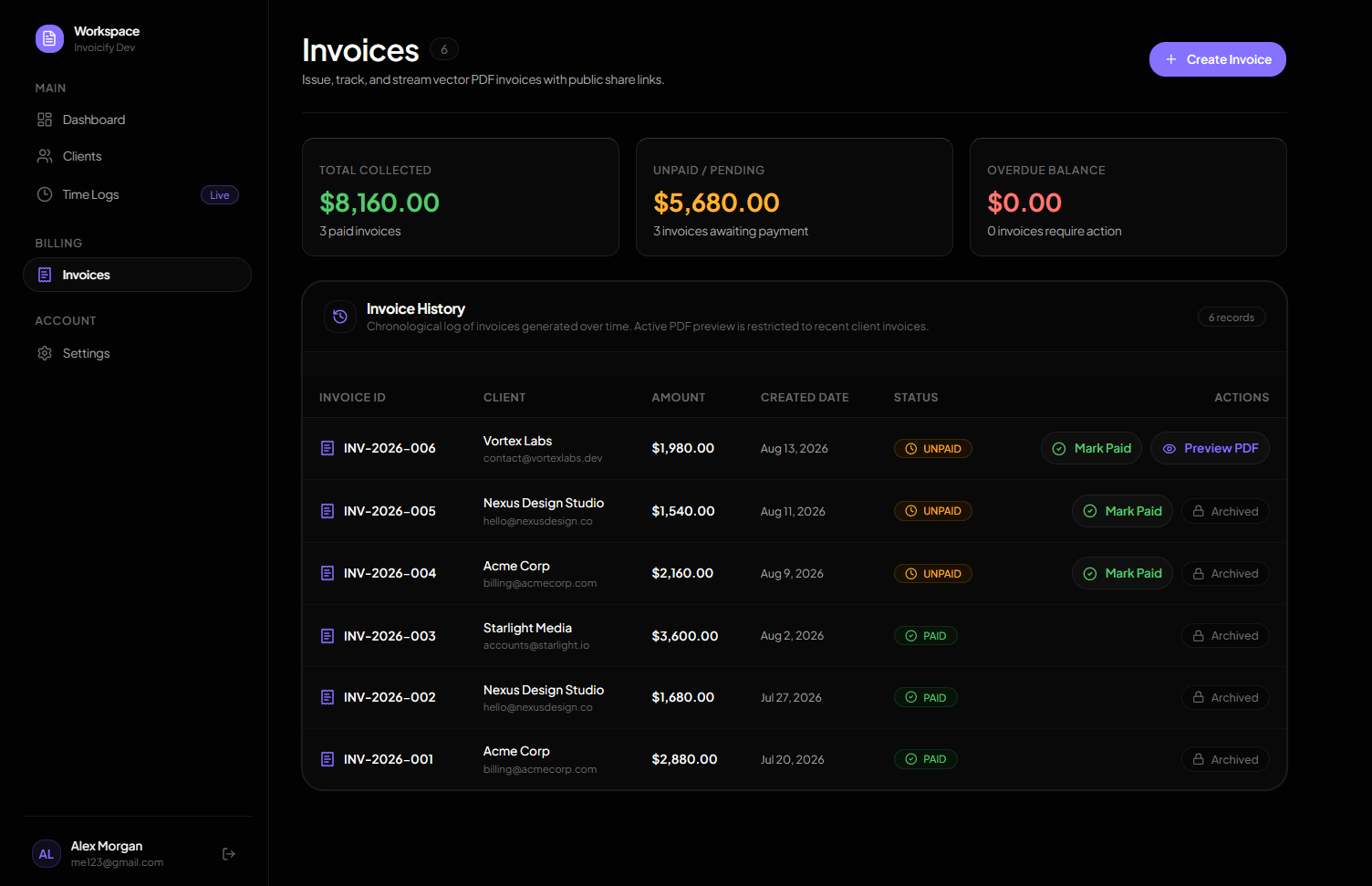
| No record of what's been paid vs. what's outstanding | Invoice lifecycle management — track UNPAID → PAID status with optimistic UI updates |
Architecture & Technical Decisions
This isn't a tutorial project. Every architectural decision was driven by a real problem I encountered during my freelancing workflow.
Full-Stack Architecture
┌─────────────────────────────────────────────────────────────┐
│                      Next.js 15+ App Router                 │
│              React Server Components + Server Actions        │
├──────────────┬──────────────┬──────────────┬────────────────┤
│  Dashboard   │   Clients    │  Time Logs   │   Invoices     │
│  (analytics) │   (CRUD)     │  (tracker)   │   (PDF gen)    │
├──────────────┴──────────────┴──────────────┴────────────────┤
│                     Server Actions Layer                     │
│         dashboard.ts · client.ts · timelog.ts · invoices.ts  │
├─────────────────────┬───────────────────────────────────────┤
│   Prisma ORM        │         Redis (ioredis)               │
│   PostgreSQL        │   Query cache · PDF binary cache      │
│   Schema-first      │   Singleton connection management     │
├─────────────────────┴───────────────────────────────────────┤
│                    Better Auth (Sessions)                    │
│              Email/password · Session tokens                 │
└─────────────────────────────────────────────────────────────┘
Why These Technologies
Next.js App Router with Server Actions — No separate API layer. Server Actions colocate data mutations with the UI components that trigger them, eliminating boilerplate REST endpoints while maintaining type safety from database to render.
Prisma ORM over raw SQL — Schema-first modeling with generated TypeScript types means my
Invoice,Client,TimeLog, andInvoiceItemrelations are type-checked at compile time. When I query an invoice with its client and line items, the return type is exact — noany, no runtime surprises.Redis caching layer — Unbilled time log queries and PDF binary buffers are cached with short TTLs (60–120s). I serialize PDFs to Base64 for Redis storage and deserialize on read. A singleton connection pattern (
globalThis) prevents connection leaks during Next.js hot reloads.PDFKit for server-side PDF generation — Vector-based PDF rendering with programmatic control over typography, layout grids, table positioning, and color. No browser dependency, no headless Chrome, no Puppeteer overhead.
HMAC-SHA256 signed URLs — Invoice share links are cryptographically signed with a 24-hour expiration window. The token encodes
invoiceId + expiresAtand is verified server-side before rendering. No database lookup required for token validation.
Tech Stack
| Layer | Technology |
|---|---|
| Framework | Next.js 15+ (App Router, RSC, Server Actions, Turbopack) |
| Language | TypeScript (strict mode, end-to-end type safety) |
| Runtime | React 19 (useOptimistic, useTransition, Suspense) |
| Database | PostgreSQL + Prisma ORM (schema-first, generated types) |
| Caching | Redis via ioredis (query cache, binary PDF cache) |
| Auth | Better Auth (session-based, email/password) |
| PDF Engine | PDFKit (server-side vector PDF generation) |
| Styling | Tailwind CSS v4 + OKLCH color system |
| Charts | Recharts (ComposedChart — bar + line overlays) |
| Validation | Zod (runtime schema validation for forms and server actions) |
| State | Zustand (client-side state), React 19 optimistic updates |
| Testing | Vitest + Testing Library (unit + integration) |
| UI Components | Base UI + shadcn/ui primitives |
| Icons | Lucide React |
Key Features
🕐 Time Tracking
- Per-client session-based time logger with start/stop controls
- Automatic duration calculation (minutes → human-readable format)
- Bulk selection of unbilled time logs for invoice generation
- Status lifecycle:
UNBILLED→INVOICED(automatically updated on invoice creation)
📄 One-Click Invoice Generation
- Select a client → pick unbilled time logs → generate a professionally formatted PDF invoice
- Automatic invoice numbering (
INV-2026-001,INV-2026-002, ...) - Line-item breakdown with hours, hourly rate, and line totals
- PDFs rendered server-side with PDFKit — no browser dependency
🔗 Secure Shareable Links
- 24-hour HMAC-SHA256 signed URLs for client invoice sharing
- Tamper-proof token verification (no database query needed)
- Public preview page with embedded PDF viewer, download, and print controls
- Expiration badge with countdown indicator
📊 Financial Dashboard
- 12-month revenue trajectory (collected revenue bars + billable hours trend line)
- Real-time unbilled accrual tracking across all clients
- Per-client breakdown: hourly rate, unbilled hours, unbilled amount
- All metrics derived from live database queries — zero mock data
✅ Invoice Lifecycle Management
- Mark invoices as PAID with confirmation dialog and optimistic UI updates
- Status badges:
UNPAID(pending amber) /PAID(success green) - Instant 0ms UI feedback using React 19's
useOptimistichook
Engineering Highlights
These are the problems I'm most proud of solving:
Optimistic UI with Zero-Latency Feedback
Deleting a time log or marking an invoice as paid updates the UI in 0 milliseconds using React 19's useOptimistic hook. The server action executes asynchronously in the background while the user sees the change instantly. If the server action fails, the UI automatically reverts.
Redis Singleton Connection Management
Next.js hot module replacement creates new module instances on every file save during development. Without careful handling, each reload spawns a new Redis connection. I solved this by storing the Redis client on globalThis — a single connection persists across hot reloads, preventing resource exhaustion and connection pool limits.
Deterministic Invoice Generation Caching
Repeated "Generate Invoice" clicks (double-clicks, impatient users) don't create duplicate invoices. I compute a deterministic cache key from userId + clientId + sorted(timeLogIds) and check Redis before writing to the database. The cached result is returned during a short TTL window.
PDF Binary Caching in Redis
Redis doesn't natively store Buffer objects safely. I serialize generated PDFs to Base64 strings for storage and deserialize them back to Buffer when serving. TTLs are kept short (60–120s) to balance memory usage with cache hit rates.
Cryptographic Link Sharing Without Database Overhead
Instead of storing share tokens in the database, I generate HMAC-SHA256 signatures over invoiceId:expiresAt using a server-side secret. Verification is a pure computation — no database round-trip required. Links auto-expire after 24 hours with no cleanup job needed.
Data Model
User ──┬── Client ──┬── TimeLog
       │            └── Invoice ── InvoiceItem
       ├── TimeLog
       └── Invoice
- User → owns clients, time logs, and invoices (cascade delete)
- Client → has an hourly rate, linked to time logs and invoices
- TimeLog → tracks
startTime,endTime,durationMinutes, and billing status - Invoice → auto-numbered, tracks
totalAmountand payment status - InvoiceItem → line-item breakdown (description, hours, rate, lineTotal)
Testing
npx vitest run
✓ __tests__/signed-urls.test.ts (4 tests)
  ✓ generates a valid HMAC-SHA256 signed token
  ✓ verifies a legitimate token successfully
  ✓ rejects a tampered token signature
  ✓ rejects an expired token

✓ __tests__/pdfkit.test.ts (1 test)
  ✓ generates a valid PDF binary buffer

Test Files  2 passed (2)
     Tests  5 passed (5)
Getting Started
# Install dependencies
npm install

# Set up environment variables
cp .env.example .env
# Configure DATABASE_URL (PostgreSQL) and REDIS_URL

# Generate Prisma client and run migrations
npx prisma generate
npx prisma db push

# Start the development server (Turbopack)
npm run dev
Project Structure
invoicify/
├── app/
│   ├── (auth)/              # Login / Register pages
│   ├── (dashboard)/         # Dashboard, Clients, Time Logs, Invoices
│   ├── (marketing)/         # Landing page
│   ├── actions/             # Server Actions (client, timelog, invoice, dashboard, pdfkit)
│   ├── api/                 # API routes (PDF streaming, auth)
│   ├── preview/             # Public invoice preview page
│   └── validations/         # Zod schemas
├── components/
│   ├── dashboard/           # Sidebar, layout components
│   ├── clients/             # Client CRUD dialogs and table
│   ├── timelogs/            # Time tracker, metrics, table
│   ├── invoices/            # Invoice creation flow, table, dialogs
│   └── ui/                  # Base UI primitives (Button, Card, Dialog, AlertDialog)
├── lib/
│   ├── auth.ts              # Better Auth client configuration
│   ├── redis.ts             # Redis singleton connection
│   ├── signed-urls.ts       # HMAC-SHA256 token generation & verification
│   └── generated/prisma/    # Prisma generated client
├── prisma/
│   └── schema.prisma        # Database schema
├── __tests__/               # Vitest test suites
└── vitest.config.ts         # Test configuration
Lessons Learned
Building Invoicify taught me things no tutorial could:
Redis isn't plug-and-play in serverless-adjacent environments. Connection management, binary serialization, and cache invalidation timing all required deliberate engineering decisions rather than "just add Redis."
Optimistic UI is a UX superpower. The difference between a 500ms delay and instant feedback is the difference between "this feels broken" and "this feels native." React 19's
useOptimisticmade this trivial to implement correctly.PDF generation belongs on the server. Headless browser approaches (Puppeteer, Playwright) are heavyweight and fragile. PDFKit gives me vector-perfect output with full programmatic control and zero browser dependencies.
Signed URLs > stored tokens for ephemeral access. Computing an HMAC signature is cheaper than a database write + cleanup job. For short-lived share links, cryptographic verification is the right architectural choice.
Type safety isn't optional — it's velocity. End-to-end TypeScript (Prisma generated types → Server Actions → React components) eliminated entire categories of runtime bugs. When the types compile, the data flows correctly.
Built with conviction by a freelancer who needed better tools — and decided to engineer them.
Built With
- css
- javascript
- nextjs
- typescript
