
Inspiration
Freelancers and small businesses are often forced to wait 30–90 days for invoice payments, creating unnecessary financial stress and halting growth. Traditional invoice financing depends on banks, manual approvals, heavy fees, and a rigid infrastructure that doesn’t scale globally. We wanted to design a system where earning and liquidity are not separated by bureaucracy. The QIE blockchain’s speed, near-zero fees, and instant finality created the perfect environment to experiment with decentralized invoice financing that works in real life. We imagined an ecosystem where unpaid invoices become tokenized assets, backed by trustless data and transparent AI credit scores—accessible to anyone, anywhere.
What it does
InvoiceX transforms unpaid invoices into digital on-chain assets. Users can mint invoice NFTs that contain structured metadata such as invoice amount, due date, buyer information, and short-term lending parameters. Our Gemini AI underwriting engine analyzes invoice and buyer data to produce a risk score (0–100), letter grade (A–F), and recommended APR range. Lenders can then choose to fund the invoice through QIE or tokenized liquidity. When the client pays, the repayment is settled on-chain, and the invoice NFT lifecycle moves from Pending → Funded → Repaid, distributing capital and yield automatically without intermediaries.
How I built it
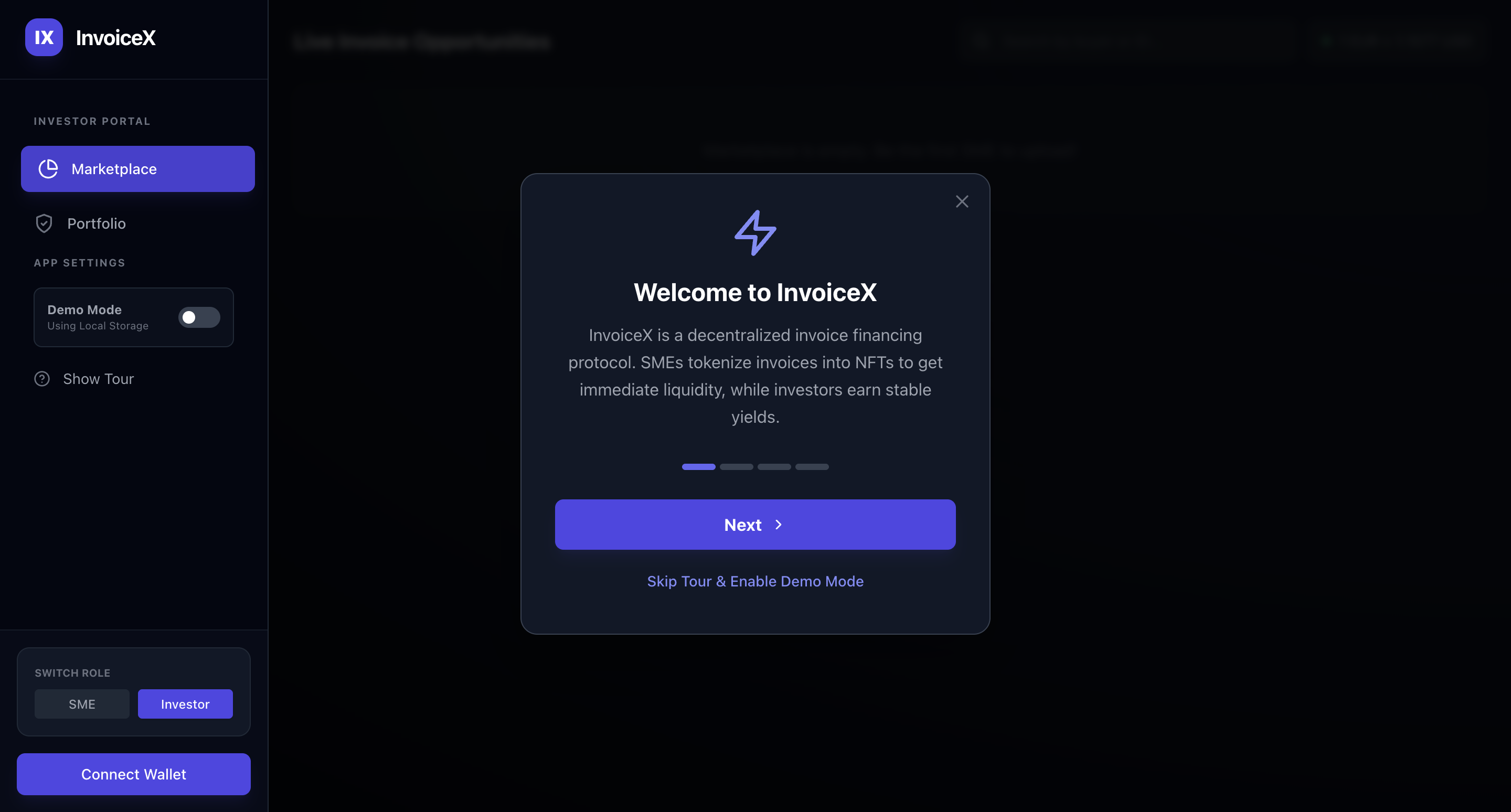
I built InvoiceX around a dual-mode architecture designed for hackathon testing and real user deployment. Live Mode integrates a QIE Web3 wallet, local data persistence, real invoice minting, and mock oracle forex conversions. Demo Mode provides rich pre-populated invoices, transaction simulations, and instant lender interactions so the app can be evaluated without real funds. The Gemini AI engine performs underwriting by analyzing invoice value, customer type, duration, and business risk patterns, and then dynamically generates risk outputs. The front end features a cinematic splash screen, an interactive AI terminal, visual analytics via bar and pie charts, and an event-driven notification layer. All lifecycle status transitions and payment checkpoints are stored immutably through QIE smart contracts.
Challenges I ran into
The biggest challenge was balancing realism with hackathon constraints. Real invoice financing requires legal compliance, institutional liquidity, identity verification, and cross-border regulations. To address this, I built a mock data system and a demo layer that simulates financing flows while maintaining real smart contract behaviors. Another challenge was modeling risk in a way that is transparent and understandable to users; enterprise-grade underwriting is complex, so we used AI to simplify outputs to risk scores and grades. Final hurdle: making decentralized finance usable. Instead of forcing users through dozens of DeFi steps, we created a single Mint–Fund–Repay lifecycle that feels familiar and frictionless.
Accomplishments that I'm proud of
I am most proud that InvoiceX bridges real-world finance and decentralized technology without resorting to gimmicks. The app doesn’t just mint NFTs—it generates a financial asset that lenders can reason about, price, and fund transparently. I successfully integrated AI, oracle data, smart contracts, visual analytics, and premium UX into a single demoable MVP. The ability to switch between Demo Mode and Live Mode makes the system practical for judges, users, and future partners.
What I learned
I learned that building real-world DeFi is not about hype—it’s about reducing risk and increasing clarity. Blockchain alone cannot solve invoice liquidity; underwriting, identity, market signals, and human incentives matter. Integrating Gemini AI taught me how to create interpretable scoring outputs instead of opaque models. I also learned how to leverage the strengths of the QIE ecosystem—its speed, low fees, and instant finality—to make finance tools that feel usable instead of experimental.
What's next for InvoiceX
The next stage is to expand InvoiceX with multi-lender pools, DID-based business reputation, institutional partnerships, and automated collections for defaulted invoices. We plan to allow lenders to fund invoices collaboratively, create invoice-backed liquidity markets, and onboard real SMEs in global trade and service economies. Over time, InvoiceX will evolve into a decentralized credit layer where real businesses can unlock capital instantly, safely, and transparently—powered by QIE.

Log in or sign up for Devpost to join the conversation.