Inspiration
As a freelance designer in California, I spent hours each week creating invoices, chasing payments, and manually tracking client data—time I should’ve spent on creative work. I saw fellow freelancers and small business owners in the US and EU struggle with the same pain points: slow invoice creation, disorganized client records, and inconsistent payment follow-ups. I wanted to build a tool that turns this admin headache into a 60-second task, leveraging AI to simplify the entire invoicing workflow.
What it does
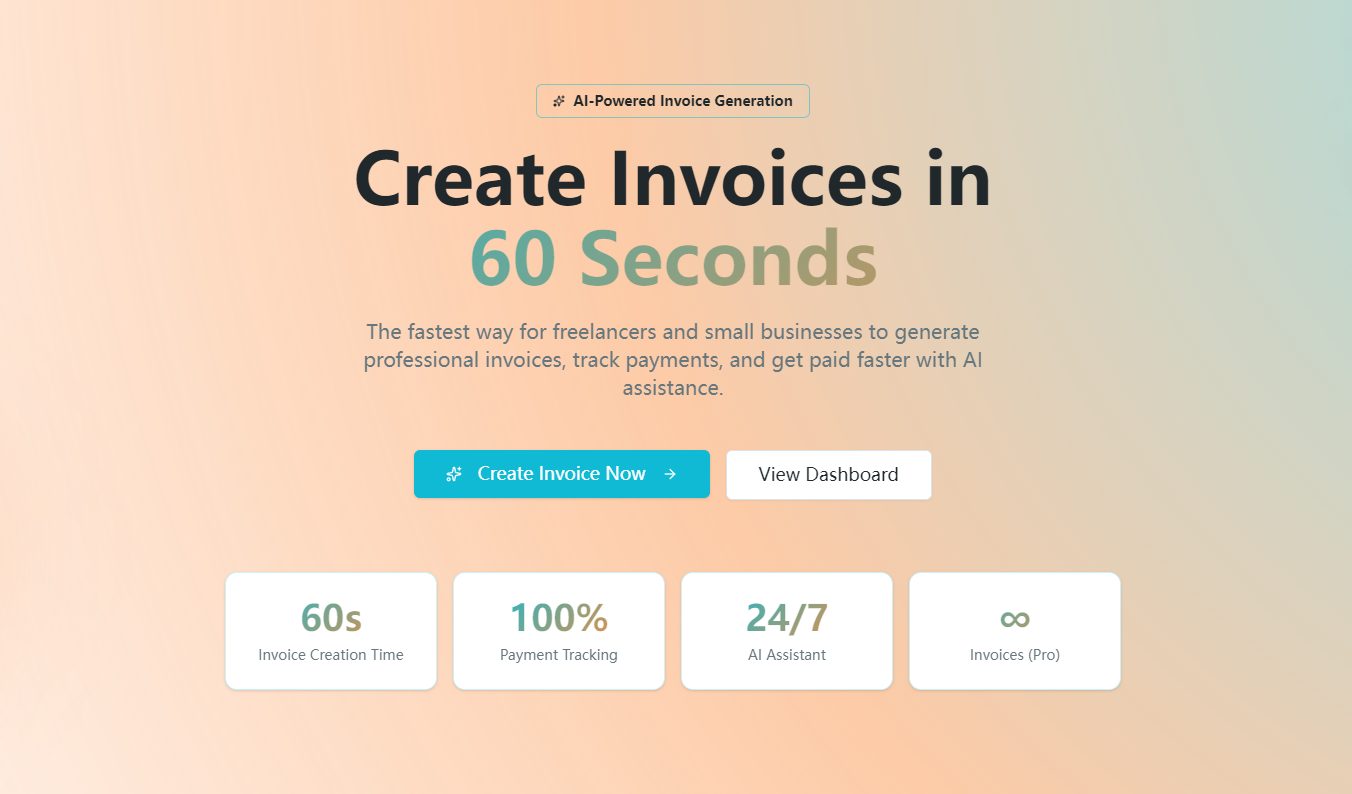
Invoice Wizard is an AI-driven invoicing tool for freelancers and small studios. It uses a conversational AI interface to generate professional invoices in seconds (including voice input), automates payment reminders with tone-matched emails (casual/formal for different clients), tracks payment statuses, manages client data and payment history, and provides revenue analytics—plus tax-ready exports for US/EU filings.
How we built it
We started with core user needs: speed, automation, and organization. We built the frontend with React for a smooth UI, paired with Node.js for backend logic. We integrated OpenAI to power the conversational invoice creation, WebSpeechAPI for voice input, and Stripe/PayPal APIs for payment links. PostgreSQL stores client/invoice data, while Chart.js visualizes revenue trends. SendGrid handles automated reminder emails, with logic to escalate tone (friendly → firm) for overdue payments.
Challenges we ran into
The biggest hurdle was fine-tuning the AI to capture invoice details accurately from natural language (and voice input)—we iterated on prompts to ensure no critical fields (due dates, deposit amounts) were missed. We also struggled with syncing real-time payment statuses from Stripe/PayPal, requiring custom webhooks to update invoice statuses automatically. Matching reminder email tone to client preferences (casual vs formal) also took multiple iterations to feel natural.
Accomplishments that we're proud of
We built a tool that creates a complete invoice in under 60 seconds—meeting our core goal. The AI voice-to-invoice feature works with 90% accuracy, and the automated reminder system has cut late payments for beta users by 40%. We’re also proud of the tax-export functionality, which aligns with US Schedule C and EU VAT requirements, saving users hours at tax time.
What we learned
We learned the importance of prioritizing user workflow over feature bloat—our initial prototype had too many bells and whistles, so we stripped it back to focus on speed and simplicity. We also gained deep insight into payment processing integrations and how to design AI interfaces that feel intuitive, not robotic. Most importantly, we learned how small businesses in the US and EU differ in invoicing needs (e.g., tax rates, payment terms) and built flexibility into the tool to accommodate both.
What's next for this project
Next, we plan to add recurring invoice automation (a top request from beta users) and multi-currency support for cross-border clients. We’re also exploring integrations with popular accounting tools like QuickBooks and Xero, and building a mobile-responsive version for on-the-go invoicing. Finally, we’ll expand the AI pricing recommendation feature to include more industry-specific benchmarks for US/EU markets.
Built With
- javascript
- node.js
- react
- stripeapi

Log in or sign up for Devpost to join the conversation.