-
-
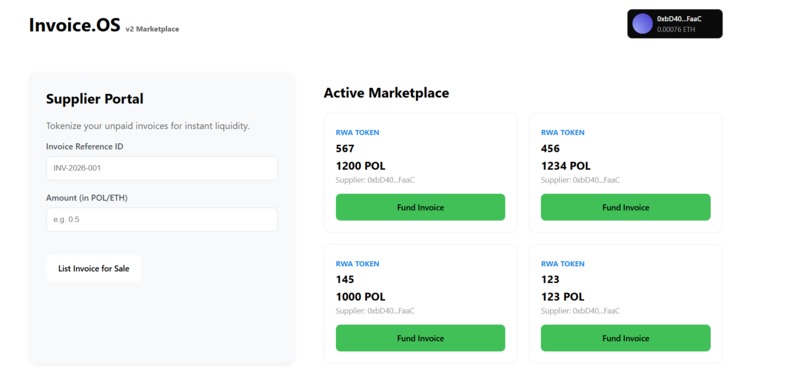
Dashboard
-
Logo
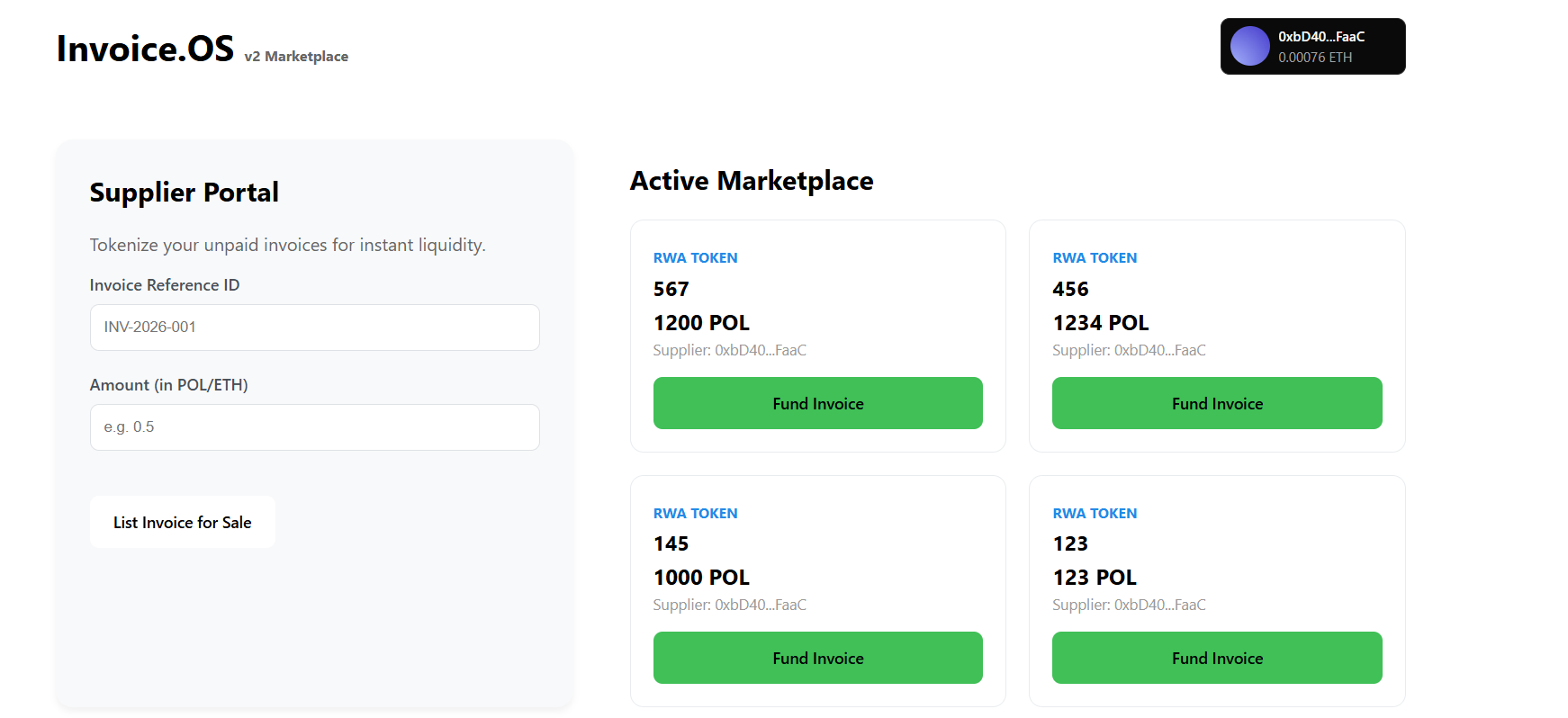
Inspiration As a student in Chennai, I noticed that many small-scale local businesses struggle with cash flow despite having successful sales. They are often trapped in a "Liquidity Gap"—waiting 60–90 days for corporate payments while still needing to pay their own staff and suppliers today. Traditional "factoring" is too expensive and inaccessible for these SMEs. I wanted to build Invoice.OS to democratize access to finance, using the Base blockchain to turn these stagnant paper invoices into liquid, yield-bearing digital assets.
What it does Invoice.OS is a decentralized marketplace for Real-World Asset (RWA) tokenization.
For Suppliers: It allows them to upload and tokenize unpaid invoices, effectively "selling" their future receivables for instant liquidity.
For Investors: It provides a new class of "Real-World" yield. Investors can purchase tokenized invoices at a small discount, earning a predictable return when the invoice is eventually settled.
Security: The protocol uses the transparency of the Base L2 to solve the "Double Financing" problem—ensuring that an invoice ID can only be tokenized once, eliminating a multi-billion dollar fraud risk.
How we built it The project is architected as a full-stack monorepo to ensure seamless synchronization between the blockchain and the user interface.
Smart Contracts: Developed in Solidity using the thirdweb SDK for audited, secure asset minting. Deployed on Base Sepolia.
Frontend: A responsive React application that provides a Web2-like experience for a Web3 protocol.
Database & Real-time: Supabase acts as the indexing layer, caching on-chain data to provide instant search and filtering for the marketplace.
Environment: Developed using a Hardhat testing suite to ensure the "Atomic Swap" logic (asset for cash) is bulletproof before deployment.
Challenges we ran into The biggest hurdle was managing a nested Git architecture. Since both the thirdweb contract and the React webapp had their own .git folders, they initially appeared as broken "submodules" on GitHub. I had to manually "de-couple" the sub-repositories to create a unified monorepo. Additionally, I navigated a complex Hardhat version conflict that initially broke the getSigners function, which I resolved by performing a clean sweep of the node_modules and re-aligning the @nomicfoundation toolbox.
Accomplishments that we're proud of Successful Monorepo Integration: Managed to merge a complex blockchain backend with a modern React frontend into one cohesive, deployable project.
Double-Financing Prevention: Successfully implemented the on-chain logic that prevents a single invoice ID from being minted more than once.
Vercel Deployment: Configured the sub-folder build pipeline to host the marketplace live, complete with environment variable security and SPA routing.
What we learned Building Invoice.OS was a deep dive into Real-World Asset (RWA) economics. I learned that blockchain isn't just about "crypto"—it's a tool for transparency. Technically, I mastered the nuances of Hardhat's testing environment and learned how to properly structure a full-stack project so that it scales without breaking the deployment pipeline.
What's next for Invoice.OS Institutional Oracle Integration: Integrating Chainlink Oracles to verify invoice data with external tax and accounting systems.
Credit Scoring: Building an AI-driven "Supplier Score" based on on-chain repayment history.
Mainnet Launch: Transitioning from Base Sepolia to Base Mainnet to begin onboarding real SMEs in the Chennai ecosystem.
Please note that the project can be accessed only if you have a MetaMask wallet (Network Base Sepolia).
Built With
- blockchain
- ethereum
- ethers.js
- hardhat
- react
- smart-contract
- solidity


Log in or sign up for Devpost to join the conversation.