-
-
-
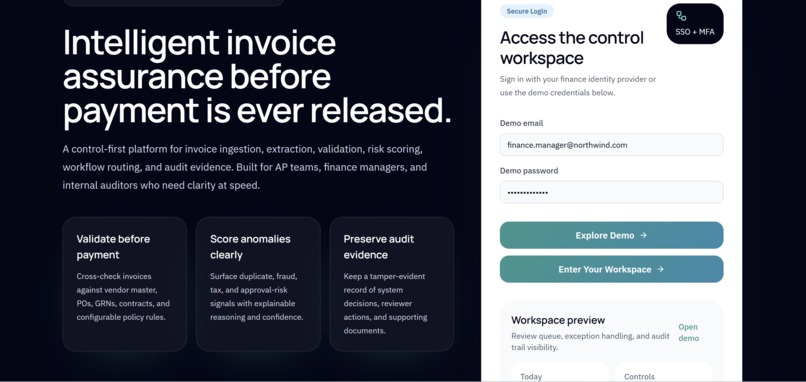
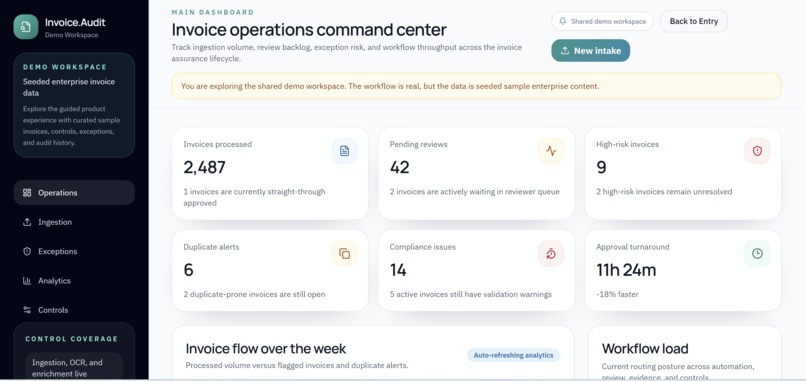
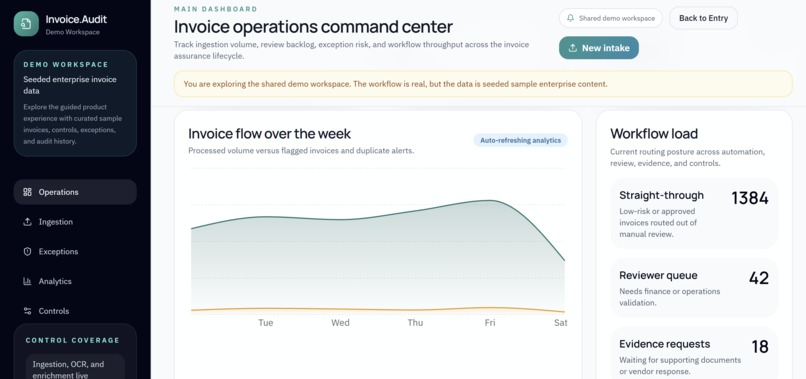
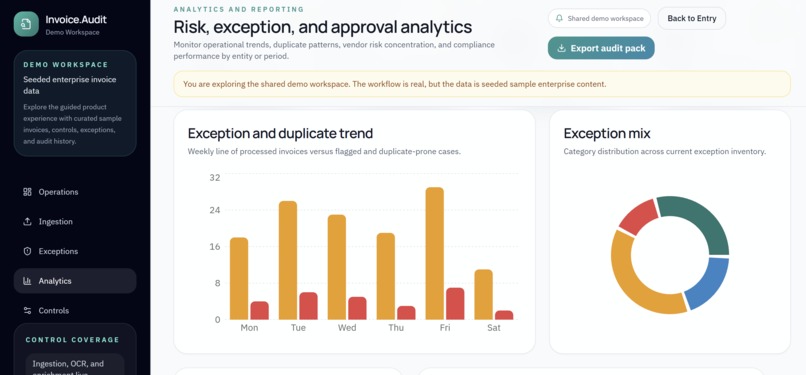
Invoice.Audit-"Intelligent Pre-Payment Invoice Assurance Platform"
-
-
-
-
-
-
-
-
-
FINTECH
Inspiration
Financial systems rely heavily on trust, yet in many real-world workflows, that trust is assumed rather than verified.
I was inspired by a recurring problem observed across organizations: invoices are processed efficiently, but very few systems truly evaluate whether an invoice should be paid at all. Real-world fraud cases involving invoice manipulation, duplicate submissions, and vendor impersonation highlighted a critical gap in existing systems.
One notable example is when companies like Google and Facebook were defrauded of over $100 million through fake invoices and vendor impersonation schemes (BlackRock -https://www.wsj.com/finance/how-fake-invoices-duped-blackrock-unit-into-a-400-million-loan-888b7e06, Google & Facebook - https://www.bbc.com/news/technology-39744007, https://www.ndtv.com/india-news/rs-266-crore-gst-invoice-scam-busted-mastermind-arrested-8862984 etc.). The attackers exploited weaknesses in verification processes, sending seemingly legitimate invoices that passed through existing workflows without sufficient validation.
Most solutions focus on speed: extracting data, routing approvals, and completing payments faster.
However, speed without control introduces risk.
This led me to ask:
-Can invoices be validated using rule-based verification across vendor, PO, and contract data?
-Can duplicates be detected using fuzzy matching on vendor, amount, and date patterns?
-Can fraud signals be identified using anomaly detection on historical behavior?
-Can decisions be supported using an explainable risk scoring model instead of blind approval flows?
These questions became the foundation of Invoice.Audit.
What it does
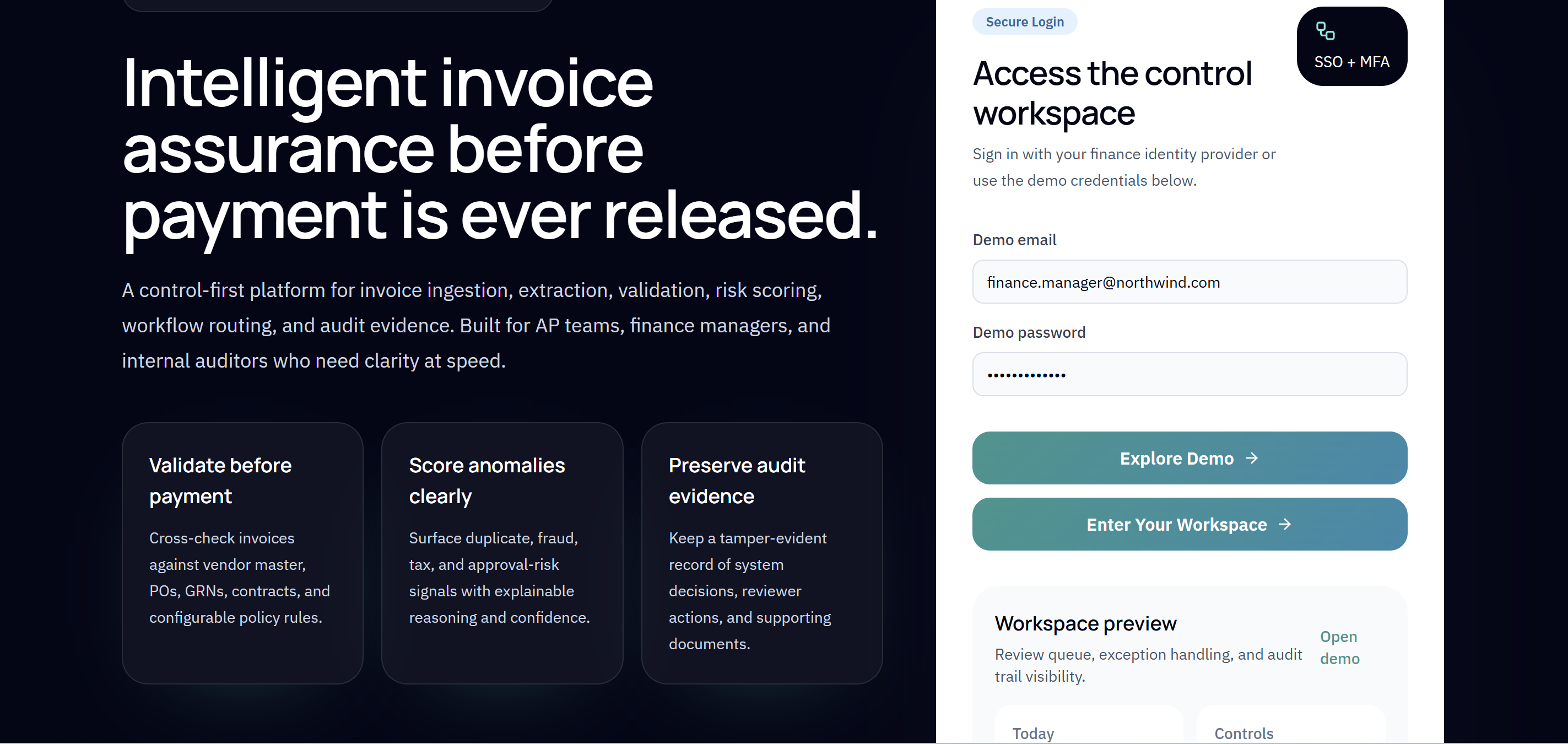
Invoice.Audit is a control-first invoice assurance SaaS platform built around a simple principle:
Every payment should be validated before it is released.
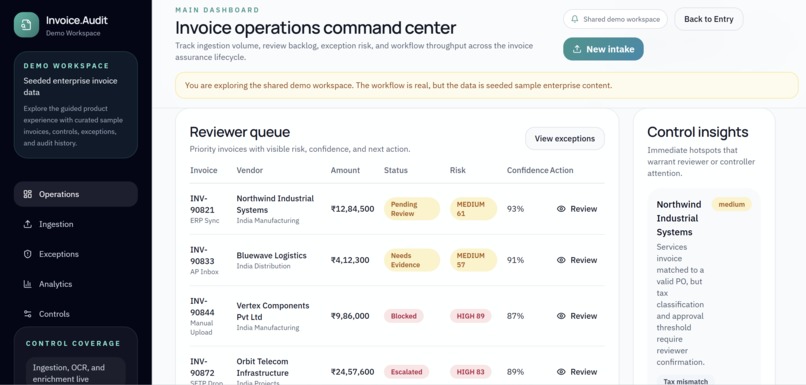
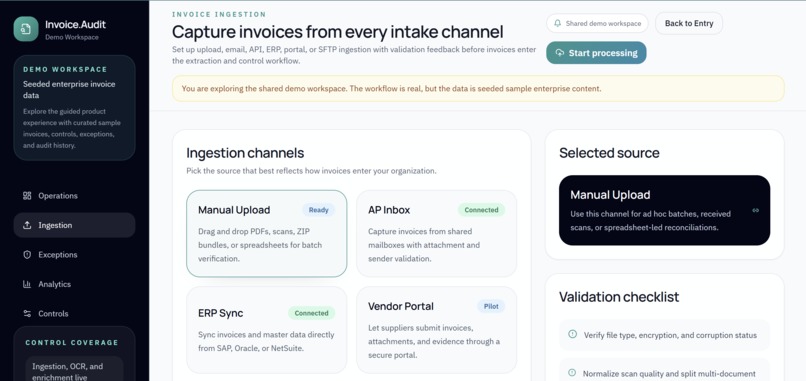
The platform enables users to:
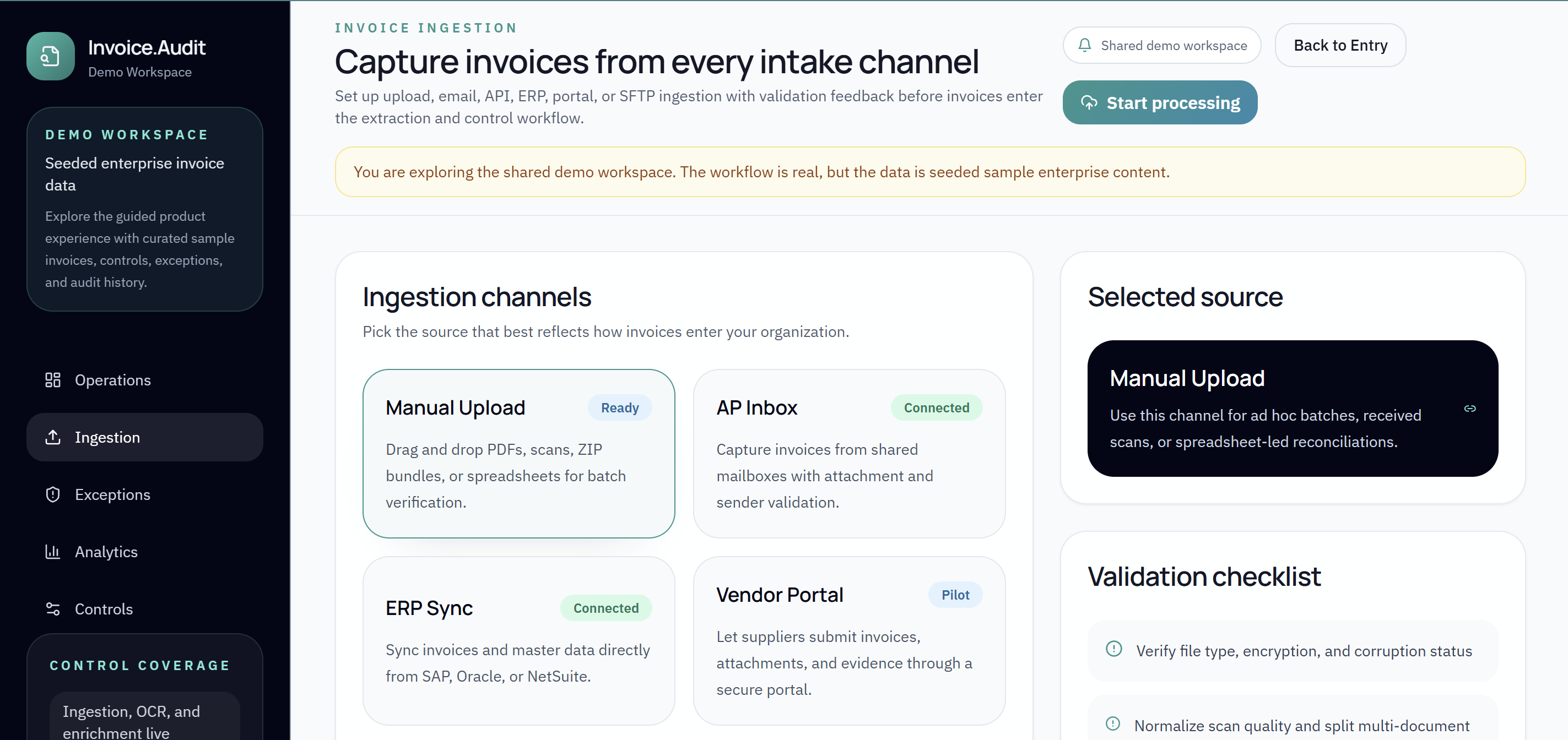
- Upload invoices through multiple ingestion channels such as manual upload, API, and email
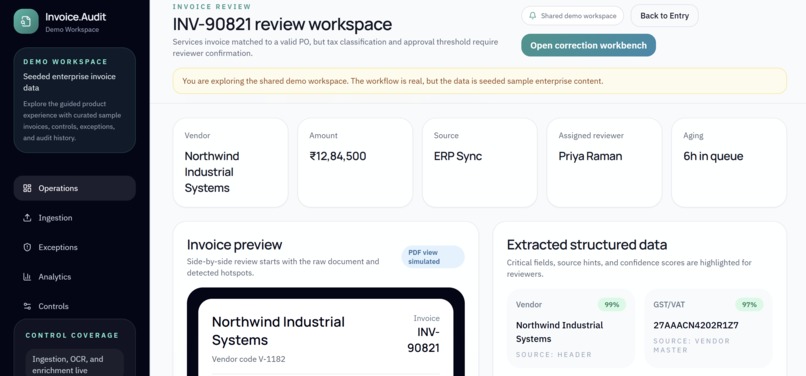
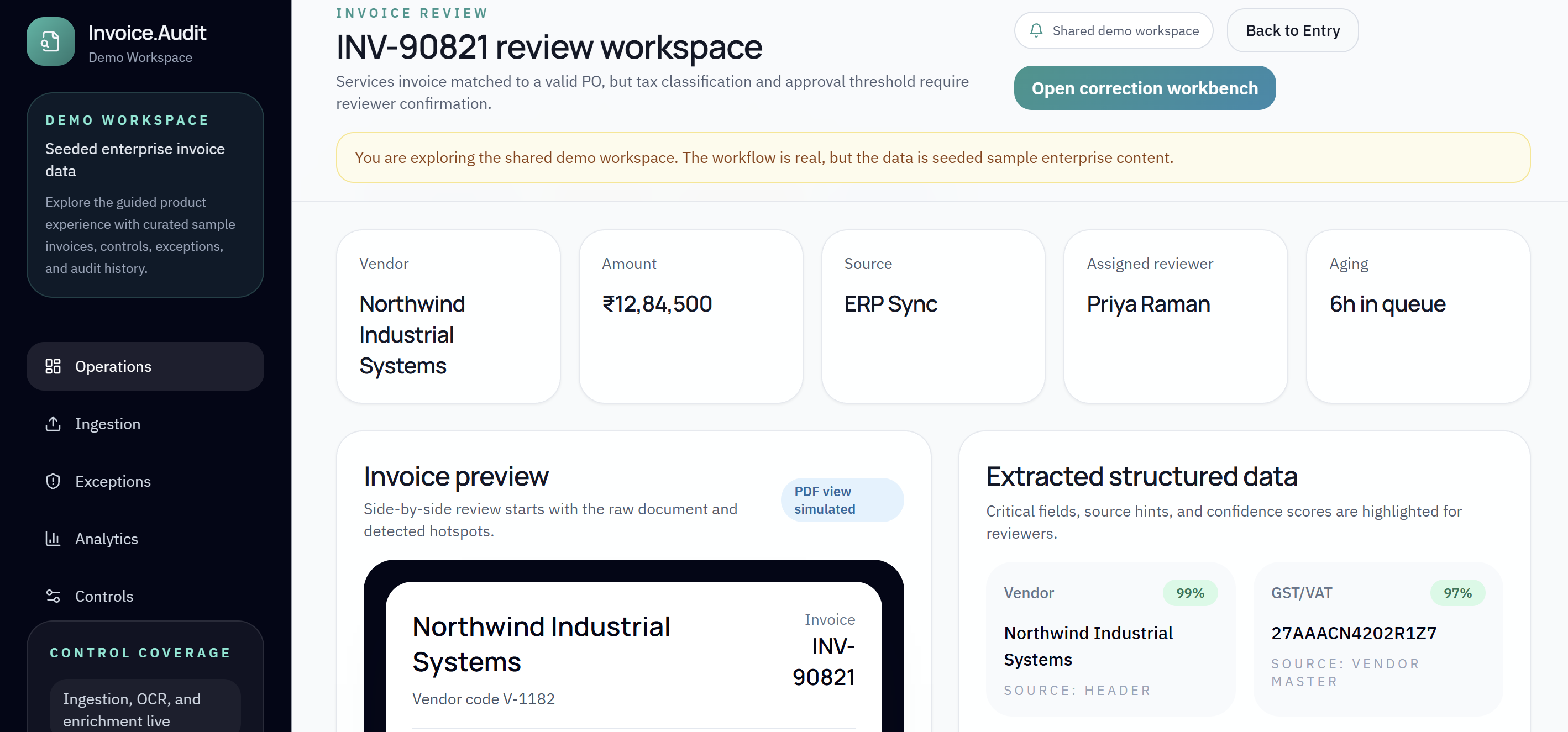
- Automatically extract structured financial data from invoice documents
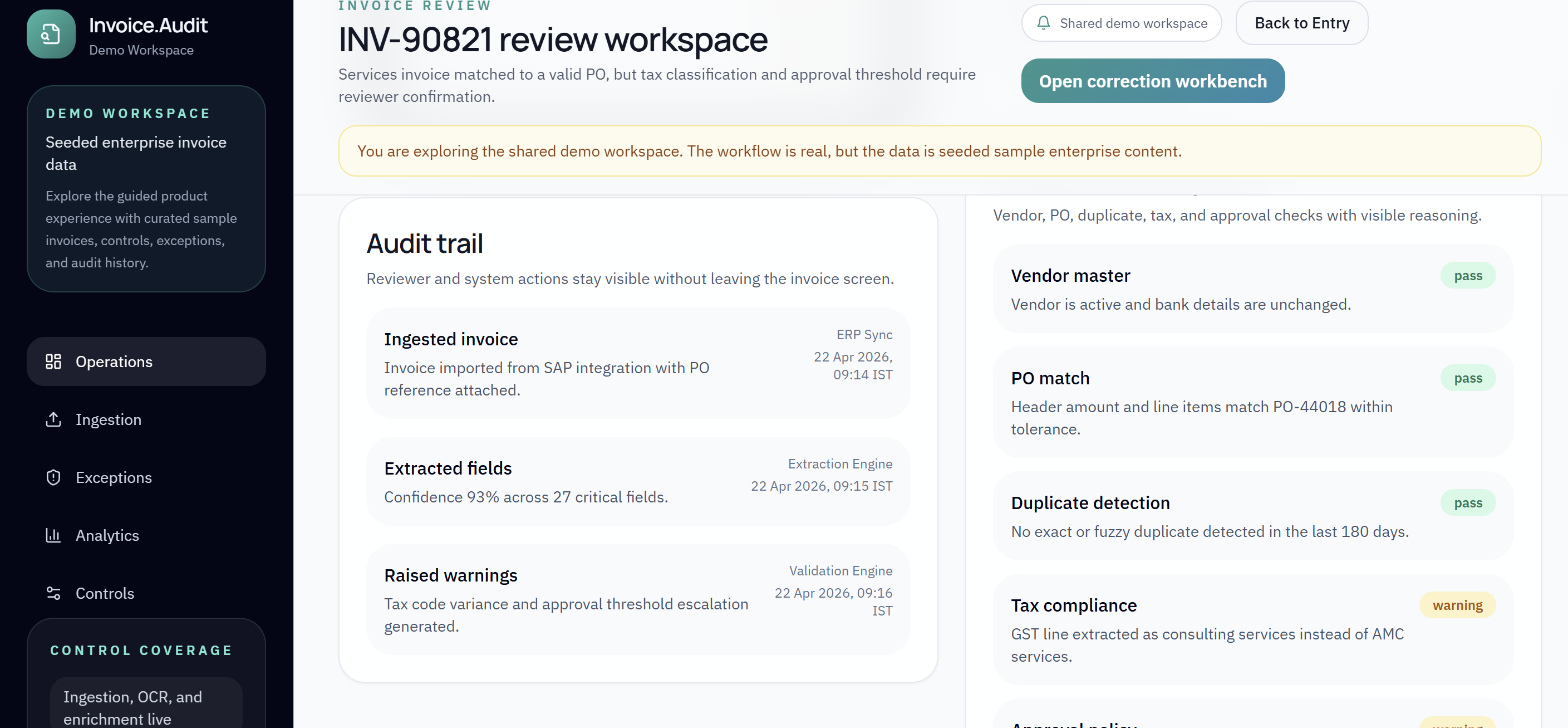
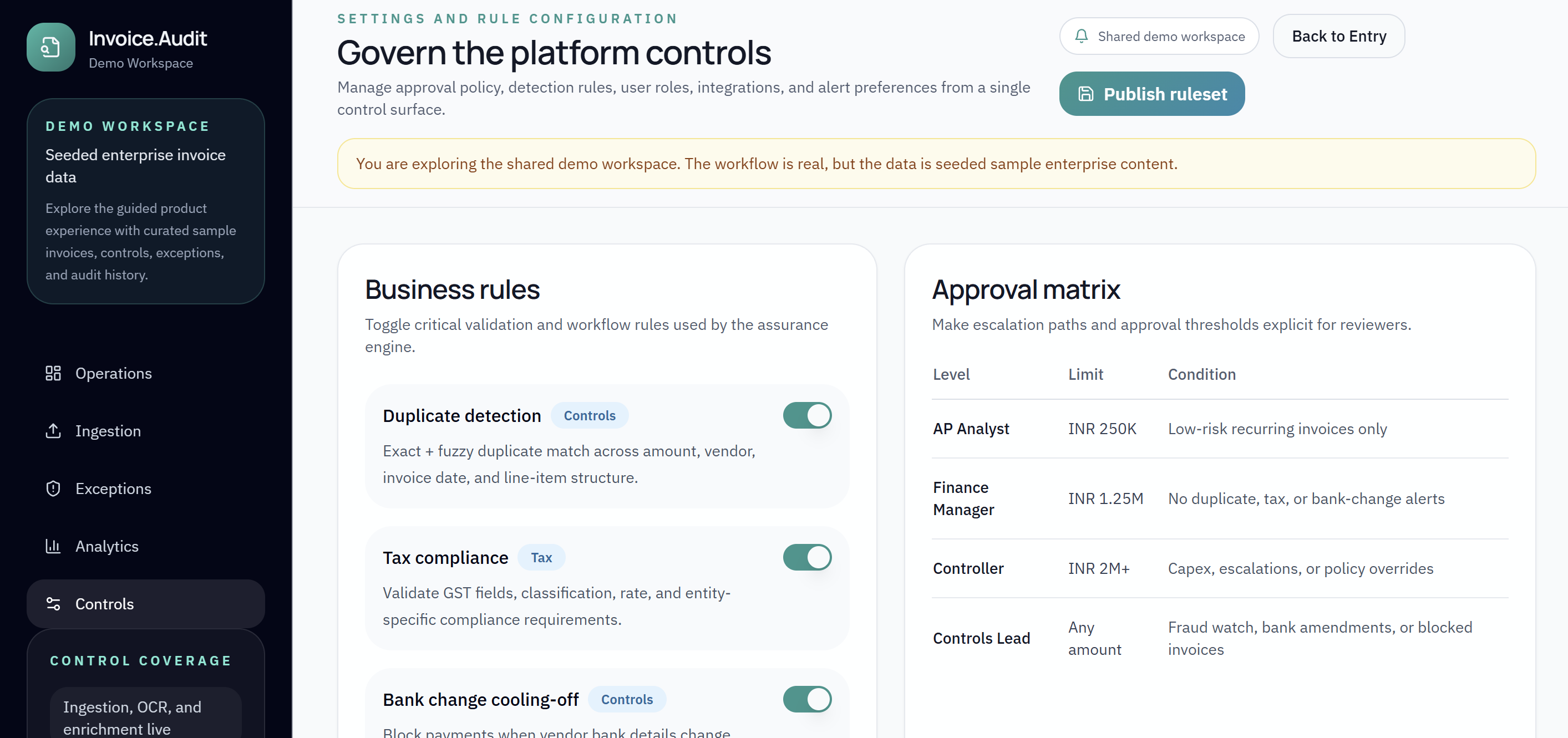
- Validate invoices against vendor master data, purchase orders, goods receipt notes, contracts, and business rules
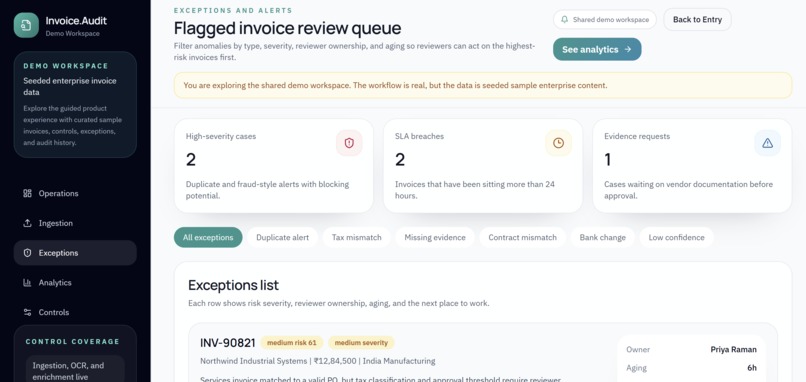
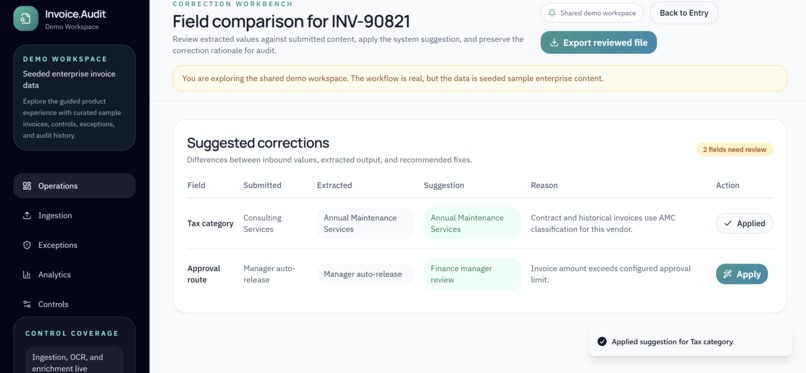
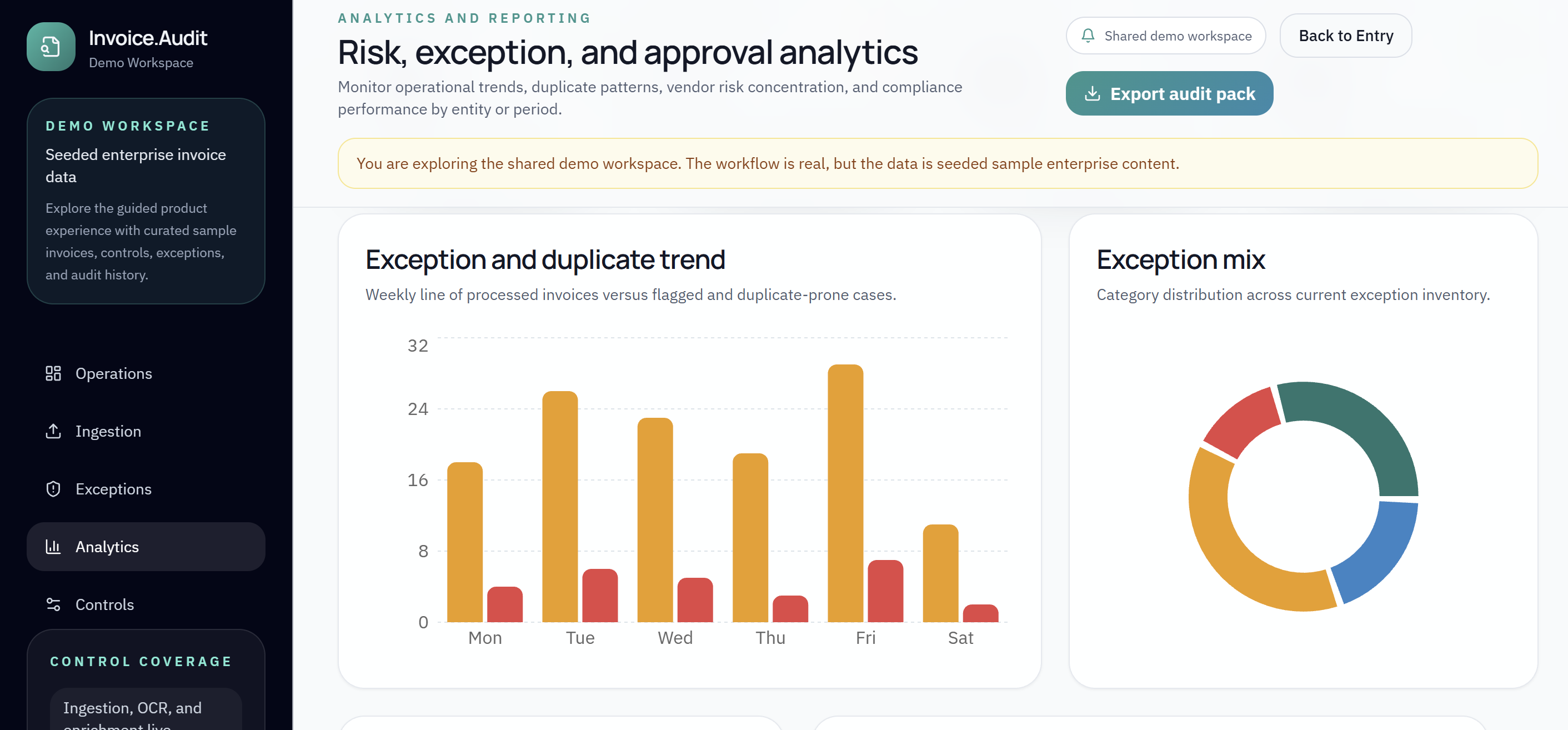
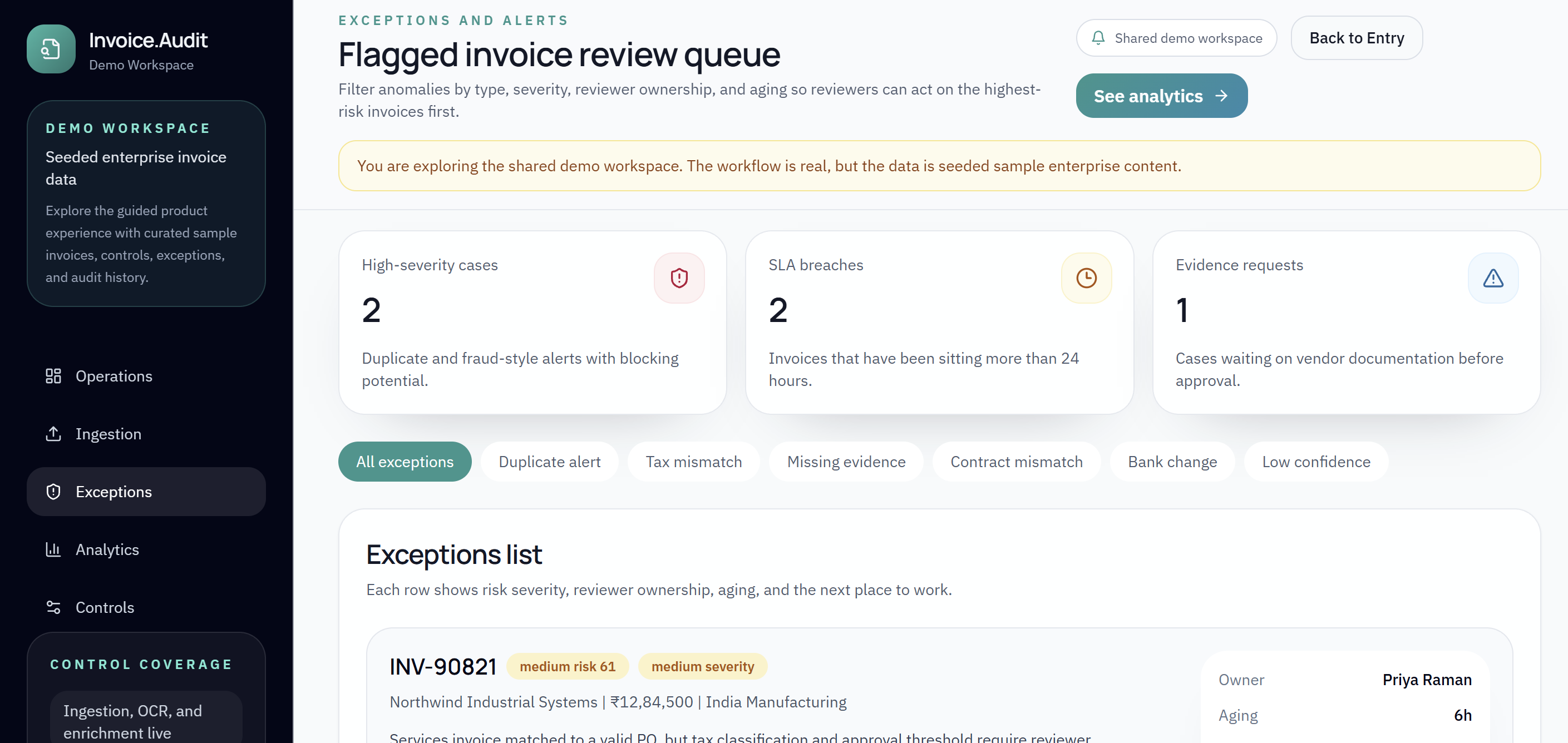
- Detect anomalies such as duplicate invoices, fraud patterns, tax inconsistencies, and approval irregularities
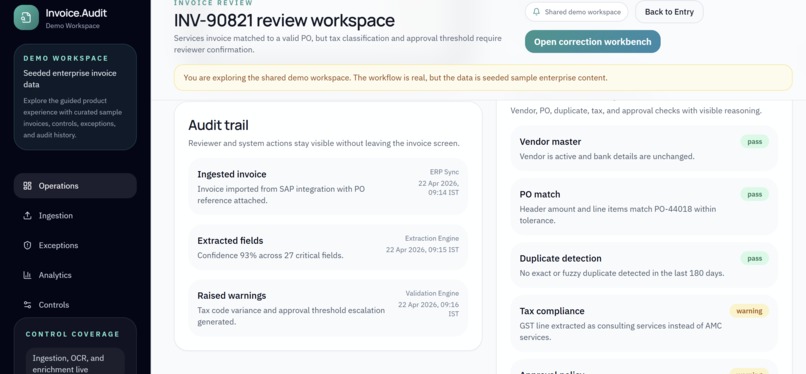
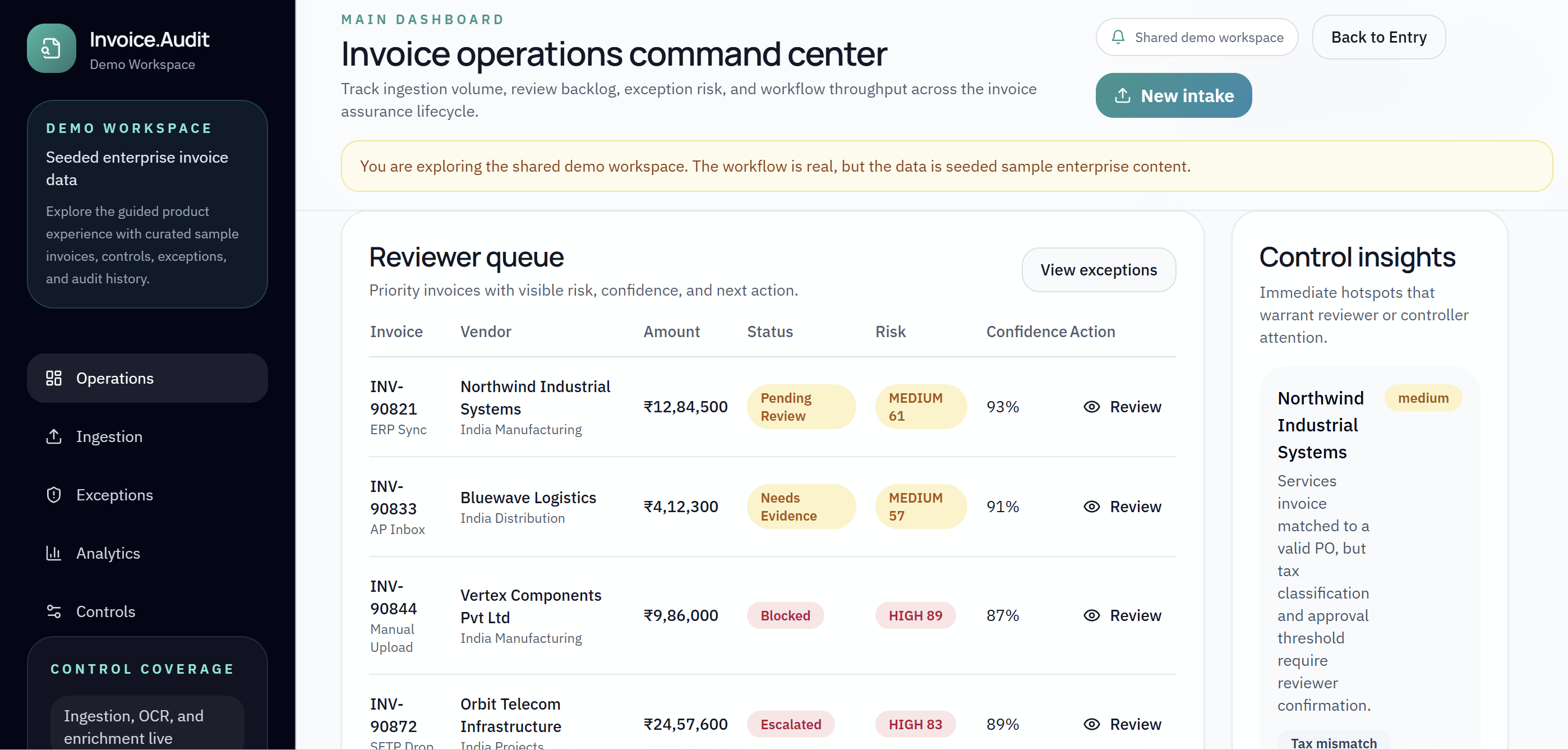
- Generate an explainable risk score with clear reasoning
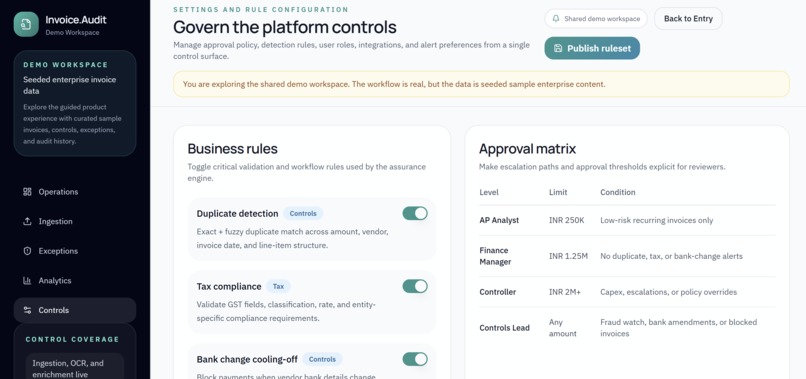
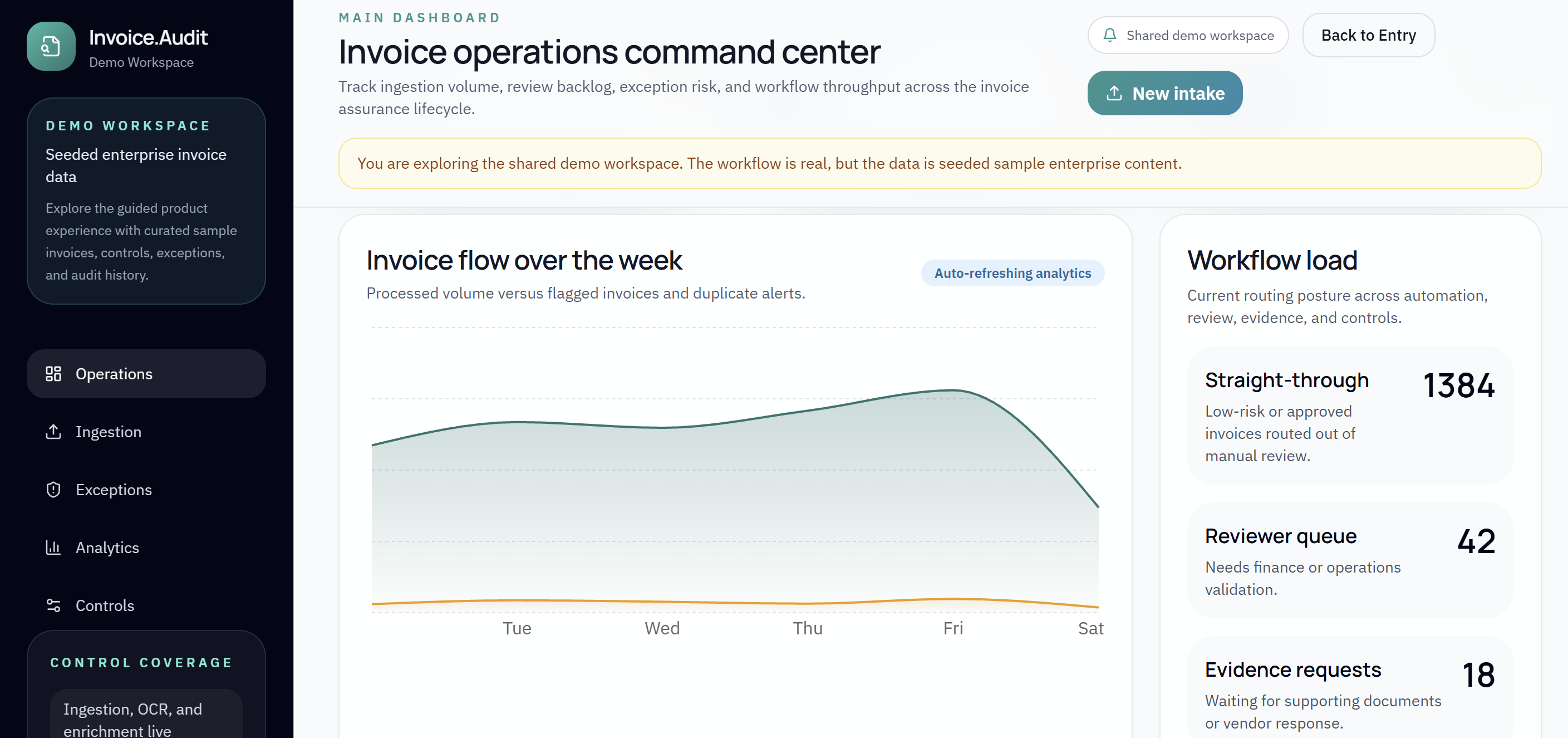
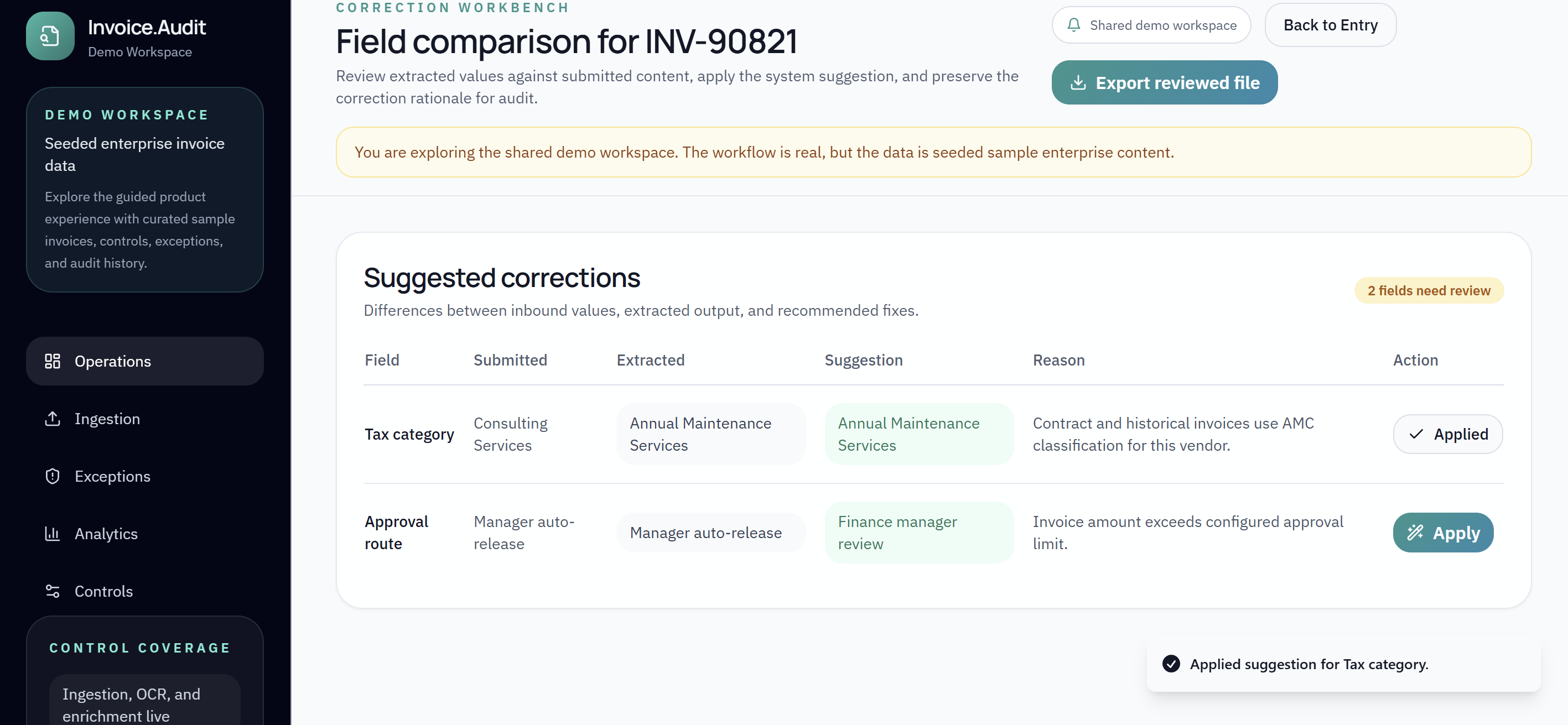
- Route invoices through workflows such as auto-approval, manual review, or escalation
Instead of treating invoices as items to be processed, the system treats them as transactions that must be justified.
How I built it
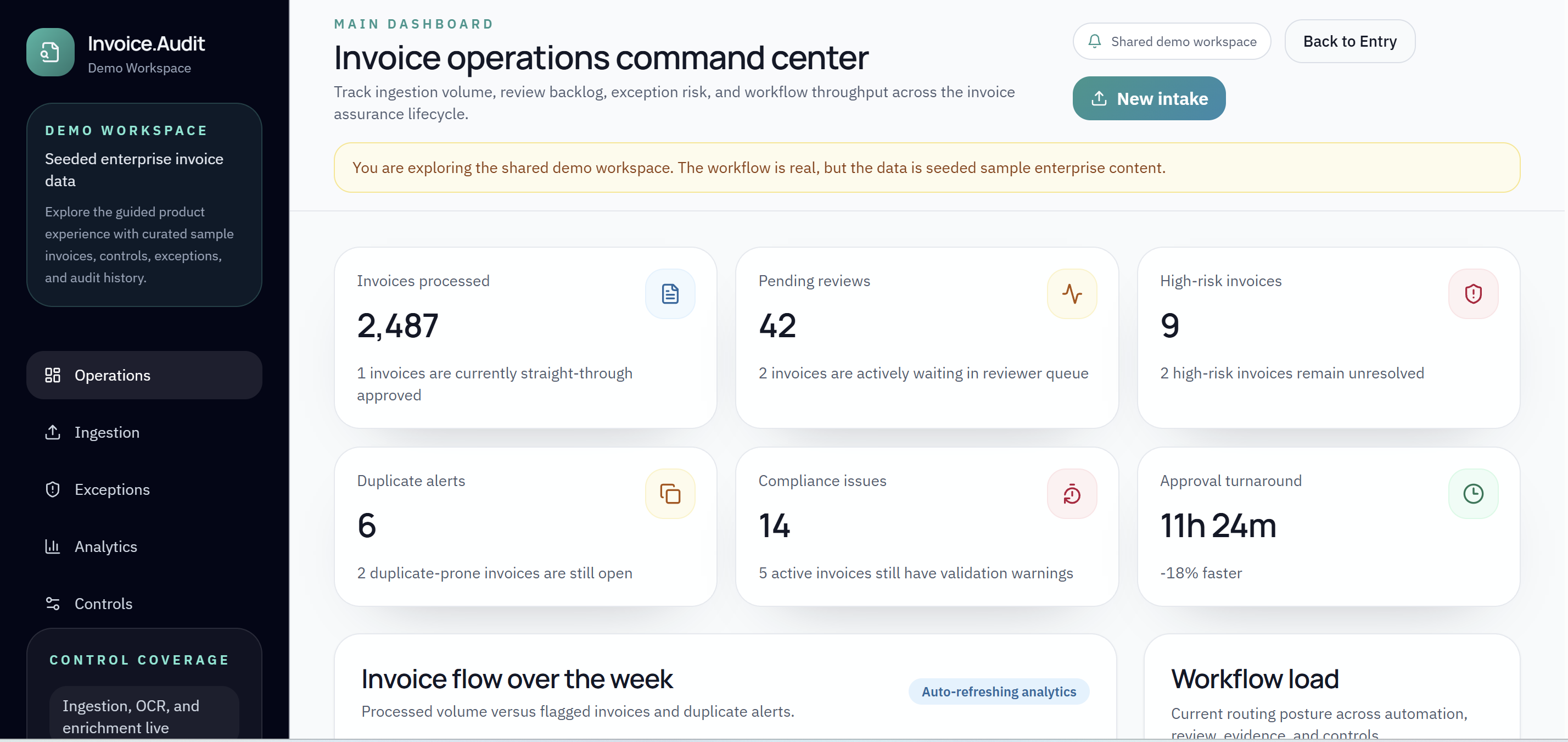
Invoice.Audit is designed as a modular SaaS platform focused on clarity, control, and enterprise usability.
The system is structured around:
- Ingestion Service: Handles invoice intake from different sources
- Extraction Engine: Converts invoice documents into structured data
- Validation Engine: Cross-checks invoice data against business systems and rules
- Risk Scoring Engine: Evaluates anomalies and assigns a risk level with reasoning
- Workflow Engine: Routes invoices based on risk and approval logic
- Audit Trail Service: Records actions, decisions, and changes for traceability
The platform uses a service-oriented backend approach, asynchronous processing for document handling, and a dashboard-based frontend to support review and decision-making.
How it works
The system follows a structured validation and decision pipeline:
- Invoice is uploaded into the system
- Data is extracted and converted into a structured format (Excel format)
- Extracted data is validated against vendor records, purchase orders, and predefined rules
- The system detects anomalies such as duplicates, inconsistencies, and unusual patterns
- A risk score is generated along with explainable reasoning
- Invoice is routed for auto-approval, manual review, or escalation
- All actions are recorded in an audit trail for traceability
Use Case and Impact
Invoice.Audit is designed for real-world financial workflows across multiple users:
- Small and Medium Businesses (SMEs): Prevent duplicate payments and financial loss
- Finance Teams and Accountants: Validate invoices before approval instead of relying on manual checks
- Auditors and Compliance Teams: Use audit trails for verification and reporting
- Enterprises: Add a control layer over existing ERP systems
For example, if two invoices with slight variations are submitted, traditional systems may process both. Invoice.Audit detects such patterns and flags them before payment is released.
This improves financial accuracy, reduces fraud risk, and builds trust in payment workflows.
Challenges I ran into
Shifting from automation to control:
Initially, the focus was on extraction and workflow. Later, I realized the real value lies in validation and decision-making, not just processing speed.
Making risk explainable:
Flagging an invoice is not enough. Users need to understand why it was flagged and what evidence supports that decision.
Balancing complexity with usability:
Financial workflows can become complex, so the interface had to remain clean while still showing risk, validation, and audit information clearly.
Handling real-world invoice variability:
Invoices differ widely in format and structure, so the system needed to be designed with flexibility in mind.
Accomplishments that I am proud of
The project evolved beyond a basic invoice processing tool into a financial control system.
Key accomplishments include:
- Reframing invoice processing as pre-payment assurance
- Designing an explainable risk scoring mechanism
- Creating a control-first architecture
- Building an audit-ready decision trail
- Combining validation, anomaly detection, and workflow into one system
Most importantly, the project addresses a practical and high-impact problem faced by real organizations.
What I learned
This project showed me that automation alone is not enough in financial workflows. Accuracy, transparency, and control are equally important.
I learned that:
- Risk detection must be explainable to be useful
- Systems should support human decision-making rather than blindly replace it
- Real-world business problems often depend on trust, validation, and process reliability
It also helped me understand the importance of designing systems around how decisions are actually made in practice.
Tech Stack
- Frontend: React / TypeScript / Tailwind
- Backend: Node.js / Python (FastAPI)
- Database: PostgreSQL / MongoDB
- Document Processing: OCR and parsing libraries
- APIs: Validation and rule-based engines
What's next for Invoice.Audit
Future improvements include:
- Advanced fraud detection using graph-based vendor relationships
- Continuous learning from reviewer feedback
- Multi-country compliance and tax validation
- ERP and accounting system integrations
- Real-time financial risk monitoring dashboards
- Stronger audit evidence mechanisms with improved integrity guarantees
In the long term, Invoice.Audit can evolve into a continuous financial control platform that helps organizations make safer and more reliable payment decisions.
Invoices record transactions.
Invoice.Audit ensures those transactions are trustworthy.
Built With
- api
- css
- express.js
- node.js
- ocr
- playwright
- postgresql
- react
- rest
- shadecn/ui
- tailwind
- typescript
- vite


Log in or sign up for Devpost to join the conversation.