-
-
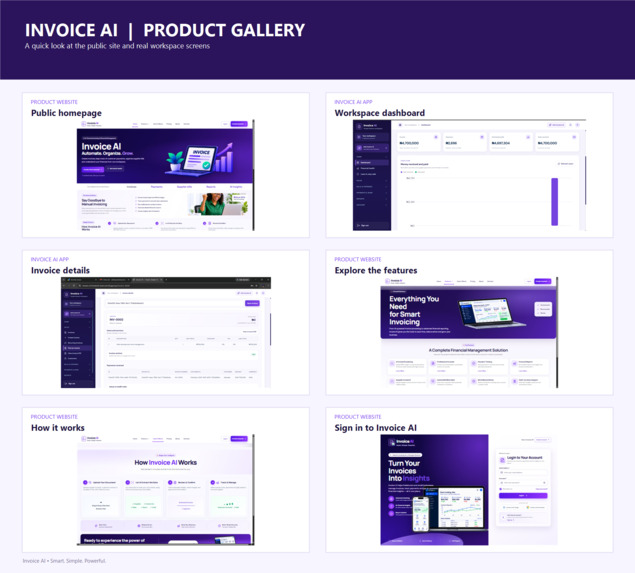
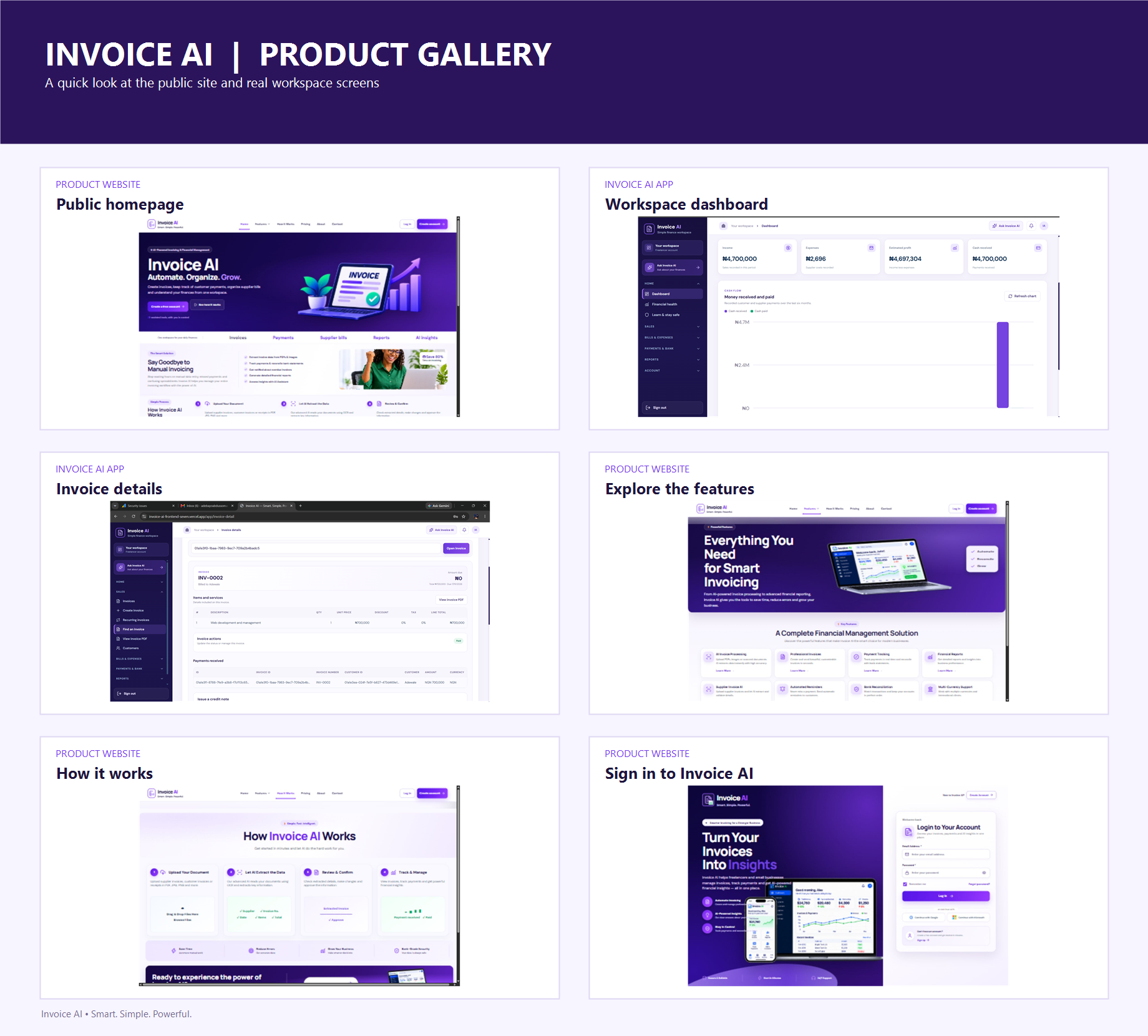
Invoice AI — Smart, Simple, Powerful. A look at the website, dashboard, invoice details, features, workflow, and sign-in experience.
Inspiration
The inspiration behind Invoice AI came from observing the challenges freelancers, independent professionals, and small businesses face when managing invoices, tracking payments, and keeping their financial records organized. Many people rely on spreadsheets, manual calculations, messaging applications, and disconnected tools to manage their finances. This makes it difficult to know which clients have paid, which invoices are overdue, how much money is coming into the business, and whether the business is actually making a profit.
I wanted to build something that goes beyond traditional invoicing software. Instead of creating another platform that simply generates invoices, I envisioned an intelligent financial assistant that helps users understand their financial activities, identify potential problems, and make better business decisions.
This idea led to Invoice AI, a platform that combines invoicing, payment tracking, financial management, and artificial intelligence in one place.
What it does
Invoice AI is an AI-powered invoicing and financial management platform designed for freelancers, independent professionals, and businesses.
The platform allows users to create professional invoices, send them to clients, and receive payments through integrated Paystack payment links. Users can monitor invoice statuses, identify overdue payments, and maintain a centralized record of their financial transactions.
Beyond invoice creation, Invoice AI provides financial record management, allowing users to track income and expenses, upload external invoices and receipts, and review their financial activities over different periods.
Its AI capabilities are designed to transform financial records into useful insights. By analyzing available financial data, Invoice AI can help users identify payment patterns, recognize outstanding invoices, understand their income and expenses, monitor business performance, and receive recommendations for improving their financial management.
My goal is to give users more control over their finances while reducing the manual work associated with managing a business.
How I built it
I designed Invoice AI as a centralized financial management platform with a modular architecture that brings invoicing, payment processing, financial records, and AI-powered intelligence together.
I chose PostgreSQL for structured financial data and record management. The backend is designed to handle user accounts, invoice generation, transaction records, payment tracking, and communication between the different components of the platform.
I selected Paystack for payment processing because it provides a way to facilitate invoice payments. My planned payment architecture uses Paystack subaccounts to support payment routing for individual freelancers and businesses, subject to Paystack's onboarding and eligibility requirements.
I also designed the AI component to work beyond a standalone chatbot. My intention is for it to interact with the application's financial data, provide contextual insights, identify potential issues, and generate useful recommendations.
Throughout development, I have prioritized usability, security, scalability, and making complex financial information easier to understand.
Challenges I ran into
One of my biggest challenges was defining what Invoice AI should actually solve. I had to distinguish between building a simple invoicing application and creating a more comprehensive financial management platform.
Another major challenge was designing a payment architecture that could support multiple freelancers and businesses without mixing their financial transactions. Understanding how payment gateways, subaccounts, transaction verification, and payment records work together required careful planning.
Integrating AI into a financial application also presented a challenge. I wanted the AI to provide meaningful insights based on actual financial records rather than simply generate generic responses. This required thinking carefully about how the AI would access, interpret, and use application data.
Building the project independently also means handling different aspects of development, from product planning and database design to backend architecture, payment integration, and user experience.
Accomplishments that I'm proud of
One of my biggest accomplishments is developing a clear vision for a platform that goes beyond traditional invoice generation.
I'm particularly proud of bringing invoicing, payment tracking, financial record management, and AI-powered financial insights together into one unified product concept.
I'm also proud of the payment architecture I've designed around Paystack, which considers how different businesses can receive payments independently through dedicated subaccounts.
Another accomplishment is identifying how AI can become an active part of financial management by helping users understand their records, recognize payment issues, and make more informed decisions.
Most importantly, I'm proud of taking an idea and developing it into a structured product with a clear problem, target audience, technical direction, and long-term vision.
What I learned
Working on Invoice AI has helped me understand that building a useful AI-powered product involves much more than connecting an application to an AI model.
I learned the importance of understanding the actual problem, designing reliable data structures, planning secure payment integrations, and ensuring that AI-generated insights are grounded in relevant application data.
I also gained a better understanding of payment gateway architecture, transaction verification, financial record management, and the importance of separating business transactions from platform subscription payments.
Perhaps my biggest lesson is that AI becomes more valuable when it is connected to a real-world problem and provides information that helps people take meaningful action.
Building Invoice AI independently has also challenged me to think beyond writing code and approach development from a product-building perspective.
What's next for Invoice AI
My next goal is to continue developing Invoice AI into a reliable and comprehensive financial management platform.
I plan to expand its AI capabilities to include more advanced financial analysis, intelligent payment reminders, overdue invoice detection, cash flow monitoring, automated financial summaries, and personalized recommendations.
I also intend to improve document processing so users can upload invoices and receipts and have relevant financial information extracted and organized automatically.
Future improvements will include more detailed financial dashboards, customizable reports, business performance analytics, and additional automation features that reduce repetitive administrative work.
I also plan to strengthen the payment infrastructure, improve the overall user experience, and explore integrations with other financial services as the platform grows.
My long-term vision is to make Invoice AI a trusted financial companion for freelancers and businesses, helping them not only manage their invoices but also understand their money, improve their financial decisions, and build sustainable businesses.
Built With
- artificial-intelligence
- asp.net-core
- automation
- backend-development
- business-intelligence
- c#
- cash-flow-management
- css
- entrepreneurship
- financial-analytics
- financial-management
- fintech
- gemini
- generative-ai
- html
- invoice-management
- javascript
- machine-learning
- payment-processing
- paystack
- postgresql
- rest-api
- saas
- web-development
