Inspiration
The spark for Inviso came from our visit to an NGO that works with visually impaired individuals. We realized how limited access to multilingual Braille content still is, especially for audio-based inputs. This inspired us to build a solution that bridges the gap between audio and tactile communication — giving voice to Braille and hope to those navigating the world without sight.
What it does
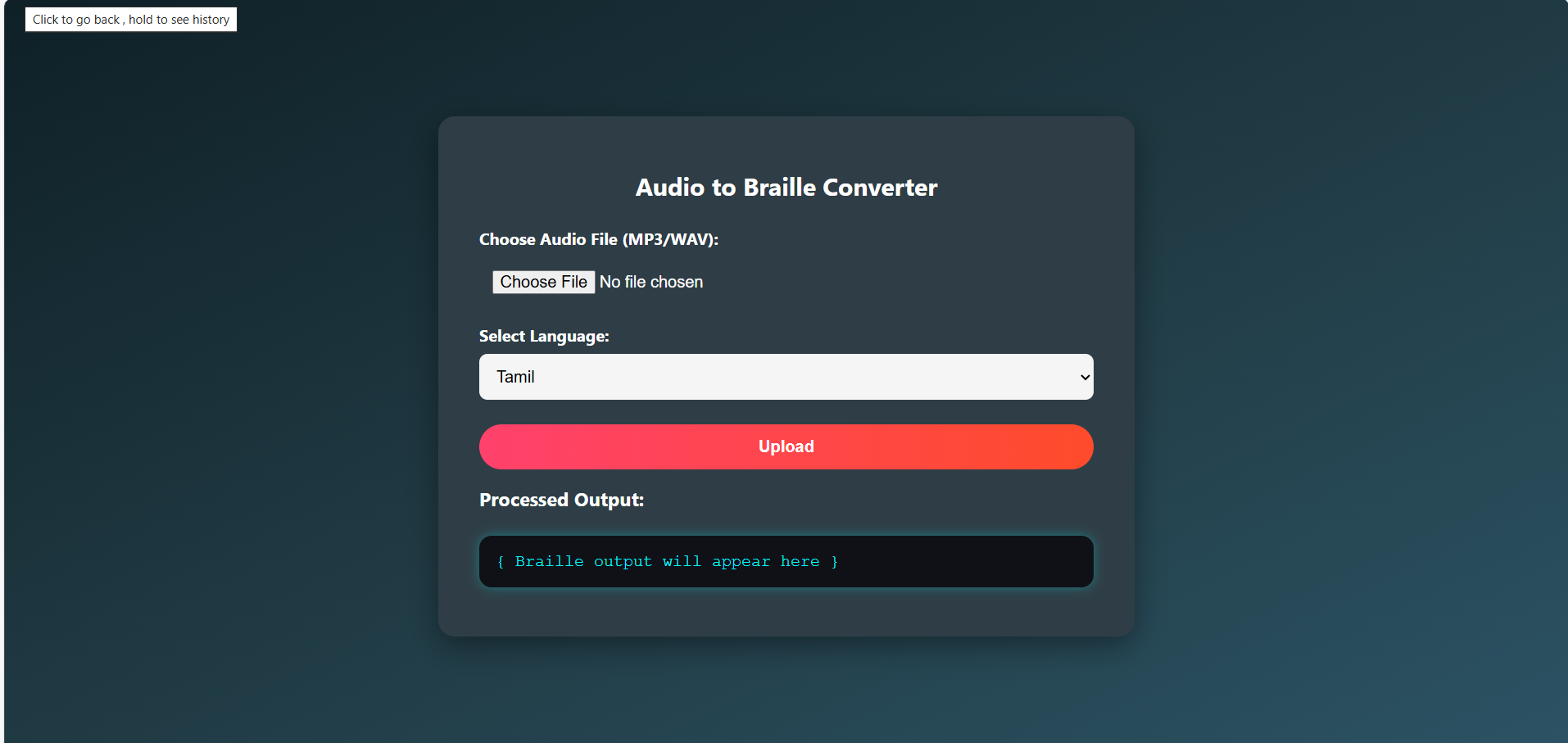
Inviso is a smart Braille solution that converts audio input into multilingual Braille output using a fully serverless architecture on AWS.
Here’s how it works:
- Users upload an audio file through the web interface.
- The audio is sent to Amazon Transcribe, which converts it into text.
- The transcribed text is passed to Amazon Translate to support regional languages like Tamil, Telugu, and Hindi.
- A custom AWS Lambda function then converts the translated text into Braille format.
- The final Braille output is stored and made accessible through Amazon S3.
Inviso creates a smooth, end-to-end pipeline that empowers visually impaired users to access spoken content in their preferred language — instantly and in Braille.
How we built it
We built Inviso using a serverless architecture powered by AWS services to enable a seamless flow from audio input to Braille output. Here's a breakdown of our build process:
Frontend Interface
- Developed a simple web interface where users can upload audio files.
- Integrated with Amazon API Gateway to communicate with backend services.
- Developed a simple web interface where users can upload audio files.
Input Storage with Amazon S3
- Audio files are uploaded and stored in a dedicated S3 bucket.
- Upload events from this bucket trigger the backend logic.
- Audio files are uploaded and stored in a dedicated S3 bucket.
AWS Lambda Functions
- Lambda functions were used to automate the workflow:
- One function sends audio to Amazon Transcribe for speech-to-text.
- The next sends the transcribed text to Amazon Translate for multilingual support.
- The final function processes the translated text into Braille format.
- One function sends audio to Amazon Transcribe for speech-to-text.
- Lambda functions were used to automate the workflow:
Braille Conversion Logic
- We designed a custom algorithm to map translated text to standardized Braille characters.
Output Storage
- The generated Braille output is stored in a separate S3 bucket for user access.
Security with IAM
- Configured IAM roles to allow secure communication between Lambda, S3, Transcribe, and Translate services.
This fully serverless build allows Inviso to scale, stay cost-efficient, and remain maintenance-free while offering real-time accessibility support.
Challenges we ran into
Braille Conversion Logic One of the main challenges we faced was building an accurate and flexible Braille conversion system. Mapping regular text to Braille isn’t just about replacing characters — it involves understanding spacing, punctuation, and language-specific nuances. Supporting regional languages like Tamil and Hindi made it even more complex, as we had to ensure proper encoding and alignment with Braille standards. We had to research Braille representations for multiple languages, handle unsupported symbols gracefully, and test output across different scenarios to ensure clarity and readability.
Accomplishments that we're proud of
- Tested our solution at Jeeva Velicham, an NGO for the visually impaired, where real users interacted with the system and validated its impact.
- Enabled Braille conversion for South Indian languages like Tamil, Telugu, Kannada, and Malayalam, making the solution more regionally accessible and inclusive.
What we learned
- Gained hands-on experience building a serverless architecture using AWS services like Lambda, S3, Transcribe, and Translate.
- Understood the complexity of Braille conversion, especially when handling multiple regional languages.
- Learned how to create an end-to-end automated workflow triggered by real-time events using AWS Lambda.
- Discovered the importance of accessibility-focused design, and how technology can make a real-world impact.
- Improved our skills in team collaboration, cloud integration, and working with language processing tools in a practical, user-driven project.
What's next for INVISO
Our vision for Inviso goes beyond static conversions. We aim to make accessibility real-time, intuitive, and multilingual:
- Enable live audio-to-Braille conversion using streaming input, helping users interact instantly with their environment.
- Integrate with Braille devices and smartphones for on-the-go accessibility.
- Expand support to all South Indian languages, making the tool more inclusive across regional boundaries.
- Connect with home assistants for voice-based interactions that output both spoken and Braille responses.
- Deploy in inclusive classrooms, helping both visually impaired and sighted students learn together.
We are building a future where every voice is heard and every word is felt.
Built With
- amazon-web-services
- api
- braille
- conversionlogic
- gateway
- html
- javascript
- lambda
- python
- transcribe
- translate


Log in or sign up for Devpost to join the conversation.