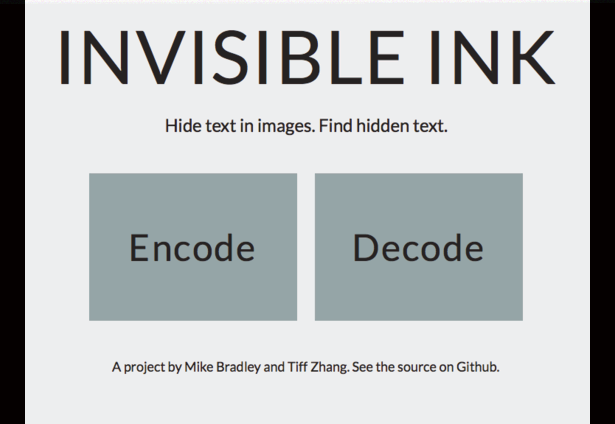
Our app allows users to encode text hidden within an image file. It does this by subtly changing the color values of the pixels, at a level too fine for the human eye to detect. In doing so we are able to store one ascii character per pixel of the image.
This allows for hiding messages in a way which is not immediately visible that, while not cryptographically secure, can provide for an extra layer of security, especially in environments where merely sending a coded message is seen as suspicious. It also allows users to store a large amount of text in an image, either as an easter egg or as a practical way to add descriptions or background information to images with no additional memory cost.
Our product is targeted at three main customer groups. First, people who want to communicate in a way which is not immediately obvious. We envision this technology being used in countries where freedom of expression is not at the level we enjoy in the United States. In these countries, any encrypted communication can be seen as suspicious, even if the contents are not read. In order to facilitate this use, the entire app is open source and easily downloadable and usable offline.
The second group we see using our app are people who want an extra layer of security for their messages. This type of user would couple strong encryption with our app to create messages that not only are protected by cryptography, but are not even identifiable as messages at all. While we add only a small measure of security against a dedicated attacker, this technology should help avoid automated attempts at intercepting messages.
The final group we see using our app are users who intend to make no secret of their use. Our app allows embedding of text about an image directly into the image itself, which holds promise for storage and retrieval of archival images and is a safeguard against loss of related information. Easter eggs can likewise be applied to images, for example hiding information in advertisements for dedicated readers to find. The simple one character per pixel nature of our algorithm should enable others to use our format without trouble, and here our open source nature is again beneficial.

Log in or sign up for Devpost to join the conversation.