Inspiration
Individual investors often manage portfolios across multiple brokers, accounts, currencies, and asset classes. Unfortunately: brokers calculate performance differently portfolio trackers disagree with broker balances historical performance becomes unreliable after transfers, FX conversions, dividends, or corporate actions investors spend hours reconciling spreadsheets instead of understanding their investments. Most existing tools focus on visualization. They assume imported data is already correct. Investory starts with a different assumption: financial data is imperfect and must first be reconciled before it can be analyzed.
What it does
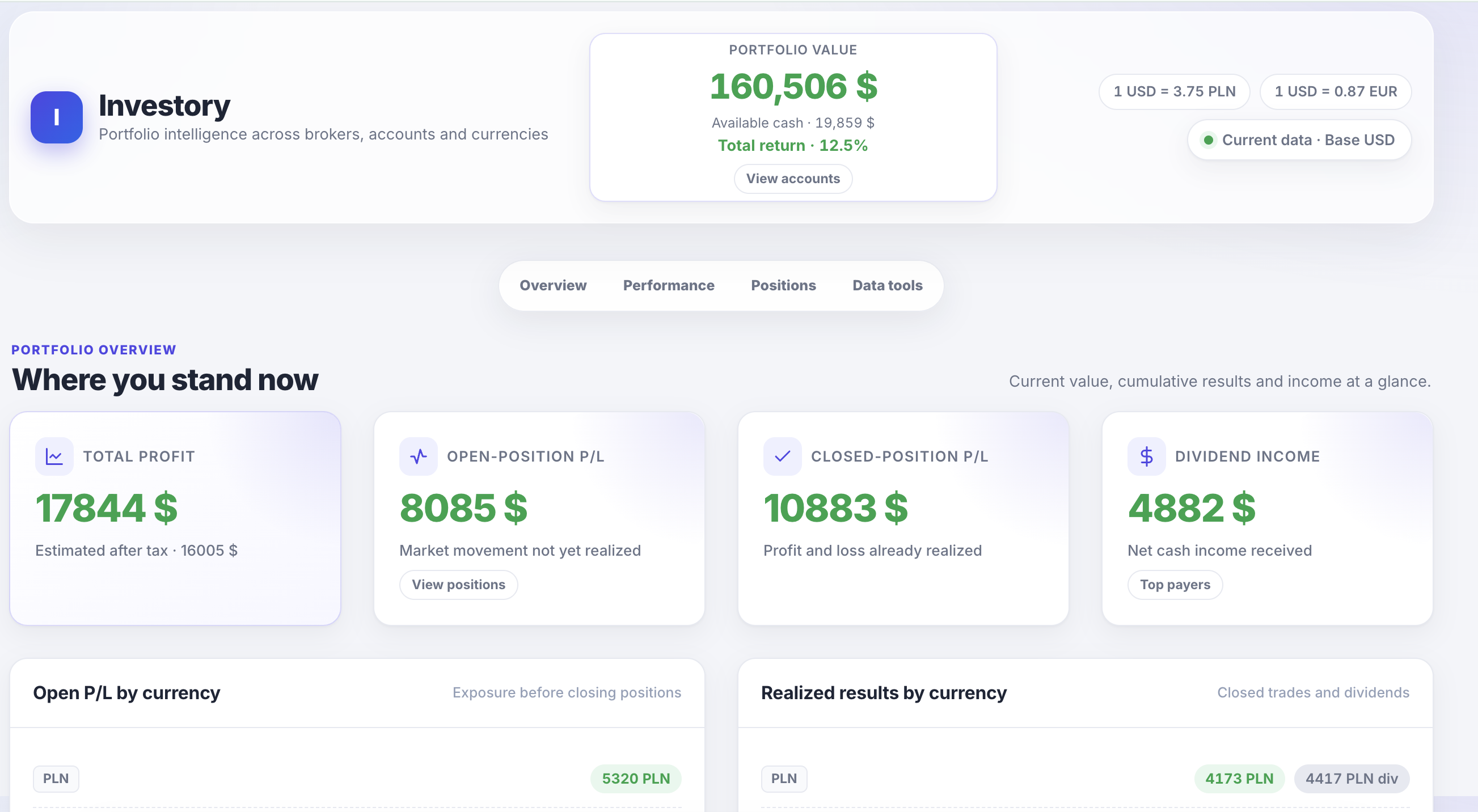
Investory is an AI-powered investment operating system built around an immutable accounting ledger. Instead of trusting broker snapshots, it reconstructs portfolio history from: trades cash operations dividends fees taxes transfers historical market prices foreign exchange rates A reconciliation engine identifies inconsistencies between calculated values and broker-reported balances, allowing users to understand where differences come from instead of silently accepting inaccurate performance. On top of this trusted financial model, GPT-5.6 provides natural-language explanations of portfolio behavior. Instead of asking: "Where is this chart?" Users can ask: Why did my portfolio fall last month? Which positions generated the most after-tax profit? How much performance came from FX? What were my biggest investing mistakes? How different would my returns be if I simply bought SPY
Key features Multi-broker portfolio management Support for Interactive Brokers and XTB Multi-currency accounting Historical portfolio reconstruction Portfolio reconciliation Realized vs unrealized P/L Dividend tracking Tax-aware performance Daily portfolio history AI portfolio assistant powered by GPT-5.6
How we built it
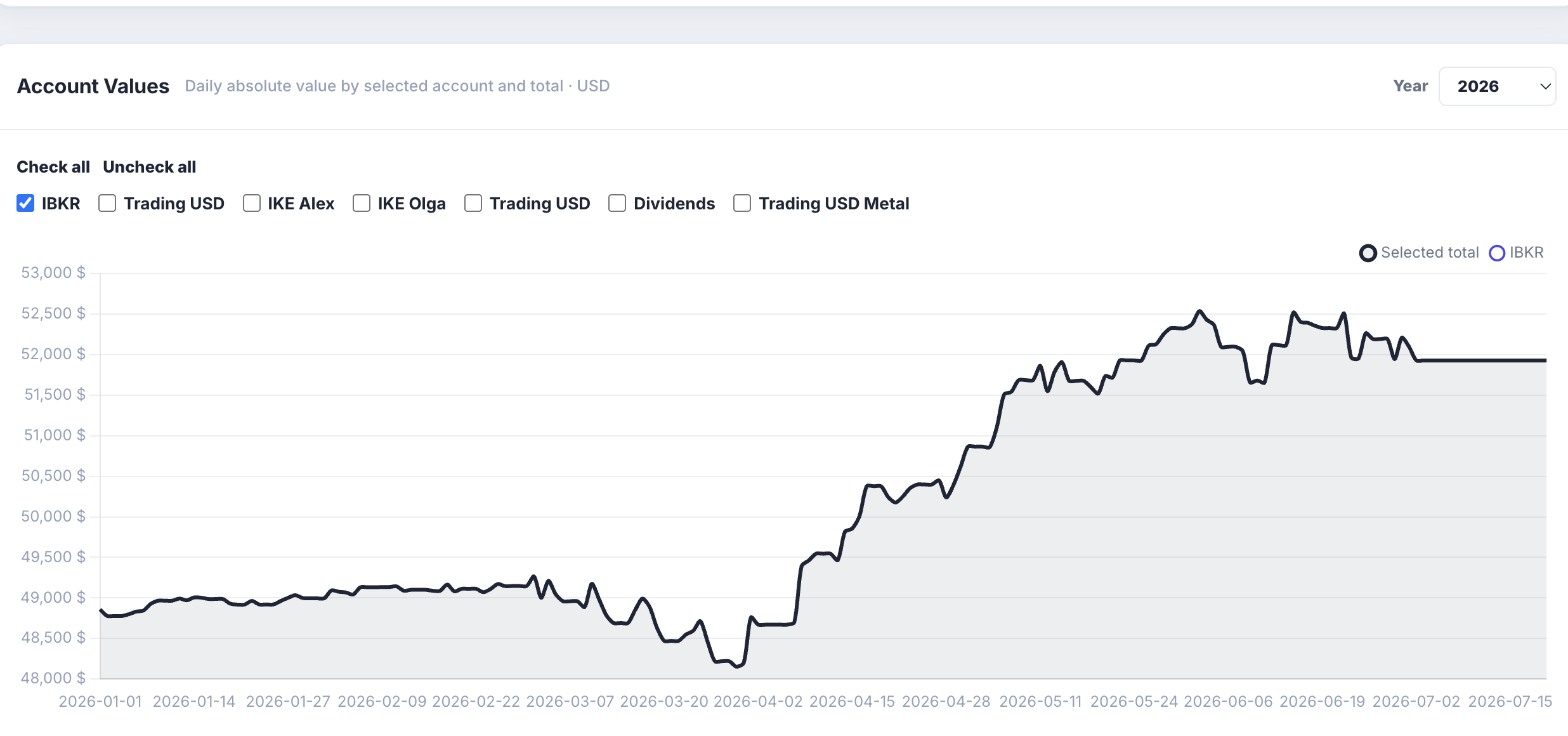
Investory separates the system into three independent layers: Accounting An immutable ledger stores every trade, cash operation, dividend, fee, tax, and transfer. Valuation Historical market prices and FX rates reconstruct portfolio value on every day in history. Reconciliation Calculated balances are continuously compared against broker-reported values to detect missing prices, FX issues, transfers, or other discrepancies before analytics are generated. This architecture keeps transactions immutable while isolating valuation and reconciliation logic. Materialized views provide fast dashboard queries without sacrificing accounting accuracy. Built with OpenAI OpenAI tools accelerated both development and the product experience. GPT-5.6 portfolio analysis natural-language explanations financial reasoning user interaction Codex architecture design SQL optimization reconciliation algorithms debugging refactoring documentation
Challenges we ran into
One of the biggest challenges was reconciling portfolio history across multiple brokers. While transaction histories are generally accurate, broker-reported daily balances can differ because of missing historical prices, exchange rate differences, timing of transfers, and broker-specific valuation methods. We designed a reconciliation process that rebuilds portfolio history from immutable transactions and then compares the calculated results with broker balances to identify and explain discrepancies instead of hiding them.
Supporting multiple currencies introduced another layer of complexity. Cash flows, trades, dividends, taxes, and transfers can all occur in different currencies, and historical FX rates are required to produce consistent daily valuations and performance metrics. Ensuring these calculations remained accurate over long periods required careful separation of accounting data from valuation data.
Performance was also a key challenge. Reconstructing historical portfolio values from thousands of transactions can be computationally expensive, especially when dashboards need to remain responsive. We addressed this by combining an immutable ledger with materialized views and precomputed analytics, allowing fast queries without compromising the accuracy or auditability of the underlying data.
Finally, integrating AI effectively required more than connecting an LLM. We found that high-quality answers depend on a reliable financial model and well-structured portfolio data. This reinforced our belief that AI delivers the most value when paired with a trustworthy data foundation rather than raw broker exports.
Accomplishments that we're proud of
Most portfolio trackers answer: "What is my portfolio worth?" Investory answers: "Can I trust these numbers, and why did they change?" That shift—from visualization to trustworthy financial intelligence—is the core idea behind the project.
What we learned
Building Investory reinforced that the hardest part of investment analytics is not creating charts—it's establishing a trustworthy financial model. We learned that accurate portfolio analysis depends on reconstructing history from immutable transactions rather than relying on broker snapshots, which can differ across platforms and over time.
Working with multiple brokers also highlighted the complexity of handling foreign exchange rates, cash transfers, dividends, taxes, and incomplete historical market data. Designing a reconciliation layer to identify and explain discrepancies proved to be just as important as the analytics themselves.
Using GPT-5.6 and Codex significantly accelerated development. Codex helped us iterate on architecture, database design, SQL optimization, debugging, and reconciliation logic, allowing us to spend more time refining the product instead of solving routine implementation problems. GPT-5.6 also demonstrated how natural-language interfaces can make sophisticated financial analysis more accessible by explaining portfolio performance in plain English instead of requiring users to interpret complex reports.
The biggest takeaway is that AI is most valuable when it's built on top of reliable, well-structured data. A conversational interface is only as useful as the financial model behind it, and combining a trustworthy ledger with AI creates a much more powerful experience than either approach alone.
What's next for Investory
Future development includes: additional broker integrations corporate actions automation benchmark attribution portfolio optimization retirement planning conversational investment copilot automated portfolio diagnostics
Built With
- chatgp
- codex
- docker
- java
- javascript
- postgresql

Log in or sign up for Devpost to join the conversation.